
CozyWorld game guide · By CozyWorld
This guide covers our own game, written from the current game rules and browser checks.
How to Play Backgammon: Rules, Setup and Strategy
Backgammon is the two-player race game of checkers, dice and the doubling cube. Here is how to set up the board, how the opening roll and moving work, the rule for using both dice, hitting and entering from the bar, bearing off, gammons and backgammons, the cube and the Crawford rule, how strong each level of our computer opponent is, and the basic strategy, common mistakes and tips that win more games.
How do you play backgammon? Two players race 15 checkers each around a board of 24 points, in opposite directions, moving by the roll of two dice. The first to bring all 15 into their home board and bear them off wins. On the way you can hit a lone checker of the other side and send it back to the start, and build points of two or more checkers that the other side cannot land on. A game takes ten or twenty minutes, the dice make every game different, and how you play each roll shows over a series of games.
This guide covers the standard rules, as set out by the U.S. Backgammon Federation in its Backgammon Basics: How To Play page and summarized in the Wikipedia article Backgammon: the setup, the opening roll, moving, the rule for using both dice, hitting and the bar, bearing off, gammons and backgammons, and the doubling cube with the Crawford rule for matches. Then it shows the controls in Lemon Terrace Backgammon, where you can play backgammon online free against Remo the tortoise, how strong each of Remo’s levels is, and the basic strategy, common mistakes and tips. The strength figures and the shot counts come from our own simulation and our own count, and each is labeled.
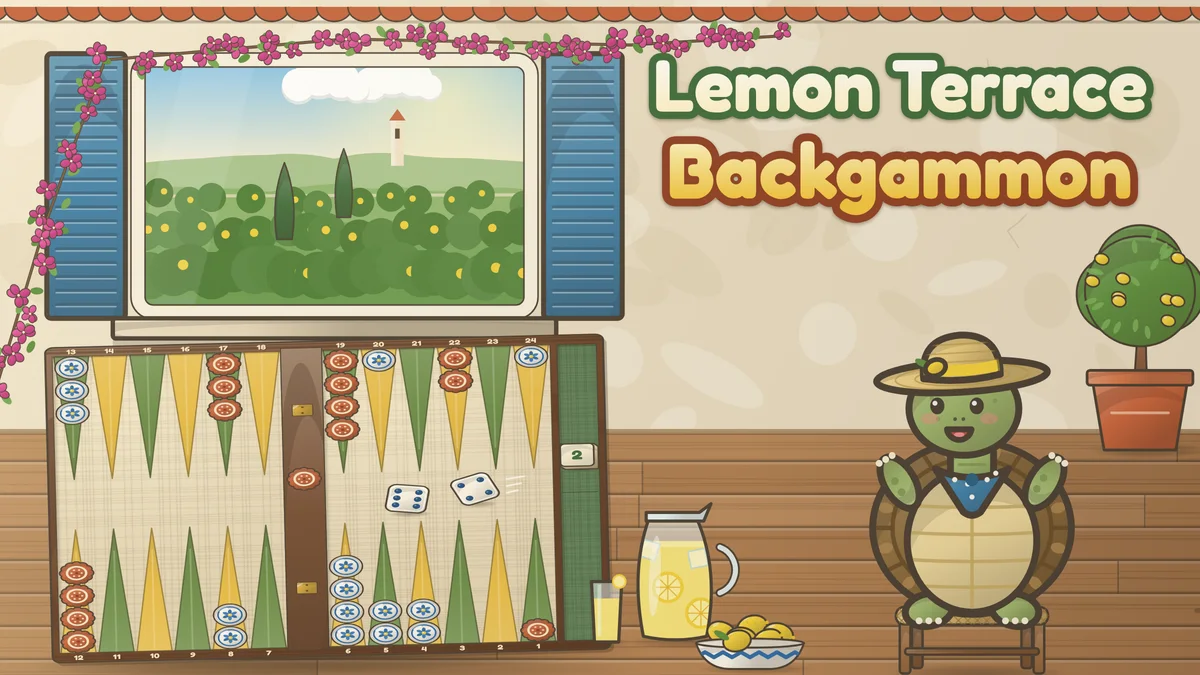
What is backgammon?
Backgammon is a board game for two players. Each player has 15 checkers of one color and a pair of six-sided dice. The board has 24 long triangles called points, in four quarters of six, with a raised strip called the bar down the middle.
The two players move their checkers around the board in opposite directions, each toward their own home board, and then take them off the board, which is called bearing off. The first player to bear off all 15 checkers wins the game. Hitting, blocking and the doubling cube make it more than a race: the dice decide what you can do, and you decide what to do with them.
The rules in this guide are the standard ones. Our sources are the U.S. Backgammon Federation’s Backgammon Basics: How To Play page (usbgf.org) and the Wikipedia article Backgammon. Lemon Terrace Backgammon plays by the same rules.
How to set up a backgammon board
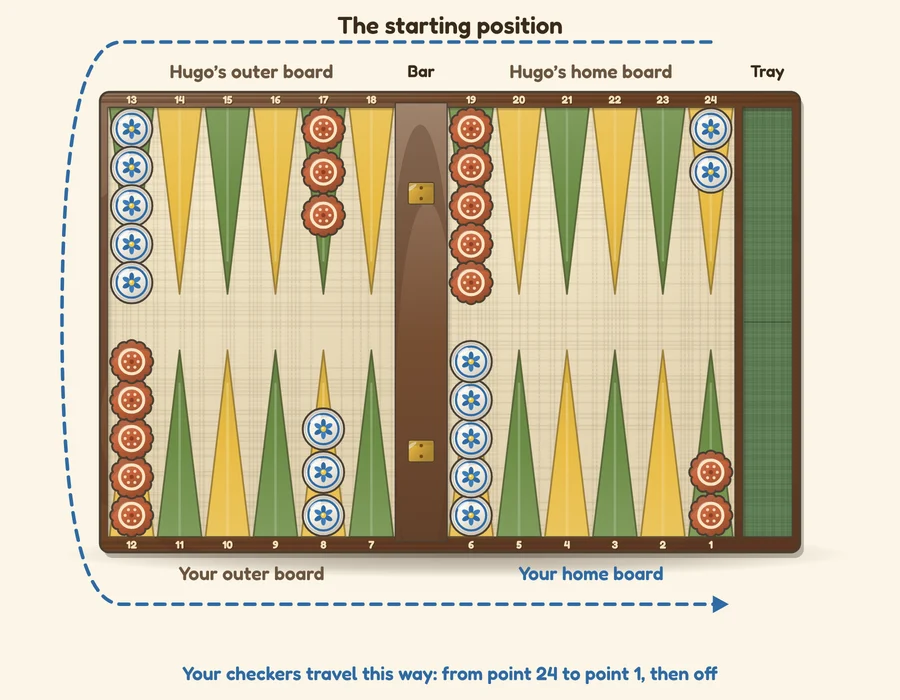
Lay the board between the two players. The points are numbered 1 to 24 from each player’s own side, so your 1-point is the other player’s 24-point. Your home board is your points 1 to 6 and your outer board is points 7 to 12. Across from them are the other player’s outer board (your points 13 to 18) and home board (your points 19 to 24).
Each player sets out 15 checkers the same way, counted from their own side: two on the 24-point, five on the 13-point, three on the 8-point and five on the 6-point. The two sides mirror each other, so your two back checkers start on the other player’s 1-point, deep in their home board, and theirs start in yours.
Each player also needs dice, and games that use the doubling cube start with it in the middle. At the start, each player’s pip count, the total number of points all 15 checkers must travel to bear off, is 167: 2 × 24 + 5 × 13 + 3 × 8 + 5 × 6.
In Lemon Terrace Backgammon your white checkers with the blue painted flower start with your home board at the bottom right of the screen, and Remo’s terracotta checkers with the fluted edge start in the mirror places. The point numbers on the frame of the board are always counted from your side.
| Point | Checkers | Where it is |
|---|---|---|
| 24-point | 2 | The other player’s home board (their 1-point) |
| 13-point | 5 | The other player’s outer board (their 12-point) |
| 8-point | 3 | Your outer board |
| 6-point | 5 | Your home board |
| Every other point | 0 | Empty at the start |
Starting the game: the opening roll
To start, each player rolls one die. The player with the higher number moves first, and plays the two numbers just rolled as the first move: if you roll a 5 and the other player a 2, you play a 5 and a 2. If the two dice show the same number, both players roll again until they differ.
After the opening move, the players take turns. On each turn you roll both dice and move by the numbers you rolled.
In Lemon Terrace Backgammon the opening roll shows one of your ivory dice and one of Remo’s terracotta dice side by side, and the message line says who goes first and with which numbers.
How checkers move
Each die is a separate move of one checker by that number of points, always forward: you move from higher-numbered points toward your 1-point, and the other player moves the opposite way. With a 5 and a 2 you may move one checker 5 points and another 2 points, or one checker 7 points, as long as the point where it stops after the first number is open.
A checker may land on a point that is empty, that holds your own checkers, or that holds exactly one of the other player’s checkers. It may not land on a point held by two or more of the other player’s checkers: that point is closed. Any number of your own checkers may share a point.
Doubles are played four times. A roll of 3 and 3 gives four moves of 3, which you can share among one to four checkers.
You must use both numbers if you can. If only one of the two numbers can be played, you must play that one, and if either number could be played but not both, you must play the larger. If neither number can be played, your turn passes. With doubles, you play as many of the four moves as you legally can.
Lemon Terrace Backgammon builds these rules in. When you pick up a checker, it lights only the landings that keep a legal play in reach, so it will not let you play the 3 of a 6 and 3 in a way that leaves the 6 with nowhere to go when another order would use both.
| After the roll | What you must do |
|---|---|
| Both numbers can be played | Play both |
| Only one number can be played | Play that one |
| Either number can be played, but not both | Play the larger one |
| Neither number can be played | Your turn passes |
| Doubles | Play four moves of that number, or as many as you legally can |
Hitting and the bar
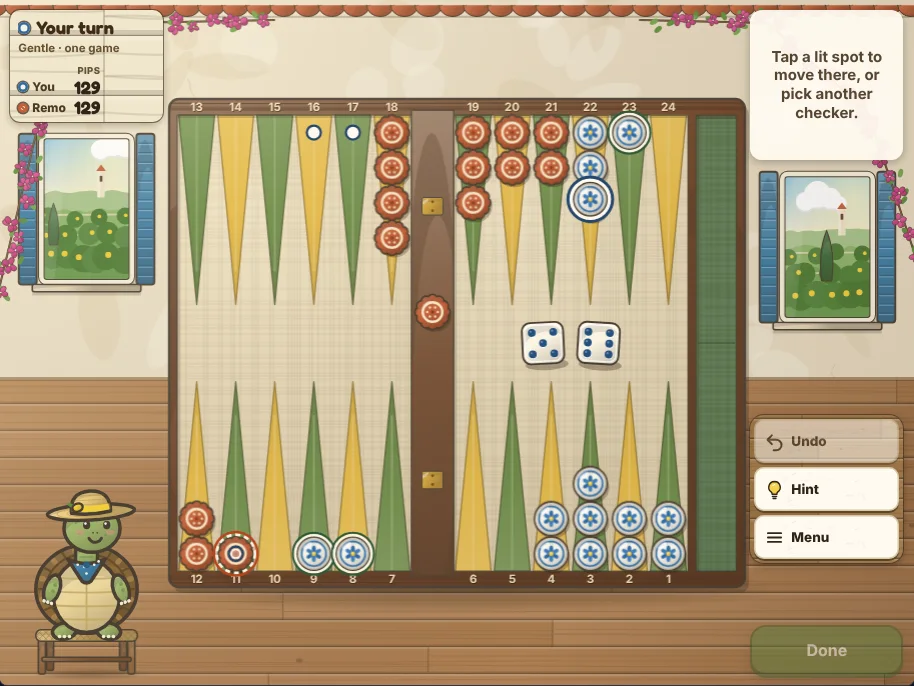
A single checker alone on a point is called a blot. If the other player lands a checker on it, your blot is hit and placed on the bar, the strip down the middle of the board.
A checker on the bar must come back into play before any of your other checkers may move. It enters in the other player’s home board: from your side, a 1 enters on your 24-point and a 6 on your 19-point. It may enter on any point that is not closed, and it can hit a blot as it enters. If you have two checkers on the bar, both must enter before anything else moves. If neither number gives an open point, you cannot move at all that turn.
Hitting costs the other side every pip the checker had traveled. A checker of yours hit on your 5-point had 5 pips left to go; on the bar it has 25, so the hit costs you 20 pips.
In Lemon Terrace Backgammon a dashed ring marks a checker you would hit, the checker on the bar is picked up for you when it is the only one that can move, and the message line says when Remo has hit one of yours.
Bearing off
Once all 15 of your checkers are in your home board, you may start bearing them off. A die takes off a checker from the point of that number: a 4 bears off a checker from your 4-point.
If no checker is on that point, you must use the number to move a checker from a higher point inside your home board. Only when there is no checker on any higher point does a higher number bear off a checker from your highest occupied point: with checkers only on your 3-point and below, a 6 bears off a checker from the 3-point.
Bearing off is never compulsory. You may use a number to move a checker inside your home board instead, if that move is legal.
If one of your checkers is hit while you are bearing off, it must come all the way around to your home board again before you can bear off any more checkers.
Lemon Terrace Backgammon has a bear-off assist: once no contact is left and all your checkers are home, it plays your bear-off for you, choosing as Sharp Remo would. You still press Done, Undo hands the roll back to you, and Settings can turn the assist off.
Winning: single games, gammons and backgammons
The first player to bear off all 15 checkers wins the game. How many points the win is worth depends on how far the loser got.
If the loser has borne off at least one checker, the game is a single game, worth 1 point. If the loser has not borne off any, it is a gammon, worth 2. If the loser has not borne off any and still has a checker on the bar or in the winner’s home board, it is a backgammon, worth 3. With the doubling cube in use, these points are multiplied by the cube’s value.
Gammons are common. In our own simulation, 112 of 400 single games between Sharp and Steady Remo (28.0 percent) ended in a gammon or a backgammon, so saving a gammon when you are losing, or playing on for one when you are winning, matters in many games.
| Result | When | Points |
|---|---|---|
| Single game | The loser has borne off at least one checker | 1 |
| Gammon | The loser has borne off none | 2 |
| Backgammon | The loser has borne off none and still has a checker on the bar or in the winner’s home board | 3 |
The doubling cube and the Crawford rule
The doubling cube is a large die marked 2, 4, 8, 16, 32 and 64. It keeps track of what the game is worth. At the start it sits in the middle with 64 showing, which stands for a value of 1.
Before rolling, a player who feels ahead may offer to double the value of the game. The other player either takes, and the game goes on at twice the value with the taker now owning the cube, or passes, and loses the game at its value before the double. Only the player who owns the cube may make the next double, called a redouble, and after a take the cube changes hands again.
When should you take? As a basic rule, a take is right when you still win about one game in four or more: the Wikipedia article gives 25 percent as the raw take point for a single game, and the real figure moves with gammons and, in a match, with the score.
Players often play a match to a set number of points, such as 3, 5 or 7, where the cube’s value and gammons count toward the score. Matches use the Crawford rule: the first time either player comes within one point of winning the match, the next game, called the Crawford game, is played without the cube. After that one game the cube is back in use.
In Lemon Terrace Backgammon the cube only counts points in a game or match. It is on for matches by default and left out of a single game, and Settings can use it in single games too or leave it out entirely. Beavers and the Jacoby rule, which some players add outside matches, are not used.
Controls in Lemon Terrace Backgammon
Press Roll to roll your dice. The checkers that can move wear a ring; tap one and the spots it can reach light up, including spots it reaches by using both numbers, which show a hollow dot. Tap a lit spot to move there. Or tap one of your dice to move by that number, and the game picks the checker. When your play is complete, press Done; until then, Undo takes back your moves one at a time, and the dice never change, because every roll follows from the game’s seed.
On a keyboard, R rolls, the arrow keys move a visible focus along the points, the bar and the tray, and Enter or Space picks up the checker in focus and moves it to the spot in focus. The number keys 1 to 6 move by that die, Enter finishes the turn once the play is complete, U undoes, H asks for a hint, D doubles, T takes and P passes.
Hint gives Sharp Remo’s view of your position: the play he prefers and your chances from there, or whether to double, take or pass. Menu starts a new game or match and opens Settings, where you choose Remo’s level, a single game or a match to 3, 5 or 7, the cube, the bear-off assist and the move speed. Your pip count and Remo’s are always on the score sign, statistics are kept for each level, and your match is saved on this device as you play.
How strong is each level?
Remo has three levels, and all three use the same evaluator: a small neural network we trained ourselves by self-play over 300,000 games, which rates a position by the chances to win, to win a gammon and to lose one. Gentle plays a quarter of his moves at random, picking any legal play, and for the rest chooses loosely among the plays the evaluator rates close to the best. Steady plays the evaluator’s best play right after the move, without looking ahead. Sharp takes the best few plays and looks one roll further: for each, every one of the 21 different rolls you could throw next and your best reply to it.
To check the levels we ran our own simulation of single games with the cube off, the two players swapping seats every game: 1,000 games for each pairing, or 400 for the pairings with Sharp, who thinks longer. A random player picks any legal play. The scripted beginner hits when it can, makes new points, bears off when it can and avoids leaving blots within reach, but never looks ahead. It stands in for a newcomer.
The beginner beat Gentle in 590 of 1,000 games, so Gentle really is beatable while you learn. Steady and Sharp each beat that same beginner about six games in seven. Sharp beat Steady in 233 of 400 games and scored 0.25 points a game more, counting gammons. The dice decide a great deal in any one game, so treat the numbers as a guide to the gaps between the levels.
| Pairing | Games | Won | Lost | Points a game |
|---|---|---|---|---|
| Gentle against a random player | 1,000 | 987 | 13 | +2.44 |
| Steady against a random player | 1,000 | 996 | 4 | +2.59 |
| Sharp against a random player | 400 | 400 | 0 | +2.69 |
| Scripted beginner against a random player | 1,000 | 995 | 5 | +2.54 |
| Scripted beginner against Gentle | 1,000 | 590 | 410 | +0.45 |
| Scripted beginner against Steady | 1,000 | 147 | 853 | -1.21 |
| Scripted beginner against Sharp | 400 | 53 | 347 | -1.31 |
| Steady against Gentle | 1,000 | 909 | 91 | +1.58 |
| Sharp against Gentle | 400 | 371 | 29 | +1.72 |
| Sharp against Steady | 400 | 233 | 167 | +0.25 |
Matches and the cube: how the levels compare
We also played matches to 5 points in the same simulation, with the doubling cube and the Crawford rule, the way a match goes in the game. The scripted beginner never doubles and takes every double; the levels double and answer doubles as Remo does.
Matches tell a different story from single games. Gentle won about two matches in five against the scripted beginner, and Steady lost only one of 200 matches to Gentle. Sharp beat Steady in 118 of 200 matches (59.0 percent) but won only 364 of the 732 games, about half, partly because Sharp turned down 198 doubles and Steady only 100. A pass gives up a game at the current cube value, so a player who passes more often can lose more games while still winning more matches.
| Pairing | Matches | Matches won | Games won |
|---|---|---|---|
| Scripted beginner against Gentle | 200 | 120 | 388 of 643 |
| Steady against Gentle | 200 | 199 | 380 of 444 |
| Sharp against Steady | 200 | 118 | 364 of 732 |
Basic strategy
Count the race. Your pip count is the total number of points your checkers must still travel to bear off: for each checker, the number of its point, or 25 for a checker on the bar. Lemon Terrace Backgammon shows both counts on the score sign. Being ahead in the race favors breaking contact and running for home; being well behind is a reason to keep checkers back and wait for a shot.
Make points. Two or more checkers make a point safe from being hit, and every point you make is one the other side cannot land on. Points in your home board and your 7-point, called the bar point, are the most useful, because they block checkers that have to come past them. Six points in a row, called a prime, cannot be passed at all.
Leave blots where they are hard to hit. A blot within six points of an opposing checker can be hit by a single number; farther away it takes both dice together, which is much less likely. The table below counts the rolls that hit from each distance when nothing is in the way. Points in between that are closed cut these numbers down.
| Distance | Rolls that hit | Chance |
|---|---|---|
| 1 | 11 | 30.6% |
| 2 | 12 | 33.3% |
| 3 | 14 | 38.9% |
| 4 | 15 | 41.7% |
| 5 | 15 | 41.7% |
| 6 | 17 | 47.2% |
| 7 | 6 | 16.7% |
| 8 | 6 | 16.7% |
| 9 | 5 | 13.9% |
| 10 | 3 | 8.3% |
| 11 | 2 | 5.6% |
| 12 | 3 | 8.3% |
Opening moves and game plans
The first move of the game sets the tone. The table shows the play Sharp Remo chooses for each opening roll at the start of a single game. Making a point in your home board with 3-1, 4-2, 5-3 and 6-4, and the bar point with 6-1, are the clearest patterns. With the other rolls Sharp brings a checker down from the 13-point, splits the two back checkers, or runs one back checker with 6-5.
Wikipedia’s backgammon article names the common game plans. In a running game you race for home when you are ahead. In a priming game you build a wall of points to trap the other side’s checkers behind it. A blitz attacks blots in your home board while keeping the other side on the bar. In a holding game you keep an anchor, a point of your own in the other side’s home board, and wait for a shot. A back game holds two or more anchors when you are far behind in the race, and is usually a last resort.
These plans change as the dice fall. Count the race, look at who has the stronger board, and ask whether you would rather race, block or wait.
| Roll | Sharp Remo plays |
|---|---|
| 2-1 | 13/11 24/23 |
| 3-1 | 8/5 6/5 |
| 3-2 | 24/21 13/11 |
| 4-1 | 13/9 24/23 |
| 4-2 | 8/4 6/4 |
| 4-3 | 13/9 13/10 |
| 5-1 | 13/8 24/23 |
| 5-2 | 13/8 13/11 |
| 5-3 | 8/3 6/3 |
| 5-4 | 13/8 24/20 |
| 6-1 | 13/7 8/7 |
| 6-2 | 24/18 13/11 |
| 6-3 | 24/18 13/10 |
| 6-4 | 8/2 6/2 |
| 6-5 | 24/18 18/13 |
Common mistakes
Playing the smaller number when only one can be played. If either number could be played but not both, the rule says the larger one. Lemon Terrace Backgammon will not let you break it, but over a real board it is an easy rule to forget.
Leaving blots in direct range for no reason. A blot six points in front of an opposing checker is hit about one time in two. When you have a choice, stack checkers safely or leave the blot seven or more points away.
Breaking your best points too early. A point in your home board blocks a checker on the bar; give it up and the other side comes in freely. Move spare checkers first and keep your strongest points as long as you can.
Passing a double you could take. If you still win about one game in four or more, taking usually costs less than passing. Ask for a hint when Remo offers the cube, and compare its view with yours.
Forgetting the pip count. A player far ahead in the race who keeps hitting and staying back can turn a sure win into a close one. Check the counts on the score sign before you decide whether to run.
Tips for winning more games
Use the hint and undo to learn. Make your play, look at the hint to see what Sharp Remo would do and your chances from there, then undo and try his play to see the difference. Nothing is confirmed until you press Done.
Bring builders. Checkers spread out in your outer board, a few points from where you want to make points, give more rolls a way to make a new point next turn.
Hit and make points with the same roll when you can. Sending a checker back while building your board does double work.
Start against Gentle, and move up to Steady when you win more than you lose. Steady never plays at random, and Sharp looks a roll ahead and handles the cube well, so each level asks a little more of you.
Related games
If you like the dice and the thinking of backgammon, try Meadowlark Barn Shut the Box for another game of rolls and choices, Kingfisher Canal Checkers for a calm board game against a computer neighbor, or Sunflower Mill Mancala for a counting game with a friendly opponent. For cards, Birch Cove Gin Rummy and Kettle Burrow Hearts keep the same gentle pace, and the guides linked below explain each one.
Keep playing
Backgammon rewards a few habits above all: use both numbers, make points before you scatter checkers, keep your blots out of easy reach, and watch the pip count to know whether to race or wait. Start against Gentle Remo, use the hint and undo to compare your plays with Sharp’s, and move up to Steady when you win more than you lose. For more classic games, try Kingfisher Canal Checkers, our board game against Otis the otter; Meadowlark Barn Shut the Box, another dice game; Sunflower Mill Mancala, our seed-sowing board game; or Birch Cove Gin Rummy, our two-player card game.
- Play Lemon Terrace Backgammon
- Lemon Terrace Backgammon: features, controls and FAQ
- Kingfisher Canal Checkers: classic checkers on a canal boat
- Meadowlark Barn Shut the Box: the classic dice and tiles game
- Sunflower Mill Mancala: sow seeds around a carved board
- Birch Cove Gin Rummy: the classic two-player card game
- How to play checkers: rules, setup and strategy
- How to play Shut the Box: rules and strategy
- How to play mancala: rules, setup and strategy
- How to play gin rummy: rules and scoring
- How to play Hearts: rules, scoring and strategy
- How to play Klondike solitaire: setup and rules
- How to play FreeCell solitaire: setup and rules
- How to play Pyramid solitaire: setup and rules
More guides and roundups
Farkle is the six-dice game where you set aside dice that score and decide, throw after throw, whether to bank your points or push on. Here are the rules, the full scoring chart, hot dice and the final round, the common house rules, and strategy with the chances worked out exactly.
How to Play Chinese Checkers: Rules and StrategyChinese checkers is the race across a six-pointed star: step or hop your ten marbles into the point opposite before anyone else fills theirs. Here is how to set up for two, three, four or six players, how steps and hop chains work, how a game is won, what to do about marbles left in your home, how strong each level of our computer players is, and the strategy that wins more races.
How to Play Four in a Row: Rules and StrategyFour in a Row is the two-player game of dropping discs into an upright rack and lining up four. Here is how to set up, how a turn works, how a game is won or drawn, what the solved game says about going first, how strong each level of our computer opponent is, and the strategy that wins more games: the middle column, threats and blocks, and odd and even rows.
How to Play Dots and Boxes: Rules and StrategyDots and boxes is the pencil-and-paper game of joining dots and claiming boxes. Here are the rules, board sizes and extra turns, then the strategy that wins: safe lines, chains, leaving the last two boxes and the long chain rule, with how strong each level of our computer opponent is.