Cozy Classic
Free Checkers
Kingfisher Canal Checkers
Classic checkers with the pieces that can move ringed, compulsory jumps signposted, multi-jumps played one hop at a time, a friendly computer opponent at three levels, hints with a reason, and unlimited undo.
What you do
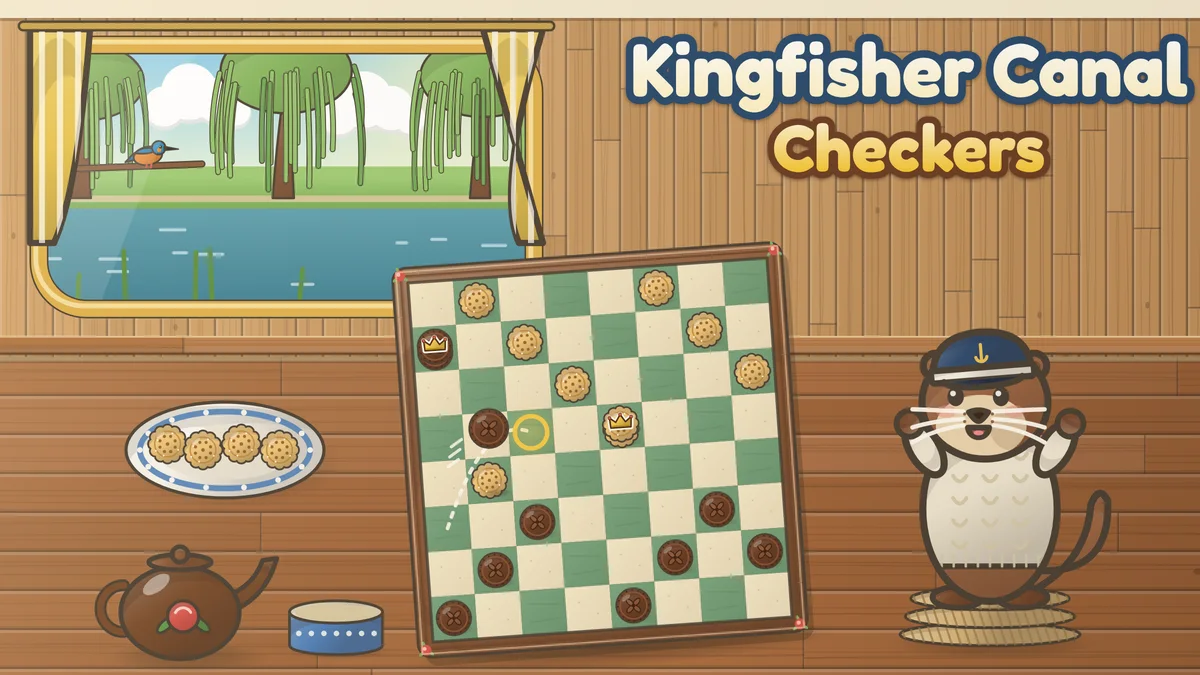
Kingfisher Canal Checkers is checkers with the standard American rules, played on a painted board on the fold-down table inside a narrowboat called the Kingfisher, moored under a willow, with a teapot at one elbow and a cookie tin at the other. Each side starts with 12 pieces on the dark squares nearest them. Pieces move one square diagonally forward, jump over an opposing piece to capture it, keep jumping while they can, and become kings that move both ways when they reach the far row. Here the pieces are cookies: round chocolate cookies with a flower pressed into the middle against pale shortbread rounds with a fluted edge and pricked holes, so the two sides differ in shape and pattern as well as color. A king is two cookies stacked with a gold icing crown on top. Your opponent is Otis, a river otter in a cream cable-knit sweater and a navy skipper’s cap, who sits on a coil of rope by the window, rubs his chin while he thinks, cheers his own good jumps and claps for yours.
- Three levels for Otis: Gentle often plays a move simply because he likes it and otherwise looks only one reply ahead, Steady looks four moves ahead, and Sharp searches far deeper, often ten or more moves ahead.
- The pieces that can move wear a ring on your turn. When a jump is available, only the pieces that can jump are ringed, in gold, and the message says you must jump.
- Multi-jumps are played one hop at a time: tap each landing square in turn while a Jump again! tag sits over the piece, and the pieces you jump stay faded until the move is done.
- Hints from the same deep search Sharp uses, with a short reason: a jump and how many pieces it takes, a crowning, a trade, a move that leaves Otis nothing to jump, or the best move found.
- Unlimited undo that takes back your move and Otis’s reply together, a choice of side (chocolate always moves first) or taking turns, three move speeds, and a captures-optional house rule that is off unless you choose it.
- Taken pieces pile up on a plate beside the board with a count, and statistics for each level (games, wins, losses, draws and your quickest win) are saved on this device with the game in progress.
How to play
- Press Play. The board has 64 squares, and only the 32 dark squares are used. Your 12 cookies fill the dark squares of the three rows nearest you, at the bottom of the screen, and Otis’s 12 face them. By default you play the chocolate pieces, and chocolate always moves first.
- On your turn, tap one of your ringed pieces, then tap a lit square to move it there. A piece that is not a king moves one square diagonally forward onto an empty dark square.
- To capture, jump diagonally over an opposing piece that sits next to yours onto the empty square just beyond it. If the same piece can then jump again, it must keep going in the same turn. Jumping is compulsory: when any jump is available you must take one, though you may choose which.
- When one of your pieces reaches the far row it is crowned a king, and that ends its move, even in the middle of a jump. A king moves and jumps one square diagonally in any of the four directions.
- You win by taking all of Otis’s pieces or by leaving him with no legal move on his turn. The game is a draw if the same position comes up for the third time with the same player to move, or after 40 moves each with no capture and no uncrowned piece moved.
Controls
- Touch or mouse: tap one of your ringed pieces, then a lit square. You can also drag a piece onto its square. In a multi-jump, tap each landing in turn. Tap the picked-up piece again to put it down. Undo, Hint and Menu sit on the shelf below the board, or beside it on a wide screen.
- Keyboard: the arrow keys move a visible focus between the dark squares, and Enter or Space picks up the piece in focus and moves it to the square in focus. U undoes, H shows a hint, and Escape puts a piece down or takes back an unfinished jump.
- Restart in the toolbar starts a new game. Menu starts a new game, changes Otis’s level, your side, the jumping rule and the move speed in Settings, and shows your statistics and the rules. The toolbar also has pause, help, optional sound and fullscreen.
Tips worth knowing
- Keep your back row home as long as you can, since Otis cannot crown a king while it is full. If some must move, many players keep the second and fourth back squares from their left, a pair called the bridge, which on their own can stop a lone piece from crowning.
- Move toward the center. Pieces in the middle of the board have two ways forward and are harder to trap, while a piece on the side edge has only one.
- Before every move, look at what Otis could jump next. A piece cannot be jumped from the front when the square behind it is filled, or at all while it stands on the side edge, so move in pairs and keep your pieces touching.
- Use compulsory jumps on purpose. Offering one piece can force Otis to jump into a spot where you take two back, and the hint marks a trade like this when it finds one.
- When you are ahead, trade pieces. Every even swap makes your lead count for more, and two kings against one can corner it.
- Use the hint and undo to learn. The hint says why a move is good, and undo lets you try the other choice and see what Otis does.
Accessibility
- Everything can be played with a keyboard: the arrow keys move a visible focus between the dark squares, Enter or Space picks up a piece and moves it, U undoes and H shows a hint.
- Every dark square is labeled for screen readers with its name from your side of the board (a1 to h8), the piece on it, and whether it can move, must jump or is a square you can move to.
- The two sides differ in shape and pattern as well as color: round chocolate cookies with a pressed flower against fluted shortbread with pricked holes. Kings are two cookies stacked under a gold crown, and each kind of highlight has its own shape.
- Nothing is timed. Otis waits while a menu is open, and undo is unlimited.
- Reduced motion places each piece at once instead of sliding and hopping it, stops the pulsing rings and Otis’s fidgeting, and keeps the sparkles small and still. Sound is optional and never needed to play.
Questions
How strong is each level?
We measured Otis with our own simulation of 1,000 games for each pairing, with jumps compulsory and the two sides swapping colors every game. Against a player that picks legal moves at random, Gentle won 878 games (87.8 percent), Steady all 1,000 and Sharp all 1,000. Against each other, Steady beat Gentle in 999 games with 1 draw, Sharp beat Gentle in all 1,000, and Sharp beat Steady in 994 with 6 draws and no losses. These are computer players, not people, so treat the numbers as a guide.
Can a beginner beat Gentle?
Yes, that is what Gentle is for. In the same simulation, a simple scripted beginner that takes the biggest jump it sees, otherwise crowns a king, otherwise makes a move that cannot be jumped straight back, beat Gentle in 740 of 1,000 games (74.0 percent) and drew 126 more. The same beginner won 1 of 1,000 against Steady and none of 1,000 against Sharp, so Steady and Sharp expect you to look ahead.
Which checkers rules does this use?
The standard rules of American checkers, also called English draughts: an 8 by 8 board played on the dark squares, 12 pieces each, the dark side moving first, men moving one square diagonally forward, compulsory jumps with a free choice among them, multi-jumps completed in full, crowning on the far row that ends the move, and kings that move one square in any diagonal direction. Kings do not fly across the board as they do in international draughts.
Do I have to take the jump that captures the most pieces?
No. When you have more than one jump, you may choose any of them, even one that takes fewer pieces. What you may not do is stop partway: once you start a jump, the same piece must keep jumping until it has no jump left or it is crowned.
How does the game end in a draw?
Two ways. The game is a draw when the same position, with the same player to move, comes up for the third time, or when both players have made 40 moves in a row with no capture and no uncrowned piece moving. These keep two kings from chasing each other forever. In real play a draw is usually agreed by the players; here the game calls it for you.
What does the game save?
Your settings, the game in progress with every move, and your statistics for each level (games played, won, lost and drawn, and your quickest win), all in this browser’s local storage. There is no account.