
CozyWorld game guide · By CozyWorld
This guide covers our own game, written from the current game rules and browser checks.
How to Play Checkers: Rules, Setup and Strategy
Checkers is the two-player board game of diagonal moves, jumps and kings. Here is how to set up the board, how pieces move, why you must jump, how multi-jumps and crowning work, how a game is won or drawn, how strong each level of our computer opponent is, and the strategy, common mistakes and tips that win more games.
Checkers is a board game for two players on the same 8 by 8 board used for chess. Each side starts with 12 pieces, moves them diagonally forward, captures by jumping over the other side’s pieces and earns kings by reaching the far row. The rules take a few minutes to learn, a game takes ten or fifteen, and the game has kept players thinking for centuries because one careless step can hand over a double jump.
This guide covers the standard American rules, the same game the British call draughts: setting up the board, moving, jumping, multi-jumps, kings, winning and draws, and the common house rules. Then it shows the controls in Kingfisher Canal Checkers (CozyWorld’s free checkers game against Otis the otter, on a canal boat), how strong each of Otis’s levels is, beginner strategy, the most common mistakes and a few tips. The strength figures come from our own simulation, which plays the game’s real rules.
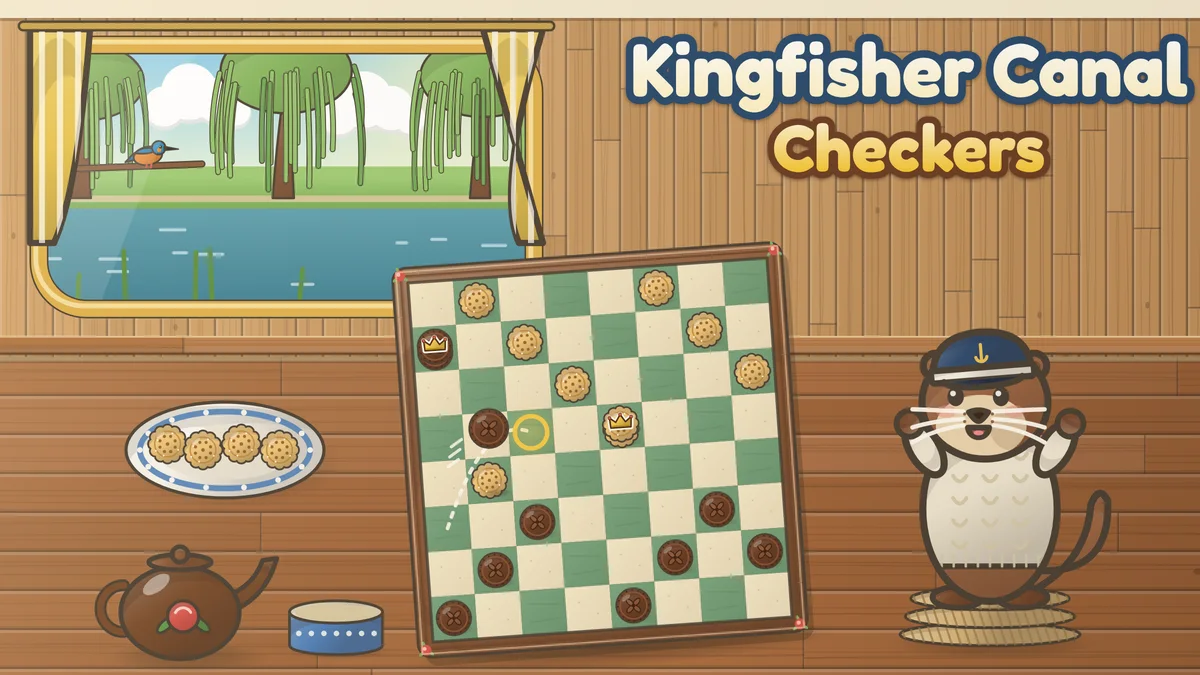
How to set up a game of checkers
Checkers uses a board of 64 squares in 8 rows of 8, colored light and dark in turn. Only the 32 dark squares are ever used. Lay the board between the two players so that each has a light square in the corner at their right hand and a dark square in the corner at their left.
Each player has 12 pieces of one color, traditionally black or red against white. Put them on the dark squares of the three rows nearest you, four to a row, and leave the two middle rows empty. The player with the darker pieces always makes the first move, and then the players take turns.
A piece that has not been crowned is called a man. Every piece starts as a man; the section on kings below explains how a man becomes a king.
In Kingfisher Canal Checkers the pieces are cookies. You play the round chocolate cookies, with a flower pressed into the middle, unless you choose otherwise in Settings, and chocolate moves first. Otis plays the pale shortbread rounds with a fluted edge and pricked holes. Your pieces always start at the bottom of the screen, whichever side you play.
| Rows, from your side | At the start | Whose pieces |
|---|---|---|
| 1 to 3 (nearest you) | 4 pieces a row on the dark squares, 12 in all | Yours |
| 4 and 5 (the middle) | Empty | Nobody yet |
| 6 to 8 (nearest your opponent) | 4 pieces a row on the dark squares, 12 in all | Your opponent’s |
| Any row | The light squares stay empty all game | Never used |
Checkers rules and the goal
You win by capturing all of your opponent’s pieces, or by leaving them with no legal move when their turn comes. Pieces that are blocked in count for nothing: a player with pieces left but nowhere to move loses.
On every turn you must move exactly one of your pieces. You may not pass. There are only two kinds of move, a step and a jump, and only two kinds of piece, men and kings. The sections below take them one at a time.
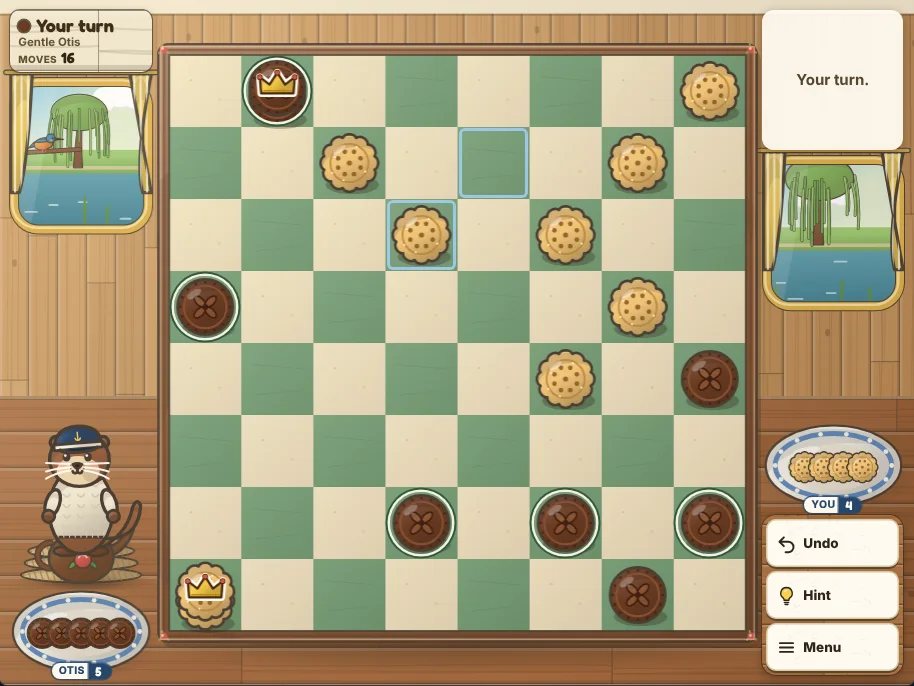
How pieces move
A man moves one square diagonally forward, toward the other player’s side, onto an empty dark square. Men never move straight ahead, sideways or backward, and a man in the middle of the board has at most two squares it can step to.
A step is only allowed when no jump is available. If any of your pieces can jump, you must jump instead, as the next section explains.
A man on the side edge of the board has only one diagonal forward, so pieces on the edge move less freely than pieces in the middle.
Jumping and capturing
To capture, a piece jumps diagonally over an opposing piece on the square next to it, onto the empty square just beyond. The piece jumped over is captured and comes off the board. A man jumps forward only; a king may jump forward or backward. You can never jump your own pieces, and you cannot jump when the square beyond is filled or off the board.
Jumping is compulsory. If any of your pieces can jump at the start of your turn, you must make a jump, even if you would rather step somewhere else and even if the jump costs you a piece in return. This rule is what makes checkers tactical: you can offer a piece on purpose and know your opponent has to take it.
When you have more than one jump available, you may choose any of them. You are not required to take the jump that captures the most pieces, only to finish the one you choose.
Multi-jumps
After a jump, if the same piece can jump again from the square where it landed, it must keep jumping in the same turn. A run of jumps like this is called a multi-jump, or a double or triple jump for two or three pieces. Each jump can change direction, left or right, but a man still jumps forward only.
You must complete the whole sequence. You may not stop partway because you would prefer to land somewhere else. If two different continuations are open, you may pick either one, but the piece keeps going until it has no jump left.
Each piece can be jumped only once in a move, and only the piece that started the move may jump. Your other pieces wait until your next turn.
In Kingfisher Canal Checkers a multi-jump is played one hop at a time. After the first landing, a Jump again! tag appears over your piece, the pieces you have jumped stay faded on the board until the move is done, and only the next landing squares are lit. Undo takes back a jump in progress.
Kings
When a man reaches the far row, the row nearest the other player, it is crowned a king. On a real board you crown it by stacking a captured piece of the same color on top of it. In Kingfisher Canal Checkers a king is two cookies stacked with a gold icing crown on top.
Reaching the far row ends the move. That is true even in the middle of a jump: a man that lands on the far row is crowned and stops there, even if it could jump again as a king. It may make that jump on a later turn. A piece that was already a king does not stop when it reaches the far row during a multi-jump.
A king moves one square diagonally in any of the four directions, forward or backward, and jumps the same way. In the American rules a king moves only one square at a time. Kings that slide any distance along a diagonal belong to other versions of the game, such as the 10 by 10 international game.
| Man | King | |
|---|---|---|
| Steps | One square diagonally forward | One square diagonally, forward or backward |
| Jumps | Forward only | Forward or backward |
| Multi-jumps | Yes, forward only, and the move ends if it reaches the far row | Yes, in any direction |
| How you get one | Every piece starts as a man | A man that reaches the far row is crowned |
How the game ends: winning and draws
The game ends with a win as soon as one player has no pieces left, or has pieces but no legal move on their turn. Being blocked in loses just as surely as being captured.
Some games cannot be won by either side, for example one king each with nothing else on the board. When players face each other they simply agree a draw. Kingfisher Canal Checkers calls the draw for you in two cases: when the same position comes up for the third time with the same player to move, or when both players have made 40 moves in a row with no capture and no man moved. Tournament rules have similar tests that a player can ask a referee to apply; the game applies its two tests automatically, so a game never goes on forever.
House rules and variations
Many families play with captures optional: you may take a jump or ignore it. It makes a gentler game but removes most of the tactics, because you can no longer force your opponent to take a piece. Kingfisher Canal Checkers offers it in Settings as Captures optional (house rule). It is off unless you choose it, and a jump you start must still be finished.
An old house rule called huffing lets a player remove an opponent’s piece that failed to make a compulsory jump. The modern rules dropped it, since the jump is simply required, and the game does not use it.
Other countries play their own versions, with flying kings, men that may jump backward, or a bigger board. The rules in this guide, and in the game, are the American ones.
Controls in Kingfisher Canal Checkers
On your turn the pieces that can move wear a ring. Tap one, and the squares it can move to are lit: a small dot for a step, and a gold ring with a dot for a jump, with a dashed ring on the piece the jump would capture. Tap a lit square to move there, or tap the piece again to put it down. With a mouse you can also drag a piece onto its square.
When you must jump, only the pieces that can jump are ringed, in thick gold, and the message line says so. Tapping a piece that cannot move gives it a little shake and says why.
On a keyboard, the arrow keys move a visible focus between the dark squares, and Enter or Space picks up the piece in focus and moves it to the square in focus. U undoes, H asks for a hint, and Escape puts a piece down or takes back an unfinished jump.
Undo takes back your last move together with Otis’s reply, as many times as you like. Hint asks the same deep search that Sharp Otis uses for your best move and says why: a jump and how many pieces it takes, a crowning, a trade that forces Otis to jump into a return capture, a move that leaves him nothing to jump, or simply the best move it found. Menu starts a new game and opens Settings, where you choose Otis’s level, your side (chocolate always moves first) or taking turns, the jumping rule and the move speed. Statistics are kept for each level, and your game is saved on your device as you play.
How strong is each level?
Otis has three levels. Gentle plays half of his moves simply because he likes them, picking any legal move, and for the rest looks at his own move and your best reply, choosing loosely among the moves that look nearly as good as the best. Steady looks four moves ahead, counting each player’s turn as a move, follows any jumps to the end, and picks among the moves that score close to the best. Sharp searches as far as a fixed budget allows, often ten or more moves ahead.
To check that each level does what it says, we ran our own simulation of 1,000 games for each pairing, with jumps compulsory and the two players swapping sides every game, so each moved first in 500. A random player picks any legal move. The scripted beginner takes the jump that captures the most pieces when it has one, otherwise crowns a king when it can, otherwise makes a move that cannot be jumped straight back, which is roughly how many people play their first games.
The beginner beat Gentle about three games in four, so Gentle really is beatable while you learn. Steady and Sharp both beat that beginner almost every time, so they expect you to look ahead. Sharp, given the same games, clearly beats Steady. These are computer players, not people, so treat the numbers as a guide to the gap between the levels.
| Pairing | Won | Lost | Drawn |
|---|---|---|---|
| Gentle against a random player | 878 | 101 | 21 |
| Steady against a random player | 1,000 | 0 | 0 |
| Sharp against a random player | 1,000 | 0 | 0 |
| Scripted beginner against Gentle | 740 | 134 | 126 |
| Scripted beginner against Steady | 1 | 965 | 34 |
| Scripted beginner against Sharp | 0 | 1,000 | 0 |
| Steady against Gentle | 999 | 0 | 1 |
| Sharp against Gentle | 1,000 | 0 | 0 |
| Sharp against Steady | 994 | 0 | 6 |
Beginner strategy
Look before every move at what your opponent could jump next. Most games between new players are decided by a piece left where it can be jumped, or by a step that opens a double jump. It takes a second to check each diagonal next to the piece you are moving, and the piece you are leaving behind.
Head for the center. The four squares in the middle of the board give a piece two ways forward and let it support its neighbors. A piece on the side edge cannot be jumped, but it can only move one way and often gets stuck.
Move your pieces together. A piece with a friend behind it cannot be jumped from the front, because the landing square is filled. Pairs and small triangles of pieces advance safely where a lone runner gets picked off.
Keep your back row home. While all four squares of your back row are filled, your opponent cannot crown a king. You will need those pieces eventually, so move the others first; if you must thin the row, many players keep the second and fourth back squares counting from their left, a pair called the bridge, which on their own can stop a lone man from crowning.
Common mistakes
Forgetting that jumps are compulsory. Your opponent can use the rule against you: they offer a piece, you must take it, and the jump lands your piece where they take two back. Before you step next to an opposing piece, check where the forced jump would leave you.
Emptying the back row early. It is tempting to push every piece forward, but a gap in your back row lets the other side crown a king, and a king behind your lines can pick off pieces that can only move forward.
Leaving holes. A gap between two of your pieces is a landing square, and a landing square in the right place turns a single jump into a double. Fill gaps or move the pieces next to them.
Racing one piece up the board. A lone man far ahead of its friends is easy to trap or capture. Unless the way to the far row is truly open, bring support with it.
Tips for winning more games
Trade when you are ahead. Each even swap leaves you with a bigger share of the pieces on the board, and in the endgame two kings can corner one. When you are behind, avoid trades and keep pieces on the board.
Set up shots. A shot is a planned sacrifice: give up one piece so that the forced reply lands an opposing piece where you can jump two or more. Look for an opposing piece with an empty square behind it and work out where it must land if it is forced to jump.
Corner a lone king the right way. A lone king is hardest to catch in a double corner, the corner with two dark squares side by side. Drive it out with two kings working together, or block it in the single corner, where it has only one way out.
Use undo and the hint to learn. Ask for a hint when you are unsure, read why it likes the move, and use undo to try your own idea and see how Otis answers.
Keep playing
Checkers rewards one habit above all: before you move, look at what your opponent can jump next, and remember that a jump on the board must be taken. Start against Gentle, keep your back row home, move your pieces together toward the center, and move up to Steady when you win more than you lose. For more classic games, try Sunflower Mill Mancala, our seed-sowing board game; Teahouse Mahjong, our tile-matching game; Sprout Sudoku, with hints that explain the next step; or Kettle Burrow Hearts, our four-player card game.
- Play Kingfisher Canal Checkers
- Kingfisher Canal Checkers: features, controls and FAQ
- Sunflower Mill Mancala: sow seeds around a carved board
- Teahouse Mahjong: match tiles in four seasonal tea rooms
- Sprout Sudoku: classic 9x9 puzzles with helpful hints
- Kettle Burrow Hearts: the classic four-player card game
- How to play mancala: rules, setup and strategy
- How to play Hearts: rules, scoring and strategy
- How to play gin rummy: rules and scoring
- How to play Klondike solitaire: setup and rules
- How to play FreeCell solitaire: setup and rules
- How to play Pyramid solitaire: setup and rules
More guides and roundups
Match mahjong tiles, solve sudoku and killer sudoku, stitch a nonogram, find hidden words, fit a jigsaw, rake leaf piles, sort shells, merge fruit or crack firefly codes. Choose a puzzle by the decisions it asks you to make.
Free Online Games for Seniors and Older AdultsFree online games for seniors and older adults: solitaire, mahjong, word search, sudoku, jigsaw and nonograms that open in a browser, with no countdown, no accounts and no purchases. Here is how the eight compare on round length, timers and help.
How to Play Sudoku: Rules, Techniques and HintsHow to play sudoku, from the rules and a first puzzle to what easy, medium, hard and expert mean, plus every technique Sprout Sudoku uses and how its hints and garden work.
Leaf Pile Nap Guide: Rules, Shapes and HintsThe rules of Leaf Pile Nap, how the animal shapes and the no-touch rule let you solve every garden without guessing, and how blankets, acorns, stars, hints and the daily garden work.