
CozyWorld game guide · By CozyWorld
This guide covers our own game, written from the current game rules and browser checks.
How to Play Hearts: Rules, Scoring and Strategy
Hearts is the classic four-player card game where you try not to win the wrong tricks. Here is how to deal, how the pass works, how a trick is played, when hearts may be led, how a hand is scored, what shooting the moon means, how the game ends and ties are broken, how strong each level of our computer players is, and the strategy, common mistakes and tips that keep your score low.
Hearts is a card game for four players with one ordinary deck. Everyone plays one card to each trick, and the highest card of the suit led takes it, but in Hearts you usually do not want the trick: every heart in it costs you a point and the queen of spades costs 13. A hand takes a few minutes, the rules fit on a single card, and the game stays interesting for a lifetime because every card you play tells the table something.
This guide covers the standard rules: the deal, passing three cards, playing a trick, the first trick, breaking hearts, scoring a hand, shooting the moon, how the game ends and what happens on a tie, and the common ways families change the rules. Then it shows the controls in Kettle Burrow Hearts (CozyWorld’s free Hearts game, played with Hazel the hedgehog, Bertie the badger and Mabel the mole), how strong each level of the computer players is, beginner strategy, the most common mistakes and a few tips. The strength figures come from our own simulation, which plays the game’s real rules.
How to deal Hearts
Hearts uses one standard 52-card deck with the Jokers taken out, and four players, each playing for themselves. Aces are high, so the ranks run from 2 up to ace, and there are no trump suits. Choose the first dealer any way you like. The dealer shuffles and deals all the cards out one at a time, clockwise, so everyone has 13. The deal then passes one seat to the left for the next hand.
Sort your hand by suit as you pick it up. Who deals matters very little in Hearts, because the first trick is always led by whoever holds the 2 of clubs.
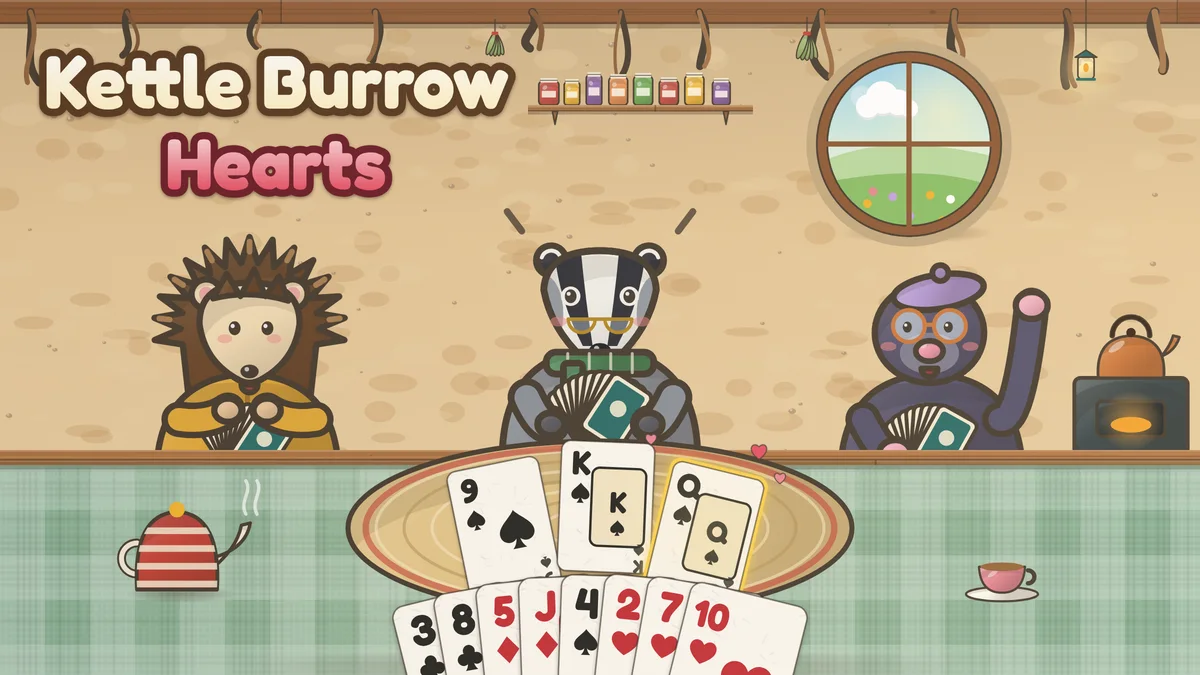
In Kettle Burrow Hearts, you sit at the bottom of the table with Hazel on your left, Bertie across from you and Mabel on your right. Your cards arrive sorted by suit, clubs, diamonds, spades and hearts, each from low to high.
| Card | Points |
|---|---|
| Each heart, 2 to ace | 1 point |
| Queen of spades | 13 points |
| Every other card | No points |
| Jack of diamonds (optional rule) | Minus 10 points |
Passing cards in Hearts
Before the first trick, each player chooses three cards from their hand and passes them face down to another player. Everyone picks their three before looking at the cards coming to them. The direction changes from hand to hand in a cycle of four, shown in the table.
The pass is your chance to get rid of trouble: the queen of spades, the high spades that could catch her, high hearts, and the cards of a short suit. The cards you receive can bring trouble back, so look at them carefully.
In Kettle Burrow Hearts, tap three cards to pick them (they rise and get an outline), check the panel to see who they go to, and tap Pass. The three cards passed to you arrive with a blue edge and keep it until you play your first card. A pass is final once made.
| Hand | Pass three cards to |
|---|---|
| 1st, 5th, 9th and so on | The player on your left |
| 2nd, 6th, 10th and so on | The player on your right |
| 3rd, 7th, 11th and so on | The player across the table |
| 4th, 8th, 12th and so on | Nobody: a hold hand with no passing |
Hearts rules: playing a trick
The player holding the 2 of clubs leads it to the first trick. Play goes clockwise, and each player in turn adds one card. You must follow suit, playing a card of the suit that was led, if you can. If you have none of that suit, you may play any card, which is how points usually change hands.
When all four cards are down, the highest card of the suit led wins the trick. A card of another suit can never win, however high it is. The winner gathers the trick face down and leads any card to the next one, subject to the rule on hearts below. After 13 tricks the hand is over and the points are counted.
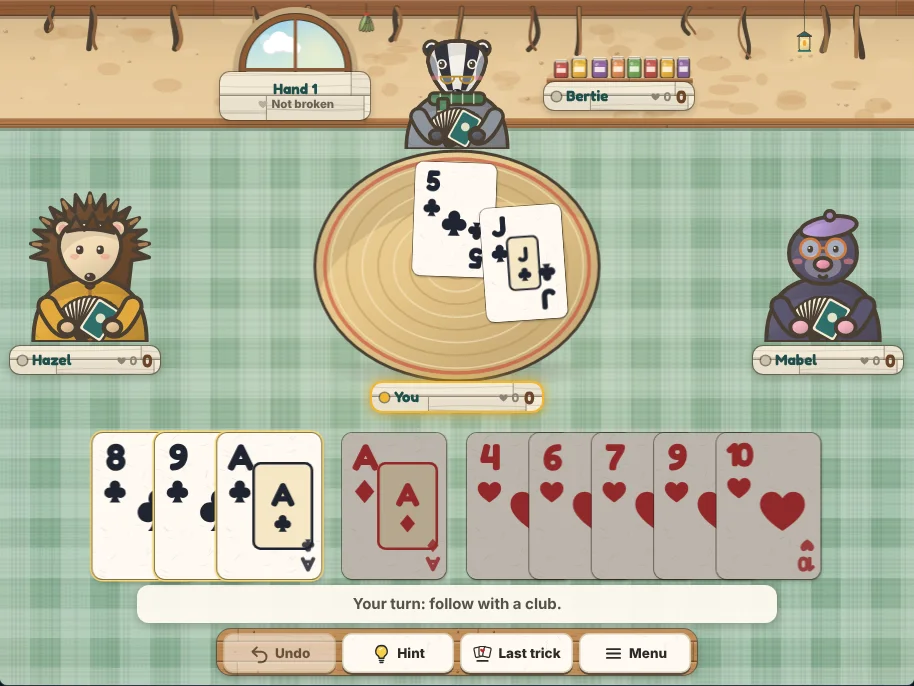
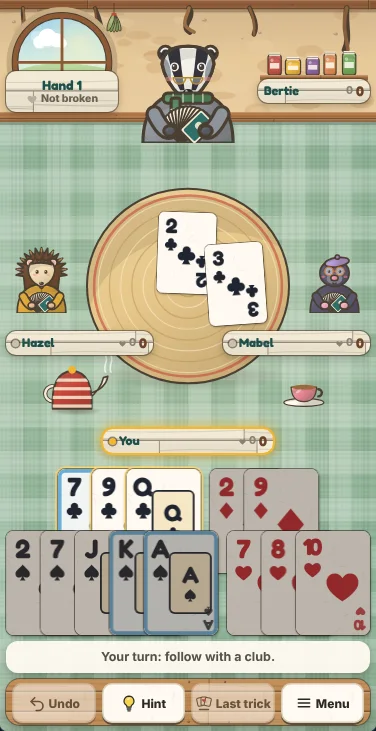
In Kettle Burrow Hearts, the cards you may play are outlined and the others dim, and a card you cannot play says why when you tap it. Tap a card to pick it up and tap it again to play it. Each finished trick stays on the mat for a moment, with the winning card glowing, before it goes to its winner.
The first trick and breaking hearts
Most players add a rule for the first trick: nobody may play a heart or the queen of spades to it, even with no clubs, unless their hand holds nothing else. This keeps an unlucky deal from costing points before anyone has had a choice. Some rule books, such as the base rules on Pagat, allow points on the first trick, and Kettle Burrow Hearts offers that as an option.
Hearts may not be led until hearts are broken: until a heart has been played to an earlier trick, usually by a player who could not follow suit. The one exception is a leader who holds nothing but hearts, who may lead one. In the most common rules, which this game follows, playing the queen of spades does not break hearts.
In Kettle Burrow Hearts, the hand sign at the top of the table shows a whole heart until hearts are broken and a cracked heart after, and your hearts stay dimmed when you lead until then.
How to score a hand of Hearts
When the 13th trick is done, each player counts the points in the tricks they took: 1 for every heart and 13 for the queen of spades. That makes 26 points in every hand, shared among the players. The points are added to each player’s running score, and low is good.
For example, you take three hearts, Hazel takes the queen of spades and two hearts, Bertie takes eight hearts, and Mabel takes none. You score 3, Hazel 15, Bertie 8 and Mabel 0.
In Kettle Burrow Hearts, each name plate shows a player’s game score and the points they have taken so far this hand, and a score card after every hand lists each player’s hearts, the queen and the hand’s points beside the new totals.
| What you took | What you score |
|---|---|
| Some of the 26 points | 1 for each heart, plus 13 for the queen of spades |
| No points at all | Nothing: a clean hand |
| All 26 points (shooting the moon) | Nothing, and everyone else scores 26 |
| The jack of diamonds (optional rule) | Minus 10 off your score for the hand |
Shooting the moon
If one player takes every heart and the queen of spades, all 26 points, they have shot the moon. Instead of scoring 26, the shooter scores nothing and every other player scores 26. It turns the game upside down, and it is the reason you cannot simply dump every heart on whoever seems to be collecting them.
Rule books differ on how a moon is scored. Some take 26 off the shooter’s own score instead of adding it to everyone else, and some, including the main rules on Pagat, let the shooter choose. Kettle Burrow Hearts adds 26 to the others by default, and Settings offers taking 26 off the shooter or the shooter’s choice. When you have the choice, the game shows both results and suggests the better one: never the one that ends the game with someone else lowest.
Going for the moon is a risk. If even one heart slips to another player, you are left with up to 25 points. Try it only with a hand full of high cards, long suits and few low cards, and give up the moment someone else takes a point.
How a game of Hearts ends
Play goes on hand after hand until, at the end of a hand, at least one player has reached 100 points or more. The game then ends, and the player with the lowest score wins. Everyone else finishes second, third and fourth by score.
If the lowest score is tied when someone passes 100, Kettle Burrow Hearts plays another hand, and keeps going until one player alone has the lowest score, so every game has a single winner. Some families end the game anyway and share the win. For a shorter game, Settings offers a game to 50.
Common Hearts rule variations
Hearts has been played at kitchen tables for well over a century, so almost every family has a house rule or two. The table lists the ones Kettle Burrow Hearts offers, with its default first. Other variations exist, such as counting the 10 of diamonds instead of the jack, or letting the queen of spades break hearts, but these are the most common.
| Rule | Default | Option |
|---|---|---|
| Points on the first trick | Not allowed unless you hold nothing else | Allowed for a player with no clubs |
| Shooting the moon | Everyone else scores 26 | 26 off the shooter, or the shooter chooses |
| Game length | To 100 | To 50 |
| Jack of diamonds | No points | Minus 10 for whoever takes it |
Controls in Kettle Burrow Hearts
On a phone or tablet, tap three cards and then Pass for the pass. In play, tap a card to pick it up and tap it again to play it; Settings can switch to playing a card on one tap. After a hand, tap Next to deal the next one. With a mouse, click the same way.
On a keyboard, the arrow keys move along your hand and Enter or Space picks or plays the card in focus. P passes your three cards, N deals the next hand, L shows the last trick, U undoes and H shows a hint.
Undo takes back the card you just played, as long as nobody has played a card since, so no new card has been seen. Last trick shows who played what to the trick just finished. Hints look only at what you can see (your cards, every card played and the three cards you passed) and say why. Your friends wait while a menu is open, and their speed can be set to Relaxed.
How strong are Hazel, Bertie and Mabel?
All three friends play at the level you choose. Gentle plays the lowest card it can when following suit, throws its highest card when it cannot, leads its lowest card, and four times in ten simply plays a legal card at random. It never tries to shoot the moon. Steady passes and dumps its dangerous cards, ducks under the winning card and leads low. Sharp plays like Steady and also counts every card and every void, remembers where its passed cards went, hunts the queen of spades with low spades, stops a player who has taken every point from shooting the moon, and shoots the moon itself when its cards are strong enough.
We measured the levels with our own simulation of 1,000 games to 100 for each pairing, one player against three of another, with the seats and the first dealer moving round the table. The scripted beginner passes its three highest cards, plays its lowest card when it can follow suit, throws the queen of spades or its highest heart when it cannot, and leads its lowest card. In a four-player game an even match wins about one game in four, 250 of 1,000, with an average place of 2.5.
So a newcomer playing simple, sensible cards wins half their games against Gentle, twice an even share. Steady and Sharp are real opponents: the same beginner wins fewer than one game in five against Steady and fewer than one in ten against Sharp. In the Sharp against Steady games, Sharp shot the moon 109 times in 1,000 games. These are computer players, not people, so treat the numbers as a guide.
| Who played | Games won of 1,000 | Average place |
|---|---|---|
| Gentle against three random players | 752 | 1.32 |
| Steady against three random players | 945 | 1.06 |
| Sharp against three random players | 946 | 1.06 |
| Scripted beginner against three Gentle | 500 | 1.83 |
| Scripted beginner against three Steady | 180 | 2.79 |
| Scripted beginner against three Sharp | 86 | 3.23 |
| Steady against three Gentle | 688 | 1.43 |
| Sharp against three Gentle | 735 | 1.33 |
| Sharp against three Steady | 375 | 2.10 |
| Steady against three Sharp | 182 | 2.79 |
Beginner Hearts strategy
Pass the queen of spades unless you hold four or more lower spades to hide behind; then she is safer in your hand than in someone else’s. Pass the ace and king of spades for the same reason: they can be forced to win a trick with the queen in it. High hearts are good passes too.
Use the pass to empty a suit. If you pass your only two diamonds and one high club, you may be void in diamonds, and every diamond trick becomes a chance to throw away the queen or a high heart.
When you follow suit, duck: play the highest card that still loses to the card winning the trick. That gets rid of a dangerous high card without taking points, and saves your low cards for later, when they are what keep you safe.
Lead low cards in suits that are still safe. Once a player has shown they are void in a suit, leading it invites them to throw points on the trick. Leading low spades while the queen is still out pushes whoever holds her to play her, as long as you do not hold the king or ace of spades yourself.
Common Hearts mistakes
Holding on to the ace and king of spades while the queen is still out. Sooner or later a spade is led, you have to follow, and someone drops the queen on your king.
Winning tricks early with middle cards for no reason. Every trick you win means you lead next, often from a weaker position.
Dumping every heart on the player who is collecting them. If they already have every point so far, you may be helping them shoot the moon. Take one heart yourself to stop them.
Forgetting to count. Keep track of how many spades and hearts have been played, and which players have shown a void. Hearts rewards remembering more than any other card skill.
Panicking about one bad hand. A single hand with the queen is 13 points; the game is long, and the lowest score after someone reaches 100 is what counts.
Hearts tips
Look at the passing direction before you choose your three cards. Play goes clockwise, so the player on your right usually plays just before you and the player on your left just after you. Cards you pass to the right often show up before you have to play; cards you pass to the left come after your card, when it is too late to change it.
Keep a low card in each suit as an exit for as long as you can, so you can give up the lead when you need to.
After the pass, remember the three cards you gave away. If you passed the ace of hearts to Mabel, you know where it is until she plays it.
Use the hint to learn. In Kettle Burrow Hearts it names a card and the reason, using only what you can see at the table, and the last trick button lets you check what was just played.
Keep playing
Hearts comes down to a handful of habits: pass your dangerous cards, empty a short suit, duck under the winning card, count the spades until the queen is gone, and keep an eye on anyone who is taking every point. Start with Gentle friends, use the hint when you are unsure, and move up to Steady when you finish first more often than not. For more classic card games, try Birch Cove Gin Rummy, two-player gin rummy against Murray the moose; Porch Swing Solitaire, our Klondike game; or Snowberry Cabin Solitaire, our FreeCell game. For a board game, try Sunflower Mill Mancala.
- Play Kettle Burrow Hearts
- Kettle Burrow Hearts: features, controls and FAQ
- Birch Cove Gin Rummy: gin rummy against the computer
- Porch Swing Solitaire: Klondike on a porch at dusk
- Snowberry Cabin Solitaire: FreeCell in a snowy cabin
- Sunflower Mill Mancala: two-player mancala against the computer
- How to play gin rummy: rules, scoring and strategy
- How to play Klondike solitaire: setup and rules
- How to play FreeCell solitaire: setup and rules
- How to play mancala: rules and strategy
- How to play checkers: rules and strategy
More guides and roundups
Pyramid is the quick solitaire of pairs: clear a pyramid of 28 cards by removing two free cards that add up to 13. Here is how to set up the pyramid and the stock, the card values and pairs, the rules for the waste and passes, how often a deal can be cleared, and the strategy, common mistakes and tips that clear more pyramids.
How to Play Spider Solitaire: Setup and RulesSpider is the two-deck solitaire where you gather ten columns into runs from King down to Ace. Here is how to set up the 104-card deal, the rules for moving cards and dealing from the stock, one, two or four suits, how often a deal can be won, and the strategy, common mistakes and tips that win more deals.
Free Online Games for Seniors and Older AdultsFree online games for seniors and older adults: solitaire, mahjong, word search, sudoku, jigsaw and nonograms that open in a browser, with no countdown, no accounts and no purchases. Here is how the eight compare on round length, timers and help.
How to Play Golf Solitaire: Rules and StrategyEvery card in Golf solitaire is face up from the deal, so each hole is a planning puzzle. Here are the rules, the King rule and the scoring, how to plan runs and count ranks, when to turn the stock, and how Golf differs from TriPeaks.