
CozyWorld game guide · By CozyWorld
This guide covers our own game, written from the current game rules and browser checks.
How to Play Mancala: Rules, Setup and Strategy
Mancala is the two-player game of sowing seeds around a board of pits. Here is how to set up the board, how sowing works, when you get a free turn, how captures work, how the game ends, how strong each level of our computer opponent is, and the strategy, common mistakes and tips that win more games.
Mancala is a family of very old board games played by sowing: you scoop up the seeds or stones in one pit and drop them one at a time into the pits that follow. The version most people in North America know, with two rows of six pits and a store at each end, is often called Kalah, and it is the one that comes with most mancala sets sold in stores. Turns are quick and the rules fit on a card, but planning a free turn two moves ahead, or leaving your opponent nothing to capture, keeps it interesting for years.
This guide shows how to set up the board, then covers sowing, free turns, captures, how the game ends, the controls in Sunflower Mill Mancala (CozyWorld’s free mancala game against Pepper the field mouse), how strong each of Pepper’s levels is, beginner strategy, the most common mistakes and a few tips. The strength figures come from our own simulation, which plays the game’s real rules.
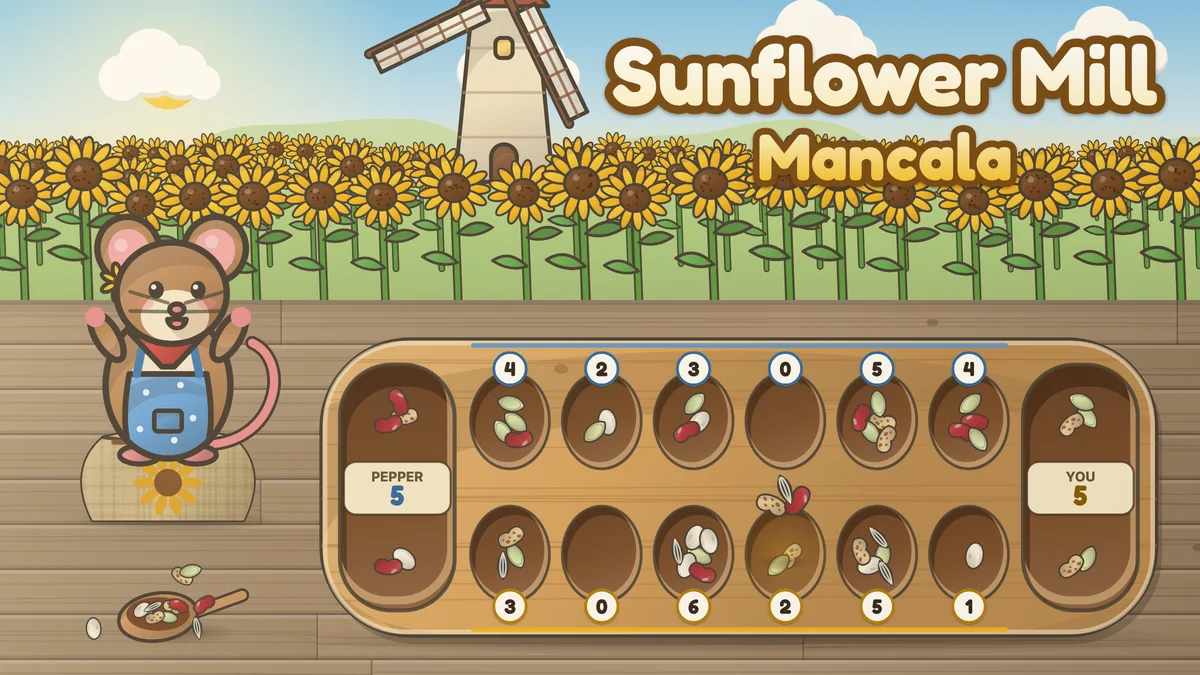
How to set up a game of mancala
A mancala board has two rows of six small pits and a larger pit, the store, at each end. The two players sit facing each other with the board between them. Each player owns the six pits on their side and the store on their right.
Put four seeds, beans or stones in each of the twelve pits, 48 in all, and leave both stores empty. Four is the most common start. Three a pit makes a shorter game and five a longer one, and Sunflower Mill Mancala offers both in Settings.
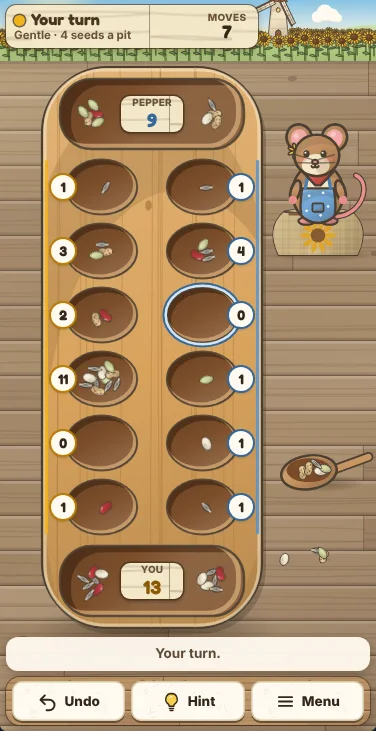
In Sunflower Mill Mancala your pits are edged in gold. On a computer or a tablet held sideways they run along the near side of the board with your store on the right; on a phone held upright the board stands lengthwise, with your pits down the left and your store at the bottom. Pepper’s pits, edged in blue, face yours, and her store is at the other end. Every pit has its count on a little badge, and each store shows its count on a plaque, so you never need to count by eye.
| Place | At the start | Who it belongs to |
|---|---|---|
| Your six pits | 4 seeds each | You: you sow from them |
| Your store, on your right | Empty | You: seeds here are yours for good |
| Pepper’s six pits | 4 seeds each | Pepper: she sows from them |
| Pepper’s store, on her right | Empty | Pepper: you never sow into it |
Mancala rules and the goal
The goal is to finish with more seeds in your store than your opponent has in theirs. Players take turns, and on every turn you must sow one of your own pits that has seeds in it. You never sow from your opponent’s pits or from a store.
A seed that reaches your store stays there for the rest of the game, so every seed you sow into your store is a point you keep. Seeds in the pits are still in play: they move around the board and can be captured.
There are only three more rules to learn: free turns, captures and the end of the game. The sections below take them one at a time.
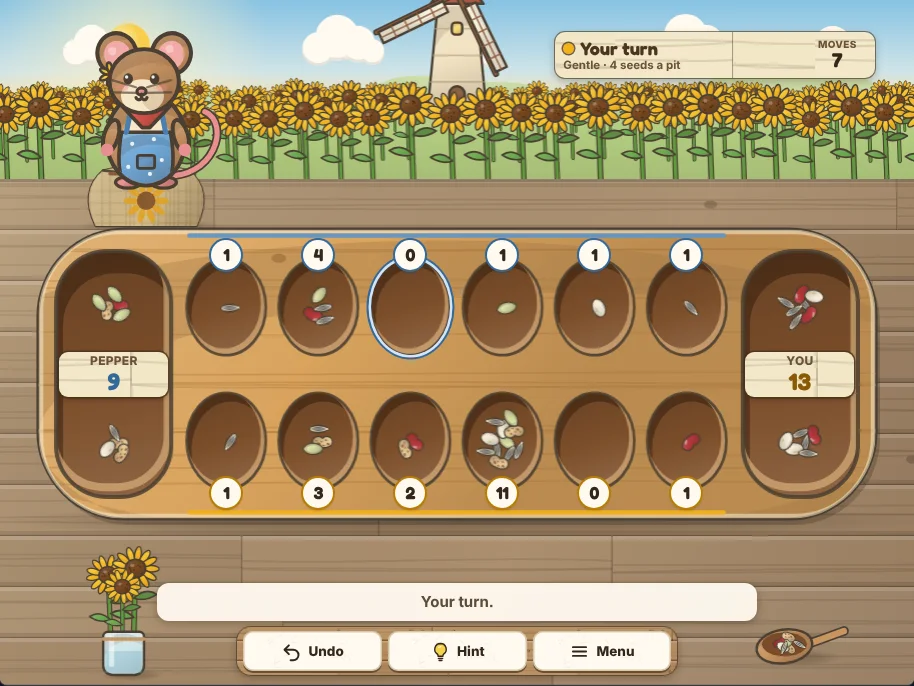
How sowing works
To sow, pick up every seed in one of your pits. Then, moving counterclockwise, drop one seed into each pit that follows: first along your own row, then into your store, then along your opponent’s row. If you still have seeds when you come round to your opponent’s store, skip it and carry on into your own pits again. Your opponent’s store never gets a seed from you, and yours never gets one from them.
For example, if your third pit holds four seeds, they go one each into your fourth, fifth and sixth pits and into your store. If it held six, the last two would go into your opponent’s first two pits.
A pit with many seeds can go all the way round the board. Because one store is skipped, there are 13 places to drop seeds in, so a pit with 13 seeds puts its last seed back into the pit it started from.
Free turns
If the last seed you sow lands in your own store, you take another turn straight away. There is no limit: a good run of free turns can earn several moves in a row.
You can tell a free turn before you move by counting. A pit earns one when its seed count equals its distance from your store: one seed in the pit next to the store, two in the pit before it, and so on up to six in the pit farthest away. A pit with 13 more than that, which goes all the way round first, works too.
| Your pit, counting back from your store | Seeds for a free turn |
|---|---|
| 1st (next to your store) | 1 or 14 |
| 2nd | 2 or 15 |
| 3rd | 3 or 16 |
| 4th | 4 or 17 |
| 5th | 5 or 18 |
| 6th (farthest from your store) | 6 or 19 |
Captures
If the last seed you sow lands in an empty pit on your own side, look straight across the board. If the opposite pit has seeds in it, you capture them: take that last seed and every seed in the opposite pit and put them all in your store. The pit you started from counts as empty once you have picked its seeds up, which is how a 13-seed pit always captures.
Your opponent captures the same way, so a big pile of yours across from one of their empty pits is at risk whenever they can land a seed in that empty pit.
Rule sheets differ about one case: your last seed lands in your own empty pit, but the pit across is empty too. With the usual rule, which Sunflower Mill Mancala plays unless you change it, nothing is captured and the seed simply stays. A common variant sends that one seed to your store anyway; choose it in Settings as Empty captures too.
How the game ends
The game ends the moment either player’s six pits are all empty, after any move, even in the middle of a run of free turns. The other player then puts all the seeds still in their own pits into their own store. Count the stores: more seeds wins, and equal stores are a tie. With 48 seeds, 25 is enough to win.
Rule sheets for other mancala games handle the leftover seeds in different ways. In Kalah, and in Sunflower Mill Mancala, the seeds left on a side always go to the owner of that side. That makes the last few moves a race: emptying your own side early hands your opponent everything still on theirs.
Controls in Sunflower Mill Mancala
Tap one of your pits to sow it. The seeds are carried round the board and dropped one at a time, the count badges change as each seed lands, and the message line says what happened: a free turn, a capture and how many seeds it took, or the end of the game. With a mouse, resting the pointer on a pit rings the place its last seed will land and tells you in words.
On a keyboard, the arrow keys move between your six pits and show where each one’s last seed lands, Enter or Space sows the pit in focus, and the keys 1 to 6 sow your pits in order toward your store. U undoes and H asks for a hint.
Undo takes back your last move together with Pepper’s reply, as many times as you like. Hint asks the same deep search that Sharp Pepper uses for your best move and says why: a free turn, a capture, or simply the strongest move it found. Menu starts a new game and opens Settings, where you choose Pepper’s level, three, four or five seeds a pit, the capture rule, who goes first and the sowing speed. Statistics are kept for each level, and your game is saved on your device as you play.
How strong is each level?
Pepper has three levels. Gentle takes the free turns and captures she can see in front of her, but often just plays a pit she likes. Steady looks four moves ahead and watches for your captures. Sharp searches far deeper, often a dozen moves ahead.
To check that each level does what it says, we ran our own simulation of 1,000 games for each pairing, with four seeds a pit, the usual capture rule and the first move alternating between the players. A random player picks any legal pit. The scripted beginner takes a free turn when it sees one (from the pit nearest its store), otherwise the biggest capture it sees, otherwise a random pit, which is roughly how many people play their first games.
The beginner beat Gentle about three games in four, so Gentle really is beatable while you learn. Steady wins most games against that beginner, and Sharp almost all of them. These are computer players, not people, so treat the numbers as a guide to the gap between the levels.
| Pairing | Won | Lost | Tied |
|---|---|---|---|
| Gentle against a random player | 886 | 86 | 28 |
| Steady against a random player | 989 | 8 | 3 |
| Sharp against a random player | 1,000 | 0 | 0 |
| Scripted beginner against Gentle | 766 | 194 | 40 |
| Scripted beginner against Steady | 191 | 759 | 50 |
| Scripted beginner against Sharp | 20 | 973 | 7 |
| Steady against Gentle | 931 | 50 | 19 |
| Sharp against Gentle | 992 | 4 | 4 |
| Sharp against Steady | 978 | 15 | 7 |
Beginner strategy
Count before you move. For each of your pits, work out where its last seed will land. That one habit finds every free turn and every capture on the board.
Take free turns first, starting with the pit nearest your store. Sowing that pit leaves your farther pits untouched, so any free turns they had are still there for your next move. Take them in the other order and the first sowing can spoil the second.
Look across the board before you move, not just at your own side. Find Pepper’s empty pits and check what sits opposite them on your side. If a big pile of yours faces an empty pit she can reach, move that pile, or sow a seed into her empty pit so it is no longer empty.
Plan a capture of your own. An empty pit on your side, with a full pit across from it, is a target: look for one of your pits whose last seed would land there.
Common mistakes
Feeding your opponent. Sowing a big pile drops many seeds into the other player’s pits, which gives them more seeds to play with and more chances for free turns. Sometimes it is right, but count what it hands over first.
Using up a free turn too early. A pit with exactly the right count is a free turn waiting for you. Spending it when you have nothing else lined up can be fine, but taking a free turn from a far pit before a near one often destroys the near one.
Ignoring the end of the game. Players often empty their own side late in the game without noticing that the game then ends and every seed left on the other side goes to the opponent. Count both rows before your last few moves.
Forgetting the stores are skipped one way only. You sow into your own store but never into your opponent’s, so a pit that seems to end in their store actually ends one pit later on your side.
Tips for winning more games
Hoard on your side late. A row of seeds you can keep away from captures is worth points at the end, because the leftovers on your side are yours when the other side runs empty.
Let one pit grow. A pit you leave alone fills up as seeds are sown into it, and once it holds 13 or more it can go all the way round the board and make a capture the other player cannot easily stop. Just keep an eye on the pit across from it, since a big pile is also a big target.
Leave your opponent bad choices. Before you move, look at what Pepper could do next: a move that leaves her no free turn and no capture is often better than one that takes a seed or two.
Use undo and the hint to learn. Ask for a hint when you are unsure, read why it likes the move, and use undo to try your own idea against it and see how Pepper answers.
Keep playing
Mancala rewards a quick count before every move: where will the last seed land, and what does that leave for the other player? Start against Gentle, take your free turns from the pit nearest your store, keep an eye on Pepper’s empty pits, and move up to Steady when you win more than you lose. For more classic games, try Teahouse Mahjong, our tile-matching game; Sprout Sudoku, with hints that explain the next step; Porch Swing Solitaire, our Klondike game; or Puffin Bluff Solitaire, our Pyramid game.
- Play Sunflower Mill Mancala
- Sunflower Mill Mancala: features, controls and FAQ
- Teahouse Mahjong: match tiles in four seasonal tea rooms
- Sprout Sudoku: classic 9x9 puzzles with helpful hints
- Porch Swing Solitaire: Klondike on a porch at dusk
- How to play Klondike solitaire: setup and rules
- How to play Pyramid solitaire: setup and rules
- How to play FreeCell solitaire: setup and rules
More guides and roundups
Match mahjong tiles, solve sudoku and killer sudoku, stitch a nonogram, find hidden words, fit a jigsaw, rake leaf piles, sort shells, merge fruit or crack firefly codes. Choose a puzzle by the decisions it asks you to make.
Free Online Games for Seniors and Older AdultsFree online games for seniors and older adults: solitaire, mahjong, word search, sudoku, jigsaw and nonograms that open in a browser, with no countdown, no accounts and no purchases. Here is how the eight compare on round length, timers and help.
How to Play Spider Solitaire: Setup and RulesSpider is the two-deck solitaire where you gather ten columns into runs from King down to Ace. Here is how to set up the 104-card deal, the rules for moving cards and dealing from the stock, one, two or four suits, how often a deal can be won, and the strategy, common mistakes and tips that win more deals.
How to Play Sudoku: Rules, Techniques and HintsHow to play sudoku, from the rules and a first puzzle to what easy, medium, hard and expert mean, plus every technique Sprout Sudoku uses and how its hints and garden work.