
CozyWorld game guide · By CozyWorld
This guide covers our own game, written from the current game rules and browser checks.
How to Play Spider Solitaire: Setup and Rules
Spider is the two-deck solitaire where you gather ten columns into runs from King down to Ace. Here is how to set up the 104-card deal, the rules for moving cards and dealing from the stock, one, two or four suits, how often a deal can be won, and the strategy, common mistakes and tips that win more deals.
Spider is the solitaire with two decks and ten columns. Instead of sending cards to foundations one at a time, you gather them on the table into runs of one suit, from King down to Ace, and each finished run leaves the table at once. Clear all eight runs and you have won. It became one of the best-known solitaire games when it came with Windows, and it is easy to learn with one suit and a real challenge with four.
This guide shows how to set up Spider with real cards, then covers the rules, the traditional rule about dealing, one, two and four suits, how often a deal can be won, the controls in Dewdrop Garden Solitaire (CozyWorld’s free Spider game), beginner strategy, the most common mistakes and a few tips. The win rates come from our own solver and scripted players, which play through the game’s real rules.
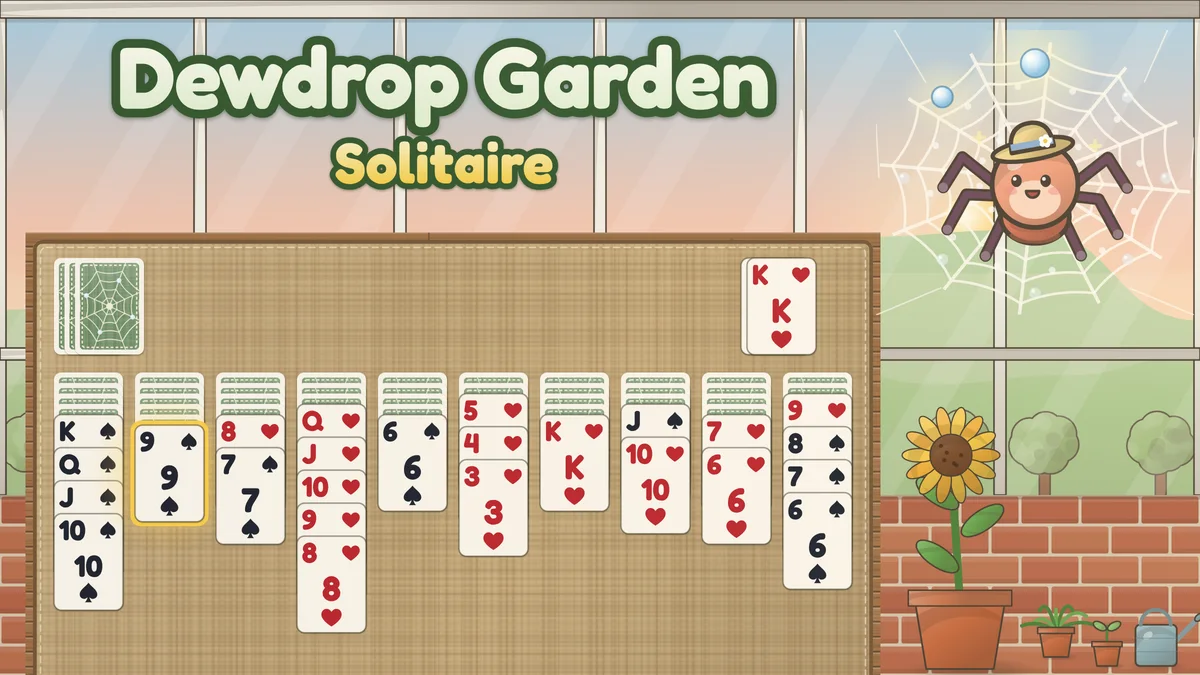
How to set up a game of Spider solitaire
Spider uses two standard 52-card decks shuffled together, 104 cards with the Jokers taken out. For the one-suit and two-suit games with real cards, you need eight sets of Ace to King in one suit, or four in each of two suits, which you can make from several old decks. Most people play those versions on a computer.
Deal ten columns in a row from left to right; together they are called the tableau. Deal by rows, one card to each column at a time, until 54 cards are out: the first four columns get six cards each and the other six columns get five. Only the last card of each column, the one nearest you, is face up. The 44 cards beneath them are face down.
Put the other 50 cards face down to one side as the stock. They are dealt later, ten at a time, so the stock holds exactly five deals. Leave room for the finished runs as well. In Dewdrop Garden Solitaire the stock sits at the top left in stacks of ten, one stack for each deal left, and the finished runs gather at the top right; on a phone turned sideways, both move to the strips beside the columns.
| Pile | Cards dealt | Face down | Face up |
|---|---|---|---|
| Columns 1 to 4 (each) | 6 | 5 | 1 |
| Columns 5 to 10 (each) | 5 | 4 | 1 |
| All ten columns | 54 | 44 | 10 |
| Stock (five deals of ten) | 50 | 50 | 0 |
Spider solitaire rules and the goal
The goal is to build eight runs, each a full suit in order from King down to Ace, and clear them off the table. In the columns, any face-up card can go on a card exactly one rank higher, whatever its suit: a 7 goes on any 8, and a Jack on any Queen. Nothing goes on an Ace, and the ranks do not wrap around from King to Ace.
Moving several cards at once is where the suits matter. A group of cards moves together only if it is a run in one suit, in order: the 9, 8 and 7 of hearts can move as one onto any 10, but a 9 of hearts with an 8 of spades on it cannot. You can always move part of a run, such as just the 8 and 7 of hearts. When the last face-up card leaves a column, turn over the face-down card under it. In Dewdrop Garden that happens by itself.
Any card or run can go into an empty column, not only a King. That makes empty columns precious: they are the only place to park cards while you sort out a column.
When a column ends in a complete run of one suit from King down to Ace, those 13 cards leave the table. In some versions you lift them off yourself; in Dewdrop Garden they go by themselves, and Thimble hangs a shining dewdrop on her web for each one. Once all eight runs are gone, you have won.
Dealing from the stock, and the empty column rule
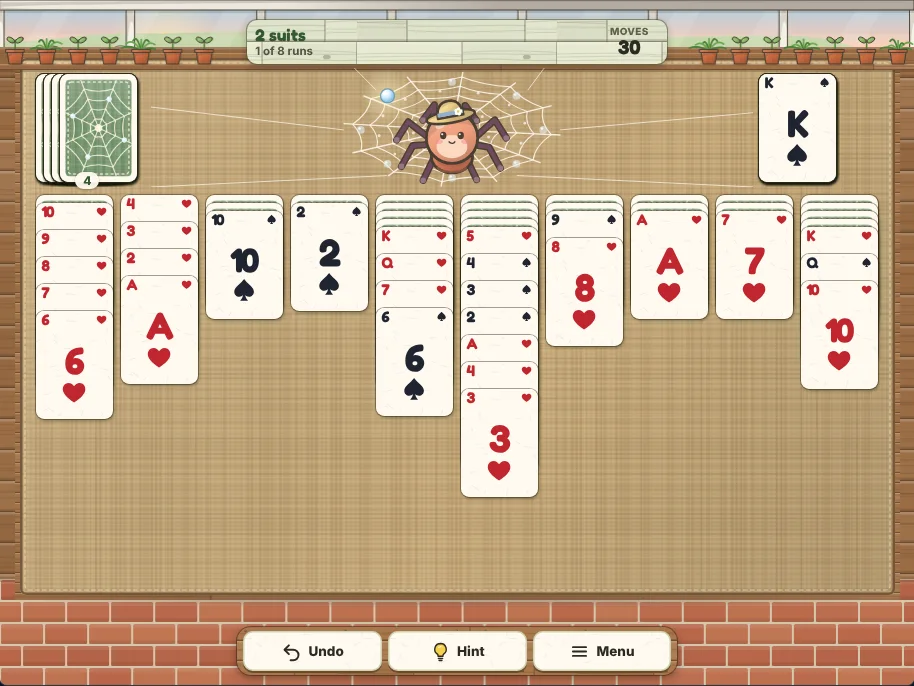
When the table has no more useful moves, deal from the stock: one card face up onto the end of every column, ten cards in all, whatever is already there. The new cards often land on runs you were building, so make every move you want before you deal.
The traditional rule, used by the classic computer versions, is that you may not deal while any column is empty. Fill every empty column first, even with a single card, then deal. Dewdrop Garden follows this rule. Its one exception comes at the very end of a game: if fewer than ten cards are left on the table, the columns cannot all be filled, so the deal goes ahead.
Rules for scoring vary. Many computer versions start each game at 500 points, take away one point for every move and add 100 for every finished run. Dewdrop Garden does not score points. It counts your moves, keeps your fewest moves for a win with each number of suits, and has a timer only if you turn one on.
One suit, two suits or four
Spider comes in three strengths, and the deal and the rules are the same in all of them. With one suit, all 104 cards are spades, so every card you put on a card one higher is already part of a run, and the game is mostly about uncovering cards and using empty columns. It is the best way to learn, and it is the default in Dewdrop Garden.
With two suits, half the cards are spades and half are hearts. A 6 can still go on any 7, but only a 6 of hearts on a 7 of hearts joins a run that can move as one, so you start choosing where cards go. With four suits, the traditional game, the cards are two ordinary decks, runs form only when suits match, and most deals take long planning and many undos.
You can change the number of suits in the settings at any time. A deal in progress keeps its suits, and your statistics are kept separately for one, two and four suits.
How often can you win at Spider?
Most one-suit deals can be won, and many two-suit deals. We ran Dewdrop Garden’s solver on 1,000 shuffled deals for each number of suits. The solver plays through the game’s real rules with every card visible, the face-down cards and the stock order included, so every win it finds is a real one. Within a search of 200,000 steps per deal, it proved 989 of 1,000 one-suit deals winnable, 700 of 1,000 two-suit deals and 47 of 1,000 four-suit deals. It could not settle the rest either way, so the true share is higher. With four suits the search is far too small for most deals, and the real share of winnable deals is certainly much higher than that figure.
A player who cannot see the face-down cards wins less often, because some winning lines depend on knowing what lies underneath. Our scripted player that follows the game’s own hint, which sees only what you see, won 148 of 200 one-suit deals, in about 150 moves on average, and 34 of 200 two-suit deals. With four suits it won none of 200: the hint plans only as far as the next card it would turn over, and four-suit Spider needs much longer plans than that. A strong human player who uses undo freely does better than our hint.
Every deal in Dewdrop Garden is an ordinary shuffle, so a deal that will not come out may need a cleverer line, or may not come out at all. Undo, or start a fresh deal, and try again.
Controls in Dewdrop Garden Solitaire
Drag a card, or a run in one suit, to its new place, or tap it and then tap where it should go; the places it can go glow. If you tap a card in the middle of a column that is not part of a run, the game picks up the run below it that can move. Double-tap or double-click a card to send it, and the cards on it, to the best place for them. Tap the stock to deal. Undo, Hint and Menu sit on a tool tray below the cards, or beside them on a wide screen.
On a keyboard, the arrow keys move between the stock, the finished runs and the ten columns, and in a column Up and Down choose how many cards to pick up. Enter or Space picks up and puts down, the number keys 1 to 9 and 0 pick up from or drop onto a column, D deals, F sends the cards to their best place, U undoes, H shows a hint and Escape puts the cards back.
Undo is unlimited. The hint uses only what you can see, never a face-down card or the order of the stock, and it tells you why it chose a move: to turn over a card, finish a run, empty a column or build in suit. When the stock is used up and no move can change anything, the game tells you and offers to undo, replay the deal or start a new one. Long columns close up to fit the screen, keeping every covered card’s rank and suit in view up to 20 cards deep. The deal in progress is saved on your device as you play.
Beginner strategy
Turn over face-down cards first. Each face-down card is one you cannot use yet, so when you have a choice, make the move that uncovers one. Work on the columns with the most face-down cards, the first four in a new deal, because they hide the cards you will wait for longest.
Build in suit whenever you can. Putting a 5 of hearts on a 6 of spades is a fine way to free a card, but those two cards can never move together again. Put the 5 of hearts on a 6 of hearts instead, if there is one, and the pair can travel as one later. When you must build out of suit, prefer to do it on a card that will not need to move again soon.
Value empty columns. An empty column lets you take a mixed column apart and put it back together in suit, a few cards at a time. Do not fill one with a single card just because you can; use it, then fill it again before you deal.
Make every useful move before you deal. A deal puts a new card on every column, covering the runs you were building and the cards you were about to free. With one suit you can be braver; with four suits, look twice.
Common mistakes
Dealing too soon. It is tempting to deal as soon as nothing obvious is left, but a move that uncovers a card or joins two runs in suit is almost always worth more than ten new cards on top of everything.
Building out of suit for no reason. A run of mixed suits is stuck where it is: the cards can only move one at a time, or as the in-suit piece at the end. Each out-of-suit build should free something.
Filling an empty column too early. An empty column is worth far more than one card sitting in it. Keep it open while you can use it to move things around, and fill it only before a deal, when the rule says you must.
Breaking up a good run for nothing. Lifting the 8 of spades off the 9 of spades loses a link, so do it only when it gains something, such as joining the 8 to a longer run of spades. Otherwise move the whole run, or leave it.
Forgetting the Kings. A King can only move into an empty column, and nothing ever goes above it. A King dealt on top of a face-down pile buries those cards until you have an empty column for it, so plan for it early.
Tips for winning more deals
Use undo to explore. Undo never changes your result in Dewdrop Garden, so try a line and take it back if it goes nowhere. It is the quickest way to learn which choices matter, and with two or four suits it is how strong players win.
Learn on one suit. With every build already in suit, you can see how empty columns and uncovering cards win the game, without the extra puzzle of matching suits. The gap is large: the hint-following player won 148 of 200 deals with one suit, 34 of 200 with two and none with four.
Let the hint teach you. A scripted player with simple habits, which turned over a card whenever it could, otherwise built in suit, otherwise dealt (filling an empty column from its longest column first), never went back to a position it had already seen, and stopped when it ran out of such moves, won none of the same 200 one-suit deals, and none with two or four suits. Spider rewards looking a few moves ahead. When you are stuck, ask for a hint and work out why it chose that move.
Watch the stock. The number on it shows how many deals are left. Once the last deal is out, the empty column rule no longer matters, so every column you empty is free room until the end of the game.
Keep playing
Spider rewards a tidy table: every card you build in suit is a card that can travel later, and every empty column is a chance to sort out the mess. Start with one suit, move up to two once the runs come easily, and keep four suits for the days you want a long puzzle. If you enjoy it, try Porch Swing Solitaire, our Klondike game, where you build down in alternating colors and send every card home; Buttercup Links Golf Solitaire, where every card starts face up and the puzzle is all planning; or Cozy Peaks Solitaire, our TriPeaks game.
- Play Dewdrop Garden Solitaire
- Dewdrop Garden Solitaire: features, controls and FAQ
- Porch Swing Solitaire: Klondike on a porch at dusk
- Buttercup Links Golf Solitaire: nine holes of Golf solitaire
- Cozy Peaks Solitaire: TriPeaks with streaks and seasons
- How to play Klondike solitaire: setup and rules
- How to play Golf solitaire: rules and strategy
- How to play FreeCell solitaire: setup and rules
More guides and roundups
Pyramid is the quick solitaire of pairs: clear a pyramid of 28 cards by removing two free cards that add up to 13. Here is how to set up the pyramid and the stock, the card values and pairs, the rules for the waste and passes, how often a deal can be cleared, and the strategy, common mistakes and tips that clear more pyramids.
Free Online Games for Seniors and Older AdultsFree online games for seniors and older adults: solitaire, mahjong, word search, sudoku, jigsaw and nonograms that open in a browser, with no countdown, no accounts and no purchases. Here is how the eight compare on round length, timers and help.
How to Play Mancala: Rules, Setup and StrategyMancala is the two-player game of sowing seeds around a board of pits. Here is how to set up the board, how sowing works, when you get a free turn, how captures work, how the game ends, how strong each level of our computer opponent is, and the strategy, common mistakes and tips that win more games.
Cozy Peaks Solitaire Guide: TriPeaks Streak TipsTriPeaks is a game of streaks. Here are the rules of Cozy Peaks Solitaire, how to look ahead and count what is buried, when to draw, and how orders, helpers and seasons work.