
CozyWorld game guide · By CozyWorld
This guide covers our own game, written from the current game rules and browser checks.
Cozy Peaks Solitaire Guide: TriPeaks Streak Tips
TriPeaks is a game of streaks. Here are the rules of Cozy Peaks Solitaire, how to look ahead and count what is buried, when to draw, and how orders, helpers and seasons work.
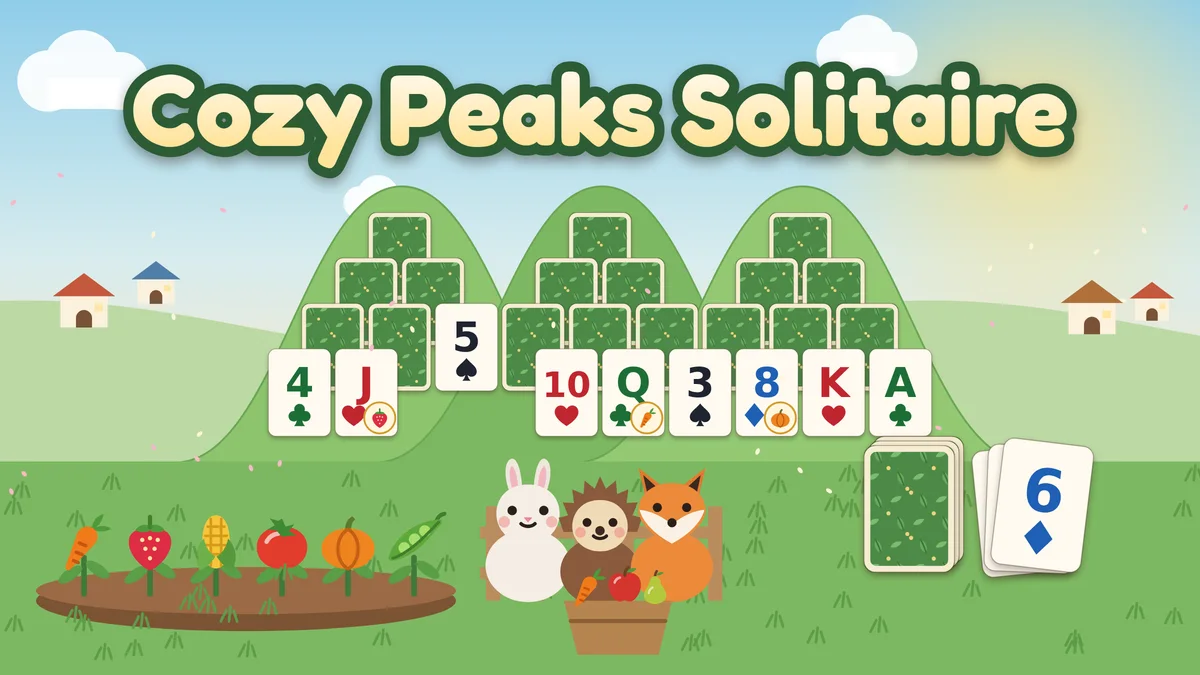
Cozy Peaks Solitaire is our version of TriPeaks solitaire, set on a hillside garden. Twenty-eight cards stand in three overlapping peaks, and you clear them one at a time by playing a card one rank higher or lower than the waste card. It is quick to learn, and the skill is in building long streaks: the more cards you play in a row, the more each one scores. Around the hands there is a small garden. Some cards carry crop stickers, your animal neighbors order crops, and filling their orders carries you through spring, summer, autumn and winter to a Harvest Festival. This guide covers the rules, how to plan a streak, when to draw, and how orders, helpers and seasons work, with every number taken from the game itself.
The rules of TriPeaks
The game uses one 52-card deck. Twenty-eight cards are dealt into three peaks: a top card on each peak, then rows of 6, 9 and 10, each row overlapping the one above it by half a card. The bottom row of ten starts face up and everything above it starts face down. One more card turns face up to start the waste pile, and the other 23 wait in the stock.
You can play any face-up card that is exactly one rank above or below the waste card, whatever its suit. A 7 takes a 6 or an 8. Ranks wrap around, so an Ace plays on a King or a Two, and a King on a Queen or an Ace. The card you play becomes the new waste card, so each play changes what fits next. A face-down card turns over as soon as both cards overlapping it are gone. When nothing fits, tap the stock to turn its next card onto the waste.
Clear all 28 cards to win the hand. When the stock is empty and nothing plays, the hand is over, unless you rescue it with a helper. If you tap a card that does not fit, it gives a little shake and the message line says what it needs, such as Needs a 6 or an 8.
Streaks and scoring
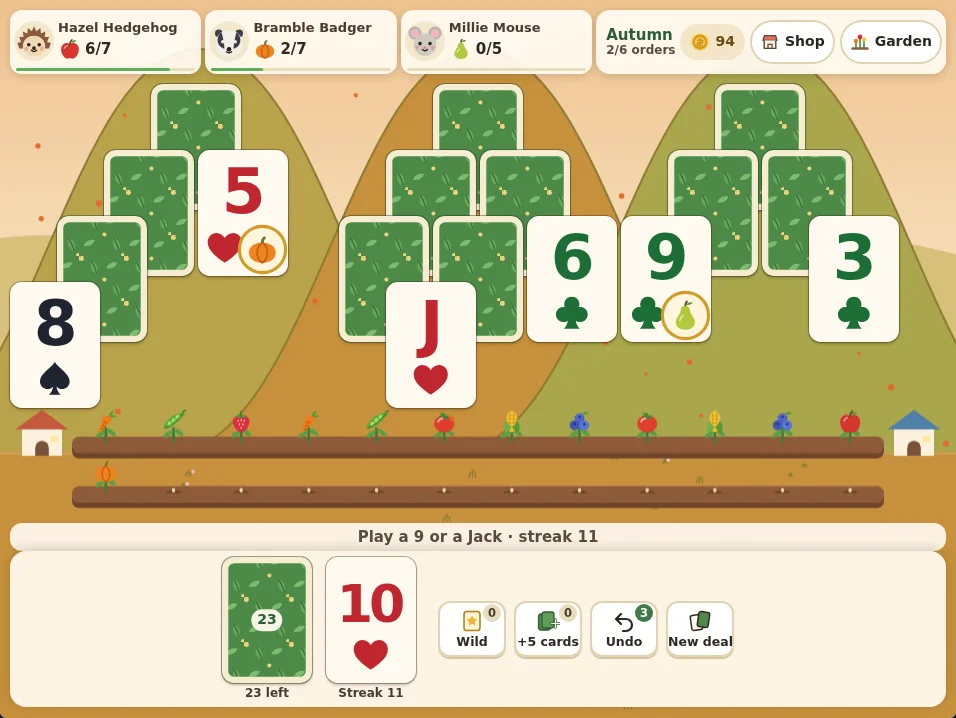
Every card you play from the peaks adds to your streak, and each card in a streak scores 10 points more than the one before: 10 for the first, 20 for the second, 30 for the third and so on. A streak of 8 is worth 360 points, while the same eight cards played in four streaks of two are worth only 120. Turning a stock card ends the streak and the next play starts again at 10.
Clearing the top card of a peak adds 100 points. Clearing the whole board adds 500, plus 50 for every card still in the stock, so a win with cards to spare is worth a lot. The toolbar shows the score of the hand you are playing, and your best hand score is saved in the garden’s stats.
How to build long streaks
Look ahead before you play. When two cards fit, follow each one forward in your head: if you play the 8 on the 7, what plays on the 8 next? The best choice is usually the one that leads to the longest run of face-up cards. The simulator’s careful player does exactly this and nothing more, and it wins 48% of hands without any helpers, against 9% for a player who plays the first card that fits.
Prefer plays that turn over face-down cards. Two cards can look equally good, but if one of them uncovers a hidden card you get a new option for free, and hidden cards are where the rest of the board is. The top cards of the peaks are the hardest to reach, so work on clearing the rows under them.
Count what is buried. There are four of each rank. If three 9s are already on the waste pile and the fourth is face up, you know no 9 is hiding under the peaks or in the stock, so a run that needs a 9 later will not get one. Counting also tells you when a card you are holding back will never be needed.
Draw only when nothing plays. Every draw ends your streak, and every card still in the stock is worth 50 points and 2 coins if you clear the board, so play every card you can before you turn the next one.
Garden orders, crops and coins
Every deal puts six crop stickers on cards in the peaks. You see a sticker once its card is face up, and clearing the card picks the crop. Three neighbors at a time place orders at the top of the screen, one for each of the season’s three crops, such as Rosie Rabbit asking for five carrots. Every crop you pick goes to the order that wants it, and all of them count in your garden’s collection.
Filling an order pays coins and plants something new in the garden bed under the peaks. Spring orders ask for 4 to 6 crops and pay 18 to 22 coins, summer and autumn orders ask for 5 to 7, and winter orders for 6 to 8, paying up to 32. Every card you clear also pays 1 coin, and winning a deal pays 2 coins for each card left in the stock.
Nothing you collect is ever taken away. Losing a hand keeps every crop and coin, and an undo puts a card back on the peaks but keeps what it gave you. Each card’s crop and coin can be collected only once per deal, so replaying a deal, or undoing and replaying a card, does not pay twice. A deal’s win coins are also paid only once.
Helpers: Wild cards, Five more cards and undos
Coins buy three helpers at the market stall, and prices never change. A Wild card (100 coins) goes on the waste pile: any card plays on it, and your streak keeps going. Five more cards (75 coins) can be used when the stock is empty and nothing plays; it puts five new cards from a fresh deck in the stock. Three undos cost 50 coins, and every hand also has three free undos of its own, which are used first.
Undo takes back your last play, draw or Wild card, and a Wild card you take back is returned to you. Five more cards cannot be undone, and moves before it are locked in. A new garden starts with one Wild card and one Five more cards. There is nothing to buy with real money.
Save the Wild card for the end of a hand. With a few cards left and nothing playing, one Wild card can start the run that clears the board. Five more cards is best when the cards left are spread across ranks, since five new chances are more likely to hit one of them. In the simulations, a casual player earned about 42 coins a hand, so a Wild card takes two or three hands to afford and an undo pack about one.
Seasons and the Harvest Festival
Each season has its own three crops and a set number of orders. Spring brings carrots, pea pods and strawberries (5 orders), summer tomatoes, corn cobs and blueberries (6), autumn apples, pumpkins and pears (6), and winter cabbages, parsnips and turnips (7). When the season’s last order is filled, a card announces the next season, the hills change color and the stickers on the cards switch to the new crops.
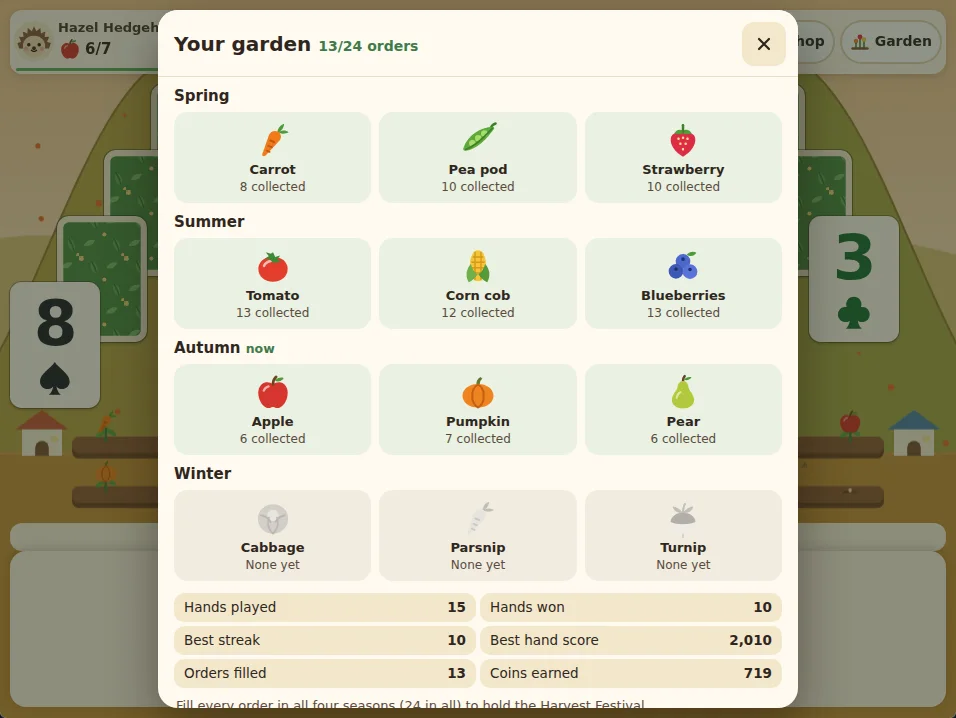
Filling all 24 orders brings the Harvest Festival after winter, with bunting over a full garden. After that the seasons keep turning with endless orders. In simulated gardens, a casual player reached the festival in 32 to 38 hands (34 on the median) and a careful player in 28 to 33. The Garden button shows every crop you have collected by season, with your hands played and won, best streak, best hand score and coins earned.
Controls, saving and accessibility
Touch or mouse: tap a card to play it and tap the stock to turn a card. The Wild, +5 cards, Undo and New deal buttons sit under the piles. Keyboard: the arrow keys move a visible focus between the face-up cards and the stock, Enter or Space plays the focused card, D draws, U undoes and W plays a Wild card. When a hand is over, the stock turns into a Next deal button.
New deal starts a fresh hand, and asks first if you are in the middle of one. Restart in the toolbar replays the same deal from the start, with its free undos back, and never touches your garden, coins or orders. Everything saves on this device, including the hand you are playing, so you can close the page mid-hand and pick up where you left off. We checked the game with automated desktop, phone and keyboard browser runs, and the numbers above come from scripted players; these are not tests on physical devices or with real players.
Keep playing
After the Harvest Festival the seasons keep turning and your neighbors keep ordering, so there is always another hand to play. If you would like a different kind of card-table calm, Toasty Tile Flip is a memory game: flip warm breakfast tiles and match every pair on the tray.
- Play Cozy Peaks Solitaire
- Cozy Peaks Solitaire: features, controls and FAQ
- Toasty Tile Flip: a cozy memory game with breakfast tiles
More guides and roundups
Match mahjong tiles, solve sudoku, find hidden words, fit a jigsaw, sort shells or crack firefly codes. Choose a puzzle by the decisions it asks you to make.
Teahouse Mahjong Guide: Mahjong Solitaire TipsTeahouse Mahjong is mahjong solitaire in a garden teahouse. Here is how free tiles and bonus tiles work, how to plan a board, when a hint helps, and what waits in the four tea rooms.
Best Cozy Memory Games to Play in 2026Want a calm matching game with chunky cards, readable icons, and no stressful fail state? Start with Toasty Tile Flip, then try these cozy memory games.
Rainy Day Jigsaw Guide: Edges, Sizes and HintsRainy Day Jigsaw is a calm jigsaw puzzle game with twelve illustrated pictures. Here is how to choose a size, build the border, sort the tray and complete the collection.