
CozyWorld game guide · By CozyWorld
This guide covers our own game, written from the current game rules and browser checks.
Teahouse Mahjong Guide: Mahjong Solitaire Tips
Teahouse Mahjong is mahjong solitaire in a garden teahouse. Here is how free tiles and bonus tiles work, how to plan a board, when a hint helps, and what waits in the four tea rooms.
Teahouse Mahjong is our take on mahjong solitaire, the tile-matching puzzle played with a stacked layout of mahjong tiles. You match pairs of free tiles until the table is empty. The path runs through four tea rooms of nine boards each, one room for each season, and the boards grow from 36 tiles on two layers to the 144-tile Old Tortoise. This guide explains which tiles count as free, how the bonus tiles match, how to plan a board, when a hint is worth it, and what each tea room holds.
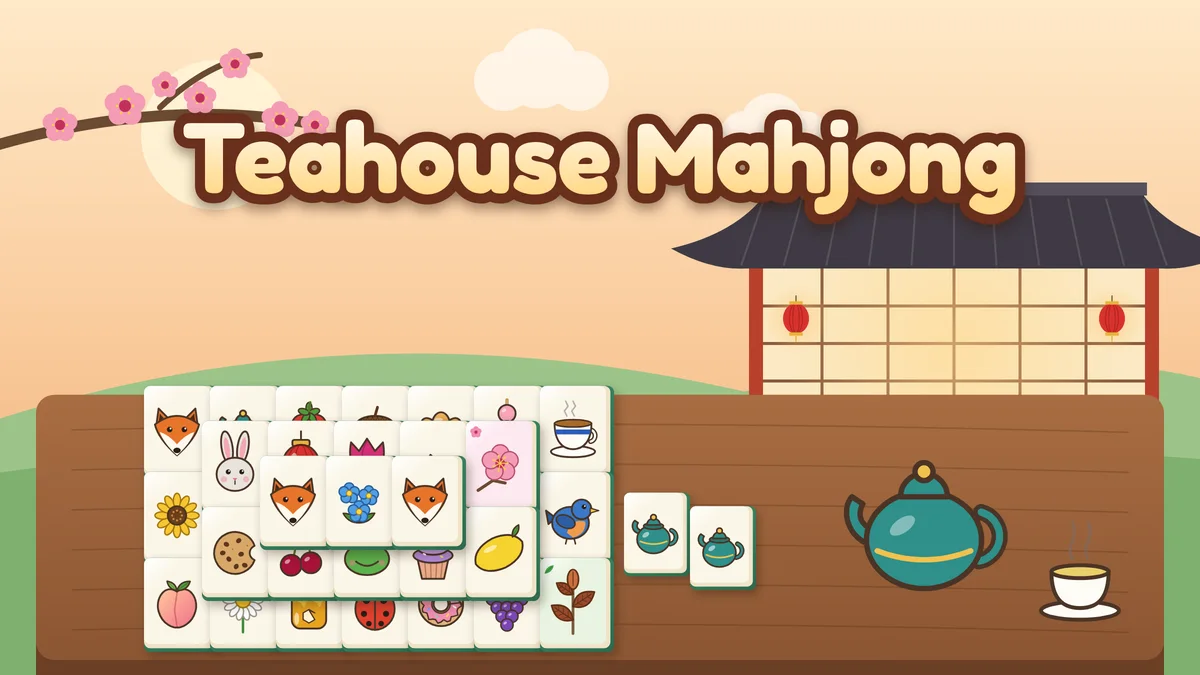
Which tiles are free
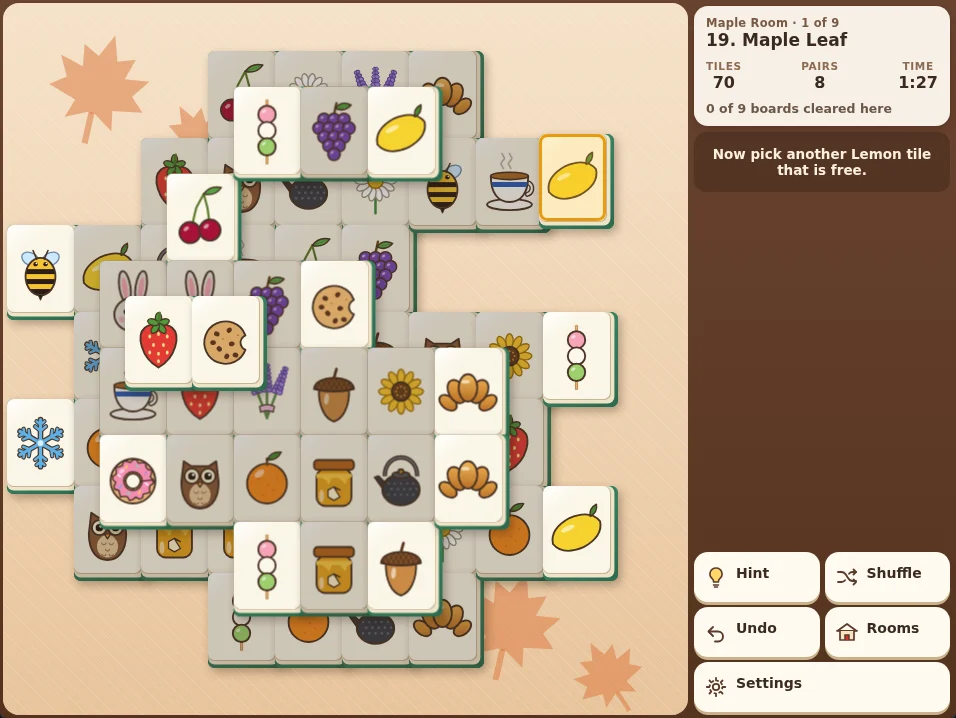
A tile is free when two things are true. First, no tile of the layer above lies on it, even partly: a tile resting half on it is enough to hold it down. Second, at least one of its sides, left or right, has no tile of its own layer touching it. A tile in the middle of a row is stuck until one of its neighbors is gone, and a tile at the end of a row is free as soon as nothing covers it. Tiles above and below in the same layer do not matter.
Some rows sit half a tile higher or lower than the row beside them. A tile there can touch two tiles on the same side, one a little above and one a little below, and that side stays blocked while either of them is still there. Tiles that are half a tile apart do not touch at all.
Tap or click a free tile to pick it up, then tap its match. With Highlight free tiles turned on (it starts on, in Settings), every tile you cannot take yet is gently dimmed. Tap a blocked tile anyway and it gives a small shake and tells you whether it is covered or blocked on both sides.
Matching tiles and the bonus groups
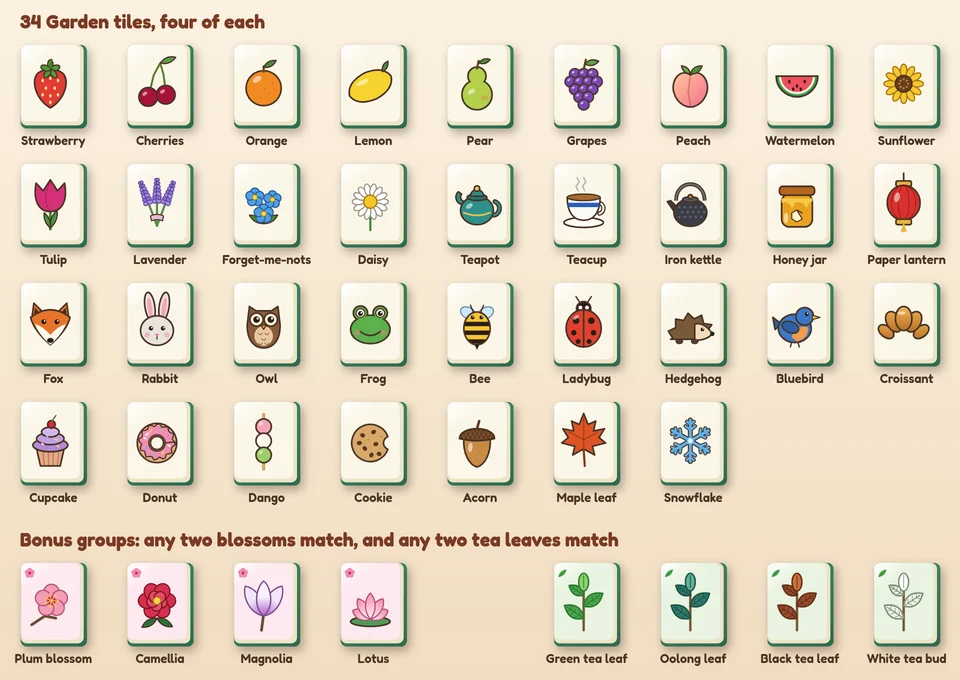
Most tiles come in fours: there are four identical tiles of each kind, so every tile has three twins. Any two of them make a pair. Smaller boards use fewer kinds, but always all four tiles of each kind they use, so nothing is ever left without a match.
Two groups are different. In the Garden set, the four blossoms (plum blossom, camellia, magnolia and lotus) all match each other, and so do the four tea leaves (green tea, oolong, black tea and a white tea bud). Their faces are tinted pink or green and carry a small blossom or leaf in the corner, so they are easy to spot. In the Classic set the same two groups are the flowers (plum, orchid, chrysanthemum and bamboo) and the seasons (spring, summer, autumn and winter), each drawn with a thin pink or blue frame and a number from 1 to 4.
How to plan a board
Every deal can be cleared: boards are built backwards from an empty table, placing matching pairs only where both tiles would be free. You can still take pairs in an order that leads to a dead end, so a little planning pays off.
Open the long rows first. A row only frees tiles from its ends, so the longest rows are the slowest to open up; start taking their end tiles early. Work on tall stacks early too. A tile under two or three layers takes the longest to reach, and the pairs you take from the top of a stack uncover new pictures.
Keep pairs that block each other in mind. If two tiles of a kind lie one on top of the other, the lower one can only leave with one of the other two, so do not use both of those elsewhere. The same goes for two twins at either end of a short row. When three tiles of a kind are free, take the two that free the most tiles and keep the third for the fourth.
Hints, shuffles and undo
All three helpers are free and unlimited. Hint (or the H key) outlines a free pair that matches. It works from a way to clear the whole board whenever it knows one: the order the deal was built with, kept up to date as you take pairs, or one it finds with a short search. If you follow hints from the start of a board, you never reach a dead end. Once your own choices have closed every way through, the hint shows the free pair that opens up the most tiles.
When no free pair is left, the game offers a Shuffle. It rearranges the tiles still on the board, keeping them in their places and only swapping pictures, so that the board can be cleared again. In the rare case where those places cannot be emptied in any order (for example a tile lying directly on its only match), the tiles settle into new places on the layout instead. Undo (U or Z) takes back one pair or one shuffle at a time, as many times as you like.
Use a hint when you have looked at the free tiles and cannot find a pair, when a board has gone quiet for a while, or to learn which picture is which. In simulations of 108 deals per room, a player taking random free pairs cleared 46% of Plum Blossom Room boards without a shuffle, and 16%, 3% and 0% in the three later rooms. Following every hint cleared all of them without one. These are scripted players, not people, but they show why planning matters more as the boards grow.
The four tea rooms
The path has 36 hand-designed boards in four rooms of nine, and they open one at a time. The Plum Blossom Room (spring) runs from the 36-tile Tea Tray to the 68-tile Plum Tree. The Lotus Pavilion (summer) goes from 64 to 96 tiles, the Maple Room (autumn) from 92 to 128, and the Snow Lantern Room (winter) from 116 to the two 144-tile boards at the end: the Snowy Pagoda and the Old Tortoise, a five-layer stack with a single tile on top. Every board fits inside 10 tile columns and 7 rows, so the tiles stay large on a phone.
Clearing the ninth board of a room earns its tea card: jasmine green tea, iced peach oolong, roasted hojicha and ginger black tea with honey. After the last board, a completion card opens free play, where any board can be played again with a new deal.
There is no countdown. The timer only records how long a board took, and it stops while the game is paused, while a menu is open and while the tab is hidden. Each finished board keeps its best time, and a small leaf marks a board you have cleared with no hints or shuffles. Undo does not cost the leaf.
Garden or Classic tiles
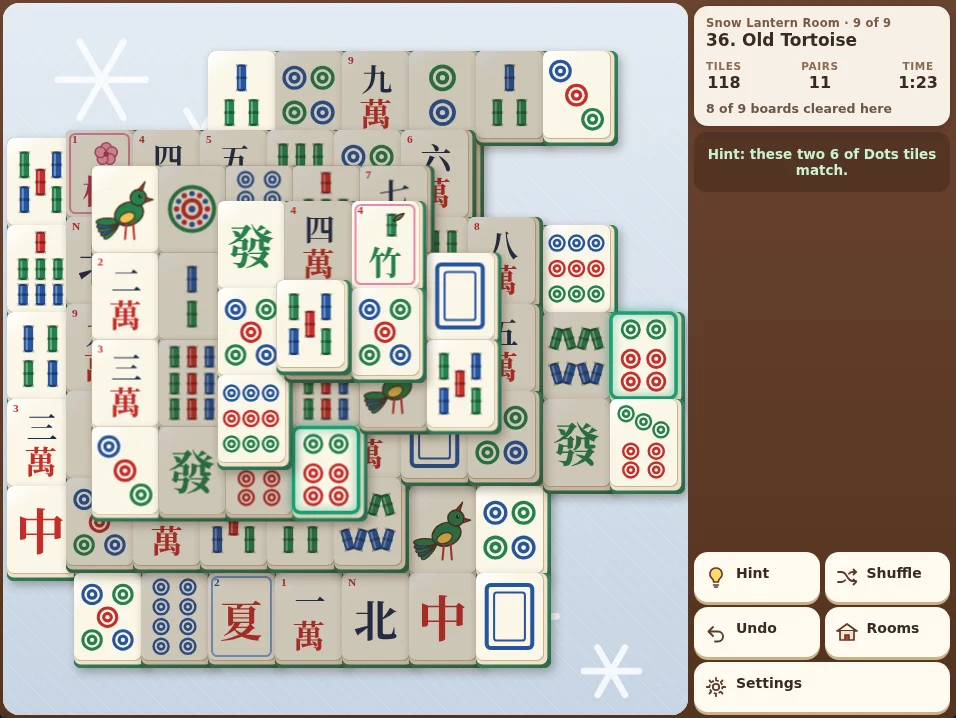
The two sets only change the pictures, and you can switch in Settings at any time, even in the middle of a board. The Garden tiles are drawn for this game: fruit, flowers, tea things, woodland animals, baked goods, an acorn, a maple leaf and a snowflake, each with its own color and shape so they stay easy to tell apart on a small screen. The Classic tiles are the traditional set of dots, bamboo and characters from 1 to 9, the four winds, three dragons, four flowers and four seasons, with large numerals and small corner numbers and letters for anyone still learning the characters.
Controls, saving and accessibility
Touch or mouse: tap or click a free tile, then its match; tap a picked tile again to put it down. Keyboard: the arrow keys move a visible cursor between free tiles, Enter or Space picks the tile under it, H shows a hint, S shuffles, U or Z undoes and Escape puts a tile down.
Your path, best times, leaves, tile set and highlight setting save on this device, along with the board in play, move by move, so a reload picks up exactly where you were. Restarting from the toolbar starts the current board again with the same deal and keeps everything else. We checked the game with automated desktop, phone and keyboard browser runs; these are not tests on physical devices or with real players.
Keep playing
Once all 36 boards are cleared, every board stays open for free play with a new deal each time, and your best times and leaves stay on the tea rooms map. If you like matching games, Toasty Tile Flip is a memory game where the tiles start face down, the opposite of mahjong solitaire, where every picture is in view.
- Play Teahouse Mahjong
- Teahouse Mahjong game page
- Toasty Tile Flip: match breakfast tiles in a memory game
More guides and roundups
Match mahjong tiles, solve sudoku, find hidden words, fit a jigsaw, sort shells or crack firefly codes. Choose a puzzle by the decisions it asks you to make.
Cozy Peaks Solitaire Guide: TriPeaks Streak TipsTriPeaks is a game of streaks. Here are the rules of Cozy Peaks Solitaire, how to look ahead and count what is buried, when to draw, and how orders, helpers and seasons work.
Best Cozy Memory Games to Play in 2026Want a calm matching game with chunky cards, readable icons, and no stressful fail state? Start with Toasty Tile Flip, then try these cozy memory games.
Rainy Day Jigsaw Guide: Edges, Sizes and HintsRainy Day Jigsaw is a calm jigsaw puzzle game with twelve illustrated pictures. Here is how to choose a size, build the border, sort the tray and complete the collection.