Cozy Classic
Free Spider Solitaire
Dewdrop Garden Solitaire
Classic Spider solitaire with big, easy-to-read cards, one, two or four suits, unlimited undo and no timer unless you want one.
What you do
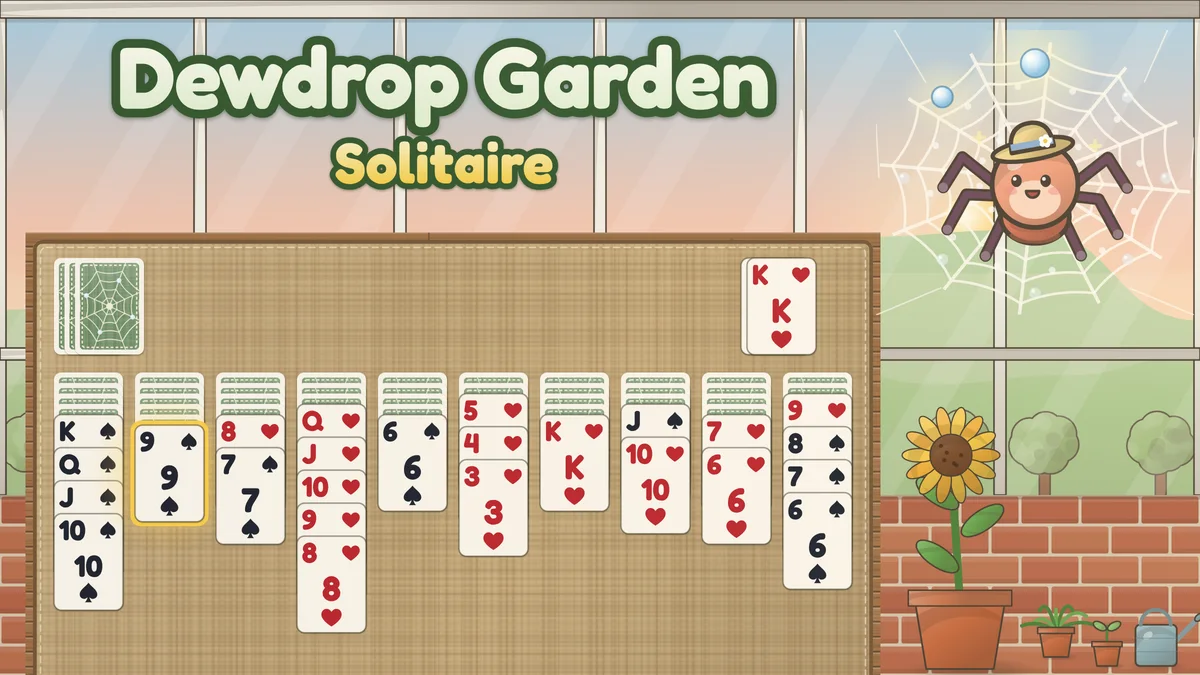
Dewdrop Garden Solitaire is Spider, the two-deck solitaire, laid out on a burlap cloth over a potting bench in a greenhouse at sunrise. Ten columns hold the 104 cards. Build down on any card one rank higher, gather each suit into a run from King down to Ace, and the finished run leaves the table; clear all eight runs to win. Thimble, a round little garden spider in a straw sun hat, keeps you company from her web above the cards. She hangs a shining dewdrop on it for every run you finish, cheers you on, and leans in to think when you ask for a hint.
- One suit (the default), two suits or four: the same 104-card Spider, from a gentle start to the traditional challenge.
- The traditional deal: ten more cards from the stock, one on every column, whenever no column is empty.
- Hints that use only what you can see, never a face-down card or the order of the stock.
- Long columns close up to fit the screen, keeping every covered card’s rank and suit in view up to 20 cards deep, even on a small phone.
- Unlimited undo, a move counter, an optional timer, and statistics for each number of suits, saved on this device with the deal in progress.
How to play
- Press Deal the cards. Two 52-card decks, 104 cards, are dealt into ten columns: the first four columns get six cards and the other six get five, 54 cards in all, with the top card of each column face up. The other 50 cards are the stock, enough for five deals of ten.
- Move a face-up card onto any card one rank higher, whatever its suit: a 7 goes on any 8. Nothing goes on an Ace, and a King can only go into an empty column. When the last face-up card leaves a column, the face-down card under it turns over by itself.
- Cards move together only as a run in one suit, in order: the 9, 8 and 7 of hearts move as one, but a 9 of hearts with an 8 of spades on it does not. Any card or run can go into an empty column.
- Tap the stock to deal one card face up onto every column. As in the traditional game, you can only deal when no column is empty. The one exception comes at the very end: with fewer than ten cards left on the table, the columns cannot all be filled, so the deal goes ahead.
- When a column ends in a full run of one suit from King down to Ace, those 13 cards leave the table. Clear all eight runs to win.
Controls
- Touch or mouse: drag a card, or a run in one suit, to where it goes, or tap it and then tap the place; the places it can go glow. Double-tap or double-click a card to send it, and the cards on it, to its best place. Tap the stock to deal. Undo, Hint and Menu sit on the tool tray below the cards, or beside them on a wide screen.
- Keyboard: the arrow keys move between the stock, the finished runs and the ten columns, and in a column Up and Down choose how many cards to pick up. Enter or Space picks up and puts down, 1 to 9 and 0 pick up from or drop onto a column, D deals, F sends the cards to their best place, U undoes, H shows a hint and Escape puts the cards back.
- Restart in the toolbar replays the same deal from the start. Menu starts a new deal, replays this one, changes the settings (one, two or four suits, and a timer) and shows your statistics. The toolbar also has pause, help, optional sound and fullscreen.
Tips worth knowing
- Turn over face-down cards first. Each one you free is a card you can use, so dig into the columns with the most hidden cards.
- Build in suit when you can. A 6 of hearts on a 7 of spades is a fine resting place, but only a 6 of hearts on a 7 of hearts can travel with it later.
- An empty column is the most useful space on the table: use it to sort out a mixed column, then fill it again before you deal.
- Make every useful move before you deal. A deal drops a card on every column, covering whatever you were about to free.
- A King can only move into an empty column, so a run that starts with a King at the top of a column never has to move again.
- Undo is unlimited and never changes your result, so try a line and take it back if it goes nowhere.
Accessibility
- Everything can be played with a keyboard: the arrow keys move a visible focus between the piles, Up and Down choose how many cards of a column to pick up, and Enter or Space picks up and puts down.
- Each pile is a button that reads out its cards: a column says how many cards are face down and names every face-up card, so the whole table can be followed with a screen reader.
- Nothing is timed unless you turn the timer on, and undo is unlimited.
- Every face-up card shows its rank and suit in its corner, and the last card of each column shows them large, red for hearts and diamonds and black for spades and clubs. The places a picked-up card can go glow.
- Reduced motion stops the dealing, flipping and sliding cards, the shakes and Thimble’s bobbing. Sound is optional and never needed to play.
Questions
Can every game of Spider solitaire be won?
Not every deal is known to be winnable, but most one-suit deals are. Our solver, which sees every card, the face-down ones and the stock included, proved 989 of 1,000 one-suit shuffles winnable, 700 of 1,000 two-suit shuffles and 47 of 1,000 four-suit shuffles, within the search it is given. It could not settle the rest either way, so the true share is higher, especially with four suits, where its search is far too small. Every deal here is an ordinary shuffle.
What is the difference between one, two and four suits?
The deal and the rules are the same; only the suits on the cards change. With one suit all 104 cards are spades, so every card you build on a card one higher is already part of a run. With two suits half the cards are spades and half hearts, and with four suits it is two ordinary decks, so runs only form when the suits match. One suit is the default and the best way to learn. Four suits is the traditional game and much the hardest.
Why can’t I deal when a column is empty?
That is the traditional Spider rule, used by the classic computer versions: every column must hold at least one card before ten more are dealt. Move any card or run into the empty column, then deal. Near the very end of a game, when fewer than ten cards are left on the table, the deal goes ahead anyway, because the columns cannot all be filled.
What does the game save?
Your settings, the deal in progress with every move, and your statistics for one, two and four suits (deals played and won, and your fewest moves), all in this browser’s local storage. There is no account.