
CozyWorld game guide · By CozyWorld
This guide covers our own game, written from the current game rules and browser checks.
How to Play Pyramid Solitaire: Setup and Rules
Pyramid is the quick solitaire of pairs: clear a pyramid of 28 cards by removing two free cards that add up to 13. Here is how to set up the pyramid and the stock, the card values and pairs, the rules for the waste and passes, how often a deal can be cleared, and the strategy, common mistakes and tips that clear more pyramids.
Pyramid solitaire is a quick game of simple sums. Twenty-eight cards are dealt face up in a pyramid of seven rows, and you take them away two at a time, pairing any two free cards whose values add up to 13. A King is worth 13 on its own, so it goes alone. The other 24 cards form a stock you turn one at a time for more cards to pair. Clear the whole pyramid and you win. A deal takes only a few minutes, but whether you get through often depends on which of two matching cards you choose to take.
This guide shows how to set up Pyramid with real cards, then covers the card values and the pairs that make 13, which cards are free, how the stock and waste work, the one-pass and three-pass rules, how often a deal can be cleared, the controls in Puffin Bluff Solitaire (CozyWorld’s free Pyramid game), beginner strategy, the most common mistakes and a few tips. The win figures come from our own solver and scripted players, which play through the game’s real rules.
How to set up a game of Pyramid solitaire
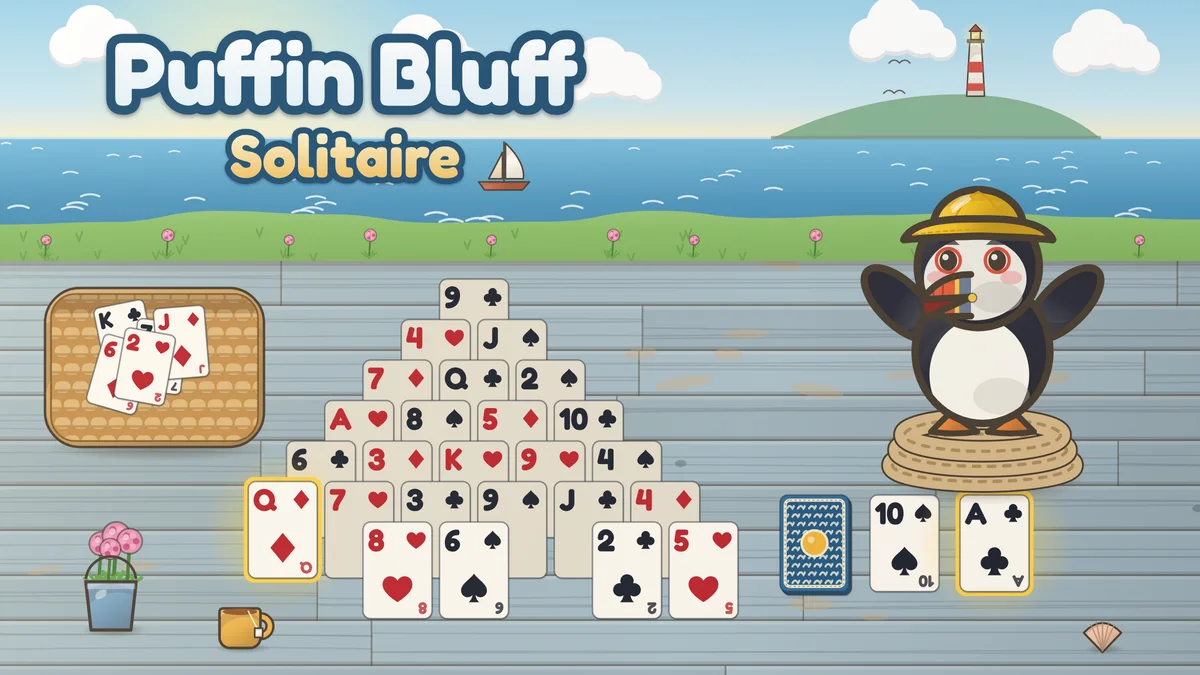
Pyramid uses one standard 52-card deck with the Jokers taken out. Shuffle, then deal 28 cards face up in seven rows to make a pyramid: one card at the top, two in the row under it, then three, and so on down to seven cards in the bottom row. Each row overlaps the row above, so every card except those in the bottom row is partly covered by the two cards just below it.
The other 24 cards are the stock. Put it face down below the pyramid, with room beside it for a waste pile. With real cards you draw the stock one card at a time; in Puffin Bluff Solitaire the top card of the stock is always turned face up, so there is always one stock card ready to pair.
In Puffin Bluff Solitaire the pyramid sits in the middle of the picnic table, the stock and waste lie side by side under it, and a woven tray beside the top of the pyramid collects the cards you remove. On a phone turned sideways, the stock and waste move to a strip on the right.
| Place | At the start | What happens to it |
|---|---|---|
| Pyramid, rows 1 to 7 | 1, 2, 3, 4, 5, 6 and 7 cards, face up (28 in all) | Cards are removed in pairs that make 13, or alone if a King |
| Stock | 24 cards, face down except its top card | Turned one card at a time onto the waste |
| Waste | Empty | Its top card can be paired; it is turned back over for each new pass |
| Removed cards | None | Out of the game for good |
Card values and the pairs that make 13
Every card has a value. An Ace is 1, the number cards count their pips, a Jack is 11, a Queen is 12 and a King is 13. Suits and colors never matter in Pyramid: the 6 of hearts pairs with any 7, red or black.
Two cards make a pair when their values add up to exactly 13. That gives six kinds of pair, plus the King, which makes 13 by itself and is removed alone. With four cards of each rank, every card has four possible partners in the deck.
| Card | Value | Pairs with |
|---|---|---|
| Ace | 1 | Queen (12) |
| 2 | 2 | Jack (11) |
| 3 | 3 | 10 |
| 4 | 4 | 9 |
| 5 | 5 | 8 |
| 6 | 6 | 7 |
| King | 13 | Nothing: a King is removed alone |
Pyramid rules and the goal
The goal is to remove all 28 cards of the pyramid. You may only use free cards. A pyramid card is free when no card covers it: at the start that is the seven cards of the bottom row, and a card higher up comes free once both cards lying on it are gone. The top card of the stock and the top card of the waste are free too.
Remove any two free cards that add up to 13, wherever they are: two pyramid cards, a pyramid card and the stock card, a pyramid card and the top of the waste, or the stock card and the top of the waste. Remove a free King on its own. Removed cards leave the game, and removing a pyramid card may free one or two cards in the row above.
A card can never pair with a card that covers it, even a few rows down, because it cannot be free while that card is still there. This matters most at the very top: the top card is covered, one way or another, by every other card in the pyramid, so it is always the last pyramid card to come free, and its partner has to come from the stock or the waste.
The stock, the waste and passes
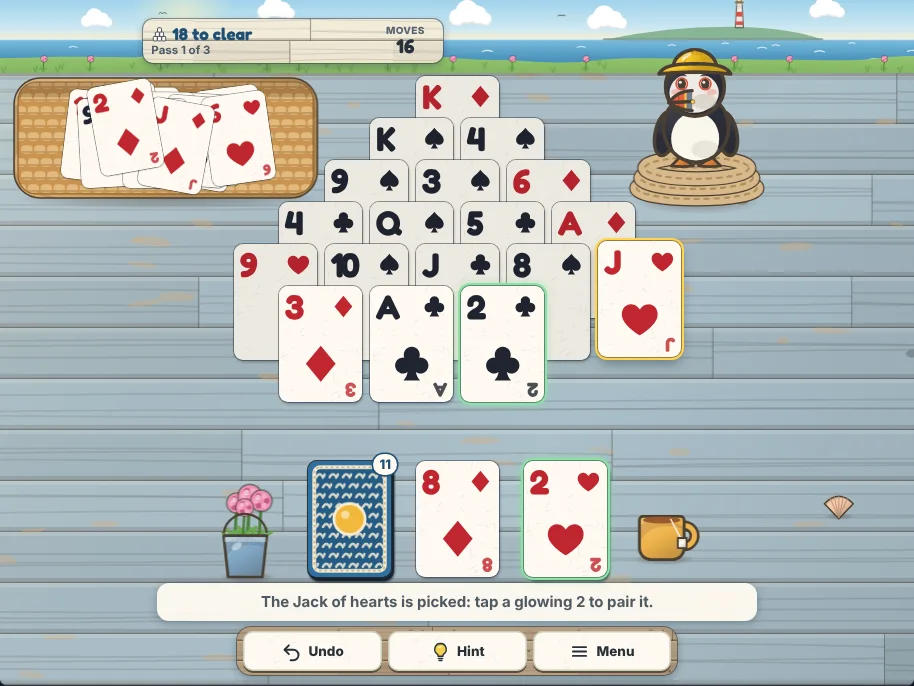
When no pair you want is free, turn the stock: the stock card moves onto the waste and the next stock card turns face up. The top of the waste and the new stock card can pair with each other or with pyramid cards. If you remove the top card of the waste, the card under it becomes the new top, so cards buried in the waste can come back into play.
When the stock runs out, the waste can be turned back over to make a new stock, in the same order, for another pass. How many passes you get is the rule that varies most. The traditional game gives a single pass, with no redeal at all, which makes it hard to win. Many computer versions allow three passes, meaning two redeals, and some allow as many as you like.
Puffin Bluff Solitaire offers all three in Settings: three passes, the default; one pass, the traditional rule; and unlimited passes, the most relaxed. A badge on the stock shows how many face-down cards are left, and the sign with the counters shows which pass you are on.
| Setting | Times through the stock | Redeals |
|---|---|---|
| Three passes (default) | 3 | 2 |
| One pass (traditional) | 1 | None |
| Unlimited passes | As many as you like | As many as you like |
When is the game won?
In most computer versions, Puffin Bluff Solitaire included, you win as soon as the last pyramid card is gone. Cards still in the stock and the waste do not matter.
Older rules, still found in some books, ask for more: you have to pair away the stock as well, so that every card in the deck is removed. That stricter rule is won far less often. If you play with real cards and want an extra challenge, keep going after the pyramid is clear and see how many stock cards you can pair away too.
How often can you win at Pyramid solitaire?
It depends on the passes. We checked 1,000 plain shuffles with our own solver, which sees every card, the order of the stock included, and either finds a way to clear the pyramid or proves there is none. With three passes it proved 671 deals can be cleared (67.1 percent), proved 312 cannot, and left 17 unsettled after a million search steps. With one pass it proved only 83 can be cleared (8.3 percent) and 917 cannot. With unlimited passes it proved 676 (67.6 percent), with 314 proven impossible and 10 unsettled. Extra passes past three barely help: the cards in the pyramid itself are what block most deals.
Because so many shuffles cannot be cleared, Puffin Bluff Solitaire deals winnable deals unless you choose any shuffle in Settings. Before a winnable deal is shown, the solver finds a way to clear it with your passes and replays that way through the game’s own rules. Today’s deal is a winnable three-pass deal too.
Winnable does not mean easy. In our tests on 200 winnable deals for each setting, a scripted player that followed the game’s own hint every move, which looks only at the cards a player can see, cleared 195 deals with three passes, all 200 with unlimited passes, but only 81 with one pass, where a wrong guess about the face-down stock cannot be put right on a later pass. A scripted player with simple habits did much worse: it took any free King, otherwise paired two pyramid cards, lowest in the pyramid first, otherwise paired a pyramid card with the stock card or the waste, otherwise paired the stock card with the waste, otherwise turned the stock. It cleared 86 of the 200 three-pass deals (43 percent), 94 with unlimited passes (47 percent) and 37 with one pass (18.5 percent). Choosing which pair to take is where Pyramid is won.
| Passes | Solver: shuffles it proved can be cleared | Hint player: winnable deals cleared | Simple player: winnable deals cleared |
|---|---|---|---|
| Three | 671 of 1,000 | 195 of 200 | 86 of 200 |
| One | 83 of 1,000 | 81 of 200 | 37 of 200 |
| Unlimited | 676 of 1,000 | 200 of 200 | 94 of 200 |
Controls in Puffin Bluff Solitaire
Tap a free King to remove it. To remove a pair, tap a free card, then tap a card that adds up to 13 with it; the cards it can pair with glow, and covered cards are shaded so the free ones stand out. You can also drag a card onto its partner, or a King onto the woven tray. Tap the face-down stock to turn a new card, and once it is empty, tap it again to turn the waste back over for the next pass. Undo, Hint and Menu sit on a wooden shelf below the table, or beside it on a wide screen.
On a keyboard, the arrow keys move between the pyramid cards, the stock and the waste. Enter or Space picks a card and pairs it, or removes a King, D turns the stock, U undoes, H shows a hint and Escape puts a picked card back.
Undo is unlimited. The hint never peeks at the face-down stock: it plans with the cards you can see and says when a move is only a best guess. Once you have seen every stock card, it can tell for sure whether a way through is left, and says so when there is none, so you know to undo. If no move at all can help, the game offers to undo, replay the deal or start a new one. The deal in progress, today’s deal and your statistics for each pass setting are saved on your device as you play.
Beginner strategy
Remove Kings as soon as they are free. A King needs no partner, so taking it away never costs you anything and may free the cards above it.
Look at what each pair frees. When you have a choice of pairs, prefer the one that uncovers cards, and above all the cards you have no other way to reach. Freeing two cards in the row above is worth more than taking a pair from the stock that frees nothing.
Choose your partner with care. When a free 6 could pair with a 7 from the pyramid or with the 7 on the waste, ask which 7 you will need later. A pyramid 7 that is the only way to free a buried card is worth keeping for that card; a stock 7 may be gone after the next turn.
Plan for the top card. The top of the pyramid always comes free last, so it must pair with a stock or waste card, or be a King. If the top card is a 4, keep an eye on the 9s and try not to use every one of them on other cards.
Common mistakes
Turning the stock before checking every pair. The stock card and the top of the waste can pair with each other, not only with pyramid cards. It is easy to miss a 5 on the waste and an 8 on the stock and turn one of them away.
Taking the first pair you see. With four cards of each rank, there are often two or three ways to pair a card. The one you take decides which partners are left for the cards still buried.
Forgetting that stacked cards cannot pair. A 3 and a 10 in the same slanting line down the pyramid, one covering the other, can never be removed together. Each needs a partner from somewhere else, so count those partners before you spend them.
Burying a card you need in the waste. Each turn of the stock covers the top of the waste. With one pass, a card turned under is gone unless you can dig back down to it by removing the cards on top of it, so pair what you can before you turn.
Clearing the easy side and ignoring the rest. Cards along the bottom edge come free quickly, but a pyramid is often lost in the middle, where each card is covered by two others. Work toward the cards that block the most.
Tips for clearing more pyramids
Count partners. There are four of each rank. If three Jacks are already gone and a 2 is still buried, the last Jack is the only card that can ever take it, so do not use it on another 2 that has other options.
Remember the stock order. When the waste is turned back over, the cards come round again in the same order, minus the ones you removed. On a second pass you know what is coming, so you can plan a pair a few turns ahead.
Use undo to explore. When two pairs look equally good, try one and undo if it leads nowhere. In Puffin Bluff Solitaire, undo is unlimited and the hint is always there to ask.
Try one pass when you are ready. The traditional rule turns every choice into a real decision. Winnable one-pass deals can still be cleared, but you have to think about the cards you cannot see yet.
Keep playing
Pyramid is a game of small choices: which 6 to take, when to turn the stock, and which partner to save for the card at the top. Take a breath before each pair, use undo freely, and try one pass when three feel easy. If you enjoy it, try Buttercup Links Golf Solitaire, our Golf game, where you clear seven columns one rank up or down at a time; Cozy Peaks Solitaire, our TriPeaks game, with its three peaks of overlapping cards; Porch Swing Solitaire, our Klondike game; or Snowberry Cabin Solitaire, our FreeCell game, where every card is face up from the start.
- Play Puffin Bluff Solitaire
- Puffin Bluff Solitaire: features, controls and FAQ
- Buttercup Links Golf Solitaire: nine holes of Golf solitaire
- Cozy Peaks Solitaire: TriPeaks with streaks and seasons
- Porch Swing Solitaire: Klondike on a porch at dusk
- How to play Golf solitaire: rules and strategy
- How to play Klondike solitaire: setup and rules
- How to play FreeCell solitaire: setup and rules
- More classic games: how to play mancala
More guides and roundups
Spider is the two-deck solitaire where you gather ten columns into runs from King down to Ace. Here is how to set up the 104-card deal, the rules for moving cards and dealing from the stock, one, two or four suits, how often a deal can be won, and the strategy, common mistakes and tips that win more deals.
Free Online Games for Seniors and Older AdultsFree online games for seniors and older adults: solitaire, mahjong, word search, sudoku, jigsaw and nonograms that open in a browser, with no countdown, no accounts and no purchases. Here is how the eight compare on round length, timers and help.
Cozy Peaks Solitaire Guide: TriPeaks Streak TipsTriPeaks is a game of streaks. Here are the rules of Cozy Peaks Solitaire, how to look ahead and count what is buried, when to draw, and how orders, helpers and seasons work.
Best Cozy Puzzle Games to Play in 2026Match mahjong tiles, solve sudoku and killer sudoku, stitch a nonogram, find hidden words, fit a jigsaw, rake leaf piles, sort shells, merge fruit or crack firefly codes. Choose a puzzle by the decisions it asks you to make.