
CozyWorld game guide · By CozyWorld
This guide covers our own game, written from the current game rules and browser checks.
How to Play Golf Solitaire: Rules and Strategy
Every card in Golf solitaire is face up from the deal, so each hole is a planning puzzle. Here are the rules, the King rule and the scoring, how to plan runs and count ranks, when to turn the stock, and how Golf differs from TriPeaks.
Golf solitaire, also called One Foundation, is a one-deck patience game scored like a round of golf. Seven columns of five cards lie face up, and you clear them onto a single waste pile, one rank up or down at a time. Each deal is a hole, the cards you could not clear are your strokes, and nine holes make a round. Because every card in the columns is visible from the start, Golf rewards planning more than most solitaire games: the stock is the only thing you cannot see.
This guide covers the standard rules, including the rule about Kings that varies between rule books, how a hole and a round are scored, how to plan runs, count the ranks still out and decide when to turn the stock, the common variants, and how Golf differs from TriPeaks. The numbers come from our own solver and scripted players in Buttercup Links Golf Solitaire, CozyWorld’s version of the game.
The rules of Golf solitaire
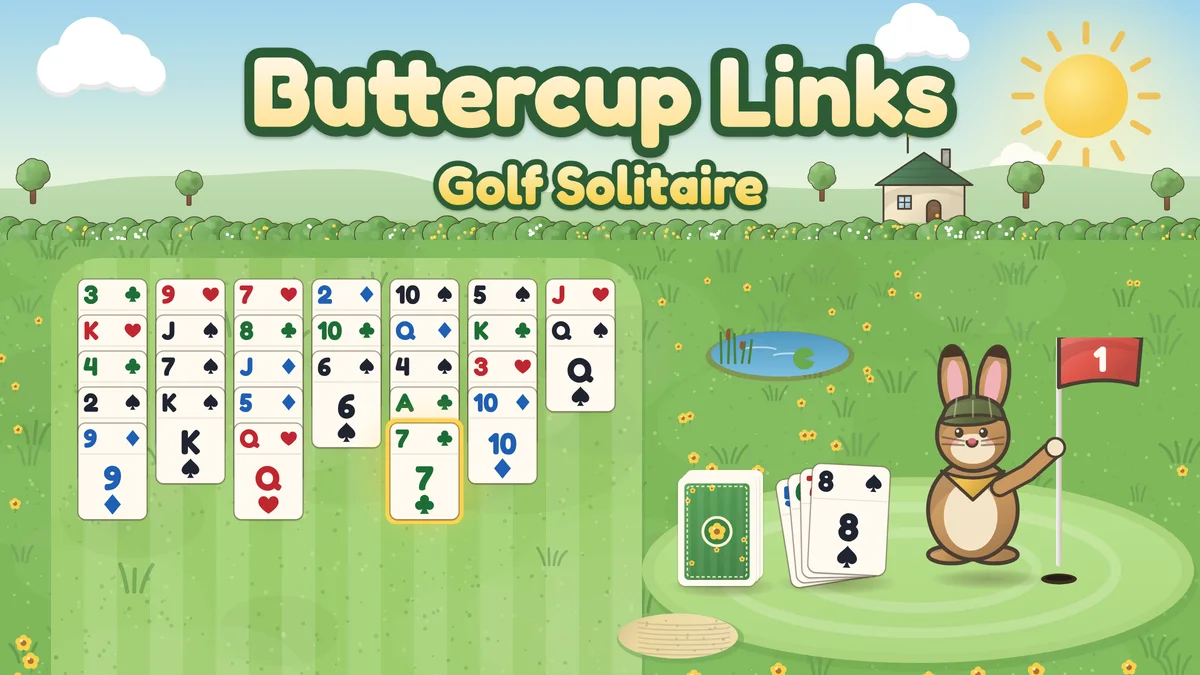
Golf uses one 52-card deck. Deal 35 cards face up in seven columns of five, each card overlapping the one above it so every rank and suit can be read. Turn one more card face up to start the waste pile (some books call it the foundation). The other 16 cards are the stock, face down.
Only the bottom card of each column, the one nearest you, is in play. You may move it onto the waste pile if it is exactly one rank higher or lower than the waste card, in any suit: a 7 plays on a 6 or an 8, and a Jack on a 10 or a Queen. The card you play becomes the new waste card, so one play can open the next, and a chain of plays is called a run. Playing a card uncovers the card above it in the same column.
Aces are low and Kings are high, and in the standard rules they do not connect: an Ace takes only a 2, and nothing at all may be played on a King. That last rule is the one that varies most between rule books (see the variants below). When nothing plays, turn the next stock card onto the waste pile and carry on. The stock goes through once, with no redeal. The hole ends when the columns are clear, or when the stock is empty and nothing plays.
Scoring a hole and a nine-hole round
Each deal is a hole. If the stock runs out with cards still in the columns, the hole scores one point for each of those cards: 7 cards left scores 7. If you clear the columns, the hole scores minus one for each card still in the stock, so clearing with 3 stock cards unturned scores minus 3. Lower is better, as in golf.
Nine holes make a round. The traditional par is 45, or 5 a hole, and a round of zero or lower is a very good one. In Buttercup Links the scorecard shows par and your score for every hole, the round total against par (such as 3 under or 12 over), and your best round for each rule set.
How hard is par? Our scripted player that follows the game’s hint, which sees only what you see, averaged 3.4 a hole on winnable deals, about 30 for a round, under the standard rules. On plain shuffles, where some deals cannot be cleared at all, the same player averaged 6.8 a hole, about 61 for a round. A player who simply played the first card that fit averaged 8.9 a hole on winnable deals. Even our solver, which knows the order of the stock, averaged only minus 1.8 a hole on winnable deals: on average its clears used just over 14 of the 16 stock cards.
How often can a deal be cleared?
Not often with a plain shuffle. We ran our solver on 1,000 shuffled deals for each rule set. It searches every line of play and is allowed to see the stock, so it finds a clear if any exists. Under the standard rules it cleared 269 of the 1,000 deals. With Queen on King it cleared 451, and around the corner (Ace and King connecting) it cleared 936. A player who cannot see the stock will clear fewer: the hint-following player cleared 5% of plain standard deals.
Buttercup Links deals winnable holes by default. Before a hole is dealt, the solver must find a way to clear it, or the game tries the next shuffle. That guarantees a clear exists. It does not make the hole easy, because the way through often depends on the stock order, which you cannot see. The hint-following player cleared 16% of winnable standard holes, and the first-card player under 1%. Plain shuffles are one setting away if you prefer the deal to fall as it may.
Plan the longest run
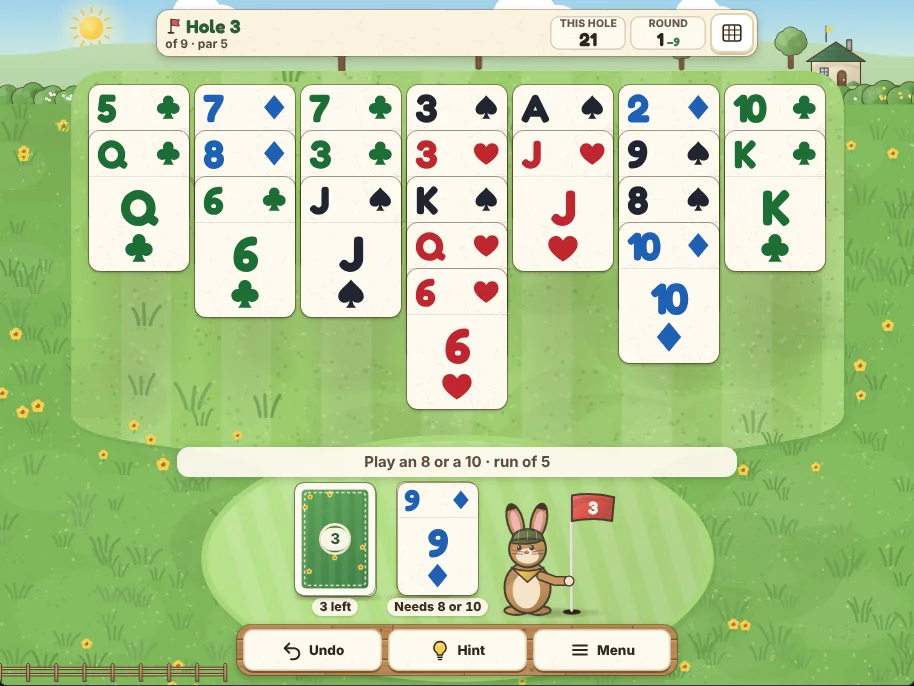
Since every column card is face up, you can trace runs before you play. Look at the waste card, find every bottom card that fits, and follow each one: if you play the 8, which bottom card or newly uncovered card fits on the 8, and what follows that? Play the card that starts the longest chain you can see, not the first one that fits.
Remember that each play uncovers a card. A 6 at the bottom of a column may sit on a 5 that extends your run, so count the cards you will uncover, not only the bottom row. In our tests this one habit was worth a lot: a scripted player that always played the longest run it could see averaged 6.7 a hole on winnable deals, against 8.9 for the player who took the first card that fit. Buttercup Links shows the longest run you can see on the message line, as in “run of 5”.
Work the tallest columns. A clear needs every column emptied, and a column of five keeps its top card buried longest. When two runs are the same length, prefer the one that takes cards from the tallest columns.
Count the ranks still out
There are four cards of each rank. Every card that is not in the columns or on the waste pile is in the stock, so you can work out exactly what the stock holds, just not its order. If three 8s are already in the waste pile or showing in the columns, only one 8 can come out of the stock to rescue a 7 or a 9.
Counting tells you which cards are in danger. Suppose a 4 sits in a column and all four 5s are already in the waste pile. That 4 can now go only onto a 3, so the next time a 3 is the waste card may be your last chance to play it. Counting also tells you when holding a card back is pointless, because the card it was waiting for has already gone. The game’s hint does this counting for you: it imagines many possible orders for the cards you have not seen and picks the move that does best across them.
When to turn the stock, and saving connector cards
Most of the time, turn the stock only when nothing plays. Every stock card you leave unturned is worth a stroke if you clear the columns, and every card you play is one less in the columns if you do not.
The exception is a connector: a card that links two groups. A 6 can join the 5s to the 7s, and spending it on a run of one can strand the cards around it. If the card that fits is your only link between two groups and playing it leads nowhere, it can be better to turn the stock and keep the connector for a card that is coming. Our hint-following player did exactly this about one time in ten when it had a card it could play.
Under the standard rules a King ends a run, because nothing plays on it, and an Ace can be followed only by a 2. Play a King when it is the last card you can reach before turning the stock, not in the middle of a run. Aces are worth playing when a 2 is waiting, since the 2 then reopens the run upward.
Variants: Queen on King and around the corner
Rule books disagree about Kings. The strict form, given by Wikipedia and Wikibooks with references to Parlett and to Hoyle’s Rules of Games, lets nothing play on a King and never connects Ace and King. Some versions let a Queen go on a King, and Solitaire Laboratory suggests that the ban on playing even a Queen on a King was a later, stricter addition. A third version turns the corner, so an Ace plays on a King and a King on an Ace; Wikipedia calls it Putt Putt.
The variants change the game a lot. On plain shuffles, our solver cleared 27% of standard deals, 45% with Queen on King and 94% around the corner, and the hint-following player cleared 5%, 9% and 40%. Buttercup Links uses the standard rules by default and offers both variants in Rules and deals, with a separate best round for each. Today’s hole always uses the standard rules, so everyone plays the same hole each day. Other variants you may meet add Jokers as wild cards or start with an empty waste pile.
How Golf differs from TriPeaks
Golf and TriPeaks are cousins. Both play cards one rank up or down, in any suit, onto a single waste pile, and both turn the stock when nothing fits. The differences change how they feel. In Golf all 35 column cards are face up from the start, so the puzzle is planning with full information about the layout. In TriPeaks 28 cards stand in three overlapping peaks, most of them face down, and each play may turn over a card you have never seen.
Golf’s stock is shorter (16 cards against 23) and is the only thing hidden, and Kings usually end a run, while TriPeaks usually wraps Aces and Kings. The scoring differs too: Golf counts the cards you leave over nine holes, while TriPeaks games usually score points for streaks. If you enjoy one, the other is a good next game, and our Cozy Peaks Solitaire guide covers TriPeaks streaks in the same way this guide covers Golf.
Playing Buttercup Links
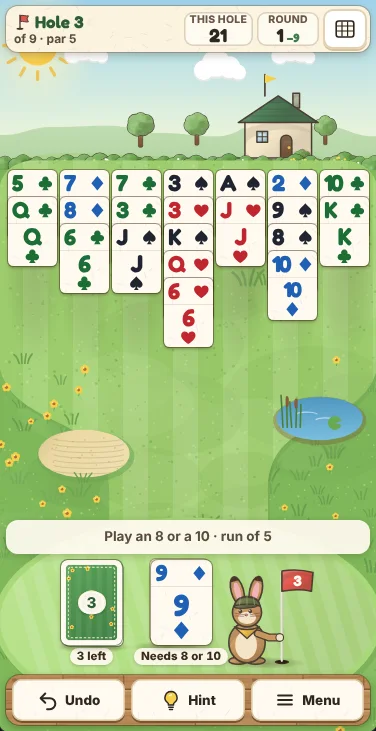
Tap a column to play its bottom card, and tap the stock to turn a card. On a keyboard, the arrow keys move between the columns and the stock, Enter or Space plays, the number keys 1 to 7 play a column, D turns the stock, U undoes, H shows a hint and N goes on once a hole is over. Undo is unlimited, and neither undos nor hints change your score. Willa the hare tends the flag, cheers a good run and keeps the hole number on her flag.
The game saves your settings, the round in progress with every move of the current hole, today’s hole and your best rounds on this device. We checked the game with automated desktop, phone and keyboard browser runs, and the numbers in this guide come from our solver and scripted players; these are not tests on physical devices or with real players.
Keep playing
Golf is quick to deal and slow to master, and a nine-hole round makes a good unit of play: long enough for a bad hole to be made up, short enough to finish over a cup of tea. If you like the run-building but want hidden cards to turn over, try Cozy Peaks Solitaire, our TriPeaks game, and its guide.
- Play Buttercup Links Golf Solitaire
- Buttercup Links Golf Solitaire: features, controls and FAQ
- Cozy Peaks Solitaire guide: TriPeaks streak tips
More guides and roundups
Free online games for seniors and older adults: solitaire, mahjong, word search, sudoku, jigsaw and nonograms that open in a browser, with no countdown, no accounts and no purchases. Here is how the seven compare on round length, timers and help.
How to Play Sudoku: Rules, Techniques and HintsHow to play sudoku, from the rules and a first puzzle to what easy, medium, hard and expert mean, plus every technique Sprout Sudoku uses and how its hints and garden work.
Leaf Pile Nap Guide: Rules, Shapes and HintsThe rules of Leaf Pile Nap, how the animal shapes and the no-touch rule let you solve every garden without guessing, and how blankets, acorns, stars, hints and the daily garden work.
How to Play Mahjong Solitaire: Rules and TipsHow to play mahjong solitaire, and how it differs from the four-player game. Free tiles, bonus tiles, planning a board, hints and the four tea rooms of Teahouse Mahjong.