
CozyWorld game guide · By CozyWorld
This guide covers our own game, written from the current game rules and browser checks.
Leaf Pile Nap Guide: Rules, Shapes and Hints
The rules of Leaf Pile Nap, how the animal shapes and the no-touch rule let you solve every garden without guessing, and how blankets, acorns, stars, hints and the daily garden work.
Leaf Pile Nap is our cozy take on Minesweeper. Animals are napping under some of the leaf piles in an autumn garden, and you rake every pile that is empty without waking anyone. The numbers work the way Minesweeper players expect, but there is a twist that changes how you think: you know exactly which animals are hiding and what shape each one curls up in, and no two animals ever touch. Every garden is checked by the game's solver to be clearable by logic alone, so you never have to guess. This guide covers the rules, the shapes, how to read the numbers, the no-touch rule, blankets, acorns, stars, hints and the gardens.
The rules
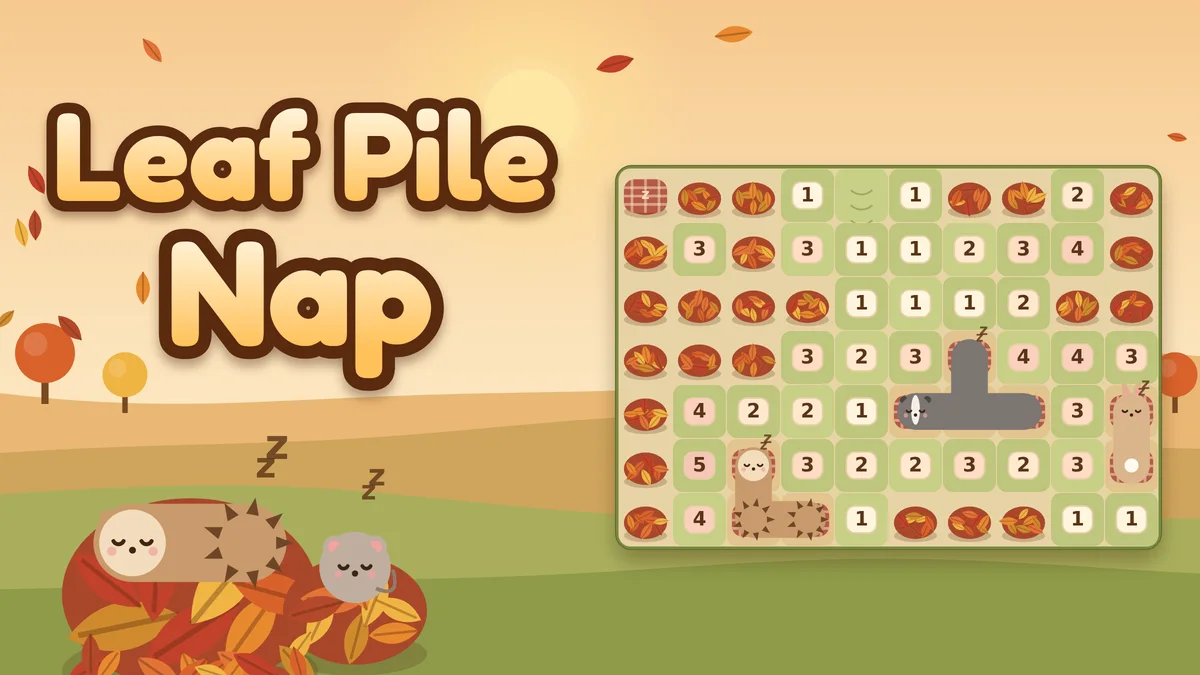
A garden is a grid of leaf piles, seven piles across. A few animals are asleep under them. Your job is to rake every pile that has no animal under it. A raked pile turns into a little patch of lawn with a number: how many animal tiles are in the eight piles around it, including the diagonals. A raked pile with no animals around it shows no number and opens all the empty piles next to it, so one lucky rake can clear a whole area.
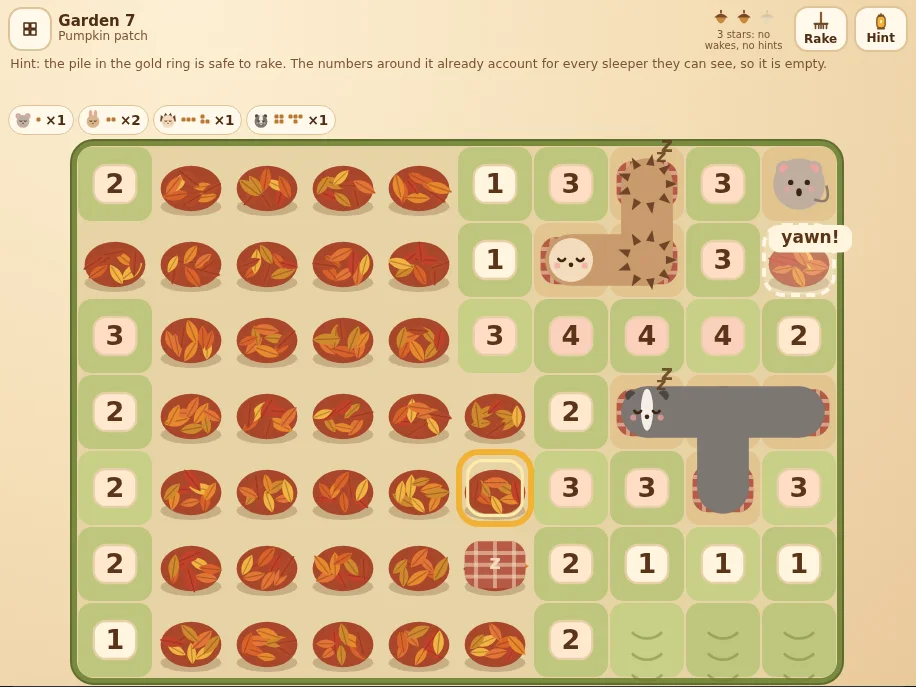
You always start with the glowing pile. It is always empty, and until you rake it the game will not let you rake anything else, lay a blanket or take a hint. In garden 1 the glowing pile opens a wide patch of lawn; in later gardens it opens a small area of at most nine piles, and the deduction starts right away. Rake every empty pile and the garden is done, with all the sleepers shown snoring.
The animals and their shapes
Four kinds of animal nap in the gardens, and each curls up in a known shape. A mouse fills one pile. A rabbit fills two piles in a straight line. A hedgehog fills three piles, either in a straight line or bent into an L. A badger fills four piles, either as a 2 by 2 square or as a T. Every shape can be turned or flipped any way. The chips under the header list the animals still hidden in this garden, with a small drawing of their shapes, so you always know exactly what is left to find.
The second rule matters just as much: no two animals ever touch, not even at a corner. Each animal has a ring of empty piles all the way around it. The moment you know where an animal is, you know that every pile around it is empty, and when an animal is found the game draws a dashed ring on those piles to remind you.
Reading the numbers
Start the way you would in Minesweeper. Look at a number and count the unraked piles around it. If the number equals that count, every one of those piles hides part of an animal. If the animals you already know about around a number add up to the number, every other pile around it is empty. These two checks, repeated across the garden, carry you a long way, especially early on.
Then look at numbers together. A 1 next to a 2 that share most of their piles often pins an animal tile to the one pile only the 2 can see. The total helps near the end: the chips tell you how many animal tiles are still hidden, so when the ones you have pinned down account for all of them, every remaining pile is empty, even piles far from any number.
Using the shapes and the no-touch rule
Here is where Leaf Pile Nap stops being plain Minesweeper. Suppose a number says one animal tile is somewhere in a short gap, and the only animal left is a rabbit. A rabbit needs two piles in a line, so the tile has to sit where a second pile fits beside it, and any pile in the gap that has no straight neighbor to pair with is empty. In the same way, a lone unraked pile with raked lawn all around it can never hide a badger, a hedgehog or a rabbit; if no mouse is left, it is empty.
The no-touch rule works from the other side. Once a number has pinned down a mouse, the piles around it cannot hold anything else, so the piles diagonal to it are empty even if no number says so directly. From garden 2 onward, every garden is generated so that part of the solve needs one of these two ideas, the shapes or the no-touch rule, not only the numbers. When you feel stuck, check the chips and ask which shapes could still fit.
Blankets and tucking in
Blankets are your notes. Lay one on a pile you know hides an animal: hold the pile on a phone or tablet, right-click it with a mouse, press M or F on the keyboard, or switch the Rake button to Mark so taps lay and lift blankets. A pile under a blanket cannot be raked by accident. Blankets never cost anything, and you can lift them whenever you change your mind.
When blankets cover an animal exactly, every one of its piles and nothing else, and every pile around it is raked, the animal is tucked in: it appears asleep under its blankets with a little snore, its chip counts it as found, and the dashed ring marks its neighbors as empty. A wrong set of blankets simply does nothing, so tucking in is also a quiet check that you read the shape right.
Acorns, wakes and stars
You start each garden with three acorns. Rake a pile with an animal under it and the animal wakes with a yawn, shows its whole shape and costs you an acorn, and play goes on. After the third wake everyone is awake and that try ends; Try again starts the same garden fresh. Waking animals never takes away a garden you have opened or a best result you have earned.
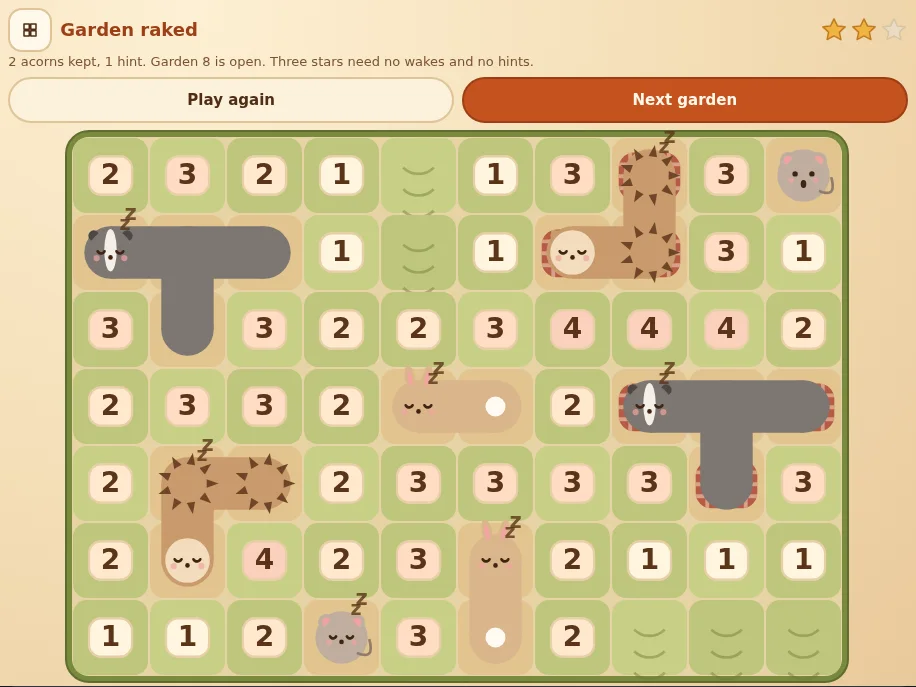
Raking a garden earns up to three stars: one for each acorn you kept, but using a hint caps the garden at two stars. Three stars means no wakes and no hints. The menu keeps your best result in every garden, and replaying a garden only ever improves it: more stars first, then more acorns kept, then fewer hints.
How hints work
Press Hint (or H) and the game finds a pile you can prove is empty from what you have raked and the animals that have woken, rings it in gold and says how it knows. The reason is one of four: counting around the numbers, the total number of animal tiles still hidden, the animal shapes, or the no-touch rule. The game always tries the simplest kind of reasoning first, and it prefers a pile near your last move.
Hints ignore your blankets, because a blanket might be wrong. Pressing Hint again before you rake the ringed pile just points at it again and costs nothing. Each new hint counts toward the garden's result, so a garden raked with hints earns at most two stars. In our automated checks, hints alone carried every generated garden from its glowing pile to the end without a guess.
Twelve gardens, endless gardens and today's garden
Garden 1, Little lawn, is a small 7 by 8 lawn with three mice and one rabbit, made for learning the rules. Hedgehogs arrive in garden 2 and badgers in garden 4, and from garden 7 the gardens are 7 by 10 with eight or nine sleepers. By our solver's count, garden 1 takes 2 deduction steps, gardens 2 to 5 take 6 to 8, and gardens 6 to 12 take 12 to 19. Each numbered garden is the same board every time you play it, so a replay is a fair try at three stars.
After garden 12, endless gardens keep coming at the top difficulty, each one new and each one checked to be solvable without guessing. They are generated in the background while you play, so the next one is usually ready the moment you want it; if not, a short Raking a new garden card shows while it is prepared. Today's garden is a 7 by 10 garden picked by your local date, the same for everyone that day. It keeps its own best result for the day and never changes your progress through the numbered gardens.
Saving, restart and accessibility
Your progress saves on this device: which gardens are open, your best result in each one, every garden in progress exactly as you left it (up to 16 at once), today's garden and your best result for the day. Restart in the toolbar starts the garden on screen over from its glowing pile and never touches your other gardens or your best results. If the browser does not allow saving, you can still play, and the game says that progress lasts only until you leave the page.
There is no timer anywhere. Everything can be played with a keyboard: the arrow keys or WASD move a cursor around the garden, Space or Enter rakes, M lays a blanket, T switches Rake and Mark, and H shows a hint, and a screen reader hears each pile as the cursor reaches it. Reduced motion turns off the flying leaves, pulsing glows and wiggles, and the game has no sound. We checked the game with automated desktop, phone and keyboard browser runs; these are not tests on physical devices or with real players.
Keep raking
Once the twelve gardens are raked, endless gardens keep coming, each one new and each one solvable without guessing, and today's garden brings a fresh board every day. If you enjoy this kind of careful deduction, Sprout Sudoku has 600 classic sudoku puzzles with hints that explain the next step, and Starlight Launch is a code-breaking game where colored clues tell you which digits are right.
More guides and roundups
Match mahjong tiles, solve sudoku, find hidden words, fit a jigsaw, rake leaf piles, sort shells or crack firefly codes. Choose a puzzle by the decisions it asks you to make.
Sprout Sudoku Guide: Rules, Techniques and HintsThe rules of sudoku, every technique Sprout Sudoku uses from Gentle to Expert, and how its hints, notes, garden and daily puzzle work.
Pasture Whistle Guide: Herding Rules, Par and TipsHow the whistle moves the flock, what the arrows mean, how pars, bells and the one hint per field work, and tips for penning every sheep in fewer whistles.
Rainy Day Jigsaw Guide: Edges, Sizes and HintsRainy Day Jigsaw is a calm jigsaw puzzle game with twelve illustrated pictures. Here is how to choose a size, build the border, sort the tray and complete the collection.