
CozyWorld game guide · By CozyWorld
This guide covers our own game, written from the current game rules and browser checks.
Pasture Whistle Guide: Herding Rules, Par and Tips
How the whistle moves the flock, what the arrows mean, how pars, bells and the one hint per field work, and tips for penning every sheep in fewer whistles.
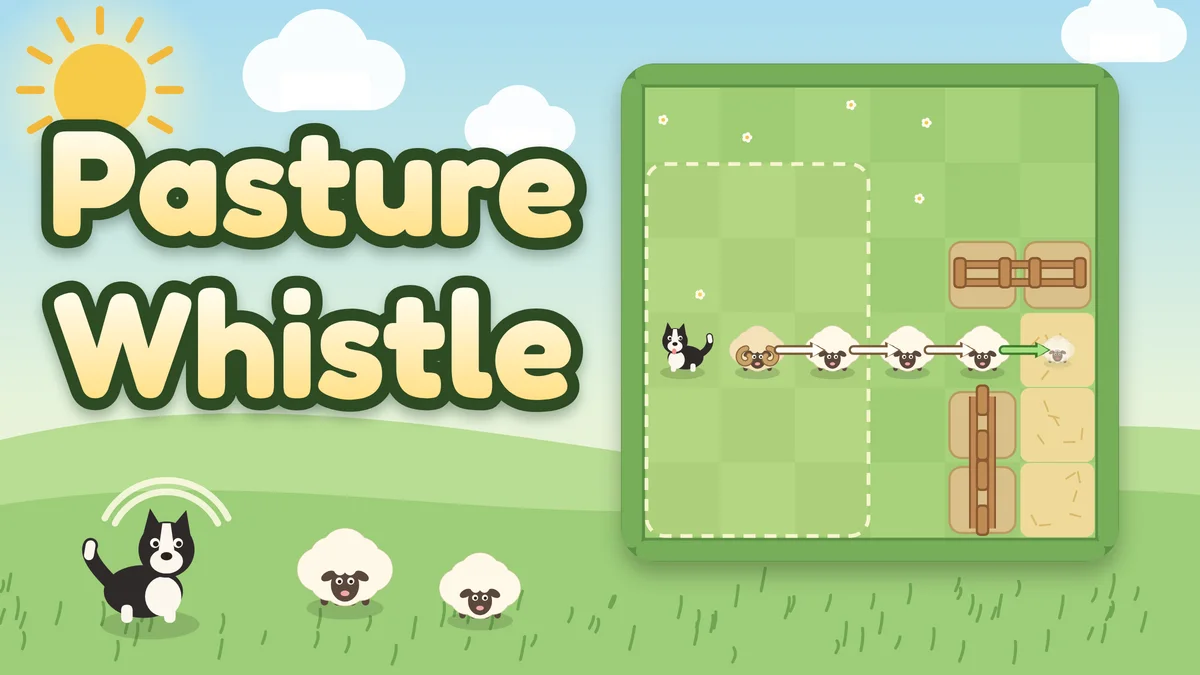
Pasture Whistle is our sheepdog herding puzzle. You walk Pip the sheepdog anywhere on open grass for free, and when he whistles, every sheep near him steps one tile away. The aim is to pen the whole flock in as few whistles as you can. There are 20 fields on the ladder, from a one-sheep tutorial to snug paddocks with a stubborn ram, and a new field every day. This guide covers exactly how the whistle moves sheep, how to read the arrows, how pars and bells work, and some tips for getting each field down to par.
How the whistle moves sheep
When Pip whistles, every sheep within two tiles of him, counting diagonals, takes one step straight away from him. The direction follows where the sheep stands: a sheep directly to his right steps right, a sheep up and to the left steps diagonally up and left, and a sheep two tiles down and one tile right steps diagonally down and right. Sheep three or more tiles away do not hear the whistle at all.
A sheep that steps into another sheep pushes it along, and a whole line of sheep moves together, even the ones too far away to hear. If the line would run into a fence, a hedge, a pond or the edge of the field, none of it moves. A diagonal step also cannot squeeze between two blocked tiles. A sheep that steps onto the hay is penned: it settles in and never moves or blocks anyone again. Pen every sheep to finish the field.
Walking is free
Tap or click any open grass and Pip walks there by the shortest way, going around fences, ponds, hedges and sheep. He never goes onto the hay. Walking never counts, so take as many steps as you like. Grass with diagonal stripes is grass Pip cannot get to right now, usually because sheep or fences wall it off. On a keyboard, the arrow keys or WASD walk him one tile at a time.
To whistle, press the Whistle button, press Space or tap Pip himself. Only whistles count toward your score, and a whistle that moves nothing is not counted: if no sheep is close enough, or every sheep that hears is pressed against something, the game tells you and the count stays the same.
Reading the arrows
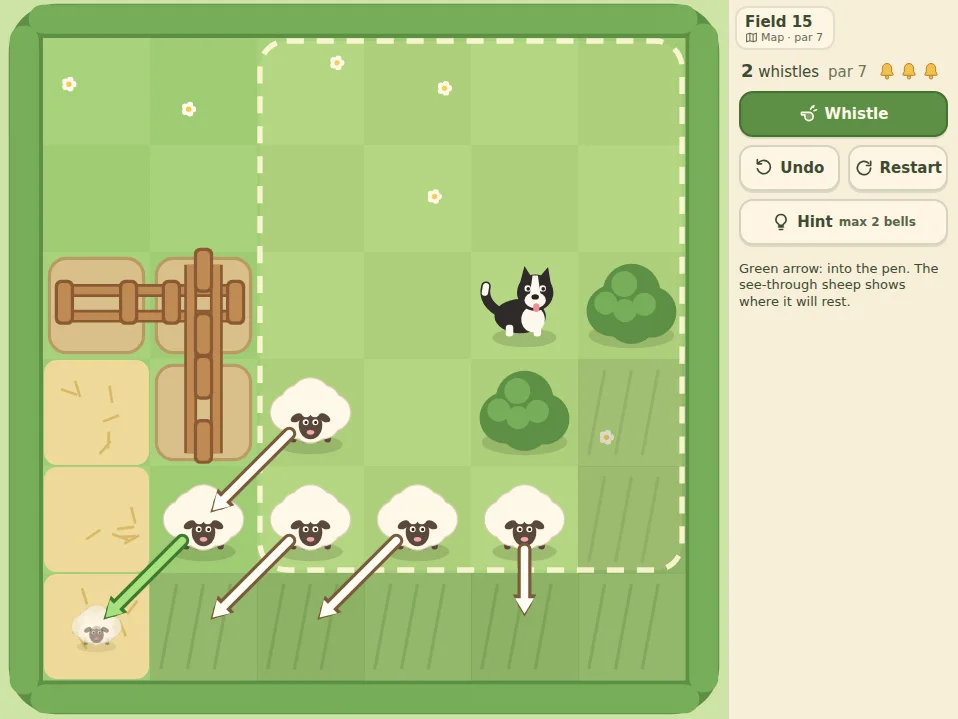
Before you whistle, the field shows exactly what will happen. A dashed frame marks the tiles within Pip’s reach, and an arrow on each sheep shows where it will end up. With a mouse, hover over any tile Pip can reach and the arrows show what a whistle from there would do, with a see-through Pip on that tile, so you can compare spots without walking.
A white arrow is an ordinary step. A green arrow goes into the pen, and a see-through sheep on the hay shows where it will rest. An amber arrow is a warning: that step would leave a sheep somewhere it can never be herded back to the pen, such as a corner with no room behind it for Pip. A sheep that hears the whistle but cannot move gets small bump marks instead of an arrow. The tip line spells out what a green or amber arrow means whenever one appears.
Pars and bells
Every field has a par: the fewest whistles that can pen its whole flock. Pars were found by a search that tries every possible whistle from every position, and our checks replay a shortest solution for every field and confirm that nothing shorter exists. Par climbs gently along the ladder, from 3 whistles on the tutorial to 9 on the last fields.
Pen the flock in par for three bells, within two whistles of par for two, and in any number of whistles for one. The bells in the corner show how many are still possible as you play. The meadow map keeps your most bells and fewest whistles for each field, so replaying a field can only improve your record, out of 60 bells across the ladder.
The ram
From field 9 a curly-horned ram joins the flock, and the game introduces him with a short card the first time. He only steps when Pip stands right beside him, above, below or to one side, never on a corner and never from two tiles away. Other sheep cannot shove him: a line of sheep that runs into the ram stops dead, just as it would at a fence.
The ram can push, though. When he steps into a sheep, he shoves it along like any other line. Many of the later fields come down to clearing a path, getting Pip beside the ram on the right side, and letting him drive the sheep ahead of him into the hay.
Undo, hints and wedged flocks
Undo is free and unlimited, and the whistle count goes back down too, so trying an idea costs nothing. Restart puts the whole field back to its start.
Each field has one hint. Press Hint (or H) and a tile glows where Pip should stand and whistle next, on a shortest route from the position on screen. It is a nudge, not a full solution. Using it caps that field at two bells, and it stays spent if you undo, restart or leave, until you pen the field. After each whistle the game also checks whether the flock can still be finished. If the check finds that it cannot, the sheep wobble and a note says how many whistles to undo to get back on track, without spending the hint.
The meadow map and today’s field
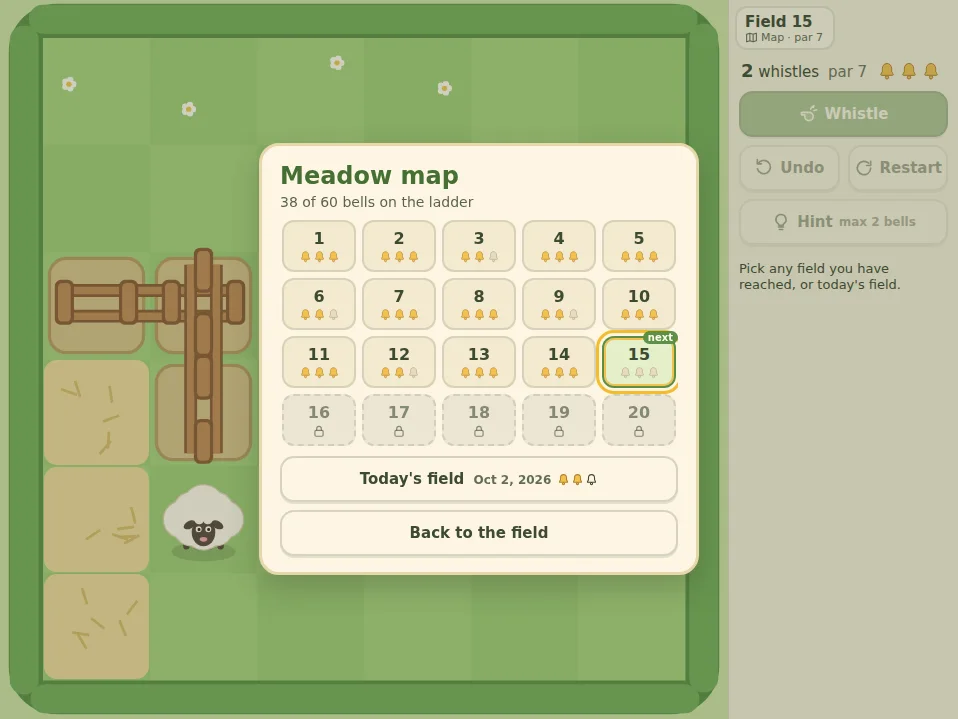
Tap the field name in the top corner, or press M, to open the meadow map. It shows all 20 ladder fields with the bells you have earned, marks the next field, and locks the fields you have not reached yet. Each field you pen opens the next one, and you can replay any open field.
Today’s field is a new field every day, picked by your local date from a pool of 150, so everyone playing on the same date gets the same field. It has its own par and keeps your best result for the day. There is no streak to keep, and a field left unfinished is cleared when the date changes.
Tips for fewer whistles
Get behind the flock. A sheep steps straight away from Pip, so stand on the far side of it from the pen and every whistle sends it toward the hay. Use the diagonals: standing off to one side moves a sheep diagonally, which covers ground on two axes at once.
Line sheep up and push them as one. A single whistle can move a whole row, and the front sheep can step into the pen while the rest follow. Use fences and the field edge as brakes: a sheep pressed against one stays put, so you can move its neighbors without disturbing it. Keep sheep out of corners and tight spots along the edge, and if an arrow turns amber, walk somewhere else before you whistle.
Since walking is free, look at the arrows from a few spots before every whistle. On the ram fields, deal with the plain sheep around him first, so that when Pip gets beside the ram his push carries sheep toward the hay instead of into a fence.
Saving, controls and accessibility
Pasture Whistle saves on this device: which ladder fields are open, your fewest whistles and most bells on each, your record on today’s field, and every field you have started but not penned, whistle by whistle, so the position and its undo history come back after a reload. Restart in the toolbar starts the field on screen over and never touches your bells, records or open fields. If your browser blocks saving, you can still play, and the game says your progress lasts only until you leave the page.
Keyboard: arrow keys or WASD walk, Space or Enter whistles, U, Z or Backspace undoes, H asks for the hint, R restarts the field and M opens the map. There is no timer and no move limit. Each whistle is announced to screen readers, and reduced motion makes walking and every step near instant. We checked the game with automated desktop, phone and keyboard browser runs; these are not tests on physical devices or with real players.
Keep herding
Once the ladder is done, today’s field brings a fresh paddock every day with its own par, and any field you have reached can be replayed from the meadow map for a third bell. If you like puzzles with a par to beat and free undo, Book Nook Shuffle turns four books at a time to sort a little library.
- Play Pasture Whistle
- More cozy puzzle games
- Book Nook Shuffle: sort a library with a par for each bookcase
More guides and roundups
Match mahjong tiles, solve sudoku, find hidden words, fit a jigsaw, rake leaf piles, sort shells or crack firefly codes. Choose a puzzle by the decisions it asks you to make.
Rainy Day Jigsaw Guide: Edges, Sizes and HintsRainy Day Jigsaw is a calm jigsaw puzzle game with twelve illustrated pictures. Here is how to choose a size, build the border, sort the tray and complete the collection.
Book Nook Shuffle Guide: Sort in Fewer TurnsFour books move together. The interesting part is deciding which shelf can get a little messier before the whole bookcase comes right.
Best Cozy Sorting Games to Play in 2026Want a calm sorting puzzle with tactile pieces, matching sets, and satisfying tidy-up moments? Start with Shell Sort Cove, then try these cozy sorting games.