
CozyWorld game guide · By CozyWorld
This guide covers our own game, written from the current game rules and browser checks.
Book Nook Shuffle Guide: Sort in Fewer Turns
Four books move together. The interesting part is deciding which shelf can get a little messier before the whole bookcase comes right.
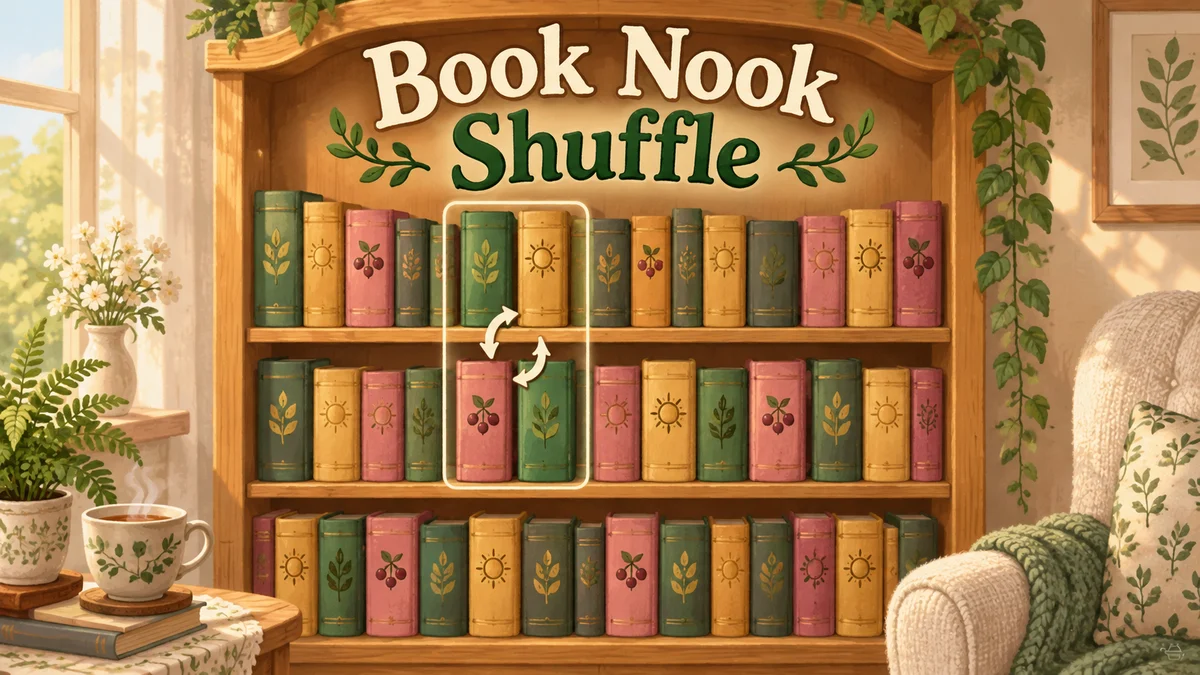
Book Nook Shuffle is our small bookshelf sorting puzzle. Turn a two-by-two group of books until every book stands on the shelf that shows its symbol. Each turn moves four books together, you cannot lift a single book, and a finished shelf does not lock. The library has 36 short puzzles in four rooms, and each room brings in a new idea or two.
Your first turn
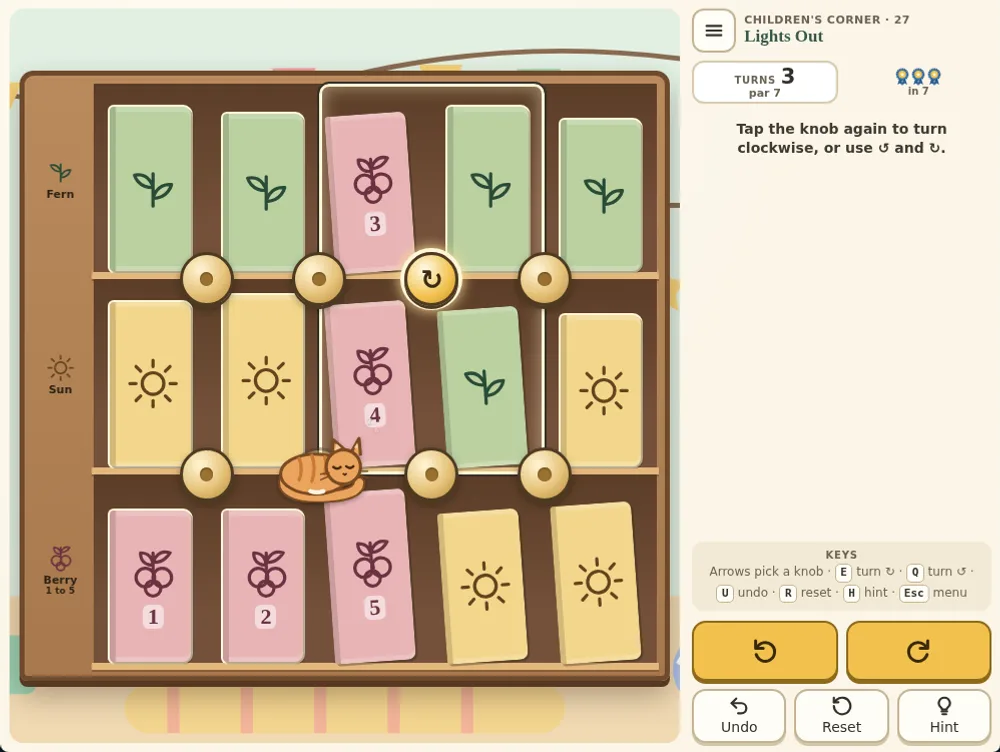
Round brass knobs sit on the bookcase wherever four books meet. Tap a knob to pick those four books; an outline shows exactly which ones will move. Picking a knob is free. Tap the same knob again, or the ↻ button, to turn the four books clockwise, or use ↺ to turn them counterclockwise. The books stay upright and trade places around the square.
Each shelf is labeled with a symbol: Fern on top, then Sun, then Berry, and in the taller bookcases a Moon shelf at the bottom. Books on the wrong shelf lean a little; books at home stand straight, and a finished shelf lights up along its edge. The symbols carry the same information as the colors.
Follow all four books around the square
The first puzzle is a single turn. Its top shelf is already done. The middle shelf reads Sun, Sun, Berry, Sun and the bottom shelf reads Berry, Sun, Berry, Berry. Pick the knob between the second and third books of those two shelves. Its square holds Sun at top left, Berry at top right, Berry at bottom right and Sun at bottom left.
A clockwise turn sends the top left Sun to the top right, the top right Berry to the bottom right, the bottom right Berry to the bottom left and the bottom left Sun to the top left. The middle shelf becomes four Sun books, the bottom shelf four Berry books, and the bookcase is finished in one turn.
Undo puts the last turn back and takes it off your count, so experimenting is free. Reset returns the whole bookcase to its start. If all four books in a square already match, turning it changes nothing and does not count.
Four rooms, one idea at a time
The Reading Nook teaches the basics on three short shelves, including turning the other way and borrowing from a finished shelf. The Attic Stacks bring longer shelves with more knobs, a fourth Moon shelf, and brass clasps: a clasped book never moves, so turning a knob beside it moves only the other three books, and one of them hops over the clasp.
The Children’s Corner adds numbered picture books, which must stand in order with 1 on the left, and Biscuit the cat. Biscuit naps on a knob, and that knob will not turn. When a turn moves any book under her, she wakes up and curls up on the knob you just turned. The Rare Books Vault adds heavy tomes, marked with a brass ↺ badge: a square holding one only turns counterclockwise. Its last puzzles combine everything.
Solving a puzzle opens the next two, so one stubborn bookcase never blocks the library. The room map shows every puzzle with its ribbons, and you can replay any open puzzle.
Par, ribbons and hints
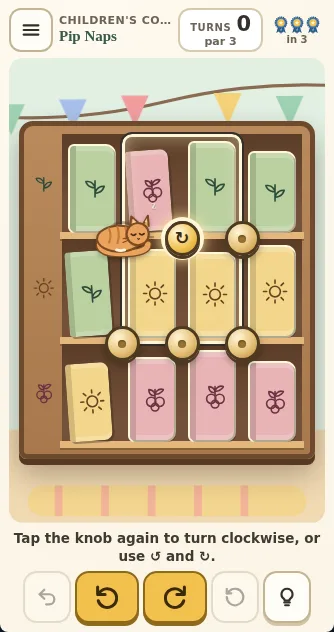
Every puzzle has a par: the fewest turns that can finish it, found by a program that checks every possible sequence of turns. Pars run from 1 turn in the first puzzles to 8 in the last. Finish at par for three ribbons, within three turns of par for two, and in any number of turns for one. There is no turn limit, and only the turns left on the board count, so undoing a wrong idea costs nothing.
For example, finishing a five-turn puzzle in seven turns earns two ribbons; nine turns earns one. Your best turn count and most ribbons are kept for each puzzle.
Hint picks the next turn of a shortest solution from wherever you are and lights up the right direction. A hint caps that puzzle at two ribbons for the visit, so it is a way through, not a shortcut to a perfect score.
Five useful ways to plan
1. Trace the whole square. Before turning, name where each of the four books will land. One good landing can hide three unhelpful ones.
2. Compare both directions. One counterclockwise turn does the work of three clockwise turns, and the two directions often lead somewhere quite different.
3. Do not chase the count. Always making the turn that puts the most books home right away is a poor plan here: in our rule checks, a program that plays that way finishes over par, or not at all, on 25 of the 27 puzzles after the Reading Nook. A finished shelf often has to lend a book and take it back.
4. Park Biscuit where she cannot hurt. Since she moves to the knob you turn next to her, a turn near her decides where she sleeps next. Leave her on a knob you no longer need.
5. Plan around clasps and heavy tomes first. Around a clasp only three books move. A heavy tome forces counterclockwise turns, so work out early which squares it has to pass through.
Controls, breaks, and what is saved
Tap or click a knob and the turn buttons on a phone, tablet or computer; Undo, Reset and Hint sit beside them. On a keyboard, the arrow keys pick a knob, E turns clockwise, Q turns counterclockwise, U undoes, R resets, H gives a hint and Escape opens the puzzle menu. The shared toolbar has instructions, pause, sound, restart and fullscreen. Reduced-motion settings turn off the turn arcs and room animations.
Your ribbons, best turns and open puzzles are saved in this browser on this device. A puzzle in progress is not saved, so leaving the page starts that puzzle over; puzzles are short. There is no clock, failure screen or turn cap, and you can pause whenever you like.
Another bookcase, or another kind of sorting?
Each puzzle takes a minute or a few, and the room map keeps your ribbons, so it is easy to come back for one more bookcase or to chase the last ribbon on an old one. When a puzzle feels stuck, undo back to a calmer moment rather than turning faster.
- Shell Sort Cove: move top shells between matching trays
- Parcel Post: pack fixed parcel shapes into a delivery van
- More cozy organizer and sorting games and how their rules differ
More guides and roundups
Match mahjong tiles, solve sudoku and killer sudoku, stitch a nonogram, find hidden words, fit a jigsaw, rake leaf piles, sort shells, merge fruit or crack firefly codes. Choose a puzzle by the decisions it asks you to make.
Free Online Games for Seniors and Older AdultsFree online games for seniors and older adults: solitaire, mahjong, word search, sudoku, jigsaw and nonograms that open in a browser, with no countdown, no accounts and no purchases. Here is how the eight compare on round length, timers and help.
Rainy Day Jigsaw Guide: Edges, Sizes and HintsRainy Day Jigsaw is a calm jigsaw puzzle game with twelve illustrated pictures. Here is how to choose a size, build the border, sort the tray and complete the collection.
Pasture Whistle Guide: Herding Rules, Par and TipsHow the whistle moves the flock, what the arrows mean, how pars, bells and the one hint per field work, and tips for penning every sheep in fewer whistles.