
CozyWorld game guide · By CozyWorld
This guide covers our own game, written from the current game rules and browser checks.
Sprout Sudoku Guide: Rules, Techniques and Hints
The rules of sudoku, every technique Sprout Sudoku uses from Gentle to Expert, and how its hints, notes, garden and daily puzzle work.
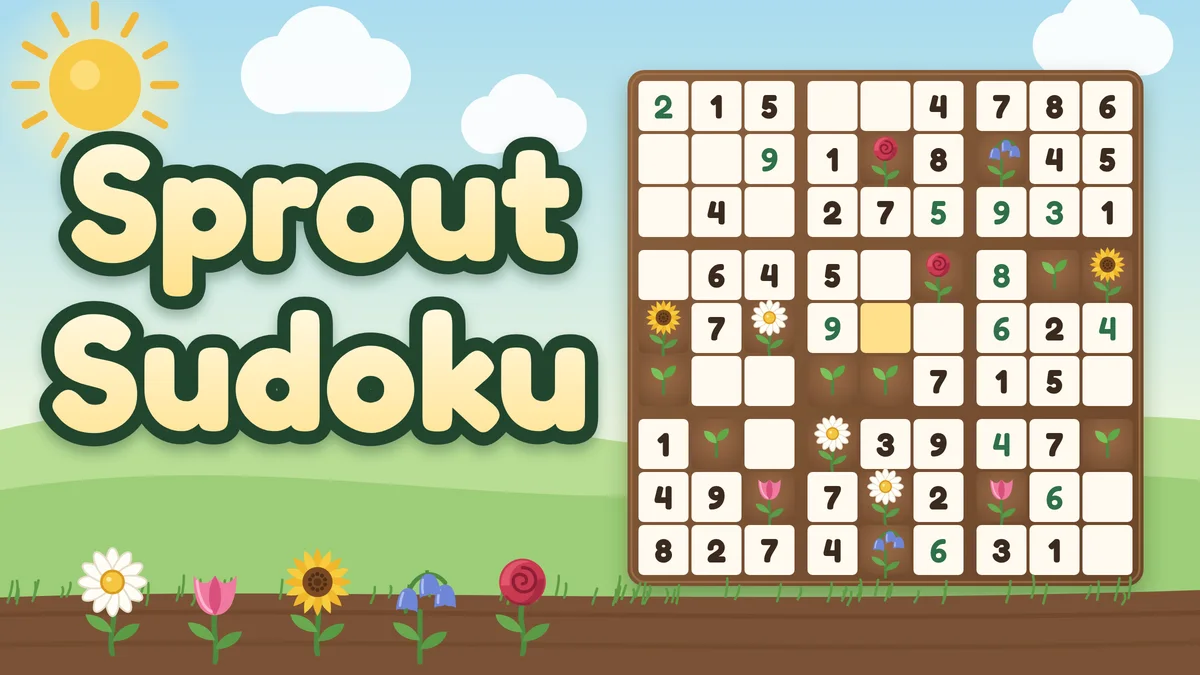
Sprout Sudoku is our cozy sudoku game: the classic 9x9 puzzle with real digits, set in a calm garden. It has 600 puzzles, 120 at each of five difficulties, and every one has exactly one solution that you can reach by logic alone. The difficulty tells you which techniques you will need, and the Hint button explains the next step in plain words instead of just filling a cell. This guide covers the rules, each technique in the order the difficulties introduce them, how hints and notes work, and how your garden grows.
The rules
Fill the 9x9 grid so that every row, every column and every 3x3 box holds the digits 1 to 9 exactly once. The dark digits at the start are the puzzle’s own and cannot change. Everything else is yours to fill. Because each digit appears once per row, column and box, every digit you place rules that digit out of 20 other cells: the rest of its row, its column and its box. Those 20 cells are what sudoku players call the cell’s peers.
Sprout Sudoku always marks a digit that repeats in its row, column or box, with a soft red tint and a wavy underline, because that breaks the rules whatever the solution is. It does not tell you when a digit is merely wrong unless you ask: turn on Check against the solution in the menu and any digit that does not match the solution turns red with a small dot. The check is off by default, so you can make your own mistakes and find them.
Placing digits, notes and undo
Select a cell with a tap, a click or the arrow keys, then press a digit on the number pad or on your keyboard. The selected cell’s row, column and box are shaded, and every cell with the same digit is highlighted, which makes it easy to see where a digit can still go. The small number in the corner of each key shows how many of that digit are left to place, and a check mark means all nine are down.
Notes are the small pencil marks for candidates. Press Notes (or N) and digits go in as notes instead; press it again to switch back, or hold Shift with a digit key to write a single note. When you place a digit, it disappears from the notes in its row, column and box, so your notes stay honest. Auto fills every empty cell with its candidates, the digits not already in its row, column or box. Erase (Backspace, Delete or 0) clears a digit, then the notes. Undo (Z) and Redo (Y) step back and forward through every change, and a placement that also cleared notes undoes as a single step.
Gentle and Easy: singles
Gentle puzzles have 36 or 37 givens and need only naked singles: a cell whose row, column and box already hold eight different digits can only be the ninth. Scan for crowded cells, and each digit you place makes its neighbors more crowded.
Easy puzzles have 30 to 34 givens and need hidden singles as well: look at one row, column or box and ask where a digit it still needs can go. When every cell but one is ruled out, that is the place, even if the cell itself could hold other digits. A typical Sprout Sudoku hint for this reads: The top-middle box needs a 7, and row 3, column 5 is the only place in that box where a 7 fits. Sweeping each box for each missing digit is the fastest way to solve Easy puzzles.
Medium: pairs, pointing and box-line reduction
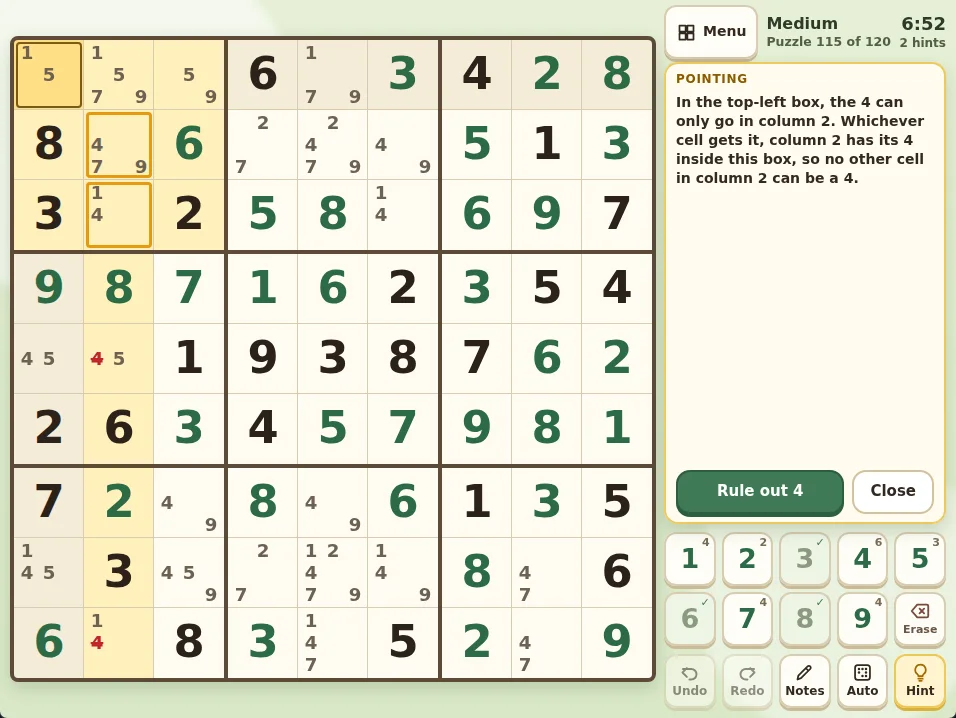
Medium puzzles (24 to 32 givens) are where notes start to pay. Pointing: if inside one box a digit can only go in a single row (or column), then that row’s copy of the digit is inside this box, so it can be ruled out of the rest of that row. Box-line reduction is the mirror image: if within a row (or column) a digit can only go inside one box, rule it out of the rest of that box.
Pairs: two cells in the same row, column or box that can only be the same two digits (a naked pair) must hold those two digits between them, so no other cell in that unit can be either. A hidden pair is the same idea from the digits’ side: if two digits fit only in the same two cells of a unit, those cells hold exactly those two digits and every other candidate in them can go.
Hard: triples and the X-wing
Hard puzzles add triples. Three cells of a unit whose candidates together are only three digits (a naked triple) take those three digits, even if no single cell has all three, so the rest of the unit loses them. Three digits that fit only in the same three cells of a unit (a hidden triple) clear every other candidate from those cells.
The X-wing is the first pattern across two units. If in two rows a digit fits in only the same two columns, each row puts its copy in one of those columns, so together they use up both columns: rule the digit out of every other cell in those two columns. The same works with columns and rows swapped.
Expert: the swordfish and the XY-wing
The swordfish is the X-wing with three rows: if in three rows a digit fits only within the same three columns, those rows use up all three columns, and the digit can be ruled out of the rest of those columns. It is rare: 9 of the 120 Expert puzzles need one.
The XY-wing uses three cells with two candidates each. The pivot can be x or y. One pincer, which shares a unit with the pivot, can be x or z; the other can be y or z. If the pivot is x, the first pincer is z; if it is y, the second pincer is z. Either way one of the pincers is z, so any cell that shares a row, column or box with both pincers cannot be z. Almost every Expert puzzle (118 of 120) needs one.
How hints work
Press Hint (or H) and the game looks at your board and finds the easiest next step, trying the techniques above from naked singles upward. The first press explains the step in a sentence, rings the cells that make the pattern and shades the row, column or box it is about. Try it yourself, or press Hint again (or the button in the hint panel) and the game does it: it places the digit, or for a step that rules candidates out it updates the notes of those cells and says what changed.
If one of your digits does not match the solution, the hint deals with that first, naming the digit and offering to erase it, because logic built on a wrong digit leads nowhere. Each new hint counts toward the puzzle’s record, so the solve card shows your time and how many hints you used. In our automated runs, hints alone carried all 600 puzzles from start to finish without ever needing to guess.
Your garden and today’s sprout
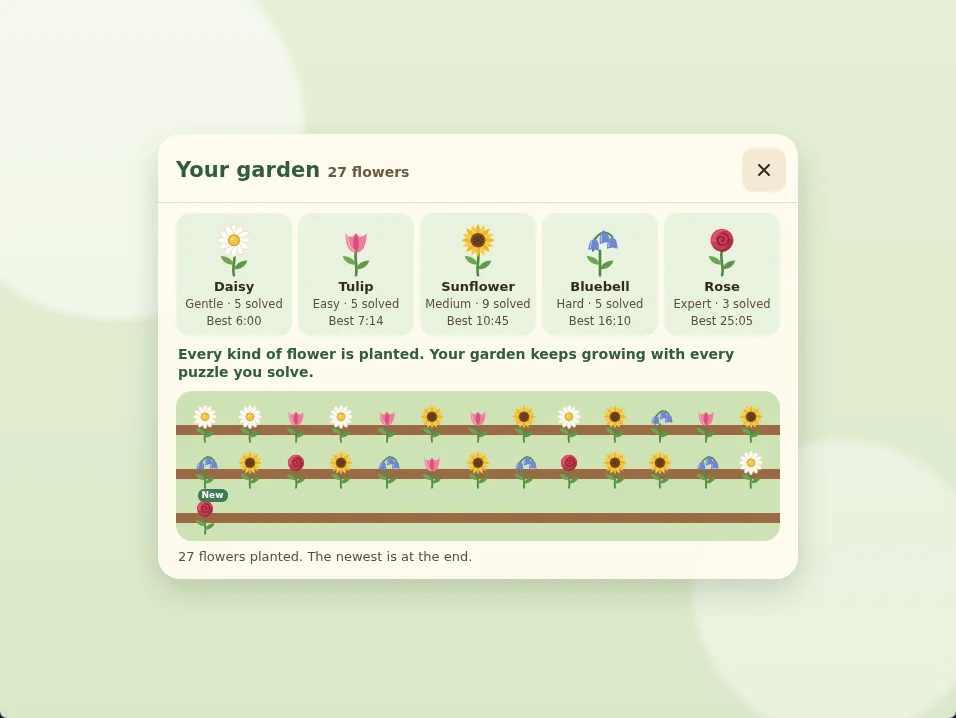
Every puzzle you solve plants a flower in your garden, a different flower for each difficulty: a daisy for Gentle, a tulip for Easy, a sunflower for Medium, bluebells for Hard and a rose for Expert. The garden shows how many puzzles of each difficulty you have solved and your best times, and draws your newest 60 flowers in a bed, oldest first. Plant one flower of every kind and a completion card celebrates the full garden; after that it simply keeps growing.
Today’s sprout is one Medium puzzle picked by your local date, the same for everyone on that day. It keeps its own record (your first solve of the day) and plants a sunflower, but there is no streak to keep. New puzzle on the menu picks the next puzzle of that difficulty you have not solved yet.
Timer, saving and accessibility
The timer is there for your records only. It stops while the game is paused, while the tab is hidden and while a card is open, and there are no lives, no mistake limit and no streaks. Restart in the toolbar starts the puzzle on the board over, clearing its digits, notes, hints and time, and never touches your garden.
Your puzzles save on this device: the one in progress at each difficulty and today’s sprout, with every digit and note, the time and the hints, plus your garden, best times and settings. Undo history lasts until you leave the page. Everything can be played with a keyboard, and reduced motion skips the bloom animation. We checked the game with automated desktop, phone and keyboard browser runs; these are not tests on physical devices or with real players.
Keep growing
Once you have planted one flower of each kind, the garden keeps growing with every puzzle you solve, and today’s sprout brings a new Medium puzzle each day. If you like calm logic with a different shape, Starlight Launch is a code-breaking game where colored clues tell you which digits are right.
More guides and roundups
Match mahjong tiles, solve sudoku, find hidden words, fit a jigsaw, sort shells or crack firefly codes. Choose a puzzle by the decisions it asks you to make.
Starlight Launch: Read the Clues, Beat the FoxCatch three glowing digits, read what the lock tells you, and let the colors do the bookkeeping. Here is how the clues, the race and the helpers work.
Cottage Word Search Guide: How to Find Every WordCottage Word Search hides a saying in every grid. Here is how selection works, how to scan for words in every direction, what the hidden sayings are and how the four seasonal books grow.
Rainy Day Jigsaw Guide: Edges, Sizes and HintsRainy Day Jigsaw is a calm jigsaw puzzle game with twelve illustrated pictures. Here is how to choose a size, build the border, sort the tray and complete the collection.