
CozyWorld game guide · By CozyWorld
This guide covers our own game, written from the current game rules and browser checks.
Starlight Launch: Read the Clues, Beat the Fox
Catch three glowing digits, read what the lock tells you, and let the colors do the bookkeeping. Here is how the clues, the race and the helpers work.
Starlight Launch is our festival-night code-breaking race. Your firework rocket has three locks, each with a 3-digit code, and the digits you guess with are carried by fireflies drifting across the meadow. Catch three to make a guess, read the colored clues, and open all three locks before Pip the fox opens its own. There is no menu: the meadow is ready the moment the page loads, and the race starts with your first catch.
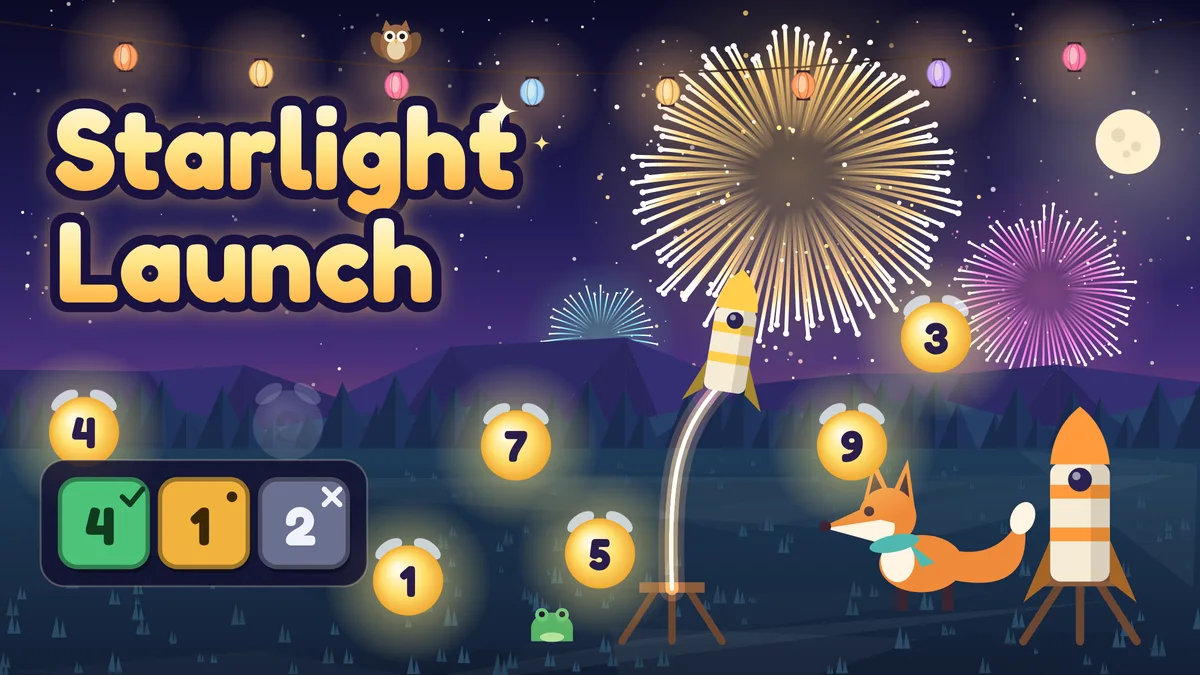
Catch three digits to make a guess
Every firefly glows with one digit from 0 to 9. Tap one to catch it, and its digit flies into your lock. Your three slots fill from left to right, so look for the digit your leftmost empty slot needs first. When the third digit lands, the lock reads the guess by itself; there is no submit button.
Changed your mind? Tap a caught digit to release it, or press Backspace, any time before the third digit lands. On a keyboard, press a number key to catch a visible firefly carrying that digit. If the digit you want is not in the meadow, wait a moment: every digit that could still be in your code drifts back into view within four seconds.
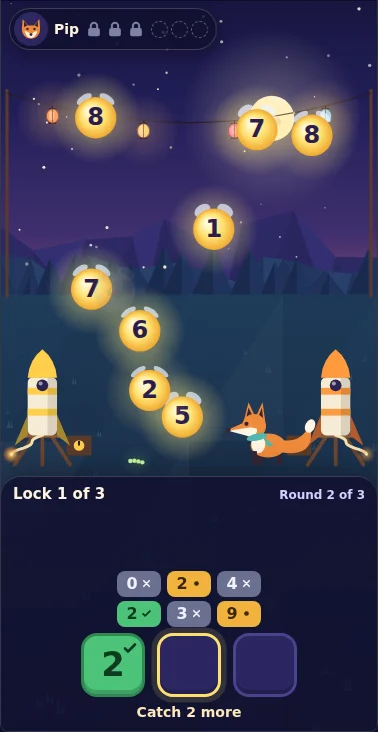
Read green, amber and gray
Each digit of a guess comes back with a clue. Green means the right digit in the right spot. Amber means the digit is in the code, but in another spot. Gray means the digit is not in the code at all. Every clue also carries a symbol (a check, a dot or a cross), so the colors are never the only way to read it.
The meadow does the bookkeeping for you. A digit that can no longer be in the code fades to a gray ghost and cannot be caught, and a green digit stays in its slot for your next guess. A good opening is three digits you have not tried: even three grays remove three digits for the rest of that lock. After that, keep your greens, move each amber to a new slot, and fill the gaps with digits that are still glowing.
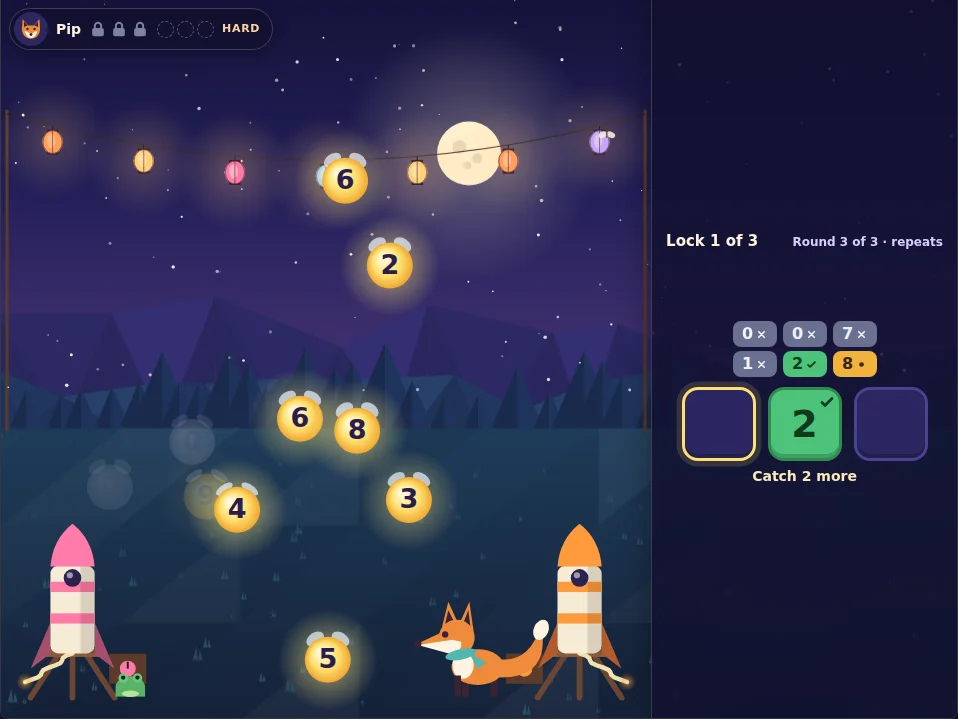
In round three, digits can repeat, and the meadow says so when the round begins: a digit can appear more than once in the code. A digit you guess twice only turns amber as many times as the code actually holds it, so a single amber on a doubled digit means one copy, not two.
Racing Pip the fox
Pip cracks its own three locks across the meadow, with its own codes and the same clue rules. It never sees your code, and its clues tell you nothing about yours. Pip waits until your first catch, then makes one guess every 12 seconds in round one, every 10 seconds in round two and every 8 seconds in round three. You can watch it trot to its lock box on each guess, and the strip at the top shows its open locks and its last clues.
The race stays close without Pip ever stopping. When you fall two locks behind, Pip slows down by 30%; when you pull two locks ahead, it hurries by 15%. Each lock you open burns a length off your rocket fuse. If Pip opens its third lock first, its rocket goes up, yours still launches after it, and the night moves on to the next round.
A festival night and its helpers
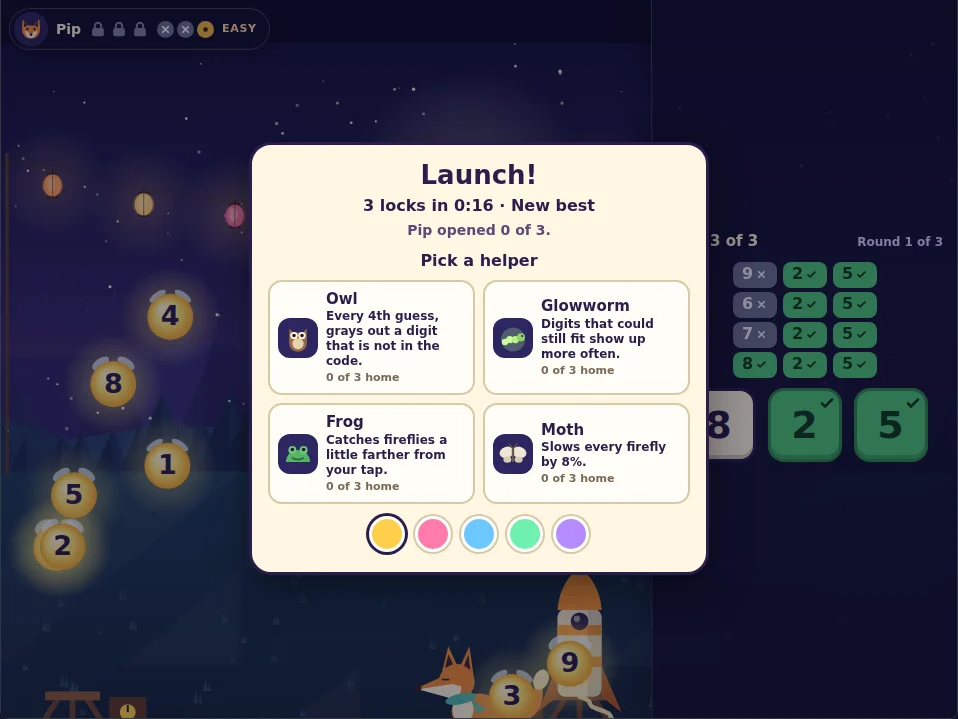
A night has three rounds against Easy, Normal and Hard Pip, and usually takes five to eight minutes. Win a round and you choose one helper to join you. Helpers act on their own, and you can keep up to three of each:
The Owl grays out one digit that is not in the code on every fourth guess, one digit per Owl. The Glowworm makes fireflies carrying still-possible digits show up more often. The Frog catches fireflies a little farther from your tap. The Moth slows every firefly by 8%. Owls pay off when a lock takes many guesses, and Moths and Frogs make catching calmer on a small screen.
Your helpers, your best time for each round, your firework color and a few totals are saved in this browser on this device. A night in progress is not saved, so a reload starts a fresh night with your helpers still at home.
Controls, pausing and taking a break
Everything works with a tap, a mouse click or the keyboard, and Tab reaches the slots and the result cards. The toolbar has pause, restart, sound, help and fullscreen. Pausing stops Pip as well as the fireflies, so you can think a guess through or step away. Sound is never needed, but each digit plays its own chime, and codes start to sound familiar.
Reduced motion stills the stars and lanterns, trims the fireworks and removes the camera tilt at launch. The fireflies still drift, because catching them is the game. Our checks covered the rules and whole nights played in desktop, phone and tablet browser emulation, not physical devices. Pip’s pace was tuned with simulated players, not people, so tell us if the race feels too quick or too slow.
Launch again, or try something new
A festival night is three rounds, and the next one is always a tap away. If you would rather follow fireflies through a forest than read clues, Firefly Hollow is our lantern-lit runner. For a slower puzzle with no clock at all, Book Nook Shuffle asks you to sort shelves in as few turns as you can.