Cozy Classic
Free Mancala
Sunflower Mill Mancala
Classic six-pit mancala with every count shown as a number, a friendly computer opponent at three levels, hints that explain a free turn or a capture, and unlimited undo.
What you do
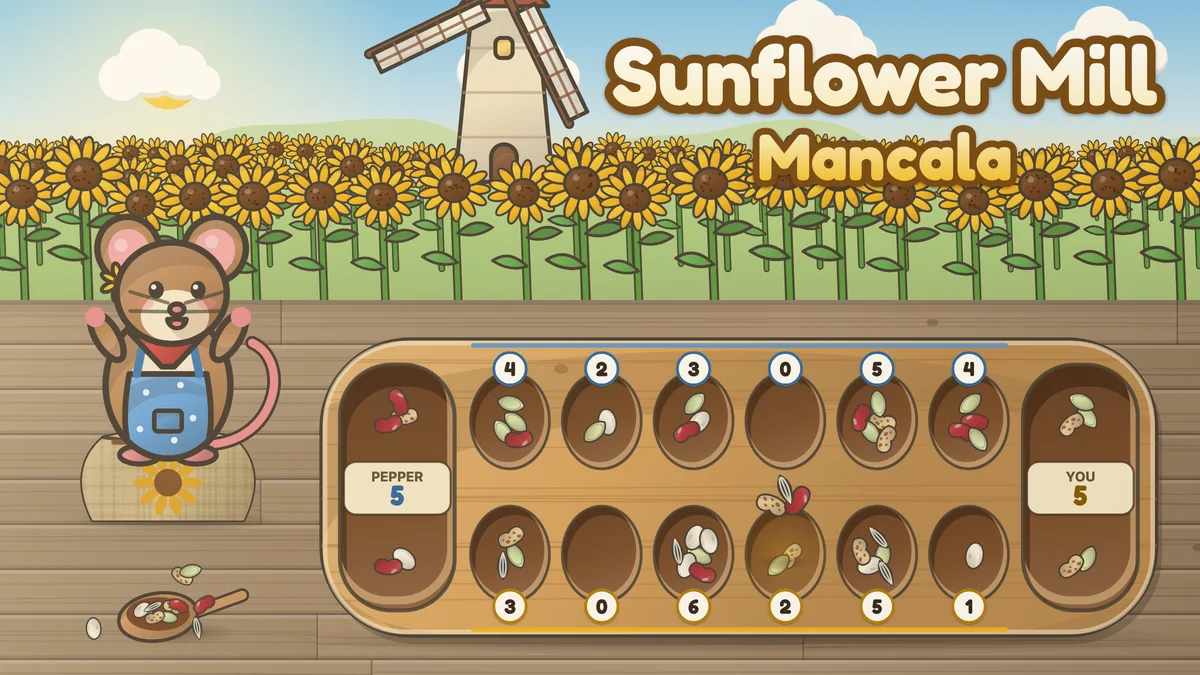
Sunflower Mill Mancala is mancala with the six-pit rules often called Kalah, played on a carved honey-colored board on a weathered table at the edge of a sunflower field, with an old windmill on the hill behind. Each player has six pits and a store. Pick up all the seeds in one of your pits and sow them one at a time counterclockwise, into your own store as you pass it but never into your opponent’s. Land your last seed in your store for another turn, or in an empty pit of your own to capture the seeds across from it. When one side runs out, each player keeps what is left on their side, and the fuller store wins. Your opponent is Pepper, a field mouse in a dotted blue apron with a sunflower petal tucked behind one ear, who thinks with a paw at her chin, cheers her own good moves and claps for yours.
- Three levels for Pepper: Gentle grabs the free turns and captures she can see and often just plays a pit she likes, Steady looks four moves ahead, and Sharp searches far deeper, often a dozen moves ahead.
- Hints from the same deep search Sharp uses, with the reason in plain words: a free turn, a capture and how many seeds it takes, or simply the best move found.
- Unlimited undo that takes back your move and Pepper’s reply together, so you can try another idea.
- Four seeds a pit (the most common start), three for a quicker game or five for a longer one, the usual capture rule or the empty-capture variant, and a choice of who goes first.
- Every pit and store shows its count as a number at all times. The sowing is animated seed by seed at three speeds, and reduced motion places the seeds at once.
- Statistics for each level (games, wins, losses, ties and your biggest win), with your game saved on this device as you play.
How to play
- Press Play. The board has two rows of six pits. Your pits are the row with the gold edge, along the near side (down the left on a tall screen), and your store is the long trough on your right (at the bottom on a tall screen). Pepper’s pits and store, edged in blue, face yours. Each pit starts with four seeds.
- On your turn, tap one of your pits that has seeds. All its seeds are picked up and sown one at a time into the following pits counterclockwise: along your row, into your store, then along Pepper’s row. Pepper’s store is skipped.
- If your last seed lands in your own store, you take another turn.
- If your last seed lands in an empty pit on your side and the pit straight across holds seeds, you capture both: that last seed and all the seeds across go into your store.
- The game ends as soon as either player’s six pits are all empty. The seeds still in the other player’s pits go into that player’s store, and whoever has more seeds in their store wins.
Controls
- Touch or mouse: tap one of your pits to sow it. With a mouse, resting on a pit shows where its last seed will land. Undo, Hint and Menu sit on the shelf below the board, or beside it on a landscape phone.
- Keyboard: the arrow keys move between your six pits and show where the last seed of the pit in focus will land, and Enter or Space sows it. The keys 1 to 6 sow your pits in order toward your store, U undoes and H shows a hint.
- Restart in the toolbar starts a new game. Menu starts a new game, changes Pepper’s level, the seeds, the capture rule, who goes first and the sowing speed in Settings, and shows your statistics and the rules. The toolbar also has pause, help, optional sound and fullscreen.
Tips worth knowing
- Look for free turns first. A pit whose seed count equals its distance from your store drops its last seed in the store: one seed in the pit next to the store, two in the pit before it, and so on.
- When you have more than one free turn, take the one nearest your store first. Sowing that pit leaves the pits farther away untouched, so their free turns are still there afterward.
- Watch Pepper’s empty pits. If one of her pits is empty and your pit across from it is full, she may land a seed there and take your whole pile, so move a big pile that sits across from her empty pit, or fill her empty pit by sowing past it.
- Keep seeds on your side late in the game. When a side runs empty the leftover seeds go to their owner, so a row of seeds near the end can be worth more than one more capture.
- A big pile can lap the board. Thirteen seeds go all the way round and drop the last one back in the pit they came from, which was empty, so it captures whatever is across.
- Use the hint and undo to learn. The hint says why a move is good, and undo lets you play the other choice and see what happens.
Accessibility
- Everything can be played with a keyboard: the arrow keys move a visible focus between your six pits, Enter or Space sows, and the keys 1 to 6 sow a pit directly.
- Every pit and store is labeled for screen readers with its owner and seed count, and your pits also say where their last seed would land.
- Every count is shown as a number on a badge or plaque at all times, so you never need to count seeds by eye, and the two sides are edged in gold and blue.
- Nothing is timed. Pepper waits while a menu is open, and undo is unlimited.
- Reduced motion places the seeds at once instead of sowing them one by one, stops Pepper’s hopping and fidgeting, and keeps the sparkles small and still. Sound is optional and never needed to play.
Questions
How strong is each level?
We measured Pepper with our own simulation of 1,000 games for each pairing, with four seeds a pit, the usual capture rule and the first move alternating. Against a player that picks pits at random, Gentle won 886 games (88.6 percent), Steady 989 and Sharp all 1,000. Against each other, Steady beat Gentle in 931 games (93.1 percent), Sharp beat Gentle in 992 and Sharp beat Steady in 978. These are computer players, not people, so treat the numbers as a guide.
Can a beginner beat Gentle?
Yes, that is what Gentle is for. In the same simulation, a simple scripted beginner that takes a free turn when it sees one, otherwise the biggest capture it sees, otherwise a random pit, beat Gentle in 766 of 1,000 games (76.6 percent). The same beginner won 191 of 1,000 against Steady (19.1 percent) and 20 of 1,000 against Sharp (2.0 percent).
Which mancala rules does this use?
The six-pit, four-seed rules often called Kalah, the rules that come with most mancala sets sold in stores: sowing counterclockwise, your own store included and your opponent’s skipped, another turn when the last seed lands in your store, a capture when it lands in an empty pit of your own with seeds across, and the seeds left on each side going to that side’s owner at the end. Settings also offers three or five seeds a pit and a common variant of the capture rule.
What if my last seed lands in my empty pit and the pit across is empty too?
With the usual rule, nothing is captured: the seed stays where it landed and Pepper moves next. With the empty-capture variant in Settings, that one seed goes to your store anyway. Rule sheets differ on this point, so the game lets you choose.
What happens when one side runs out of seeds?
The game ends at once, even in the middle of a run of free turns. Each player adds the seeds still on their own side to their own store, and the fuller store wins. Rule sheets for other mancala games differ on this, but in these rules the leftovers always go to the owner of the side they are on.
What does the game save?
Your settings, the game in progress with every move, and your statistics for each level (games played, won, lost and tied, and your biggest win), all in this browser’s local storage. There is no account.