
CozyWorld game guide · By CozyWorld
This guide covers our own game, written from the current game rules and browser checks.
How to Play Gin Rummy: Rules, Scoring and Strategy
Gin rummy is the classic two-player card game of sets and runs. Here is how to deal, how a turn works, what counts as a meld, when you may knock or go gin, how layoffs and undercuts work, how a game to 100 is scored, how strong each level of our computer opponent is, and the strategy, common mistakes and tips that win more hands.
Gin rummy is a card game for two players with one ordinary deck. Each player holds ten cards and, turn by turn, draws one card and throws one away, trying to build sets of the same rank and runs in one suit. The cards left over count against you, and as soon as they add up to 10 or less you may knock and end the hand. A hand takes a few minutes, the rules fit on a single card, and the choice of which card to throw away keeps it interesting for a lifetime.
This guide covers the standard two-player rules: how to deal, the first card, a normal turn, melds and deadwood, knocking and gin, layoffs and undercuts, the score for a hand and for a game to 100, and the ways rule books differ. Then it shows the controls in Birch Cove Gin Rummy (CozyWorld’s free gin rummy game against Murray the moose), how strong each of Murray’s levels is, beginner strategy, the most common mistakes and a few tips. The strength figures come from our own simulation, which plays the game’s real rules.
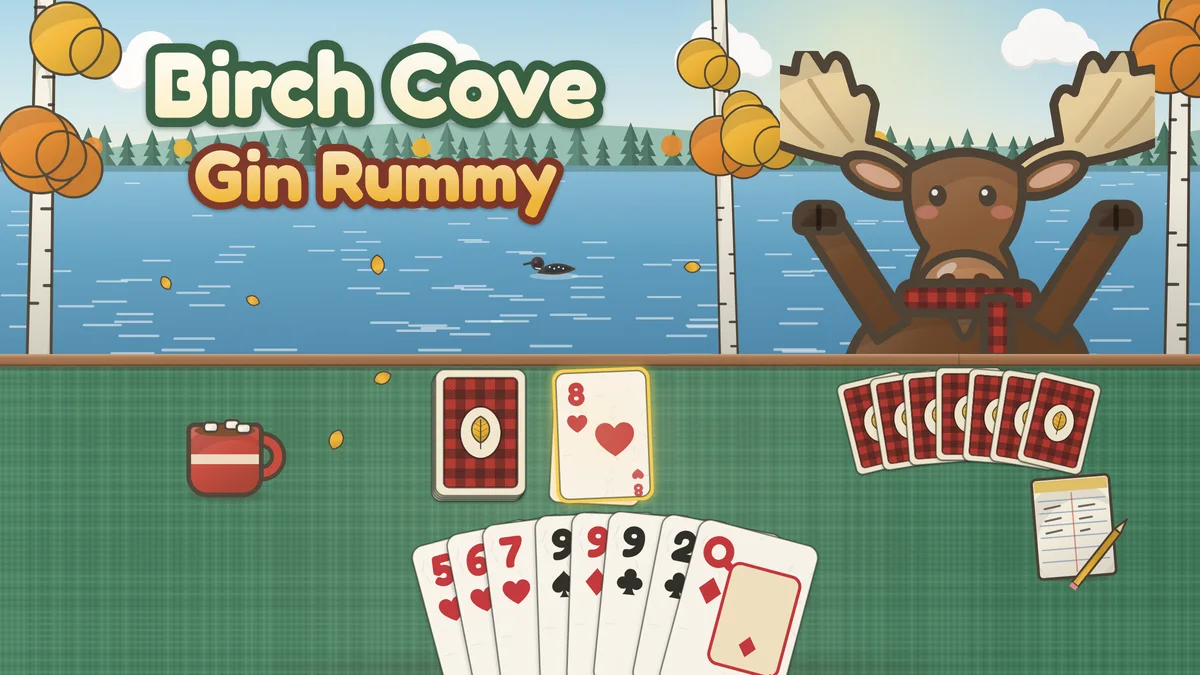
How to deal gin rummy
Gin rummy uses one standard 52-card deck with the Jokers taken out, and two players. Choose the first dealer any way you like. The dealer shuffles and deals ten cards to each player, one at a time, starting with the other player (the non-dealer). The next card goes face up on the table to start the discard pile; this first face-up card is often called the upcard. The other 31 cards go face down beside it as the stock.
After the first hand, the winner of each hand deals the next one. If a hand ends in a draw, the same dealer deals again. Some families have the loser deal instead.
In Birch Cove Gin Rummy, Murray deals the first hand of your first game, so you get the first look at the upcard, and the first deal alternates from game to game after that. The game sorts your ten cards for you as soon as they arrive.
| Card | Points |
|---|---|
| Ace | 1 |
| 2 to 10 | The number on the card |
| Jack, queen, king | 10 each |
Gin rummy rules: melds and deadwood
The goal is to arrange your hand into melds. There are two kinds. A set is three or four cards of the same rank, such as three sevens. A run is three or more cards in a row of the same suit, such as the 4, 5 and 6 of hearts. In gin rummy the ace is always low: A-2-3 is a run, but Q-K-A is not, and runs never wrap around from king to ace.
Each card can be in only one meld at a time. If you hold the 7 of hearts, 7 of spades, 7 of clubs and the 8 and 9 of hearts, the 7 of hearts can finish either the set of sevens or the run, but not both, so you choose the arrangement that leaves the fewest points over.
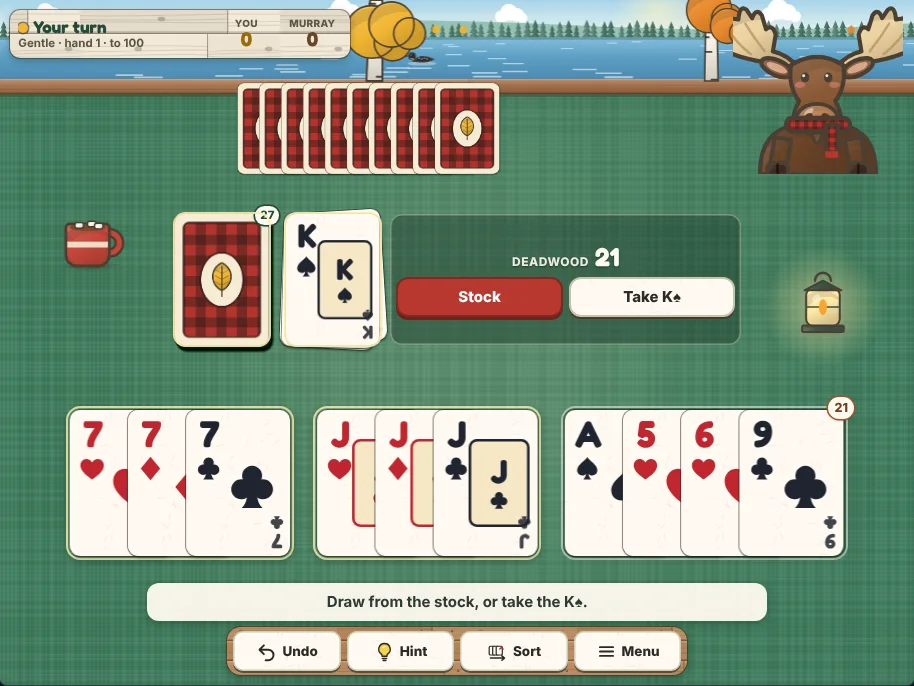
Cards that are not in a meld are your deadwood, and their points are your deadwood count. Lower is better. In Birch Cove Gin Rummy the game always arranges your cards for the least deadwood, shows each meld on its own mat with your loose cards at the end, and keeps your deadwood count on a badge, so you never have to add it up yourself.
The first card
The hand starts with an offer of the upcard. The non-dealer may take it or pass. If the non-dealer passes, the dealer may take it or pass. Whoever takes it then throws a card face up onto the discard pile, and the other player has a normal turn.
If both players pass, the non-dealer draws the top card of the stock instead, throws a card, and play goes on from there. A card that both players passed on tells each of them something: the other player probably has no use for it.
A turn in gin rummy
Every turn has two parts. First draw one card: either the top card of the face-down stock, or the top card of the discard pile. Then throw one card face up onto the discard pile. You always end your turn with ten cards.
A card you take from the discard pile cannot go straight back on the same turn; throw a different card. A card you draw from the stock may be thrown at once if it does not help you.
Taking from the discard pile shows the other player what you want, while drawing from the stock keeps your plans hidden and gives you a card you could not have planned for. Both are good moves at different times.
Knocking and going gin
You may end the hand on your turn by knocking, once you have drawn. Throw one card face down, and if the cards you keep have 10 points of deadwood or less, lay them face up on the table, sorted into your melds and your deadwood. You never have to knock; you may keep playing to lower your deadwood further.
If all ten of the cards you keep are in melds, with no deadwood at all, you have gone gin. Gin scores a bonus, and the other player cannot lay off any cards against it.
Some players also allow big gin: if all eleven of your cards meld after you draw, you lay them all down without throwing a card. Birch Cove Gin Rummy offers big gin as an option in Settings, worth 31 plus the other player’s deadwood. With big gin off, eleven melded cards simply throw one and go gin.
Layoffs and undercuts
After a knock, the other player (the defender) lays their own cards face up, sorted into melds and deadwood, and may then lay off: add loose cards to the knocker’s melds. A fourth card can go on a set of three, and the next card at either end can go on a run. Laying off one card can open the way for the next, so after the 5 of clubs goes on 2-3-4 of clubs, the 6 of clubs fits too. The knocker never lays off on the defender’s melds, and nobody lays off against gin.
Then both players count their deadwood. If the knocker has less, the knocker scores the difference. If the defender has the same or less, the defender has undercut the knocker and scores the difference plus an undercut bonus. That is the risk of knocking with 8, 9 or 10 points: a defender holding low cards can catch you.
In Birch Cove Gin Rummy, when Murray knocks, the cards of yours that fit his melds glow. Tap one to lay it off (and then tap the meld, if it fits two), and tap Done when you are finished. When you knock, Murray lays his cards off one at a time so you can follow along, and laid-off cards keep a brown edge. Then a score card adds up the hand line by line.
How to score a hand of gin rummy
The table shows the scoring Birch Cove Gin Rummy uses, which is one of the most common sets of values. The hand’s winner scores the points; the other player scores nothing for the hand.
For example, you knock with 6 points of deadwood. Murray lays off two cards and is left with 19, so you score 19 - 6 = 13. Had he been left with 5, he would have undercut you: 25 + 1 = 26 for Murray. Had you gone gin while he held 19, you would score 25 + 19 = 44.
A hand can also end in a draw. If a player draws and leaves only two cards in the stock, then throws a card without knocking, the hand is over and nobody scores. The same dealer deals again.
| How the hand ends | Who scores | Points |
|---|---|---|
| Knock, and the knocker has less deadwood | The knocker | The difference in deadwood |
| Knock, and the defender has the same or less (an undercut) | The defender | 25 plus the difference |
| Gin | The player who went gin | 25 plus the other player’s deadwood |
| Big gin (optional) | The player who went big gin | 31 plus the other player’s deadwood |
| Two cards left in the stock, no knock | Nobody | None: a drawn hand |
A game to 100 and the final count
A game is a series of hands. Keep a running total of hand points for each player; the first to reach 100 ends the game. Then add the bonuses: the player who reached 100 gets a game bonus of 100, or 200 for a shutout if the other player scored nothing at all, and each player gets a line bonus of 25 for every hand they won. The higher final count wins the game.
That is nearly always the player who reached 100, but a player who won many more hands can occasionally overtake on line bonuses. Birch Cove Gin Rummy also offers single hands in Settings, with no running total: knock, gin or undercut, and deal again.
| Bonus | Who gets it | Points |
|---|---|---|
| Game bonus | The player who reached 100 | 100 |
| Shutout game bonus | The player who reached 100, if the other player scored nothing | 200 instead of 100 |
| Line bonus | Both players | 25 for every hand won |
Where rule books differ
The play itself is the same almost everywhere, but the bonus values vary. Many rule books give 25 for gin and 25 for an undercut, as Birch Cove Gin Rummy does. Others give 20 for gin, 10 for an undercut and 20 for each hand won, and some have the loser of each hand deal the next.
A few details of play vary too. Some groups let a player throw the card just taken from the discard pile. The rules on this page, and in the game, are the common standard: the card just taken cannot go straight back, the ace is low only, and the hand is a draw when two cards are left in the stock.
Controls in Birch Cove Gin Rummy
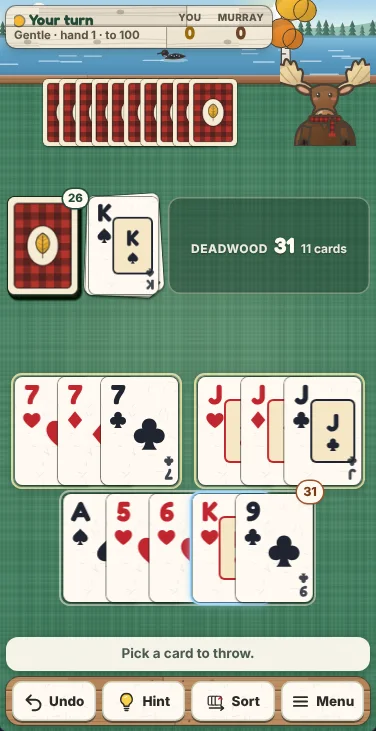
Your hand runs along the bottom of the table, already arranged: each meld on its own mat, and your loose cards at the end with a badge showing their points. To draw, tap the stock or the discard pile, or use the Take, Pass and Stock buttons beside the piles. To throw, tap a card to pick it up and tap it again (or tap the discard pile). The card you drew is outlined in blue until you throw, so you can always see what came in.
When throwing a card would leave 10 points or less, a Knock button appears beside the piles and names the card it throws; it says Gin when you would have no deadwood. Sort switches between runs first and sets first. Hint suggests a move and says why, using only the cards you can see. Undo takes back a card you picked up from the discard pile (it goes back face up, and you may draw from the stock instead) and your layoffs, one at a time. A card drawn from the stock stays, because you have seen it, and a throw ends your turn.
On a keyboard, the arrow keys move along your hand and Enter or Space picks and throws. D draws from the stock, T takes the top discard, P passes on the first card, K or G knocks, N finishes your layoffs or deals the next hand, S sorts, U undoes and H shows a hint. Menu starts a new game and opens Settings (Murray’s level, a game to 100 or single hands, big gin, how your melds are arranged and Murray’s speed), your statistics for each level and the rules. Your game is saved on your device as you play.
How strong is each level?
Murray has three levels. Gentle picks up a discard only when it finishes a meld, half the time throws a random loose card instead of his highest, and waits until his deadwood is 5 or less before he knocks. Steady keeps loose cards that work together, throws the card that leaves the least deadwood he can expect after his next draw, and knocks as soon as he can. Sharp plays like Steady but also remembers every discard and every card you pick up, holds back cards you seem to want, and picks his moment to knock.
To check that each level does what it says, we ran our own simulation of 1,000 games to 100 for each pairing, with the first deal alternating. A random player draws and throws at random but always knocks when it can. The scripted beginner takes the face-up card only when it makes a meld, otherwise draws from the stock, throws its highest loose card and knocks as soon as it can, which is roughly how many people play their first games.
All three levels won all 1,000 games against the random player, and so did the scripted beginner. Against each other, Steady beat Gentle in 899 games and Sharp beat Gentle in 911, while Sharp beat Steady in 528 of 1,000, a small edge. The beginner beat Gentle in 843 of 1,000 games, so Gentle is a fair first opponent, but won only 389 against Steady and 397 against Sharp: against a beginner the two upper levels are about equally hard, and Sharp’s extra care shows mainly against Steady. In a separate run of 1,000 single hands for each pairing, the beginner won 726 hands against Gentle, 438 against Steady and 472 against Sharp. These are computer players, not people, so treat the numbers as a guide.
| Pairing | Won | Lost |
|---|---|---|
| Gentle against a random player | 1,000 | 0 |
| Steady against a random player | 1,000 | 0 |
| Sharp against a random player | 1,000 | 0 |
| Scripted beginner against Gentle | 843 | 157 |
| Scripted beginner against Steady | 389 | 611 |
| Scripted beginner against Sharp | 397 | 603 |
| Steady against Gentle | 899 | 101 |
| Sharp against Gentle | 911 | 89 |
| Sharp against Steady | 528 | 472 |
Beginner strategy
Throw high cards early. A king, queen or jack that is in no meld costs 10 points if the other player knocks, while a loose ace costs 1. Early in the hand, when nobody is close to knocking, is the cheapest time to let them go.
Keep cards that can grow two ways. A 7 of hearts beside the 7 of spades and the 8 of hearts can finish a set or a run, so more of the cards still to come will help you. A lone card with nothing near it in rank or suit is usually the first to throw.
Knock early when you can. An early knock often wins the hand, because the other player has not had time to build melds or shed high cards. Waiting for gin is tempting, but every extra turn is another chance for the other player to knock first.
Draw from the discard pile only when it helps right away, at least while you are learning. Taking a card that only might help shows the other player your plans and leaves you a card you cannot throw back this turn.
Common mistakes
Throwing the card the other player wants. If Murray picks up the 6 of clubs, the 5 and 7 of clubs and the other sixes are the cards most likely to help him. Throw something else if you can.
Holding a pair of high cards too long. Two kings look like the start of a set, but if one of the other kings has already been thrown, only one card in the deck can finish the set, and the pair costs 20 points until it does.
Knocking with 10 late in the hand. By the time the stock is thin, the other player has usually shed their high cards, and a knock with 9 or 10 is easy to undercut. Late in a hand, knock with less, or hold out for gin.
Forgetting about layoffs. When you knock, any of the other player’s loose cards that fit your melds will be laid off. A run of 5-6-7 of hearts invites the 4 and 8 of hearts; count on losing a few points to layoffs before you knock with a close margin.
Tips for winning more hands
Count the dead cards. Only the top card of the discard pile can be taken, so every card buried under it is gone for good. If both other nines have been thrown, your pair of nines can never become a set, so treat them as two loose cards.
Watch what the other player passes on. A card they let go by, or threw themselves, is probably safe to throw back, and cards of the same rank are a little safer too.
Throw a card the other player just threw. If Murray throws the 9 of spades, he is unlikely to want the 9 of diamonds; matching his throws is a cheap way to stay safe while you build.
Use the hint and undo to learn. Ask for a hint when you are unsure and read why it likes the move. If you pick up a discard and change your mind, undo puts it back and you can draw from the stock instead.
Keep playing
Gin rummy comes down to one decision made over and over: which card to throw. Keep cards that can grow two ways, throw high loose cards early, watch what the other player picks up, and knock while the stock is still deep. Start against Gentle Murray, use the hint when you are unsure, and move up to Steady when you win more games than you lose. For more classic games, try Porch Swing Solitaire, our Klondike game; Snowberry Cabin Solitaire, our FreeCell game; Puffin Bluff Solitaire, our Pyramid game; or Sunflower Mill Mancala, the seed-sowing board game, against another friendly computer opponent.
- Play Birch Cove Gin Rummy
- Birch Cove Gin Rummy: features, controls and FAQ
- Porch Swing Solitaire: Klondike on a porch at dusk
- Snowberry Cabin Solitaire: FreeCell in a snowy cabin
- Sunflower Mill Mancala: two-player mancala against the computer
- How to play Klondike solitaire: setup and rules
- How to play FreeCell solitaire: setup and rules
- How to play Pyramid solitaire: setup and rules
- How to play mancala: rules and strategy
- More classic games: how to play Hearts
- More classic games: how to play checkers
More guides and roundups
Spider is the two-deck solitaire where you gather ten columns into runs from King down to Ace. Here is how to set up the 104-card deal, the rules for moving cards and dealing from the stock, one, two or four suits, how often a deal can be won, and the strategy, common mistakes and tips that win more deals.
Free Online Games for Seniors and Older AdultsFree online games for seniors and older adults: solitaire, mahjong, word search, sudoku, jigsaw and nonograms that open in a browser, with no countdown, no accounts and no purchases. Here is how the eight compare on round length, timers and help.
How to Play Golf Solitaire: Rules and StrategyEvery card in Golf solitaire is face up from the deal, so each hole is a planning puzzle. Here are the rules, the King rule and the scoring, how to plan runs and count ranks, when to turn the stock, and how Golf differs from TriPeaks.
How to Play Sudoku: Rules, Techniques and HintsHow to play sudoku, from the rules and a first puzzle to what easy, medium, hard and expert mean, plus every technique Sprout Sudoku uses and how its hints and garden work.