
CozyWorld game guide · By CozyWorld
This guide covers our own game, written from the current game rules and browser checks.
How to Play Chinese Checkers: Rules and Strategy
Chinese checkers is the race across a six-pointed star: step or hop your ten marbles into the point opposite before anyone else fills theirs. Here is how to set up for two, three, four or six players, how steps and hop chains work, how a game is won, what to do about marbles left in your home, how strong each level of our computer players is, and the strategy that wins more races.
Chinese checkers is a race game for two, three, four or six players on a board shaped like a six-pointed star. Each player starts with ten marbles filling one point of the star and tries to move all of them into the point straight across, stepping one hole at a time or hopping over other marbles, often several times in one turn. Nothing is ever captured, so every marble on the board, yours or anyone else’s, is a stepping stone.
This guide covers the standard rules: the board, the setup for each number of players, steps, hops and hop chains, how a game is won, the problem of marbles left in your home, and the common house rules. Then it shows the controls in Tamarack Lake Chinese Checkers (CozyWorld’s free Chinese checkers game against up to five campers by a lake), how strong each of the campers’ levels is, beginner strategy, the most common mistakes and a few tips. The strength figures come from our own simulation, which plays the game’s real rules.
Where Chinese checkers comes from
Despite the name, the game is neither Chinese nor a form of checkers. According to Wikipedia’s history of the game, it was invented in Germany in 1892 under the name Stern-Halma, a star-shaped version of the older American game Halma, which is played on a square board. Stern is German for star, and the game is still called Sternhalma in German.
The name Chinese checkers began in the United States as a marketing idea by Bill and Jack Pressman in 1928, whose company first sold the game as Hop Ching checkers. In China today the game is called tiaoqi, which means jump game, and Japan plays a close relative called the diamond game.
How to set up a game of Chinese checkers
The standard board is a six-pointed star with 121 holes: a hexagon of 61 holes in the middle and a point of 10 holes on each of its six sides. Each player has 10 marbles (or pegs) of one color and fills one point with them, four in the row next to the middle, then three, two and one at the tip.
Your goal, your home, is always the point straight across the board from where you start. The players you face depend on how many play, and the standard layouts keep every player’s race the same length. Five people cannot play, because one of them would have nobody across the board while the others pair off.
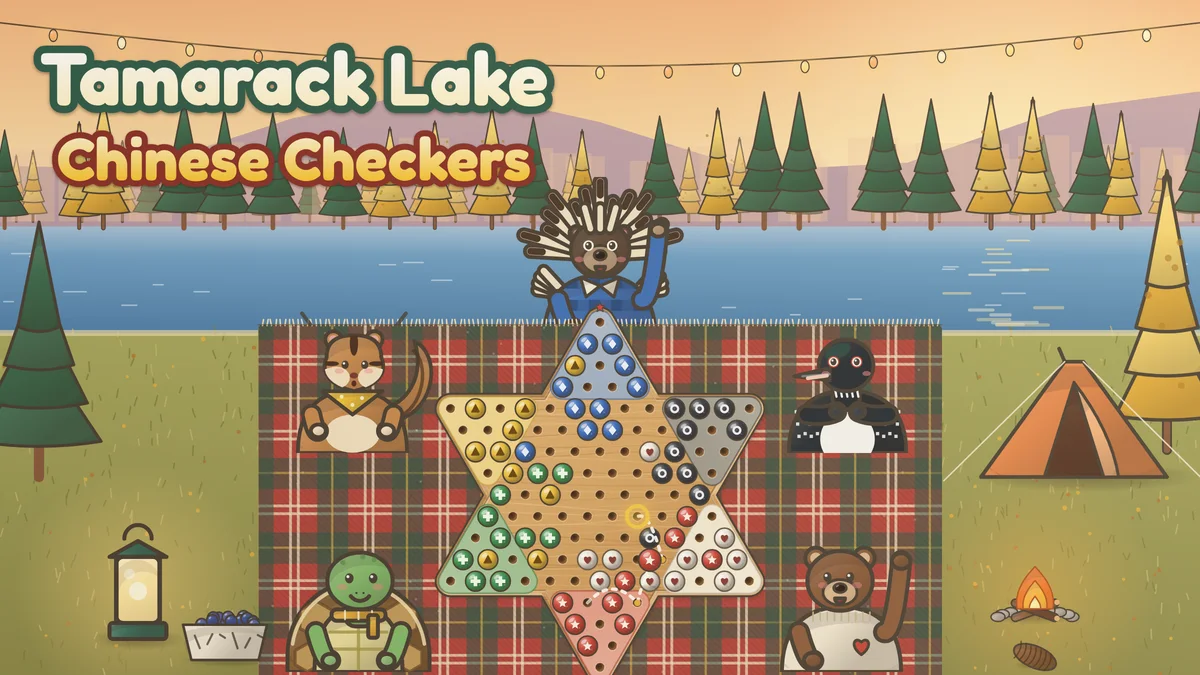
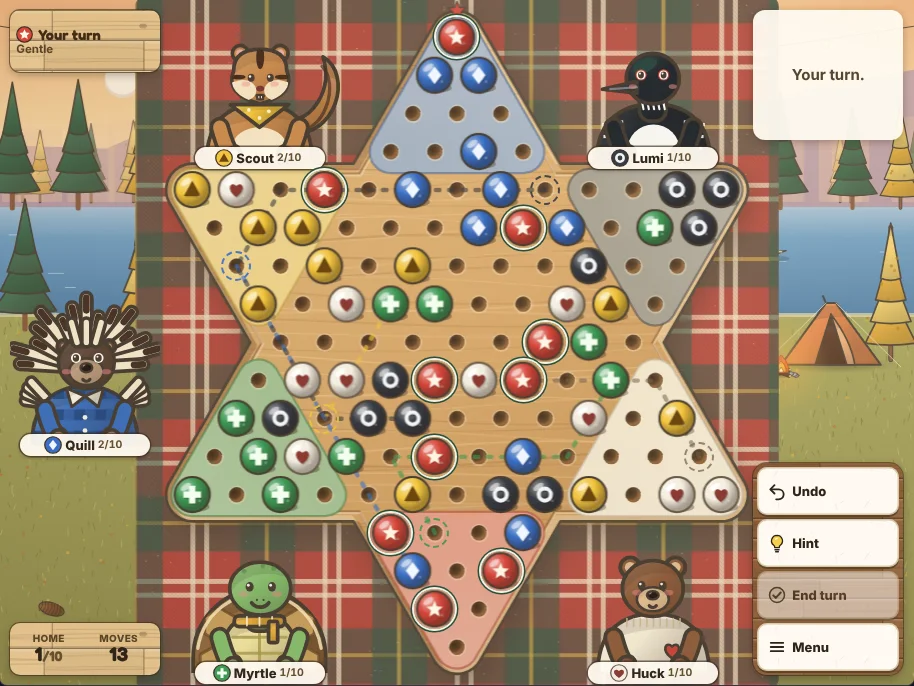
In Tamarack Lake Chinese Checkers you always start in the point at the bottom of the screen with red marbles marked with a star, and your home is the point at the top. The campers sit on the blanket beside their own points, each with their own color and shape of marble.
| Players | Points used | Where your home is |
|---|---|---|
| 2 | Two opposite points | Your opponent’s starting point |
| 3 | Every other point, so three stay empty | An empty point: each home starts empty |
| 4 | Two opposite pairs, so two opposite points stay empty | The starting point of the player across from you |
| 6 | All six points | The starting point of the player across from you |
| 5 | Not played | One player would have nobody across the board |
Chinese checkers rules and the goal
The first player to move all 10 of their marbles into their home wins. In family games the others often play on to decide second and third place; in Tamarack Lake Chinese Checkers the game ends when the first player fills their home.
Players take turns going clockwise round the board, and on your turn you move exactly one of your own marbles. A move is either a step or a chain of hops, never both, and you may move in any of the six directions, forward, sideways or back. Nothing is captured and nothing leaves the board.
How marbles move: steps and hops
A step moves a marble to an empty hole right next to it. Each hole has up to six neighbors, so a marble in the open middle of the board can step six ways. A step ends your turn.
A hop jumps over one marble right next to yours, of any color, your own included, into the empty hole directly beyond it in a straight line. You cannot hop over two marbles in a row, and you cannot hop when the hole beyond is filled. The marble you hop over stays where it is.
Marbles may go anywhere on the board, including through and into the other points, whether they belong to another player or to nobody. Published rules, such as those from the game maker Tactic, say so in as many words.
Hop chains
After a hop, the same marble may hop again from where it landed, and again, as many times as there are hops to make. Each hop can change direction. A chain like this is what makes Chinese checkers fast: a good one can carry a marble from one side of the board to the other in a single turn.
You may stop the chain after any hop; you never have to make every hop you could. Sometimes stopping early is the better move, to keep a marble where it helps your next turn or to avoid leaving a ladder for someone else. The only thing a chain may not do is a step: once you have stepped, your turn is over, and once you have hopped, you can only hop.
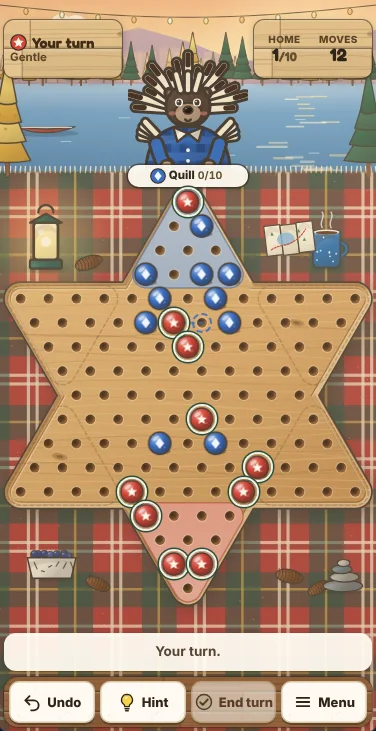
In Tamarack Lake Chinese Checkers a chain is played one hop at a time. Tap your marble and its first hops show as gold rings; tap one and the marble hops there, with a Hop again or end turn tag above it and gold rings for the next hops. Tap your marble again, or End turn, to stop. Tapping an earlier landing goes back to it, and Undo takes back a chain you have not finished. A dashed ring marks the far end of a longer chain, so you can also make the whole chain with one tap.
Winning, and marbles left in your home
Under the standard rules you win only when all 10 holes of your home hold your own marbles. That leaves a well-known problem: in a two, four or six-player game your home is someone else’s starting point, and a player who leaves a marble or two at the back of their start can keep you from finishing. Many players think this is unsporting.
Published rules deal with it in two ways, often together. GameRules.com and the rules that come with Tactic’s board both say that a marble which reaches its home may only move within it afterward. Tactic’s rules also say, and GameRules.com describes as a common anti-spoiling rule, that other players’ marbles left in your home do not stop you winning: once every hole of your home is filled, with your own marbles in all the holes the others leave free, you have won.
Tamarack Lake Chinese Checkers plays the standard rule unless you turn on the anti-blocking rule in Settings. Under the standard rule, the campers never box one of your marbles into their home, and they make room for it to leave. With the anti-blocking rule on, your marbles stay home once they arrive, and your home counts as filled once every hole holds a marble, at least one of them yours, as long as none of your own marbles is left in your starting point. That last condition is ours: without it a game could end in its first few moves, while a home is still full of the marbles that start there.
House rules and variations
Super hops, also called fast-paced or Super Chinese Checkers, let a marble hop over a marble that is not next to it. The hop lands as far beyond the marble as it started before it, so with two empty holes before the marble you land two holes past it, and every hole on the way must be empty. Wikipedia describes the variant as popular in France. You still hop only one marble at a time, and chains work as usual. Tamarack Lake Chinese Checkers offers it in Settings as Super hops (fast-paced variant); it is off unless you choose it.
Other common variations change the numbers. Two players sometimes use 15 marbles each instead of 10, players can team up with the player across the board in a four or six-player game, and in a two or three-player game each player can run two or three sets of marbles at once. The game plays one set of 10 marbles each, every player for themselves.
Controls in Tamarack Lake Chinese Checkers
Before you play, pick how many players (two, three, four or six) and how the campers play: Gentle, Steady or Sharp. On your turn the marbles that can move wear a ring. Tap one, and its moves are lit: a small dot for a step, a gold ring for a first hop, and a dashed ring for the far end of a chain. Tap a marble that cannot move and it gives a little shake and says why.
On a keyboard, the arrow keys move a visible focus between the holes, and Enter or Space picks up the marble in focus and moves it to the hole in focus. E ends a hop chain, U undoes, H asks for a hint, and Escape puts a marble down or takes back an unfinished chain.
Undo takes back your last move together with the campers’ replies, as many times as you like. Hint asks the same plan that Sharp uses for your best move and says why: a finish, a long chain of hops, a ladder for next turn, the marble farthest behind, or room made in your home. Menu starts a new game and opens Settings, where you choose the campers’ level, the number of players, who moves first, the anti-blocking rule, super hops and the move speed. Statistics are kept for each level and each number of players, and your game is saved on your device as you play.
How strong is each level?
The campers have three levels. Gentle moves four times in ten simply because it likes the move, picking any move that does not take a marble backward, and otherwise moves a marble forward, choosing at random among the moves that gain within two holes of its longest. Steady makes the move that leaves its marbles closest to home right now, counting the marble farthest behind a little extra. Sharp plans three of its own moves ahead, lets every other player answer each one with their own best move, and judges the result by its progress against everyone else’s.
To check that each level does what it says, we ran our own simulation of 1,000 games for each two-player pairing and 200 for each bigger table, under the standard rules, with the first move changing hands every game. A random player picks any legal move. The scripted beginner moves the marble that gains the most ground toward home, choosing at random among equal moves, and never looks further ahead, which is roughly how many people play their first games.
The beginner beat Gentle in 921 of 1,000 two-player games, so Gentle really is beatable while you learn. Steady beat the same beginner in 837 of 1,000 and Sharp in all 1,000, so they expect you to plan. Sharp, given the same games, beat Steady every time. At a bigger table you are racing more players at once: with one of you and five Gentle campers, an even share would be one game in six, and the beginner won 91 of 200. These are computer players, not people, so treat the numbers as a guide to the gap between the levels.
| Pairing | Games | Won | Lost |
|---|---|---|---|
| Gentle against a random player | 1,000 | 1,000 | 0 |
| Steady against a random player | 1,000 | 1,000 | 0 |
| Sharp against a random player | 1,000 | 1,000 | 0 |
| Scripted beginner against Gentle | 1,000 | 921 | 79 |
| Scripted beginner against Steady | 1,000 | 163 | 837 |
| Scripted beginner against Sharp | 1,000 | 0 | 1,000 |
| Steady against Gentle | 1,000 | 1,000 | 0 |
| Sharp against Gentle | 1,000 | 1,000 | 0 |
| Sharp against Steady | 1,000 | 1,000 | 0 |
| Scripted beginner against 2 Gentle campers | 200 | 165 | 35 |
| Scripted beginner against 3 Gentle campers | 200 | 128 | 72 |
| Scripted beginner against 5 Gentle campers | 200 | 91 | 109 |
| Steady against 5 Gentle campers | 200 | 158 | 42 |
| Sharp against 2 Steady campers | 200 | 199 | 1 |
| Sharp against 3 Steady campers | 200 | 175 | 25 |
| Sharp against 5 Steady campers | 200 | 144 | 56 |
Beginner strategy
Look for hops before steps. A step moves a marble one hole; a chain of hops can carry it across half the board. Before every move, check each of your marbles for the longest chain toward home, especially the ones at the back.
Build ladders. A ladder is a line of marbles with one empty hole between each, pointing toward your home, so that a marble behind it can hop the whole length. Your own marbles make the best ladders because you decide when they move, but anyone’s will do.
Use everyone’s marbles. Nothing is captured, so a marble in the middle of the board is a stepping stone for every player. Watch for other players’ marbles that line up with yours.
Keep the group together. Marbles that travel as a loose group keep giving each other hops. A marble far ahead of the rest has nothing to hop over, and a marble left far behind has to walk.
Common mistakes
Leaving a marble behind. The last marble out of your starting point is often the one that costs the game, because by the time you turn back for it the ladders have gone. Bring your back marbles along with the rest.
Building ladders only for others. A hop chain you open can be used by any player whose marbles line up with it, sometimes before you get to use it yourself. Look at what a move leaves for the next player, not just for you.
Filling your home from the front. Marbles that stop in the first row of your home block the holes behind them, and the last few marbles then have to squeeze in one step at a time. Send early arrivals deep, toward the tip.
Heading for the middle and staying there. The center of the board is crowded and full of hops, which is useful, but a marble that drifts sideways looking for a hop is not getting closer to home. Keep moving in the direction of your home point.
Tips for winning more games
Count the race. Each marble’s distance home in steps is a quick measure of who is ahead. A move that gains six holes for one marble beats a move that gains two, unless it leaves a marble stranded.
Stop a chain early when it helps. Ending a chain one hop short can leave your marble where it forms a ladder for your next turn, or keep it from opening a long chain for the player after you.
Plan your entry. In the last stage, work out which hole each remaining marble will take, filling the tip first, so that your final marbles have open holes to step or hop into.
Use undo and the hint to learn. Ask for a hint when you are unsure, read why it likes the move, and use undo to try your own idea and see how the campers answer.
Keep playing
Chinese checkers rewards one habit above all: before you move, look for the longest chain of hops toward home, and notice which ladders your move leaves for everyone else. Start against Gentle with two players, bring your back marbles along with the rest, and move up to Steady, or to a bigger table, when you win more than you lose. For more classic games, try Kingfisher Canal Checkers, our checkers game against an otter on a canal boat; Sunflower Mill Mancala, our seed-sowing board game; Kettle Burrow Hearts, our four-player card game; or Birch Cove Gin Rummy.
- Play Tamarack Lake Chinese Checkers
- Tamarack Lake Chinese Checkers: features, controls and FAQ
- Kingfisher Canal Checkers: the classic board game against an otter
- Sunflower Mill Mancala: sow seeds around a carved board
- Kettle Burrow Hearts: the classic four-player card game
- Birch Cove Gin Rummy: the classic two-player card game
- How to play checkers: rules, setup and strategy
- How to play mancala: rules, setup and strategy
- How to play Hearts: rules, scoring and strategy
- How to play gin rummy: rules and scoring
- How to play Shut the Box: rules and strategy
- How to play Klondike solitaire: setup and rules
More guides and roundups
Backgammon is the two-player race game of checkers, dice and the doubling cube. Here is how to set up the board, how the opening roll and moving work, the rule for using both dice, hitting and entering from the bar, bearing off, gammons and backgammons, the cube and the Crawford rule, how strong each level of our computer opponent is, and the basic strategy, common mistakes and tips that win more games.
How to Play Farkle: Rules, Scoring and StrategyFarkle is the six-dice game where you set aside dice that score and decide, throw after throw, whether to bank your points or push on. Here are the rules, the full scoring chart, hot dice and the final round, the common house rules, and strategy with the chances worked out exactly.
How to Play Cribbage: Rules, Scoring and StrategyCribbage is the classic two-player card game played with a pegging board. Here is how to deal, what to lay away to the crib, how the play to 31 scores, how to count a hand line by line, how the board and the game to 121 work, how strong each level of our computer opponent is, and the strategy, common mistakes and tips that win more games.
How to Play Mexican Train Dominoes: Full RulesMexican Train is the domino game where everyone builds a train of matching tiles from one station. Here is how to set up a round, which trains you may play on, how markers and doubles work, how a round ends and is scored, how the full 13-round game is won, the common rule variations, how strong each level of our computer players is, and the strategy, mistakes and tips that keep your score low.