
CozyWorld game guide · By CozyWorld
This guide covers our own game, written from the current game rules and browser checks.
How to Play Shut the Box: Rules and Strategy
Shut the Box is the dice game with a row of numbered tiles that you flip down to match your rolls. Here is how to set it up, how a turn works, which tiles you may shut, when you may roll one die, how scoring and winning work, the common variants, and the strategy, mistakes and tips that lower your score, with chances worked out exactly for every position.
How do you play Shut the Box? You roll two dice, add them up, and flip down numbered tiles that make the same total, then roll again, until a roll comes up that no open tiles can make. Whatever is still standing is your score, and the lower it is the better. Flip every tile and you have shut the box. The rules fit on the back of a postcard, a round takes a minute or two, and yet every roll asks a small question: which tiles should go?
This guide is a full rules reference for the Shut the Box game: what you need, how to set up, how a turn works, exactly which tiles you may shut, the one-die rule, scoring and winning alone or with other players, and the common variants. Then it covers the controls in Meadowlark Barn Shut the Box, where you can play Shut the Box online free against Posy the goat or on your own, followed by strategy with real numbers, the most common mistakes and a few tips. Every chance quoted here comes from the game’s own exact calculation or from our own simulation, and each is labeled as such.
What is Shut the Box?
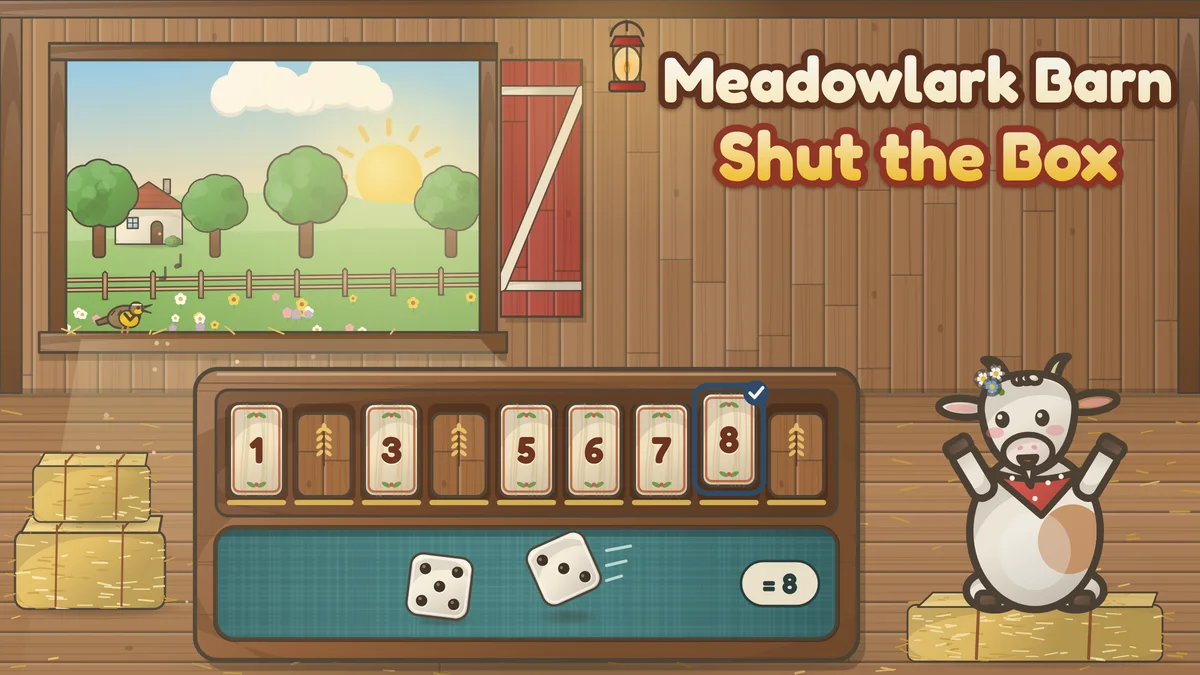
Shut the Box is a dice game for one player or any number taking turns. It is played with a wooden box that holds a row of hinged or sliding tiles numbered 1 to 9, and two ordinary six-sided dice that are rolled into a felt-lined tray inside the box. Each tile can stand open, showing its number, or be flipped down, or shut, once it has been used.
The game has been played for a long time in many places, and its exact origins are not known. It also turns up under other names, such as Batten Down the Hatches, and in boxes with 10 or 12 tiles. The rules below are the most common ones for the classic box of 9, with the usual variants after them.
You do not need a box to play. Write the numbers 1 to 9 on a piece of paper, cross each one out as you shut it, and you have the same game.
What you need and how to set up
You need a box of tiles numbered 1 to 9 (or a sheet of paper with those numbers), two six-sided dice, and something to keep score on if more than one person is playing.
At the start of every round, every tile stands open. That is the whole setup: flip all nine tiles up, pick up the dice, and the first player begins. When several people play, each one plays a full round on a fresh box in turn, and the box is reset before the next player starts.
How a turn works
Roll both dice and add the two numbers together. The total is the number you need to make with the tiles.
Shut any open tiles whose numbers add up to exactly that total. With a roll of 9 at the start, you could shut the 9 on its own, or 8 and 1, or 7 and 2, or 6 and 3, or 5 and 4, or three tiles such as 6, 2 and 1, or 5, 3 and 1, or 4, 3 and 2. You choose which, but the tiles must add up to the roll exactly.
Then roll again and do the same with the tiles that are still open. Keep going, roll after roll, until you roll a total that no combination of open tiles can make. Your round ends right there, and the tiles still standing make your score.
Some totals come up far more often than others. There are 36 equally likely ways for two dice to land, and six of them make 7, but only one makes 2 and only one makes 12. That is why the 7 is easy to use and the 9, which needs one of only four combinations, is harder to shut late in a round.
| Total | Ways out of 36 | Chance |
|---|---|---|
| 2 or 12 | 1 | 2.8% |
| 3 or 11 | 2 | 5.6% |
| 4 or 10 | 3 | 8.3% |
| 5 or 9 | 4 | 11.1% |
| 6 or 8 | 5 | 13.9% |
| 7 | 6 | 16.7% |
Which tiles you may shut
Any combination of open tiles works, as long as the numbers add up to the roll exactly. One tile, two tiles, three or four are all fine. A roll of 6 can shut the 6, or 5 and 1, or 4 and 2, or 3, 2 and 1.
You may only use open tiles, and each tile only once. A tile that is already shut stays shut until the round is over. You cannot split a roll between two turns, carry part of it forward, or shut tiles that add up to less than the roll.
If you can shut something, you must: you cannot pass on a roll that some open tiles can make. When more than one combination works, the choice is yours, and that choice is where all the strategy in the game lives.
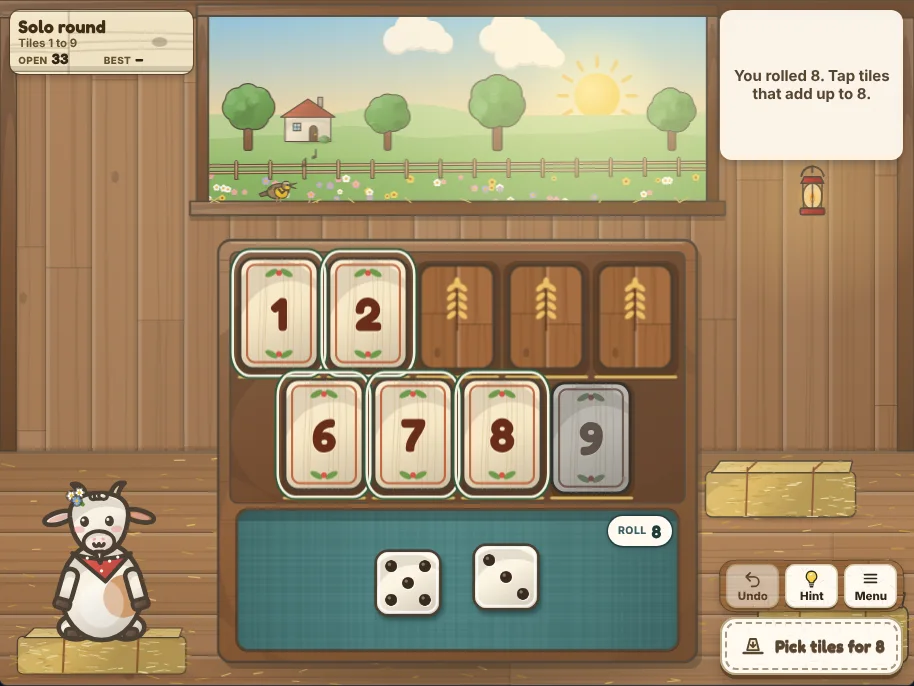
In Meadowlark Barn Shut the Box you tap the tiles you want, and a chip in the tray shows your picks adding up against the roll. Tiles that cannot be part of any combination for the roll are dimmed, and the Shut button only lights up once your picks add up exactly.
The one-die rule
Near the end of a round the open tiles are often small, and two dice, which always total at least 2, can make it hard to finish. So most players allow one die once the big tiles are gone. The most common version: once the 7, 8 and 9 are all shut, you may roll a single die instead of two. Another common version allows one die once the open tiles add up to 6 or less. A stricter house rule always uses two dice.
Rolling one die is always a choice, never a must. You can keep rolling two dice for as long as you like, and as the strategy section shows, two dice are often the better choice even when one die is allowed.
Meadowlark Barn Shut the Box offers all three: Once 7 and up are shut (the default), Once the open tiles total 6 or less, and Always two dice. When one die is allowed, the big button splits into Roll 2 dice and Roll 1 die.
Scoring and winning
When your round ends, add up the tiles that are still open. That total is your score: with 2, 3 and 5 standing, you score 10. Lower is better. The worst possible score is 45, with every tile open, though a round cannot end that way, since your first roll always shuts something. Flipping every tile scores 0, and is called shutting the box.
Playing alone, the aim is simply a low score, round after round, and the rare round that shuts the box.
With other players, everyone plays a round in turn on a fresh box, and the lowest score wins. By the traditional rule, a player who shuts the box wins at once, and the players after them do not roll. Ties can be played off with another round. Families often play several rounds and add up each player’s scores, with the lowest total winning.
Taking turns with Posy in Meadowlark Barn Shut the Box, you play your round and then she plays hers on a fresh box. The lower score wins the round, a tie is replayed, and shutting the box wins the round at once, before Posy rolls. The match goes to whoever first wins a majority of one round, a best of 3 or a best of 5.
Variants
Boxes of 10 and 12. Some boxes have tiles up to 10 or 12, and the rules stay the same. The bigger box is much harder to shut, because the highest tiles can only be made by a few rolls and there are more tiles to clear. Two dice can never total 1, so in these boxes the 1 usually goes as part of a combination, such as 1 and 2 for a roll of 3. With the one-die rule, a 1 left on its own can still be shut with one die. With two dice always, which is how Durango Bill analyzed the 12-tile box in his published study of the game, a lone 1 ends the round.
Digits scoring. Instead of adding the open tiles, read them from smallest to largest as one number, so 2, 3 and 5 left open score 235. A single tile left open is far better than two, whatever their numbers, so the game turns into a race to leave as few tiles as possible. The game offers this for the box of 9.
Other house rules you may meet include counting only how many tiles are left open, allowing at most two tiles per roll, and requiring the tiles to match the two dice separately rather than their total. They are not in the game, but every rule above works the same with a pencil and paper if you want to try them.
| Box | One-die rule | Best chance to shut the box | Lowest average score |
|---|---|---|---|
| 1 to 9 | Once 7 and up are shut | 9.76% (about 1 in 10) | 11.01 |
| 1 to 9 | Always two dice | 7.14% (about 1 in 14) | 11.16 |
| 1 to 10 | Once 7 and up are shut | 5.38% (about 1 in 19) | 16.57 |
| 1 to 10 | Always two dice | 4.04% (about 1 in 25) | 16.65 |
| 1 to 12 | Once 7 and up are shut | 0.47% (about 1 in 211) | 35.08 |
| 1 to 12 | Always two dice | 0.36% (about 1 in 276) | 35.08 |
Controls in Meadowlark Barn Shut the Box
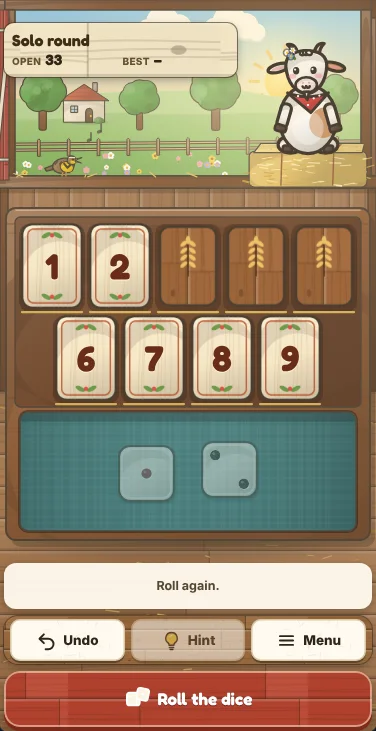
Press the big button at the bottom of the screen to roll, then tap tiles to pick them. Tap a picked tile again to put it back. When your picks add up to the roll, the button turns green and says which tiles it will shut; press it and they flip down. If you prefer, Settings can flip the tiles the moment your picks add up instead.
A tap on a tile that cannot work gets a gentle explanation rather than a buzzer: that the tile is bigger than the roll, that no combination with it adds up, or that your picks already make too much. Nothing is timed.
On a keyboard, the number keys pick tiles (0 for the 10, minus for the 11 and equals for the 12), Space or Enter rolls or shuts, O rolls one die, U undoes and H asks for a hint. Undo puts back your picks, or takes back your last shut before your next roll. The dice never change: every roll comes from a seed saved with your game, so undoing, reloading or coming back later always shows the same roll.
The hint uses the game’s own exact calculation. In a solo round it names the tiles that leave the best chance of shutting the box, and gives that chance; taking turns, it names the tiles that leave the lowest expected score. Statistics are kept for each box and for each of Posy’s levels, and your game is saved on your device as you play.
How strong is each level?
Posy has three levels, and each one plays to a different aim. Gentle picks any combination at random half the time, and otherwise shuts as many tiles as she can, a common beginner habit; she rolls one die whenever she may. Steady follows a simple habit: shut the biggest tiles first, and roll one die whenever she may. Sharp uses the exact calculation to play for the lowest expected score on every roll, including the choice between one die and two.
To check the levels we ran our own simulation of 100,000 rounds for each player on the 1 to 9 box, with one die allowed once 7, 8 and 9 are shut. The exact figures beside them are the game’s own calculation of the same strategies over every possible roll, and the two agree closely, which is a good sign that both are right. The Solo hint, which plays for the best chance to shut the box rather than the lowest score, is included for comparison, along with a player that picks any legal move at random.
Gentle is weaker than random choices on purpose, because shutting lots of small tiles is the habit most beginners have and the one that costs them most. Sharp shuts the box slightly less often than the Solo hint, but scores slightly lower on average, because a low score is what wins a round.
| Player | Average score | Boxes shut | Exact average | Exact chance to shut |
|---|---|---|---|---|
| Gentle | 22.68 | 1,382 (1.38%) | 22.65 | 1.43% |
| Steady | 12.25 | 5,580 (5.58%) | 12.27 | 5.56% |
| Sharp | 11.00 | 9,692 (9.69%) | 11.01 | 9.67% |
| Solo hint | 11.06 | 9,706 (9.71%) | 11.06 | 9.76% |
| Random choices | 20.45 | 2,038 (2.04%) | 20.43 | 2.06% |
Taking turns: how the levels compare
We also played 100,000 single rounds for each pairing in the same simulation, the way a round goes in the game: the first player rolls a full round, then the second plays on a fresh box, and shutting the box wins at once. In the game you always roll first, so the rows that start with a strategy show what you can expect if you play that way against each level.
A player making Sharp’s choices beats Gentle more than four rounds in five, and edges out Steady a little more than half the time. Luck still matters a great deal: even two Sharp players split the rounds almost evenly, and a best of 3 or 5 gives the better player more chances to show it.
| Pairing | Won | Lost | Tied |
|---|---|---|---|
| Sharp against Gentle | 82.59% | 15.53% | 1.88% |
| Steady against Gentle | 80.53% | 17.35% | 2.13% |
| Sharp against Steady | 53.89% | 42.63% | 3.48% |
| Random choices against Gentle | 55.40% | 41.42% | 3.18% |
| Steady against Sharp | 42.99% | 53.46% | 3.55% |
| Gentle against Sharp | 15.40% | 82.70% | 1.90% |
| Sharp against Sharp | 48.67% | 48.05% | 3.29% |
Strategy, with the chances worked out
Because the game is small, it can be solved exactly. For every set of tiles that could still be open (512 of them in the box of 9), the game works out the best choice for every roll, and from that the best possible chance of shutting the box: 9.7614 percent with one die allowed once 7, 8 and 9 are shut, and 7.1432 percent with two dice always. Both match the figures in Durango Bill’s published analysis of the game, as does our 0.3622 percent for the box of 12 with two dice always.
Rule one: when the roll matches an open tile, shut that tile. On the first roll it is the best move for every total from 2 to 9, and usually by a wide margin. A first roll of 8 shut as the 8 leaves an 11.88 percent chance to shut the box; shut as 5 and 3, the chance falls to 5.77 percent.
Rule two: get rid of the big tiles first. On a first roll of 10, 11 or 12 there is no single tile to shut, and the best move pairs the 9 with the smallest tile that works: 1 and 9, 2 and 9, or 3 and 9. Big tiles can only be made by a few rolls, while small tiles fit almost anything, so keep the small ones as change for later.
Rule three: roll one die only when the open tiles add up to 6 or less. The game’s calculation shows this exact line for the best chance to shut the box, in every box size: with 7 or more open, two dice are better even when one die is allowed. With 3 and 4 left, one die can only finish by rolling a 3 and then a 4, or a 4 and then a 3: a 5.56 percent chance. Two dice make the 7 at once in six rolls out of 36, for an 18.98 percent chance in all.
| Roll | Best move | Chance to shut the box after it | Next best move | Its chance |
|---|---|---|---|---|
| 2 | Shut the 2 | 5.71% | None (the only move) | – |
| 3 | Shut the 3 | 6.62% | 1 and 2 | 2.66% |
| 4 | Shut the 4 | 7.39% | 1 and 3 | 3.11% |
| 5 | Shut the 5 | 8.32% | 1 and 4 | 3.55% |
| 6 | Shut the 6 | 9.00% | 1 and 5 | 4.32% |
| 7 | Shut the 7 | 9.82% | 2 and 5 | 4.80% |
| 8 | Shut the 8 | 11.88% | 3 and 5 | 5.77% |
| 9 | Shut the 9 | 14.50% | 1 and 8 | 6.51% |
| 10 | 1 and 9 | 8.69% | 2 and 8 | 7.40% |
| 11 | 2 and 9 | 9.47% | 3 and 8 | 8.34% |
| 12 | 3 and 9 | 10.74% | 4 and 8 | 9.74% |
Common mistakes
Shutting as many tiles as possible. It feels like progress to flip three or four small tiles at once, but it leaves the 7, 8 and 9 standing and nothing small to finish with. By our exact calculation, a player who always shuts the most tiles averages a score of about 24 and shuts the box about 1 round in 94, against about 11 and 1 in 10 for best play.
Rolling one die as soon as you are allowed. Once the 7, 8 and 9 are gone it is tempting to switch to one die at once, but with 7 or more still open, two dice give the better chance. Shutting the biggest tiles first but switching to one die the moment you may cuts your chance to shut the box from 9.48 to 5.56 percent, by the same calculation.
Saving the 9 for a big roll. A 9 can only be made by four of the 36 rolls once the smaller tiles that pair with it are gone, so it is often the tile that ends your round. Take it when the roll is 9, or with a small partner on 10 to 12.
Forgetting that you must shut something. If a combination is open, you have to use it, even if you would rather wait for a better roll. Check every combination before you declare a round over: it is easy to miss that 1, 2 and 4 make 7.
| How you choose | Chance to shut the box | Average score |
|---|---|---|
| The best choice for the chance to shut the box | 9.76% | 11.06 |
| The best choice for the lowest score | 9.67% | 11.01 |
| Fewest tiles each time, one die only at 6 or less | 9.56% | 11.19 |
| Biggest tile first, one die only at 6 or less | 9.48% | 11.24 |
| Biggest tile first, one die whenever allowed | 5.56% | 12.27 |
| Any legal choice at random | 2.06% | 20.43 |
| Most tiles each time, one die whenever allowed | 1.06% | 24.23 |
Tips for lower scores
Think in totals, not tiles. Before you shut anything, glance at what will be left. Tiles that add up to a common roll, such as 7 or 8, and that can be made several ways, give the next roll more chances to work.
Play for the score when it matters. Alone, you might chase the shut box. Taking turns, a safe low score usually wins more rounds than a bold try that leaves the 9 standing. The two aims rarely disagree, but when they do, the game’s match hints play for the score.
Use undo and the hint to learn. Undo takes back your last shut before you roll again, with the same dice still showing, so you can compare your choice with the hint’s and see the difference in the chance it reports.
Try the variants once the classic box feels easy. Always two dice makes the end of a round tense, digits scoring rewards leaving a single tile, and the box of 12 is a real challenge: even perfect play shuts it only about once in 211 rounds.
Related games
If you like the quick decisions of Shut the Box, try Kingfisher Canal Checkers for a calm board game against a computer neighbor, Sunflower Mill Mancala for another counting game with a friendly opponent, or Sprout Sudoku for numbers without the dice. For cards, Birch Cove Gin Rummy and Kettle Burrow Hearts keep the same gentle pace, and the guides linked below explain each one.
Keep playing
Shut the Box comes down to two habits: flip the big tiles while the dice can still make them, and keep the small tiles as change for the end of the round. Add a third, roll one die only when the open tiles add up to 6 or less, and you are playing within a whisker of perfect. Start a few solo rounds, use the hint to compare your choices with the exact best ones, then take turns with Posy at Gentle and work up to Sharp. For more classic games, try Kingfisher Canal Checkers, our board game against Otis the otter; Sunflower Mill Mancala, our seed-sowing game; Sprout Sudoku, with hints that explain the next step; or Birch Cove Gin Rummy, our two-player card game.
- Play Meadowlark Barn Shut the Box
- Meadowlark Barn Shut the Box: features, controls and FAQ
- Kingfisher Canal Checkers: classic checkers on a canal boat
- Sunflower Mill Mancala: sow seeds around a carved board
- Sprout Sudoku: classic 9x9 puzzles with helpful hints
- Birch Cove Gin Rummy: the classic two-player card game
- How to play checkers: rules, setup and strategy
- How to play mancala: rules, setup and strategy
- How to play gin rummy: rules and scoring
- How to play Hearts: rules, scoring and strategy
- How to play Klondike solitaire: setup and rules
- How to play FreeCell solitaire: setup and rules
- How to play Pyramid solitaire: setup and rules
More guides and roundups
Match mahjong tiles, solve sudoku and killer sudoku, stitch a nonogram, find hidden words, fit a jigsaw, rake leaf piles, sort shells, merge fruit or crack firefly codes. Choose a puzzle by the decisions it asks you to make.
Free Online Games for Seniors and Older AdultsFree online games for seniors and older adults: solitaire, mahjong, word search, sudoku, jigsaw and nonograms that open in a browser, with no countdown, no accounts and no purchases. Here is how the eight compare on round length, timers and help.
How to Play Sudoku: Rules, Techniques and HintsHow to play sudoku, from the rules and a first puzzle to what easy, medium, hard and expert mean, plus every technique Sprout Sudoku uses and how its hints and garden work.
Leaf Pile Nap Guide: Rules, Shapes and HintsThe rules of Leaf Pile Nap, how the animal shapes and the no-touch rule let you solve every garden without guessing, and how blankets, acorns, stars, hints and the daily garden work.