Cozy Classic
Free Shut the Box
Meadowlark Barn Shut the Box
Shut the Box with big tiles you tap to pick, a running total of your picks, dice fixed by a seed so a reload never rerolls, hints from an exact calculation of every position, and Posy the goat as a neighbor to take turns with at three levels.
What you do
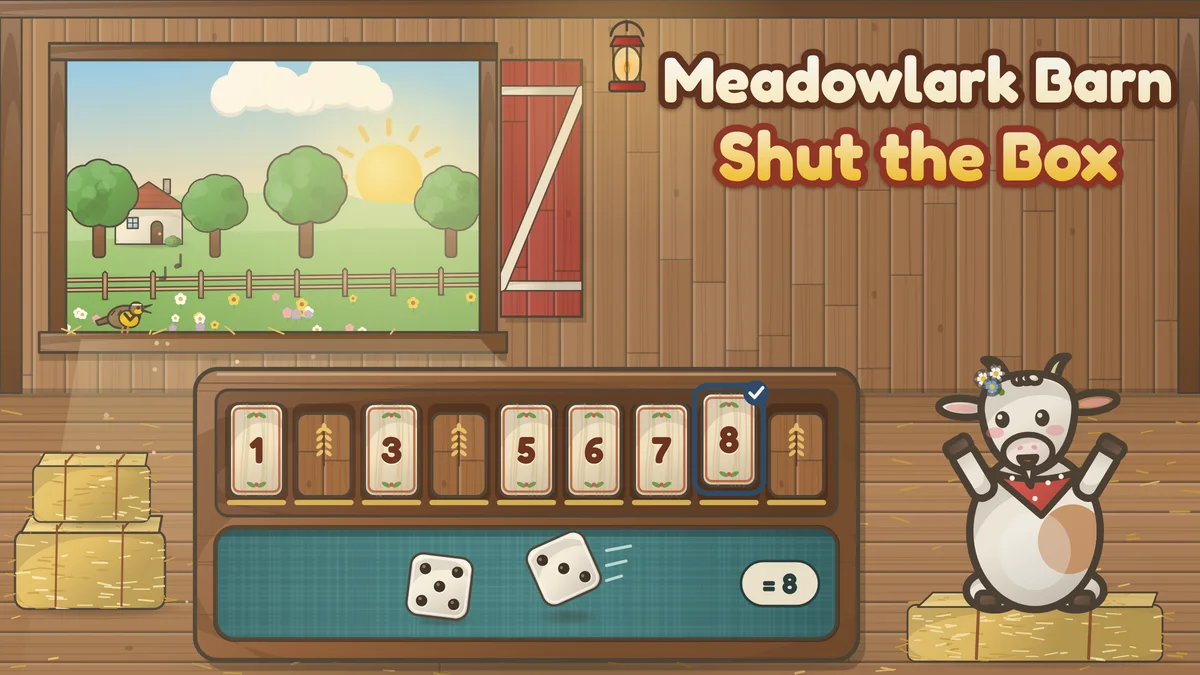
Meadowlark Barn Shut the Box is the traditional dice-and-tiles game, played in the hayloft of a red barn at golden hour. The big loft door stands open onto rolling hills and a farmhouse, a meadowlark sings on the sill, a tin lantern glows from the beam, and the wooden box sits on the floor boards with its row of cream tiles and a teal felt tray for the dice. Each round you roll two dice and shut any open tiles that add up to the roll, one tile or several, then roll again, until a roll comes up that no open tiles can make. What is left open is your score, and lower is better; shut every tile and you have shut the box. Your neighbor is Posy, a white goat with a tan patch, small curved horns, a red bandana and a posy of daisies tucked by one horn, who sits on a hay bale, shakes the dice in her hooves on her own turn, gasps at your doubles and cheers when a box comes shut.
- Solo rounds with statistics for each box (rounds, average score, boxes shut and your best), or take turns with Posy: you play a round, she plays hers on a fresh box, and the lower score wins, over one round or a best of 3 or 5.
- Three levels for Posy. Gentle often shuts whatever catches her eye and likes shutting lots of small tiles. Steady follows a simple habit: biggest tiles first, and one die whenever she may. Sharp plays the exact choice for the lowest expected score on every roll.
- Hints from the game’s own exact calculation over every position. In Solo they name the choice with the best chance of shutting the box and give that chance; taking turns, they name the choice with the lowest expected score.
- Tap tiles to pick them and watch the total build to the roll, then press Shut, or let the tiles flip the moment they add up. Tiles that cannot be part of any set for the roll are dimmed, and a tap on one explains why.
- The classic 1 to 9 box, or boxes of 10 and 12. One die once 7 and up are shut (the common rule), once the open tiles add up to 6 or less, or always two dice. A digits scoring variant for the 1 to 9 box.
- Every roll comes from a seed saved with your game, so undo never rerolls and a reload shows the same dice. Three speeds for the dice and tiles, reduced motion support and a saved game in this browser.
How to play
- Press Play and choose Solo or Take turns with Posy. The box holds tiles numbered 1 to 9, all standing open.
- Roll the dice and add them up. Then tap open tiles that add up to that number: one tile or several. A roll of 9 can shut the 9, or 6 and 3, or 5 and 4, or 4, 3 and 2, among others. Press Shut, and the tiles flip down.
- Roll again and keep going. Once every tile from 7 up is shut, you may roll one die instead of two if you like.
- The round ends when a roll comes up that no open tiles can make. Your score is the open tiles added up, so 2, 3 and 5 left open score 10. Lower is better, and shutting every tile scores 0: you have shut the box.
- Taking turns, Posy then plays her round on a fresh box. The lower score wins the round, a tie is replayed, and shutting the box wins the round at once.
Controls
- Touch or mouse: the big button at the bottom rolls the dice (or one die, when you may), and becomes Shut once you have picked tiles that add up to the roll. Tap a tile to pick it and tap it again to put it back. Undo, Hint and Menu sit on the shelf above the button, or in the right-hand strip on a wide screen.
- Keyboard: the number keys pick tiles (0 for the 10, minus for the 11 and equals for the 12), and Space or Enter rolls or shuts. O rolls one die when you may, U undoes, H shows a hint and Escape clears your picks. The arrow keys also move a visible focus between the tiles.
- Restart in the toolbar starts a new game. Menu starts a new game, opens Settings (mode, box, one-die rule, scoring, Posy’s level, match length, speed and how picks are confirmed) and shows your statistics and the rules. The toolbar also has pause, help, optional sound and fullscreen.
Tips worth knowing
- When the roll matches an open tile, shut that single tile. On the very first roll, the game’s exact calculation says the single tile is the best choice for every roll from 2 to 9, for both the chance of shutting the box and the expected score.
- Get the big tiles down early. They can only be made by a few rolls, and a 9 left near the end is shut by just 4 rolls in 36. On a first roll of 10, 11 or 12, the best move is to pair the 9 with the smallest tile you can: 1 and 9, 2 and 9, or 3 and 9.
- Avoid shutting lots of small tiles at once. The small tiles are your flexible change for the end of the round. A player who always shuts the most tiles possible scores about 24 on average, by our exact count, against about 11 for best play.
- Be choosy about rolling one die. Being allowed to does not make it better: the game’s calculation shows one die gives the better chance of shutting the box exactly when the open tiles add up to 6 or less, and two dice are better from 7 up.
- Taking turns, play for a low score rather than an all-or-nothing box, unless you need it. Sharp and the match hints aim for the lowest expected score, while the Solo hints aim for the best chance of shutting the box, and the two aims sometimes pick different tiles.
- Use undo to compare. It takes back your last shut before your next roll, and the same dice wait for a new choice, so you can try the hint’s choice against your own.
Accessibility
- Everything can be played with a keyboard: the number keys pick tiles, Space or Enter rolls or shuts, O rolls one die, U undoes, H shows a hint, and the arrow keys move a visible focus between the tiles.
- Each tile is labeled for screen readers with its number, whether it is open or shut, picked, or not part of any set for the roll, and each roll is announced with its dice and total.
- Open and shut tiles differ in more than color: an open tile shows its number on a cream board and a shut tile shows a wooden back with a wheat sprig. Picked tiles lift with a thick ring and a check mark, and Posy’s picks wear a dashed ring.
- Nothing is timed. Posy waits while a menu is open, and a wrong tap only brings a gentle explanation.
- Reduced motion lands the dice at once and flips the tiles without animation, stops the pulsing highlights and Posy’s fidgeting, and leaves out the dust and petals. Sound is optional and never needed to play.
Questions
How often can you shut the box?
With the best possible play in the classic 1 to 9 box, about 1 round in 10. The game’s own exact calculation over every position gives 9.7614 percent when one die is allowed once 7, 8 and 9 are shut, and 7.1432 percent with two dice always. Both match the figures Durango Bill published. His one-die rule, once the open tiles add up to 6 or less, gives the same best chance, because best play only rolls one die at that point anyway. The boxes of 10 and 12 are much harder: 5.38 and 0.47 percent with the one-die rule, by the same calculation.
How strong is each level?
We measured Posy with our own simulation of 100,000 rounds for each level, on the 1 to 9 box with the default rules. Gentle averaged 22.68 and shut the box in 1.38 percent of rounds, Steady averaged 12.25 and shut it in 5.58 percent, and Sharp averaged 11.00 and shut it in 9.69 percent. Taking turns, a player making Sharp’s choices and rolling first, as you do, won 82.59 percent of rounds against Gentle and 53.89 percent against Steady. These are computer players, so treat the numbers as a guide.
What does the hint percentage mean?
It is the game’s own calculation, not a guess. For every set of tiles that could still be open, the game works out the best result over every possible roll, so a hint that shutting the 8 on a first roll of 8 leaves an 11.9 percent chance to shut the box is exact for the rules you chose. In Solo the hint aims for the best chance of shutting the box; taking turns, it aims for the lowest expected score.
How does the box of 12 handle the 1?
Two dice can never add up to 1, so in the 1 to 12 box the 1 goes as part of a set, such as 1 and 2 for a roll of 3. With the one-die rule, a 1 left on its own can still be shut with one die. With the Always two dice setting, which is the version Durango Bill analyzed for the 12-tile box, a lone 1 ends the round; the game’s calculation matches his 0.3622 percent chance of shutting that box.
Can a reload or an undo change the dice?
No. Every roll in a game comes from a seed that is saved with it, along with every move, and the game rebuilds the round from them when you come back. Undo takes back your last shut before your next roll and leaves the same dice showing, so you choose again with the same roll.
What does the game save?
Your settings, the game in progress, and your statistics, all in this browser’s local storage: for Solo, the rounds, average, boxes shut and best score for each box; for taking turns, the matches and rounds won and lost against each of Posy’s levels. There is no account.