
CozyWorld game guide · By CozyWorld
This guide covers our own game, written from the current game rules and browser checks.
How to Play Farkle: Rules, Scoring and Strategy
Farkle is the six-dice game where you set aside dice that score and decide, throw after throw, whether to bank your points or push on. Here are the rules, the full scoring chart, hot dice and the final round, the common house rules, and strategy with the chances worked out exactly.
How do you play Farkle? You throw six dice, set aside the ones that score, and then choose: bank the points you have built this turn, or throw the dice that are left to build more. A throw where nothing scores is a farkle, and every point from that turn is lost. The first player to 10,000 sets off a final round, and the highest score wins. It takes a minute to learn, and every throw asks the same small question: stop now, or one more?
This guide covers the Farkle rules in full: what you need, how a turn works, the farkle dice game scoring chart, hot dice, the final round and the common house rules. Then it explains the controls in Thimbleberry Camp Dice, where you can play Farkle online free against three camp friends or on your own, followed by strategy with real numbers, the most common mistakes and a few tips. Every chance quoted here is either worked out exactly by the game’s own calculation or comes from our own simulation, and each is labeled as such.
What is Farkle?
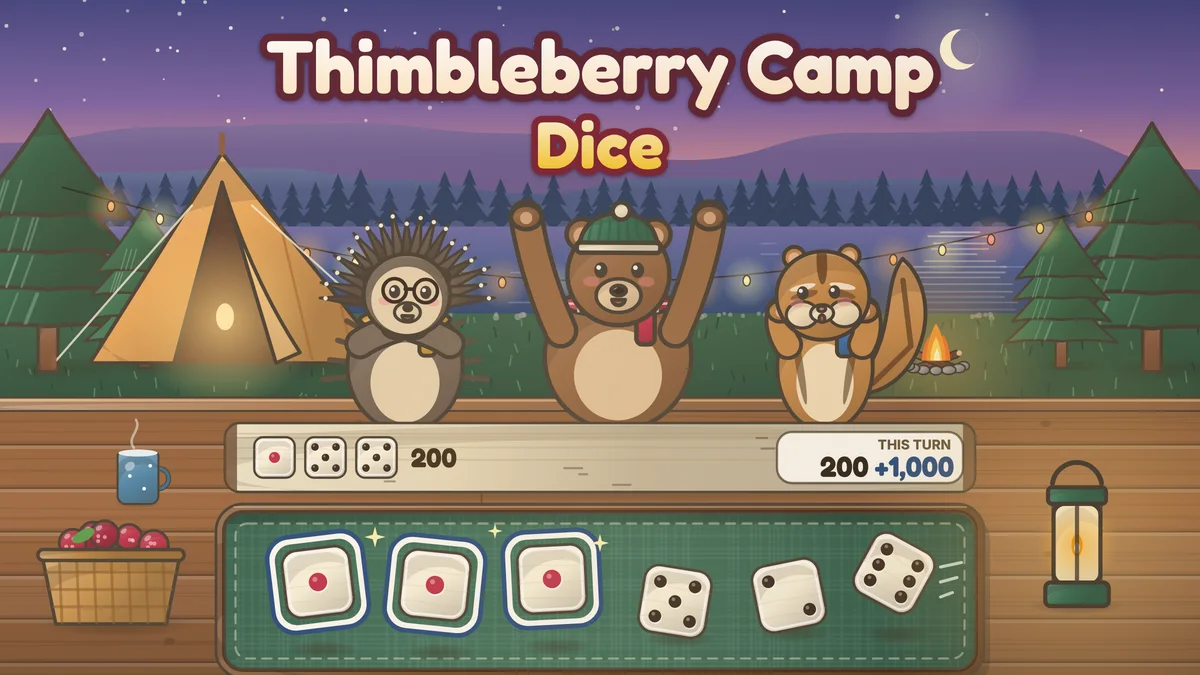
Farkle is a dice game for two or more players, or for one player trying to reach the target in as few turns as possible. It uses six ordinary dice and a score sheet. On your turn you throw the dice, keep some that score, and keep throwing the rest for as long as you dare. The tension comes from the farkle: a throw with nothing that scores wipes out the whole turn.
The game goes by many names. Ten Thousand, Hot Dice, Zilch, Zonk, Greed and Dix Mille are all in use for the same game or close relatives, and the scoring varies from table to table. Its origins are uncertain: Wikipedia’s article reports the belief that it arrived on French sailing ships in the 1600s, and gives other origin stories that are not considered credible.
The rules below use the scoring found on most published score sheets, and the common house rules come after them.
What you need and how to set up
You need six six-sided dice, a pencil and a sheet of paper for the scores, and a cup or tray to throw into if you like. Write each player’s name at the top of a column. Everyone starts at 0.
To choose who goes first, a common way is for each player to throw one die; the highest throw starts, and play passes to the left. In Thimbleberry Camp Dice you always throw first, and the campers follow around the table.
How a turn works
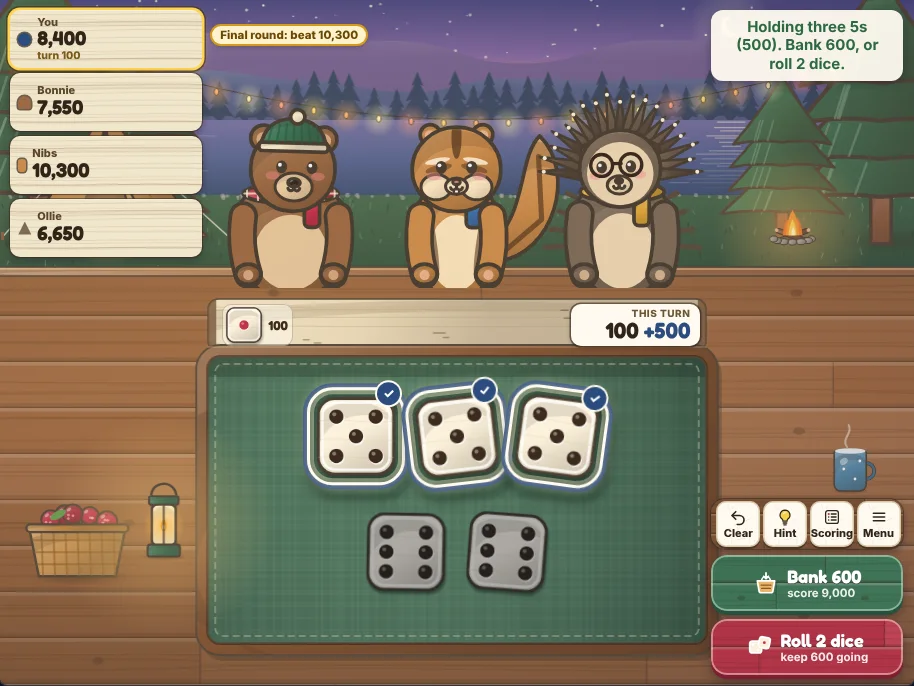
Throw all six dice. Look for dice that score: each 1, each 5, and any three or more of a kind (the full chart is in the next section). You must set aside at least one scoring die after every throw. You may set aside more, but you never have to set aside every die that could score.
Then choose. Bank, and the points you have set aside this turn go onto your score, safe for good. Or throw the dice that are left to add more. If that throw has nothing at all that scores, it is a farkle: your turn ends at once and every point you set aside this turn is lost. Points banked on earlier turns are never at risk.
Here is a sample turn. The first throw shows 1, 3, 3, 4, 6 and 6. Only the 1 scores, so you set it aside for 100 and throw the other five. They show 2, 2, 2, 5 and 6: three 2s are 200 and the 5 is 50, so you set all four aside and your turn is worth 350, with one die left. You could bank 350 now, or throw the last die hoping for a 1 or a 5, with a two in three chance of losing the 350.
Each combination must come from a single throw. A 5 set aside from one throw and two 5s from the next count 50 and 100, for 150 in all, not 500 for three 5s.
Farkle scoring chart
Single 1s and 5s always score. The other numbers score only as three of a kind or more. Three of a kind is worth 100 times the number, except three 1s, which are worth 1,000. Bigger sets and the special combinations of all six dice are worth more, as the chart shows.
When the dice you set aside could be counted in more than one way, they count the way that scores the most. Four 2s and a pair of 6s, for example, count as three pairs for 1,500 rather than four of a kind for 1,000, and four 1s count as three 1s and a single 1 for 1,100. This is the default scoring in Thimbleberry Camp Dice, and the chart is always one tap away in the game.
| Dice | Points |
|---|---|
| Each 1 | 100 |
| Each 5 | 50 |
| Three 1s | 1,000 |
| Three 2s | 200 |
| Three 3s | 300 |
| Three 4s | 400 |
| Three 5s | 500 |
| Three 6s | 600 |
| Four of a kind | 1,000 |
| Five of a kind | 2,000 |
| Six of a kind | 3,000 |
| Straight 1, 2, 3, 4, 5, 6 | 1,500 |
| Three pairs | 1,500 |
| Four of a kind with a pair | 1,500 |
| Two triplets | 2,500 |
Farkles and hot dice
The fewer dice you throw, the more likely a farkle. With all six dice it almost never happens; with one die it happens two times in three. The table gives the exact chances, counted by the game over every way the dice can land.
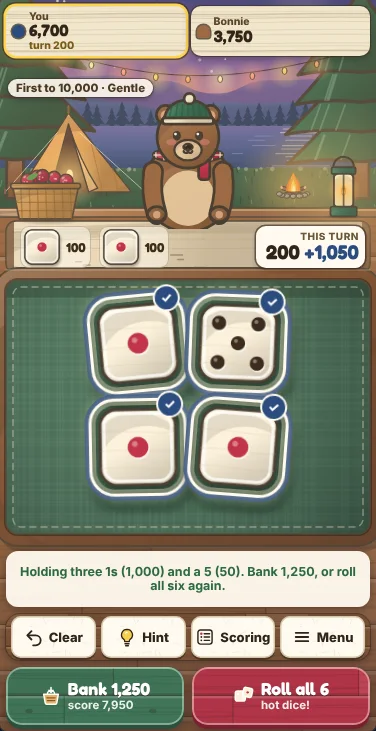
Hot dice is the happy opposite. If you manage to set aside all six dice, in one throw or over several, you may pick up all six and throw them again, keeping the points you have built this turn. There is no limit on how often it can happen in one turn. Hot dice is always a choice: you may bank instead, though throwing six dice again is almost always the better play.
| Dice thrown | Ways with nothing that scores | Chance of a farkle | Chance something scores |
|---|---|---|---|
| 1 | 4 of 6 | 66.67% | 33.33% |
| 2 | 16 of 36 | 44.44% | 55.56% |
| 3 | 60 of 216 | 27.78% | 72.22% |
| 4 | 204 of 1,296 | 15.74% | 84.26% |
| 5 | 600 of 7,776 | 7.72% | 92.28% |
| 6 | 1,080 of 46,656 | 2.31% | 97.69% |
Winning and the final round
The game is usually played to 10,000 points. When a player banks enough to reach 10,000 or more, every other player gets one last turn to beat that score. The highest score after the final round wins. If two players tie for the top, Thimbleberry Camp Dice calls it a shared win.
The final round changes how you play. If you are behind, the averages no longer matter: you need to pass the leader in this one turn, so you keep throwing until you do or until you farkle. A shorter game to 5,000 works the same way.
House rules and variants
Farkle has many house rules, and it is worth agreeing on them before the first throw. These are the common ones, and the first four are settings in Thimbleberry Camp Dice.
Getting on the board. Many players require a minimum opening score, usually 500 and sometimes 1,000, in a single turn before your first bank. Until you reach it, you must keep throwing or farkle trying.
Four, five and six of a kind. Instead of the fixed 1,000, 2,000 and 3,000, some tables double three of a kind for each extra die (four 3s are 600, five 3s 1,200), and others add three of a kind again for each extra die (four 3s are 600, five 3s 900).
The straight. Some published tables, Wikipedia’s among them, value a straight 1 to 6 at 2,500 rather than 1,500.
Three farkles in a row. Some players take a penalty, often 500 or 1,000 points, from anyone who farkles three turns in a row. In the game the penalty never takes a score below zero.
Other variants you may meet: three 1s worth only 300, three pairs worth 750, a short straight of five dice, a bonus of 500 for six dice with nothing that scores, and a target other than 10,000.
Controls in Thimbleberry Camp Dice
Press Roll to throw the dice. The dice that can score wear gold rings; tap a die to hold it and tap it again to put it back. The chip at the end of the birch board shows the turn so far plus what you are holding, and the two big buttons at the bottom say exactly what they will do: Bank and the total, or Roll and how many dice are left. Clear puts back everything you are holding.
A tap on a die that cannot score gets a gentle explanation, and if you hold one die of a three of a kind, the rest of the set is held with it. Nothing is timed, and the campers wait while a menu is open.
On a keyboard, the number keys 1 to 6 hold dice, A holds every die that scores, Space, Enter or R rolls and B banks. H shows a hint, S opens the scoring chart, and U or Escape puts back what you are holding.
The hint names every die that scores in the throw, then the best keep and the best move by the game’s own expected-points calculation, with the reason in numbers: what throwing on is worth on average against the points you would bank, or, in the final round, your chance of passing the leader. Every throw is fixed by the game’s seed when it is made, so reloading never throws again, and your game and statistics are saved in this browser.
How strong is each level?
The campers play at three levels. Gentle keeps every scoring die and pushes on until the turn is worth 1,000, so it farkles often. Steady follows a common rule of thumb: keep the most points, roll on with four or more dice, and with three or fewer bank at 300. Sharp chooses its dice and when to bank by the game’s own expected-points calculation for every throw.
To measure them we ran our own simulation of 100,000 turns for each player, in solo games to 10,000 with the default scoring, alongside three simple newcomer habits that keep every scoring die and bank at 250, 350 or 500. The exact column is the game’s own calculation of the same policy over every possible throw, for a turn with no target in sight; the two agree closely. Sharp scores a little under its exact figure in the simulation because, near the end of a solo game, it plays to reach 10,000 rather than for points beyond it.
Keeping every scoring die is a costly habit. All three newcomer habits keep everything and score well below Sharp, and the higher they set the bar for banking, the worse they do.
| Player | Points per turn | Exact points per turn | Turns ending in a farkle | Turns to reach 10,000 |
|---|---|---|---|---|
| Gentle | 401.37 | 400.11 | 69.55% | 26.64 |
| Steady | 548.01 | 547.67 | 20.66% | 19.28 |
| Sharp | 592.94 | 601.56 | 20.43% | 17.52 |
| Keep everything, bank at 250 | 495.84 | 495.81 | 12.54% | 21.00 |
| Keep everything, bank at 350 | 476.44 | 476.17 | 28.72% | 21.91 |
| Keep everything, bank at 500 | 449.53 | 450.09 | 49.11% | 23.40 |
| Random choices | 215.36 | – | 20.56% | 47.75 |
Playing the campers: how the levels compare
We also played 10,000 two-player games to 10,000 for each pairing in the same simulation, with the seats swapped every game so neither player always throws first. A newcomer habit wins about two games in three against Gentle, which is what Gentle is for, and about one in three against Steady. Sharp beats Steady about three games in five; the dice still decide a great deal, and two Sharp players split their games almost evenly.
With more campers at the table, winning is harder simply because there are more players. In 5,000 four-player games each, the bank-at-350 habit won 36.18 percent against three Gentle campers, 12.04 percent against three Steady and 7.72 percent against three Sharp, where an even share would be 25 percent.
| Pairing | Won | Shared | Lost |
|---|---|---|---|
| Bank at 250 against Gentle | 69.94% | 0.00% | 30.06% |
| Bank at 350 against Gentle | 66.49% | 0.00% | 33.51% |
| Bank at 500 against Gentle | 60.43% | 0.00% | 39.57% |
| Bank at 350 against Steady | 35.20% | 0.00% | 64.80% |
| Steady against Gentle | 75.94% | 0.00% | 24.06% |
| Sharp against Gentle | 82.76% | 0.06% | 17.18% |
| Sharp against Steady | 60.35% | 0.19% | 39.46% |
| Sharp against bank at 350 | 74.28% | 0.23% | 25.49% |
| Sharp against Sharp | 49.43% | 0.53% | 50.04% |
Strategy, with the numbers worked out
Farkle is small enough to work out exactly. For every number of dice and every turn total, the game calculates the average final value of banking and of throwing on, over every way the dice can land. With the default scoring, a turn played this way is worth 601.56 points on average. The table shows when that calculation banks.
Rule one: bank sooner with few dice and later with many. With one die left the calculation banks from 350, with two from 300 and with three from 450. With four dice it throws on until the turn is worth 1,050, with five until 3,100, and with six (hot dice) until 18,400, which in practice means always.
Rule two: you do not have to keep every scoring die. On a first throw of 1, 1, 2, 3, 4 and 6, keeping one 1 and throwing five dice is worth 404 points on average, against 347 for keeping both 1s and throwing four. On a first throw of 2, 2, 2, 3, 5 and 6, keeping just the 5 and throwing five dice is worth about 369, against about 251 for keeping three 2s and the 5 with two dice left.
Rule three: a small turn with one die left is worth a throw. With 300 or less and one die, throwing it is worth more on average than banking, because a 1 or a 5 gives you hot dice and all six dice back.
| Dice left to throw | Chance of a farkle | Bank once the turn is worth |
|---|---|---|
| 1 | 66.67% | 350 |
| 2 | 44.44% | 300 |
| 3 | 27.78% | 450 |
| 4 | 15.74% | 1,050 |
| 5 | 7.72% | 3,100 |
| 6 (hot dice) | 2.31% | 18,400 |
Common mistakes
Keeping every scoring die. Each die you set aside is one fewer to throw, and fewer dice farkle more often. A lone 5 is often worth leaving on the table when it lets you throw five dice instead of four.
Throwing two dice for a few hundred points. Two dice farkle 44.44 percent of the time. With 300 or more in the turn and two dice left, the calculation banks.
Banking with hot dice. Six dice farkle only 2.31 percent of the time, so throwing them again is almost always right, whatever you have built.
Counting across throws. A combination must come from one throw: a 5 from this throw and two 5s from the next are 150, not a three of a kind.
Banking short in the final round. If you are behind when the final round starts, a bank that leaves you below the leader loses the game. Keep throwing until you pass them.
Tips for bigger turns
Count the dice, not just the points. The same 400 is a bank with two dice left and a throw with five.
Respect the opening score. With 500 to get on the board, a turn before your first bank is worth 580.90 on average by the game’s calculation, and 504.35 with 1,000, against 601.56 once you are on.
Play the score, not just the averages. When a camper nears 10,000, a bigger turn now is worth more than a safe one, and the hint’s numbers show how far to push.
Use the hints to learn. Each one names the dice that score and the best play with its numbers, and the statistics keep your points per turn and farkle rate for every level.
Related games
If you like the quick decisions of Farkle, try Meadowlark Barn Shut the Box for another classic dice game with a friendly neighbor, Sunflower Mill Mancala for a calm counting game, or Kingfisher Canal Checkers for a board game against a computer opponent. For cards, Birch Cove Gin Rummy and Kettle Burrow Hearts keep the same gentle pace, and the guides linked below explain each one.
Keep playing
Farkle rewards two habits: keep fewer dice than you could when it lets you throw more of them, and bank sooner when you are down to two or three dice. Add a third, always throw when you have hot dice, and you are close to the best play the game’s calculation can find. Start a solo game to learn the scoring with the hints, then sit down with Bonnie at Gentle and work up to the whole camp at Sharp. For another quick dice game, try Meadowlark Barn Shut the Box; for cards, Birch Cove Gin Rummy and Kettle Burrow Hearts keep the same easy pace.
- Play Thimbleberry Camp Dice
- Thimbleberry Camp Dice: features, controls and FAQ
- Meadowlark Barn Shut the Box: the classic dice-and-tiles game
- Birch Cove Gin Rummy: the classic two-player card game
- Sunflower Mill Mancala: sow seeds around a carved board
- Kingfisher Canal Checkers: classic checkers on a canal boat
- How to play Shut the Box: rules and strategy
- How to play gin rummy: rules and scoring
- How to play Hearts: rules, scoring and strategy
- How to play mancala: rules, setup and strategy
- How to play checkers: rules, setup and strategy
More guides and roundups
Backgammon is the two-player race game of checkers, dice and the doubling cube. Here is how to set up the board, how the opening roll and moving work, the rule for using both dice, hitting and entering from the bar, bearing off, gammons and backgammons, the cube and the Crawford rule, how strong each level of our computer opponent is, and the basic strategy, common mistakes and tips that win more games.
How to Play Chinese Checkers: Rules and StrategyChinese checkers is the race across a six-pointed star: step or hop your ten marbles into the point opposite before anyone else fills theirs. Here is how to set up for two, three, four or six players, how steps and hop chains work, how a game is won, what to do about marbles left in your home, how strong each level of our computer players is, and the strategy that wins more races.
How to Play Four in a Row: Rules and StrategyFour in a Row is the two-player game of dropping discs into an upright rack and lining up four. Here is how to set up, how a turn works, how a game is won or drawn, what the solved game says about going first, how strong each level of our computer opponent is, and the strategy that wins more games: the middle column, threats and blocks, and odd and even rows.
How to Play Dots and Boxes: Rules and StrategyDots and boxes is the pencil-and-paper game of joining dots and claiming boxes. Here are the rules, board sizes and extra turns, then the strategy that wins: safe lines, chains, leaving the last two boxes and the long chain rule, with how strong each level of our computer opponent is.