
CozyWorld game guide · By CozyWorld
This guide covers our own game, written from the current game rules and browser checks.
How to Play Four in a Row: Rules and Strategy
Four in a Row is the two-player game of dropping discs into an upright rack and lining up four. Here is how to set up, how a turn works, how a game is won or drawn, what the solved game says about going first, how strong each level of our computer opponent is, and the strategy that wins more games: the middle column, threats and blocks, and odd and even rows.
How do you play Four in a Row? Two players take turns dropping discs into an upright rack of 7 columns and 6 rows. Each disc falls to the lowest empty space in its column, and the first player to line up four of their own discs, across, up and down or on a slant, wins. The rules take a minute to learn and a game takes about five, but good play takes much longer to learn, because every disc changes which spaces the other player can reach.
This guide covers the standard rules: the rack, dropping a disc, winning, draws, the common house rules, and what the solved game says about going first. Then it shows the controls in Peach Lane Four in a Row (CozyWorld’s free Four in a Row game against Tansy the hen, at a summer fruit stand), how strong each of Tansy’s levels is, and the strategy that wins more games: the middle column, threats and blocks, and odd and even rows. The rules and the solved-game facts come from Wikipedia’s article on the game and the sources it cites, and the odd and even rows from class notes on MIT OpenCourseWare. The level strengths, line counts and row figures come from our own simulation and counting, and each is labeled as such.
What you need and how to set up
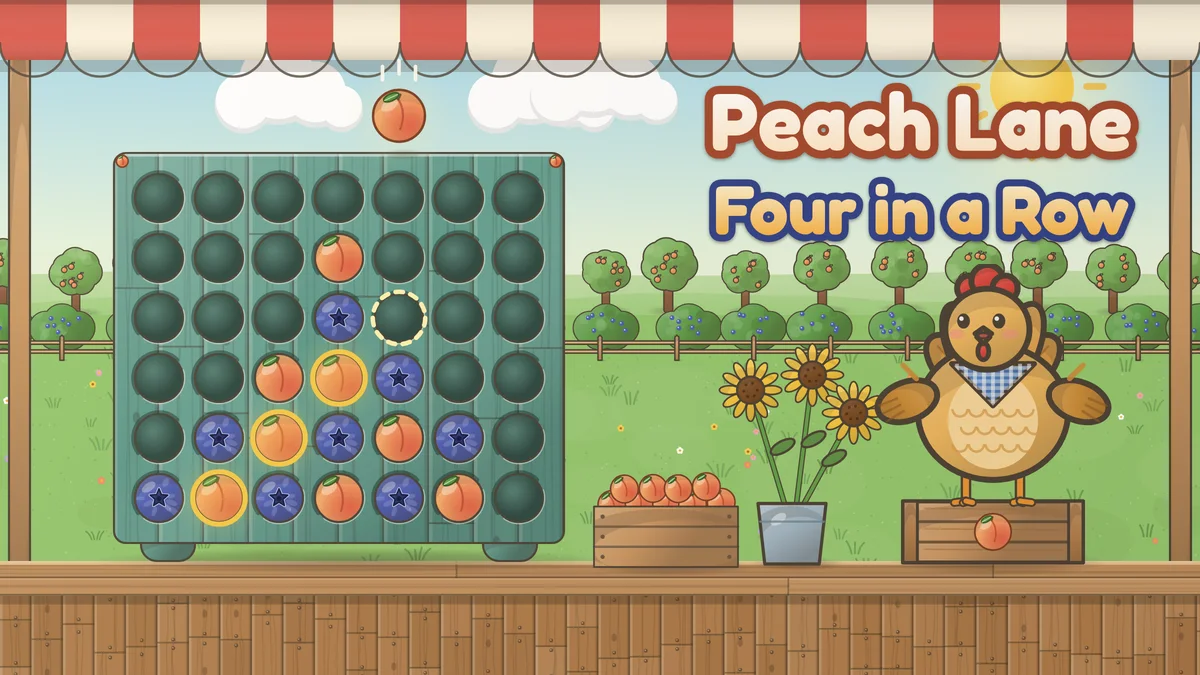
Four in a Row is played on an upright rack of 7 columns and 6 rows, 42 spaces in all. The rack stands on its edge between the two players and is open at the top of every column, so a disc dropped in at the top slides down inside it. Each player has 21 discs of one color, enough to fill half the rack.
The game goes by many names, among them Four in a Row, Four Up and Captain’s Mistress, the oldest of them. The rules are the same under every name.
To set up, check that the rack is empty, stand it on a level table and give each player their discs. The players agree who goes first. Going first is an advantage, as the section on the solved game explains, so it is fair to take turns from game to game.
In Peach Lane Four in a Row the rack stands on the counter of a roadside fruit stand, and the discs are fruit: you drop the peaches and Tansy the hen drops the blueberries. A basket for each side shows how many of its 21 discs are left. You go first unless you choose otherwise in Settings, where Tansy can go first or the two of you can swap every game.
| How many | |
|---|---|
| Columns | 7 |
| Rows | 6 |
| Spaces | 42 |
| Discs for each player | 21 |
| Possible lines of four | 69: 24 across, 21 up and down, 24 on a slant |
Four in a Row rules: dropping a disc
Players take turns. On your turn you drop one disc into the top of any column that is not full. The disc falls to the lowest empty space in that column, on top of any discs already there. You choose the column but never the row: the rack decides that, which is what makes the game so different from tic-tac-toe on a grid.
You must drop a disc on every turn, and you may not pass. A full column, with all 6 spaces taken, cannot take another disc, so you choose another column. Discs stay where they land for the rest of the game.
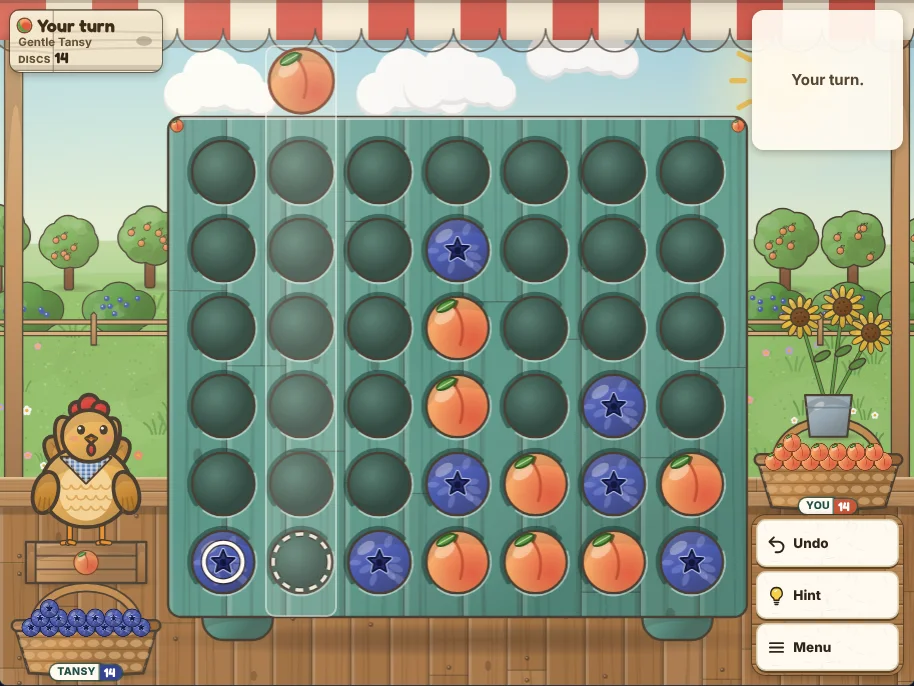
In Peach Lane Four in a Row you tap a column, anywhere from the strip above the rack down to its bottom row, and your peach drops in with a little bounce. With a mouse, the peach waits above the column you point at, and a dashed ring marks the space where it will land.
How to win, and when it is a draw
The first player to line up four of their own discs wins at once. The line can run across a row, up and down a column, or on either slant, and the four discs must fill four spaces in a straight line with no gap and none of the other color between them. A line of five or more wins too.
Every winning line is one of the 69 possible lines of four on the rack: 24 across, 21 up and down and 24 on the two slants. One disc can finish two lines at once, and it is still one win.
If all 42 spaces fill with no four in a row, the game is a draw. Since each player has 21 discs, the last disc of a full rack always belongs to the player who went second.
In Peach Lane Four in a Row the winning four is lit with gold rings joined by a band, Tansy cheers or flaps her wings, and a card shows the result with your tally for the level. Draws are counted in your statistics too.
Four in a Row is a solved game
Four in a Row on the standard rack was solved in 1988, by James Dow Allen on October 1 and independently by Victor Allis on October 16, as Wikipedia’s article on the game records, citing Allis’s master’s thesis at the Vrije Universiteit in Amsterdam and John Tromp’s record of the solutions. Later computer searches reached the same answer.
With perfect play from both sides, the first player can force a win by starting in the middle column, with the winning disc dropped no later than the 41st disc of the game. If the first disc goes in one of the columns next to the middle instead, the second player can hold the game to a draw, and if it goes in any of the four outer columns, the second player can force a win.
The same article puts the number of possible positions, from the empty rack to a full one, at 4,531,985,219,092. Nobody can learn that many, so knowing the answer does not make the game easy: people, and Tansy, still have to find the moves at the rack.
| First disc in | Result |
|---|---|
| The middle column (column 4) | The first player wins |
| Column 3 or 5, next to the middle | A draw |
| Column 1, 2, 6 or 7, the four outer columns | The second player wins |
House rules and variations
Who goes first is the choice players most often make for themselves: the loser of the last game, the youngest player, or simply taking turns.
Some racks let you release the discs from the bottom, and players have built variations on that, such as spending a turn to pull one of your own discs out of the bottom row instead of dropping one in. Others play on bigger racks or play for five in a row. These change the game a great deal, and the solved results above are for the standard game only.
Peach Lane Four in a Row plays the standard game. Its settings change how you play, not the rules: who goes first (you, Tansy, or taking turns), playing Tansy or a friend on the same device, Tansy’s level, and how fast the discs drop.
Controls in Peach Lane Four in a Row
Tap a column, or click it, to drop a disc. On a keyboard, the Left and Right arrow keys move a visible focus between the columns, and Enter, Space or the Down arrow drops a disc into the column in focus. The number keys 1 to 7 drop straight into that column. A full column gives a little shake and says so.
Undo takes back your last disc together with Tansy’s reply, as often as you like. Hint asks the same deep search that Sharp Tansy uses for your best column, lights it in gold and says why: a win, a block, two threats at once, a win it can force, a safe column when others would hand Tansy a win, a new threat on a row that suits you, or simply the best column it found. U undoes, H shows a hint and Escape clears it.
Menu starts a new game and opens Settings, where you choose to play Tansy or two players on one device, Tansy’s level, who goes first and the drop speed. In two-player mode, the players pass the screen after each disc, Undo takes back one disc, and hints work for whoever is to play. Statistics are kept for each level, with a separate tally for two-player games, and the game in progress is saved on your device as you play.
How strong is each level?
Tansy has three levels. Gentle takes a win she can see four times in five and blocks yours three times in five; otherwise she drops a disc wherever she fancies, leaning toward the middle. Steady looks four moves ahead, counting each player’s disc as a move, and picks among the columns that score close to the best. Sharp searches as deep as a fixed budget allows, often a dozen or more moves ahead, and searches all the way to the last disc once few enough spaces are left.
To check that each level does what it says, we ran our own simulation of 1,000 games for each pairing, with the two players swapping who goes first every game, so each went first in 500. A random player drops into any column that is not full. The scripted beginner completes four when it can, otherwise blocks the other side’s four, otherwise avoids dropping right under a space where the other side would complete four, and otherwise drops at random, leaning toward the middle, which is roughly how many people play their first games.
The beginner beat Gentle about three games in four, so Gentle really is beatable while you learn. Steady and Sharp beat that beginner almost every time, so they expect you to look ahead. Sharp, given the same games, clearly beats Steady. These are computer players, not people, so treat the numbers as a guide to the gap between the levels.
| Pairing | Won | Lost | Drawn |
|---|---|---|---|
| Gentle against a random player | 929 | 70 | 1 |
| Steady against a random player | 1,000 | 0 | 0 |
| Sharp against a random player | 1,000 | 0 | 0 |
| Scripted beginner against Gentle | 757 | 221 | 22 |
| Scripted beginner against Steady | 30 | 942 | 28 |
| Scripted beginner against Sharp | 0 | 1,000 | 0 |
| Steady against Gentle | 997 | 1 | 2 |
| Sharp against Gentle | 1,000 | 0 | 0 |
| Sharp against Steady | 963 | 12 | 25 |
Strategy: start in the middle
The middle column matters most because more lines of four pass through it than through any other column. Counting them ourselves, 51 of the 69 possible lines pass through the middle column, 39 through each column next to it, 27 through the next pair out and only 15 through each edge column. A disc in the middle can be part of more of your lines and gets in the way of more of the other side’s.
The same holds for single spaces. The two middle spaces of the middle column, on rows 3 and 4, are each part of 13 lines, while a corner space is part of only 3. The table shows the count for every space, with row 6 at the top as the rack stands.
That is why the solved result starts in the middle, and why Tansy’s hint suggests the middle column on an empty rack. Through the whole game, when nothing more urgent is on the rack, prefer the middle three columns to the edges.
| Row | Col 1 | Col 2 | Col 3 | Col 4 | Col 5 | Col 6 | Col 7 |
|---|---|---|---|---|---|---|---|
| 6 (top) | 3 | 4 | 5 | 7 | 5 | 4 | 3 |
| 5 | 4 | 6 | 8 | 10 | 8 | 6 | 4 |
| 4 | 5 | 8 | 11 | 13 | 11 | 8 | 5 |
| 3 | 5 | 8 | 11 | 13 | 11 | 8 | 5 |
| 2 | 4 | 6 | 8 | 10 | 8 | 6 | 4 |
| 1 (bottom) | 3 | 4 | 5 | 7 | 5 | 4 | 3 |
Threats and blocks
A threat is an empty space where one more of your discs would complete four. Before every disc, check the whole rack for a threat of the other side’s that can be filled right now, meaning the space is on the bottom row or has a disc right under it. If there is one, drop your disc there to block it, unless you can win at once yourself.
A threat that cannot be filled yet matters just as much. Never drop a disc right under the other side’s threat: your disc makes their winning space playable, and they win on the next turn. The same works in your favor. A threat of yours high in a column turns that column into a trap, because the other side can never fill the space under it without handing you the win.
Two threats at once win the game. If one disc gives you two playable spaces where you would complete four, the other side can block only one of them. A second winning shape is two threats one above the other in the same column: when the other side blocks the lower one, you win on top of it. Tansy’s hint says when it has found a double threat.
On Gentle, Tansy also warns you in the message line when she has three in a row with a space she could fill on her next turn. On Steady and Sharp you are on your own.
Odd and even rows
Late in the game, the rows matter. Number them from 1 at the bottom to 6 at the top. The class notes for ES.268, The Mathematics in Toys and Games, on MIT OpenCourseWare (Spring 2010), drawing on Allis’s thesis, explain why: if the players simply fill the rack column by column, the first player tends to get the spaces on odd rows and the second player the spaces on even rows, because every column has an even number of spaces and the second player drops the last disc.
So a threat is worth more to the player whose row it is on. A threat of the first player’s on an odd row (row 1, 3 or 5) tends to win in the end, because the second player is eventually forced to fill the space under it, and a threat of the second player’s on an even row tends to win for the same reason. The notes give the usual endgame patterns: when the first player has an odd threat and the second player an even one, the first player wins; when both have only even threats, the second player wins; and when the first player has an even threat and the second player an odd one, the game ends in a draw.
Allis called steering who gets which spaces controlling the zugzwang, a chess word for being forced to move when you would rather not. One simple tool from the notes is the follow-up: when every column holds an even number of discs, the second player can answer each disc by dropping on top of it in the same column, which keeps the second player on the even rows.
Our own simulation shows the same pattern in evenly matched games. In 1,000 games of Steady Tansy against herself, the player who went first won 455, and in 335 of those (74 percent) the winning disc landed on an odd row. The player who went second won 408, and in 312 of those (76 percent) the winning disc landed on an even row. The other 137 games were drawn. Against a player who drops at random, where most games end long before the rack fills, the pattern does not show: of Sharp’s 500 wins as the first player, only 200 ended on an odd row. Tansy’s hint looks for the rows too: when it suggests a new threat, it says whether the row suits you.
Common mistakes
Missing a threat across the rack. Threats up and down a column are easy to see; threats across a row and on a slant are the ones that get missed. Run your eye along every row and both slants before each disc.
Dropping right under the other side’s threat. It is the most common way to lose a game you were not losing. If a space has a winning space for the other side right above it, leave it alone unless you must block something else.
Letting the other side get three in a row on the bottom row with both ends open. Both end spaces are playable at once, so you can block only one. When the other side has two next to each other on the bottom row with room on both sides, put a disc beside them.
Playing the edges early. An edge disc is part of few lines and blocks few of the other side’s. Save the edge columns for blocks and for the end of the game.
Tips for winning more games
Look for discs that do two jobs: a disc that extends your line and blocks the other side’s at the same time is worth more than either alone.
Build threats that last. A threat you can fill straight away is easy to block, but a threat two or three rows up shapes the rest of the game, especially on a row that suits you.
Count the spaces left in a column before you fill it. Late in the game, the player who has to drop a disc where they would rather not usually loses, so keep spare columns that let you wait.
Use undo and the hint to learn. Ask for a hint when you are unsure, read why it likes the column, and use undo to try your own idea and see how Tansy answers. Try going second sometimes, too: it is the best way to learn to defend.
Keep playing
Four in a Row rewards one habit above all: before every disc, look along every row, column and slant for a space where either player would complete four, and never drop a disc right under the other side’s winning space. Start in the middle, build threats on the rows that suit you, and look for the move that makes two threats at once. Begin against Gentle, use the hint to see why a column is good, and move up to Steady when you win more than you lose. For more classic games, try Kingfisher Canal Checkers, our board game against Otis the otter; Sunflower Mill Mancala, our seed-sowing game; or Meadowlark Barn Shut the Box, our dice game with Posy the goat.
- Play Peach Lane Four in a Row
- Peach Lane Four in a Row: features, controls and FAQ
- Kingfisher Canal Checkers: classic checkers on a canal boat
- Sunflower Mill Mancala: sow seeds around a carved board
- Meadowlark Barn Shut the Box: the classic dice and tiles game
- Sprout Sudoku: classic 9x9 puzzles with helpful hints
- How to play checkers: rules, setup and strategy
- How to play mancala: rules, setup and strategy
- How to play Shut the Box: rules and strategy
- How to play gin rummy: rules and scoring
- How to play Hearts: rules, scoring and strategy
More guides and roundups
Dots and boxes is the pencil-and-paper game of joining dots and claiming boxes. Here are the rules, board sizes and extra turns, then the strategy that wins: safe lines, chains, leaving the last two boxes and the long chain rule, with how strong each level of our computer opponent is.
Best Cozy Puzzle Games to Play in 2026Match mahjong tiles, solve sudoku and killer sudoku, slide 2048 tiles, stitch a nonogram, find hidden words, fit a jigsaw, rake leaf piles, sort shells, merge fruit or crack firefly codes. Choose a puzzle by the decisions it asks you to make.
How to Play Reversi: Rules, Setup and StrategyReversi is the two-player board game of trapping and turning over discs. Here is how to set up the board, what makes a move legal, how discs flip in all eight directions, when you pass, how the game ends, how strong each level of our computer opponent is, and the strategy, common mistakes and tips that win more games.
How to Play Farkle: Rules, Scoring and StrategyFarkle is the six-dice game where you set aside dice that score and decide, throw after throw, whether to bank your points or push on. Here are the rules, the full scoring chart, hot dice and the final round, the common house rules, and strategy with the chances worked out exactly.