Cozy Classic
Free Four in a Row
Peach Lane Four in a Row
The classic drop-four game with big fruit discs, a friendly computer opponent at three levels, two-player pass-and-play, hints that say why, undo, and the winning line lit in gold.
What you do
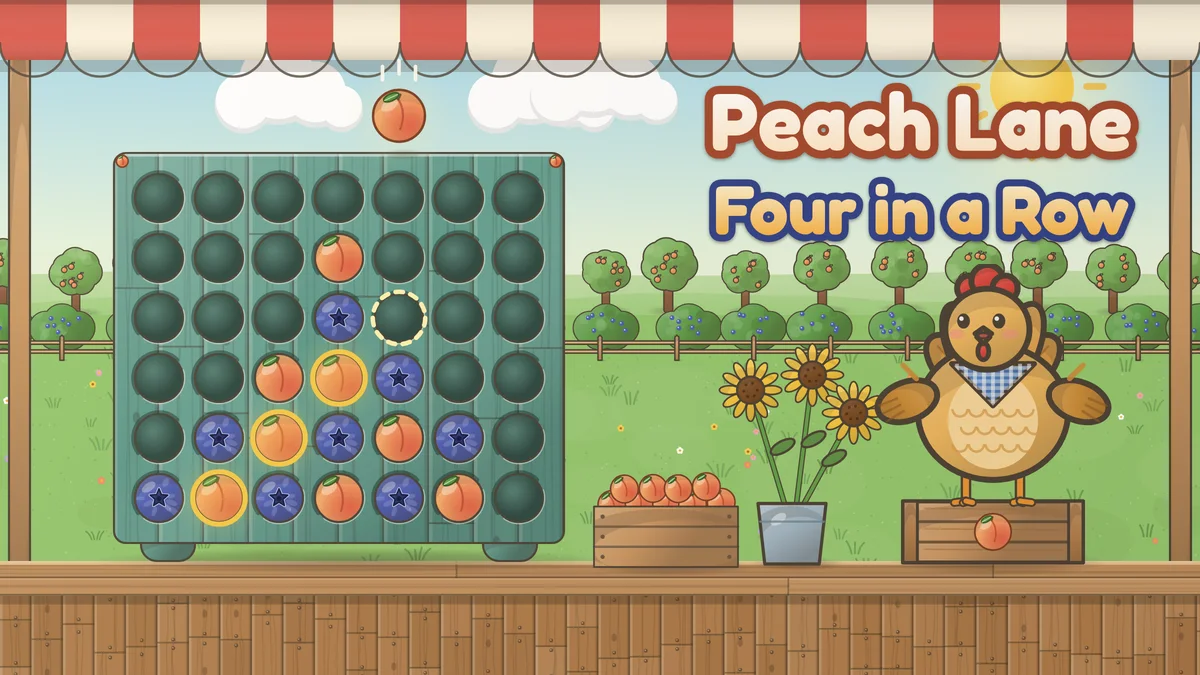
Peach Lane Four in a Row is the classic drop-disc game on an upright rack of 7 columns and 6 rows, standing on the counter of a roadside fruit stand under a striped awning, with a peach orchard and blueberry bushes on the hills behind. You take turns dropping a disc into a column, it falls to the lowest empty space, and the first to line up four of their own in a row, across, up and down or on a slant, wins. If all 42 spaces fill first, the game is a draw. Here the discs are fruit: warm peaches with a red blush, a cleft and a green leaf against deep blueberries with a dusty bloom and a dark star-shaped crown, so the two sides differ in shape as well as color. Your opponent is Tansy, a round buff hen in a blue gingham kerchief, who stands on a fruit crate beside the rack, tips her head while she thinks, cheers her own blocks and flaps her wings for your wins. Or turn Tansy into the referee and pass the screen between two players.
- Three levels for Tansy: Gentle takes a win she sees most of the time and blocks yours more often than not, Steady looks four moves ahead, and Sharp searches much deeper, often a dozen or more moves ahead, and plays the end of the game perfectly.
- Two players on one device: pass the screen between peaches and blueberries, with hints and undo for both and a separate tally of who won.
- Choose who goes first: you, Tansy, or taking turns every game. Going first is an advantage in this game, so taking turns keeps it fair.
- Hints from the same deep search Sharp uses, with a short reason: a win, a block, a double threat, a safe column, a new threat on a row that suits you, or the best column found.
- Undo takes back your last disc and Tansy’s reply, as often as you like. The winning four is lit with gold rings when the game ends.
- Big fruit discs, a basket for each side showing the discs left, three drop speeds, and statistics for each level (games, wins, losses, draws and your quickest win), saved on this device with the game in progress.
How to play
- Press Play. The rack has 7 columns and 6 rows. You drop the peaches and Tansy the blueberries; each of you has 21 discs. By default you go first.
- On your turn, tap a column. Your disc falls to the lowest empty space in that column. You may drop into any column that is not full, and you may not pass.
- Line up four of your discs in a row to win: across a row, up and down a column, or on either slant. A disc that completes a line wins at once.
- Watch Tansy’s lines as well as your own. When she has three in a row with an empty space that she could reach, drop a disc there to block it.
- If all 42 spaces fill with no four in a row, the game is a draw. Start a new game from the menu, or choose two players in Settings to play a friend on the same device.
Controls
- Touch or mouse: tap a column to drop a disc into it. With a mouse, the disc waits above the column you point at, and its landing space is marked. Undo, Hint and Menu sit on the shelf below the rack, or beside it on a wide screen.
- Keyboard: the Left and Right arrow keys move between the columns, and Enter, Space or Down drops a disc into the column in focus. The number keys 1 to 7 drop straight into that column. U undoes, H shows a hint, and Escape clears a hint.
- Restart in the toolbar starts a new game. Menu starts a new game, changes the mode, Tansy’s level, who goes first and the drop speed in Settings, and shows your statistics and the rules. The toolbar also has pause, help, optional sound and fullscreen.
Tips worth knowing
- Start in the middle column. More lines of four pass through it than through any other column, and with perfect play the first player can force a win by starting there.
- Before every disc, check every column for a space where the other side would complete four next turn, and block it.
- Never drop a disc directly under a space where the other side can complete four. Your disc would only give them the space they need.
- Build threats you can keep: a space where you would complete four, but that is not playable yet, stays a danger for the rest of the game.
- Mind the rows. A threat on an odd row (counting from 1 at the bottom) tends to help the first player, and a threat on an even row the second player, because of who is forced to fill the space under it late in the game.
- Look for a double threat: two spaces where you would win, so a single block cannot stop both. The hint says when it has found one.
Accessibility
- Everything can be played with a keyboard: the Left and Right arrow keys move between the columns, Enter, Space or Down drops a disc, the number keys 1 to 7 drop straight into a column, U undoes and H shows a hint.
- Every column is labeled for screen readers with its number, the fruit in it from the bottom up, and the row a disc would land on, or that it is full.
- The two sides differ in shape as well as color: peaches have a curved cleft and a green leaf, blueberries a dark five-pointed crown in the middle. The winning line is marked with gold rings joined by a band.
- Nothing is timed. Tansy waits while a menu is open, and undo is unlimited.
- Reduced motion places each disc at once instead of dropping it, stops the pulsing hint and Tansy’s fidgeting, and keeps the sparkles small and still. Sound is optional and never needed to play.
Questions
How strong is each level?
We measured Tansy with our own simulation of 1,000 games for each pairing, with the two sides swapping who goes first every game. Against a player that drops into columns at random, Gentle won 929 games (92.9 percent), Steady all 1,000 and Sharp all 1,000. Against each other, Steady beat Gentle in 997 games, and Sharp beat Steady in 963, losing 12 and drawing 25. These are computer players, not people, so treat the numbers as a guide.
Can a beginner beat Gentle?
Yes, that is what Gentle is for. In the same simulation, a simple scripted beginner that completes four when it can, otherwise blocks, otherwise avoids dropping right under the other side’s winning space and otherwise drops at random, leaning toward the middle, beat Gentle in 757 of 1,000 games (75.7 percent). The same beginner won 30 of 1,000 against Steady and none against Sharp, so Steady and Sharp expect you to look ahead.
What are the rules?
The usual published rules of the classic game: an upright rack of 7 columns and 6 rows, two players with 21 discs each, turns dropping one disc into a column that is not full, the disc falling to the lowest empty space, and a win for the first player to line up four of their own discs horizontally, vertically or diagonally. A full rack with no four in a row is a draw. The players decide who goes first, and the game lets you choose.
Does going first matter?
Yes. The game was solved in 1988, independently by James Dow Allen and by Victor Allis: with perfect play the first player can always force a win by starting in the middle column. Starting in one of the columns next to the middle lets the second player hold a draw, and starting in any of the four outer columns lets the second player force a win. Choose Take turns in Settings to swap who goes first every game.
Can two people play on one device?
Yes. Choose Two players in Settings or on the title screen. One player drops the peaches and the other the blueberries, passing the screen after each disc. Undo takes back the last disc, hints work for whoever is to play, and the statistics keep a separate tally of two-player games.
What does the game save?
Your settings, the game in progress with every disc, and your statistics for each level (games played, won, lost and drawn, and your quickest win) plus the two-player tally, all in this browser’s local storage. There is no account.