
CozyWorld game guide · By CozyWorld
This guide covers our own game, written from the current game rules and browser checks.
How to Play Reversi: Rules, Setup and Strategy
Reversi is the two-player board game of trapping and turning over discs. Here is how to set up the board, what makes a move legal, how discs flip in all eight directions, when you pass, how the game ends, how strong each level of our computer opponent is, and the strategy, common mistakes and tips that win more games.
Reversi is a board game for two players on a board of 8 rows of 8 squares. Every disc has a dark face and a light face, and each player plays one face. You place a disc so that it traps a straight line of your opponent’s discs, and every disc you trap turns over to your color. The rules fit on a postcard and a game takes ten or fifteen minutes, but the lead can change hands many times, because a single move can turn over a whole row.
This guide covers the standard modern rules: setting up the board, what makes a move legal, how discs turn over in all eight directions, passing, the end of the game, and a little history. Then it shows the controls in Starling Hill Reversi (CozyWorld’s free reversi game against Tobias the tortoise, on a hilltop at dusk), how strong each of Tobias’s levels is, beginner strategy, the most common mistakes and a few tips. The strength figures come from our own simulation, which plays the game’s real rules.
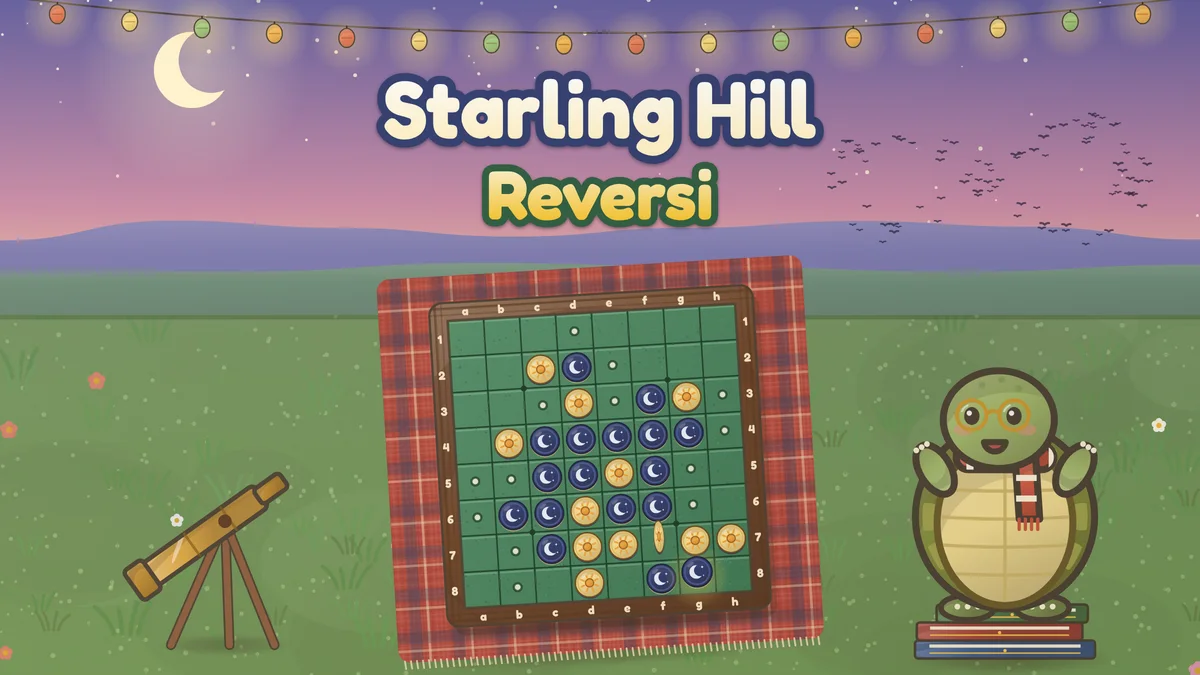
How to set up a game of reversi
Reversi uses a board of 64 squares in 8 rows of 8, all the same color, and a supply of discs that are dark on one side and light on the other. One player plays the dark face and the other plays the light face. Discs are not owned: whichever face is up says whose disc it is, and that changes every time a disc turns over.
Start with four discs in the four middle squares: two dark and two light, with the two discs of each color on a diagonal. In the usual notation, with columns a to h from the left and rows 1 to 8 from the top, light starts on d4 and e5 and dark on e4 and d5. The rest of the board is empty. Dark always moves first, and then the players take turns.
In Starling Hill Reversi the dark face is an indigo moon with a pale crescent and the light face is a cream sun with an orange middle and rays. You play moon unless you choose otherwise in Settings, and moon moves first. The letters and numbers around the edge of the board name the squares.
| Square | At the start | Notes |
|---|---|---|
| d4 and e5 | A light disc on each | One diagonal of the middle four |
| e4 and d5 | A dark disc on each | The other diagonal |
| The other 60 squares | Empty | Filled one disc at a time |
| First move | Dark | Dark has four choices, all the same up to a turn of the board |
Reversi rules and the goal
You win by having more discs of your color on the board than your opponent when the game ends. The count can swing wildly until the last few moves, so the disc count in the middle of the game says little about who will win.
On every turn you place exactly one disc of your color on an empty square, and the move must turn over at least one of your opponent’s discs. You may not pass while you have a legal move. Discs never move once placed; they only turn over.
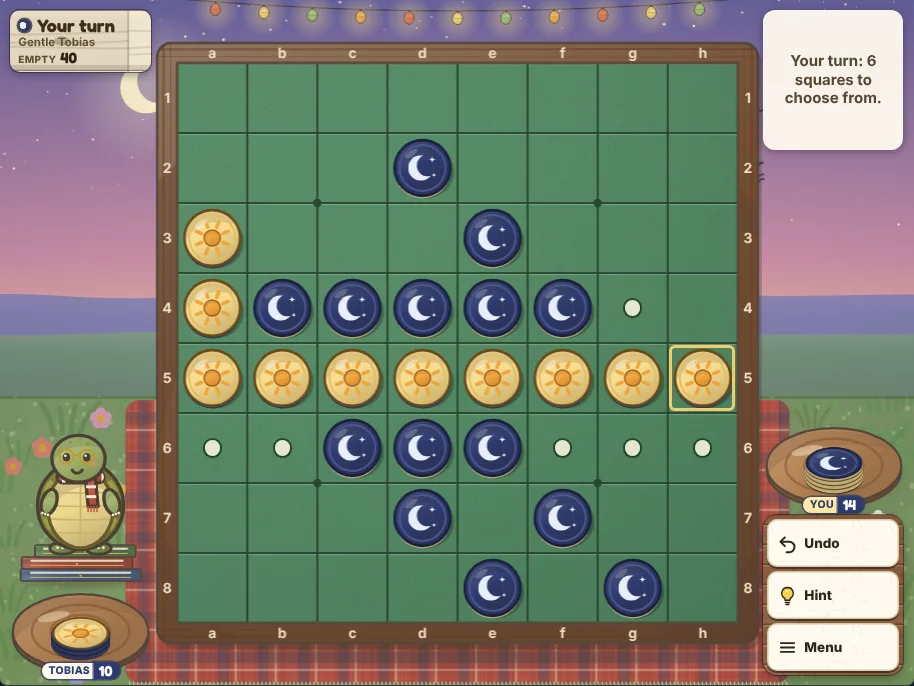
How to make a legal move
A legal move places your disc on an empty square so that at least one straight line runs from it, over one or more of your opponent’s discs in a row, to another disc of yours. The line can run across, up and down, or along either diagonal, which makes eight directions in all. There can be no empty square in the line, and your own new disc and the disc at the far end hold the line in place like two bookends.
That is called outflanking. A square next to your opponent’s discs is not enough on its own: if no line through it ends at one of your discs, the move is not allowed. If no square on the board works, you have no legal move this turn.
In Starling Hill Reversi a cream dot marks every square you can play. If you tap a square without a dot, it gives a little shake and the message line says why.
Turning discs over
When you place a disc, every opposing disc in every line you have trapped turns over to your color, all in the same move. One disc can trap lines in several directions at once, and all of them turn over. You may not choose to turn over only some of them.
Only lines that run from the disc you just placed turn over. Discs that turn over do not start new lines of their own, even if they now trap other discs, so there is no chain reaction.
In Starling Hill Reversi each trapped disc flips over in turn, nearest first, so you can see every line that changed. With a mouse, or when you move the focus with the keyboard, the discs a square would turn over are ringed before you play it, as long as the move dots are on.
Passing
If you have no legal move on your turn, you pass and your opponent plays again. You keep passing for as long as you have no move, and your opponent keeps playing. As soon as a move opens up for you, you must take your turn again.
Passing is never a choice. A player who has a legal move must make one, even if every legal move is a bad one. Passes are most likely near the end of the game, when only a few empty squares are left.
Starling Hill Reversi passes for you: when you or Tobias has no move, a tag over that side’s coaster says so, the message line explains it, and the other side plays on.
How the game ends and who wins
The game ends when neither player can move. Usually that happens when the board is full, but it can come sooner: when one side has no discs left, or when the empty squares that remain are ones neither player can legally fill.
Then count the discs. The player with more discs of their color on the board wins, and equal counts are a draw. In Starling Hill Reversi empty squares left at the end count for nobody, and the result card shows both totals.
| What happens | Result |
|---|---|
| The board fills up | Count the discs: more discs wins |
| One player has no discs left | The other player wins |
| Neither player can move, with squares still empty | Count the discs on the board: more discs wins |
| Equal counts | A draw |
A short history of reversi
Reversi is an English game from the Victorian era. Two Englishmen, Lewis Waterman and John W. Mollett, each claimed to have invented it in 1883, and each called the other a fraud.
In the original game the board started empty, and the first two moves of each player went into the four middle squares, so the players chose their own opening position. A later trademarked version, patented in Japan in 1971, fixed the four starting discs in place with the same colors on a diagonal. That fixed start is the one used in international tournaments today, and it is the one Starling Hill Reversi uses.
The game is also played on smaller boards. On the 4 by 4 and 6 by 6 boards, the second player wins with perfect play; Starling Hill Reversi offers the 6 by 6 board in Settings as a quick game.
Controls in Starling Hill Reversi
On your turn a cream dot marks each square you can play. Tap one to play there. With a mouse, resting on a dotted square rings the discs that move would turn over. Tapping while discs are still flipping finishes the flips at once. If you would like a harder game, turn the dots off in Settings, and the board shows only the discs.
On a keyboard, the arrow keys move a visible focus around the board, ringing the discs a move there would turn over while the move dots are on, and Enter or Space plays the square in focus. U undoes, H asks for a hint, and Escape clears the hint.
Undo takes back your last move together with Tobias’s reply. Hint asks the same search that Sharp Tobias uses for your best move and says why: a corner, a move that leaves Tobias with no move at all, one that keeps the corners out of his reach, one that leaves him the fewest moves, or, near the end, the exact result with best play from both sides. Menu starts a new game and opens Settings, where you choose Tobias’s level, your side (moon always moves first) or taking turns, the 8 by 8 or 6 by 6 board, the move dots and the flip speed. Both disc counts are always on show, statistics are kept for each level, and your game is saved on your device as you play.
How strong is each level?
Tobias has three levels. Gentle plays half of his moves simply because he likes the square, picking any legal move, and for the rest plays the move that turns over the most discs, without looking at your reply. Steady looks three moves ahead with a judgment of the position that values corners, mobility (how many moves each side has) and stable discs, picks among the moves that score close to the best, and plays the last 8 squares perfectly. Sharp searches much deeper with the same judgment, often eight or more moves ahead in the middle of the game, and from 14 empty squares nearly always plays the rest of the game perfectly.
To check that each level does what it says, we ran our own simulation on the 8 by 8 board, with the two players swapping sides every game so each moved first in half of them: 1,000 games for each pairing without Sharp, and 100 for each pairing with Sharp (200 against the random player), whose deeper search takes longer to run. A random player picks any legal move. The scripted beginner takes a corner whenever it can and otherwise plays the move that turns over the most discs, the greedy style that strategy guides warn against.
The beginner beat Gentle about three games in four, so Gentle really is beatable while you learn. Steady and Sharp beat that beginner almost every time, so they expect you to think about the squares your move opens up. Sharp won every one of its 100 games against Steady. These are computer players, not people, so treat the numbers as a guide to the gap between the levels.
| Pairing | Games | Won | Lost | Drawn |
|---|---|---|---|---|
| Gentle against a random player | 1,000 | 541 | 422 | 37 |
| Steady against a random player | 1,000 | 999 | 1 | 0 |
| Sharp against a random player | 200 | 200 | 0 | 0 |
| Scripted beginner against Gentle | 1,000 | 767 | 207 | 26 |
| Scripted beginner against Steady | 1,000 | 19 | 981 | 0 |
| Scripted beginner against Sharp | 100 | 0 | 100 | 0 |
| Steady against Gentle | 1,000 | 997 | 3 | 0 |
| Sharp against Gentle | 100 | 100 | 0 | 0 |
| Sharp against Steady | 100 | 100 | 0 | 0 |
Beginner strategy
Take the corners. A disc in a corner can never be turned over, because there is no square beyond it to trap it from. A corner also anchors the edges beside it: a solid row of your discs running from a corner along an edge can never be turned over either.
Keep off the squares next to an empty corner. The square diagonally next to a corner is the most dangerous on the board, because a disc there very often lets your opponent into the corner. The two edge squares beside a corner carry a smaller risk of the same kind. Once you own the corner, those squares are safe.
Think about moves, not discs. In the opening and middle game the side with more choices usually comes out ahead, because the side with fewer is eventually forced into a bad square. A move that turns over few discs and leaves your opponent few good replies is often better than a big haul.
Wait on the edges. An edge disc early in the game looks safe, but it can still be turned over along the edge, and it can give your opponent a line toward a corner. Unless an edge move gains you something clear, such as more moves than your opponent, leave the edges for later. They are strongest when they connect to a corner you already own.
Common mistakes
Grabbing as many discs as possible. It feels like winning, but a board full of your color usually means your opponent has plenty of moves and you have few. The disc count only matters at the very end.
Playing next to an empty corner. It is the classic way to hand over a corner, and with it a whole edge. Before you play any square that touches a corner, check whether your opponent could take the corner straight after.
Forgetting the diagonals. A move often traps a diagonal line you did not notice, or opens one for your opponent. Check all eight directions from the square you are about to play, and from the squares your move opens.
Rushing the last moves. Near the end, a few empty squares decide the game. Count which ones each player can still reach, and try to make the last move in each empty region yourself.
Tips for winning more games
Leave your opponent bad choices. Before you move, look at what your opponent could play next. A move that leaves them only squares next to empty corners or open edges is worth more than a few extra discs.
Keep your disc count modest early. Your opponent can only play next to your discs, so fewer of them on the board usually means fewer squares for your opponent. Do not take it to an extreme: with too few discs you can run out of moves yourself.
Make your opponent pass. A move that leaves the other side with no legal move gives you two moves in a row. The hint points these out when it finds one.
Use undo and the hint to learn. Ask for a hint when you are unsure, read why it likes the move, and use undo to try your own idea and see how Tobias answers.
Keep playing
Reversi rewards one habit above all: before you move, look at the squares your move would open for your opponent, and above all at the corners. Start against Gentle, take the corners when you can, keep away from the squares next to an empty corner, and move up to Steady when you win more than you lose. For more classic games, try Kingfisher Canal Checkers, our board game of jumps and kings; Sunflower Mill Mancala, our seed-sowing board game; Teahouse Mahjong, our tile-matching game; or Sprout Sudoku, with hints that explain the next step.
- Play Starling Hill Reversi
- Starling Hill Reversi: features, controls and FAQ
- Kingfisher Canal Checkers: classic checkers on a canal boat
- Sunflower Mill Mancala: sow seeds around a carved board
- Teahouse Mahjong: match tiles in four seasonal tea rooms
- Sprout Sudoku: classic 9x9 puzzles with helpful hints
- How to play checkers: rules, setup and strategy
- How to play mancala: rules, setup and strategy
- How to play Shut the Box: rules and strategy
- How to play Hearts: rules, scoring and strategy
- How to play gin rummy: rules and scoring
- How to play Klondike solitaire: setup and rules
- How to play FreeCell solitaire: setup and rules
- How to play Pyramid solitaire: setup and rules
More guides and roundups
Match mahjong tiles, solve sudoku and killer sudoku, slide 2048 tiles, stitch a nonogram, find hidden words, fit a jigsaw, rake leaf piles, sort shells, merge fruit or crack firefly codes. Choose a puzzle by the decisions it asks you to make.
How to Play Four in a Row: Rules and StrategyFour in a Row is the two-player game of dropping discs into an upright rack and lining up four. Here is how to set up, how a turn works, how a game is won or drawn, what the solved game says about going first, how strong each level of our computer opponent is, and the strategy that wins more games: the middle column, threats and blocks, and odd and even rows.
How to Play Dots and Boxes: Rules and StrategyDots and boxes is the pencil-and-paper game of joining dots and claiming boxes. Here are the rules, board sizes and extra turns, then the strategy that wins: safe lines, chains, leaving the last two boxes and the long chain rule, with how strong each level of our computer opponent is.
How to Play Farkle: Rules, Scoring and StrategyFarkle is the six-dice game where you set aside dice that score and decide, throw after throw, whether to bank your points or push on. Here are the rules, the full scoring chart, hot dice and the final round, the common house rules, and strategy with the chances worked out exactly.