Cozy Classic
Free Farkle
Thimbleberry Camp Dice
Farkle with six big dice you tap to hold, a running score for the turn, Bank and Roll side by side under your thumb, the scoring chart one tap away, hints that name the dice that score, and three woodland campers to play at three levels.
What you do
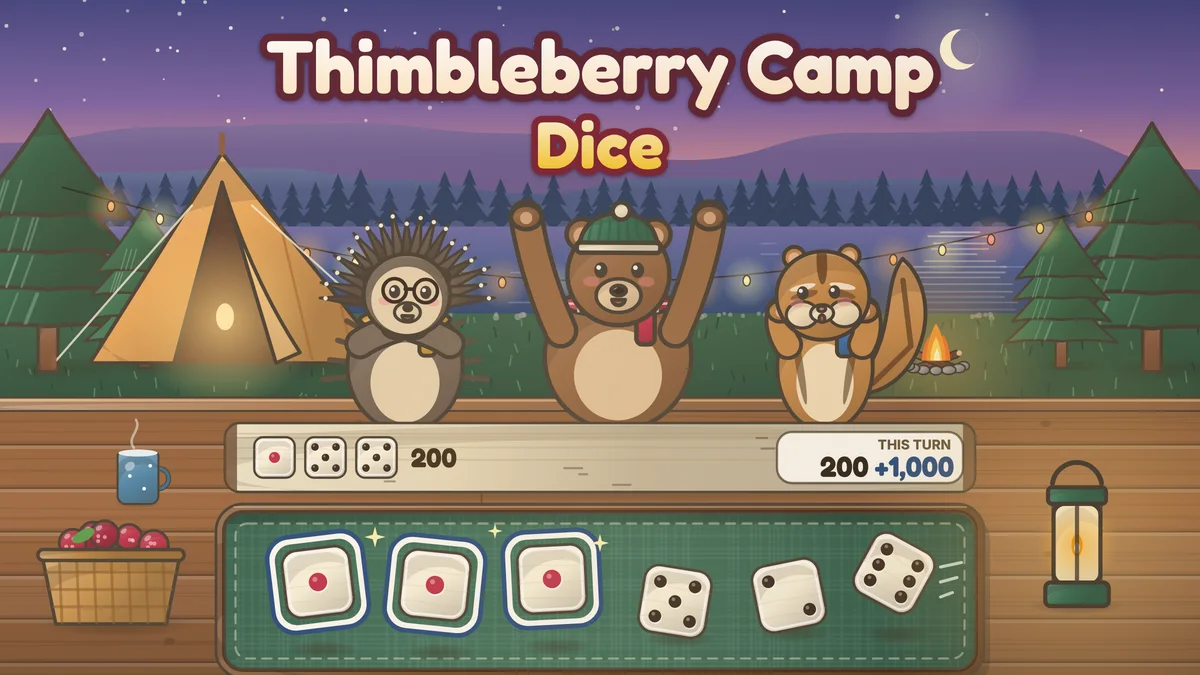
Thimbleberry Camp Dice is the traditional six-dice game known as Farkle, played at a plank table by a lake at dusk. Pines stand dark against a violet sky, string lights loop between them, a canvas tent glows from inside, a campfire crackles on the shore and a crescent moon lays a silver path across the water. The cream dice tumble onto a green felt tray, and the dice you set aside line up on a birch board above it with their points. Each turn you throw the dice, set aside some that score and decide: bank the turn’s points, or throw the dice that are left for more and lose the lot if nothing scores. Your neighbors at the table are Bonnie, a brown bear in a green knit beanie and a red plaid scarf; Nibs, a striped chipmunk with a blue neckerchief; and Ollie, a porcupine in round spectacles and a mustard scarf. They shake the dice on their own turns, lean in to watch yours, gasp at a farkle and cheer a big bank.
- Play against one, two or three campers (Bonnie, then Nibs, then Ollie), taking turns around the table to 10,000 or 5,000 with the classic final round, or play Solo practice and reach the target in as few turns as you can.
- Three levels. Gentle campers keep every scoring die and push on until a turn is worth 1,000, so they farkle often. Steady campers follow a common rule of thumb. Sharp campers play every throw by the game’s own expected-points calculation.
- Big dice you tap to hold. The dice that can score wear gold rings, held dice lift with a check mark, the points you are holding show before you choose, and Bank and Roll sit side by side at the bottom of the screen.
- The scoring chart is always one tap away, and hints name every die that scores in the throw, then the best choice by the game’s calculation and why: the points throwing on is worth, or your chance of passing the leader in the final round.
- The most common published scoring by default, with house rules in Settings: 500 or 1,000 to get on the board, doubling or adding values for four, five and six of a kind, a 2,500 straight, and a penalty for three farkles in a row.
- Statistics for every target and level: games, fewest turns, points per turn, farkle rate and best turn. Every throw comes from a seed saved with your game, so a reload never throws again. Three speeds, reduced motion support and a saved game in this browser.
How to play
- Press Play and choose who to play: the campers at a level, or Solo practice. Everyone starts at 0, and you throw first.
- Roll the six dice. Then set aside at least one die that scores by tapping it: each 1 is 100, each 5 is 50, and three of a kind is 100 times the number (three 4s are 400), with three 1s worth 1,000. Bigger sets, a straight 1 to 6 and three pairs score more; the scoring chart lists them all.
- Now choose. Bank adds the points you set aside this turn to your score and ends your turn. Roll throws the dice that are left to add more, but a throw with nothing that scores is a farkle, and the turn’s points are lost.
- Set aside all six dice and you have hot dice: roll all six again and keep building the turn.
- The first player to reach 10,000 sets off the final round, in which everyone else has one last turn to beat that score. The highest score wins. In Solo practice, reach the target in as few turns as you can.
Controls
- Touch or mouse: tap a die to hold it and tap it again to put it back. Roll and Bank sit side by side at the bottom: Roll throws the dice that are left and Bank ends your turn with the points. Clear, Hint, Scoring and Menu sit on the shelf above them, or in the right-hand strip on a wide screen.
- Keyboard: the number keys 1 to 6 hold or put back a die, A holds every die that scores, Space, Enter or R rolls, and B banks. H shows a hint, S opens the scoring chart, and U or Escape puts back the dice you are holding. The arrow keys move a visible focus between the dice.
- Restart in the toolbar starts a new game. Menu starts a new game, opens Settings (who you play, their level, target, house rules, speed and the gold rings on scoring dice) and shows your statistics and the rules. The toolbar also has pause, help, optional sound and fullscreen.
Tips worth knowing
- Know how likely a farkle is. By the game’s exact count over every throw, six dice farkle only 2.31 percent of the time, five dice 7.72 percent, four 15.74 percent, three 27.78 percent, two 44.44 percent and a single die 66.67 percent.
- You do not have to keep every scoring die. On a first throw of 1, 1, 2, 3, 4 and 6, the calculation keeps one 1 and throws five dice, worth about 404 points on average, rather than both 1s and four dice. It even passes over three 2s on a first throw when a lone 1 or 5 lets it throw five dice.
- Bank sooner with few dice and later with many. With the default rules and no score to chase, the calculation banks once the turn is worth 350 with one die left, 300 with two, 450 with three, 1,050 with four and 3,100 with five, and it always throws when it has hot dice.
- Throw a single die when the turn is small. With one die left and 300 or less, throwing it is worth more on average, because a 1 or a 5 gives you hot dice and all six dice back.
- In the final round, forget the averages: keep throwing until you pass the leader. The hint gives your chance of doing it from where you stand.
- An opening score changes the start. With 500 to get on the board, keep throwing until you have it; the calculation puts a turn before your first bank at 580.90 points on average, against 601.56 once you are on the board.
Accessibility
- Everything can be played with a keyboard: the number keys hold dice, A holds every die that scores, Space, Enter or R rolls, B banks, H shows a hint, S opens the scoring chart and the arrow keys move a visible focus between the dice.
- Each die is labeled for screen readers with its number and whether it can score or is held, the dice set aside are read out with their points, and each throw (farkles included) and each bank is announced.
- Held dice differ in more than color: they lift with a thick ring and a check mark, held dice that do not score as a set show a red mark, and the campers’ picks wear a dashed ring.
- Nothing is timed. The campers wait while a menu is open, and a wrong tap only brings a gentle explanation.
- Reduced motion lands the dice at once without tumbling, stops the pulsing highlights and the campers’ fidgeting, and leaves out the petal showers. Sound is optional and never needed to play.
Questions
Is this Farkle?
Yes. Thimbleberry Camp Dice is our own version of the traditional six-dice game known as Farkle, which people also call Hot Dice, Zilch, Ten Thousand or 10,000. The scoring follows the most common published table, and the common house rules are in Settings.
What scores?
Each 1 is 100 and each 5 is 50. Three of a kind is 100 times the number, and three 1s are 1,000. Four of a kind is 1,000, five of a kind 2,000 and six of a kind 3,000. A straight 1 to 6 is 1,500, three pairs are 1,500 and two triplets are 2,500. 2s, 3s, 4s and 6s score only as three of a kind or more, and every combination must come from one throw.
How strong is each level?
We measured the campers with our own simulation of 100,000 turns for each level and 10,000 two-player games to 10,000 for each pairing. Gentle averaged 401 points a turn and farkled on 69.6 percent of turns, Steady averaged 548, and Sharp averaged 593 (its exact value is 601.56 a turn with no target in sight). A simple newcomer habit, keeping every scoring die and banking at 350, won 66.5 percent of games against Gentle and 35.2 percent against Steady. Sharp won 60.4 percent against Steady. These are computer players, so treat the numbers as a guide.
Do the campers see the dice before they are thrown?
No. The campers choose from what you can see: the dice on the table, the turn’s points and the scores. Every throw is fixed by the game’s seed when it is made, and the campers’ choices never read it. The same position always gets the same choice from the same level.
Can I take back a throw?
No. A throw is final, as at a real table, and a reload shows the same dice. Until you roll or bank you can put back any dice you are holding, one by one or all at once with Clear.
What does the game save?
Your settings, the game in progress, and your statistics, all in this browser’s local storage: for Solo practice, the games, fewest turns and points per turn for each target; against the campers, the games won, shared and lost at each level. There is no account.