
CozyWorld game guide · By CozyWorld
This guide covers our own game, written from the current game rules and browser checks.
How to Play Mexican Train Dominoes: Full Rules
Mexican Train is the domino game where everyone builds a train of matching tiles from one station. Here is how to set up a round, which trains you may play on, how markers and doubles work, how a round ends and is scored, how the full 13-round game is won, the common rule variations, how strong each level of our computer players is, and the strategy, mistakes and tips that keep your score low.
Mexican Train is a domino game for two or more players, played mainly in the United States and usually with a double-twelve set. Every round starts from one double in a central station. Each player builds a train of matching tiles from the station toward their own seat, and everyone shares one extra train, the Mexican Train. The aim is to play every tile in your hand before anyone else, because the dots left in your hand at the end of a round count against you. A full game is 13 rounds, and the lowest total wins.
This guide covers the common published rules: the tiles, the deal, the station, the trains you may play on, drawing and markers, doubles and how they are covered, the end of a round, scoring, the full game and ties, and the ways families change the rules. Then it shows the controls in Pinecone Pass Mexican Train (CozyWorld’s free Mexican Train game, played with Walter the marmot, Mavis the cow and Chester the chipmunk), how strong each level of the computer players is, beginner strategy, the most common mistakes and a few tips. The strength figures come from our own simulation, which plays the game’s real rules.
What you need to play Mexican Train
Mexican Train is usually played with a double-twelve set of dominoes: one tile for every pair of numbers from blank (0) to 12, which makes 91 tiles. Thirteen of them are doubles, with the same number on both ends, from the double blank to the double 12. Pinecone Pass Mexican Train gives each number its own dot color as well as its own pattern, with a setting to show the numbers themselves instead.
You also need a marker for each player, traditionally a coin and nowadays often a little toy locomotive, and something to mark the station in the middle of the table. Many players use a hub, a centerpiece that holds the starting double and starts the trains.
Roy and Katie Parsons wrote and copyrighted rules for the game in 1994 and sold the production rights to Puremco, which marketed it as Mexican Train with a double-twelve set. Rule books since then differ in small ways, and the main differences are listed further down.
How to set up a round
Each round has its own starting double, called the engine. The first round uses the double 12, the second the double 11, and so on down to the double blank in the thirteenth and last round. Take the engine out of the set and place it in the station, turn the other 90 tiles face down and shuffle them.
Each player then draws a hand of tiles and stands them up so only they can see the faces. The usual number for two to four players is 15 each, though some rule books give two or three players 16, as the table shows. The tiles left over stay face down in the boneyard, ready to be drawn. The first turn moves one player clockwise each round.
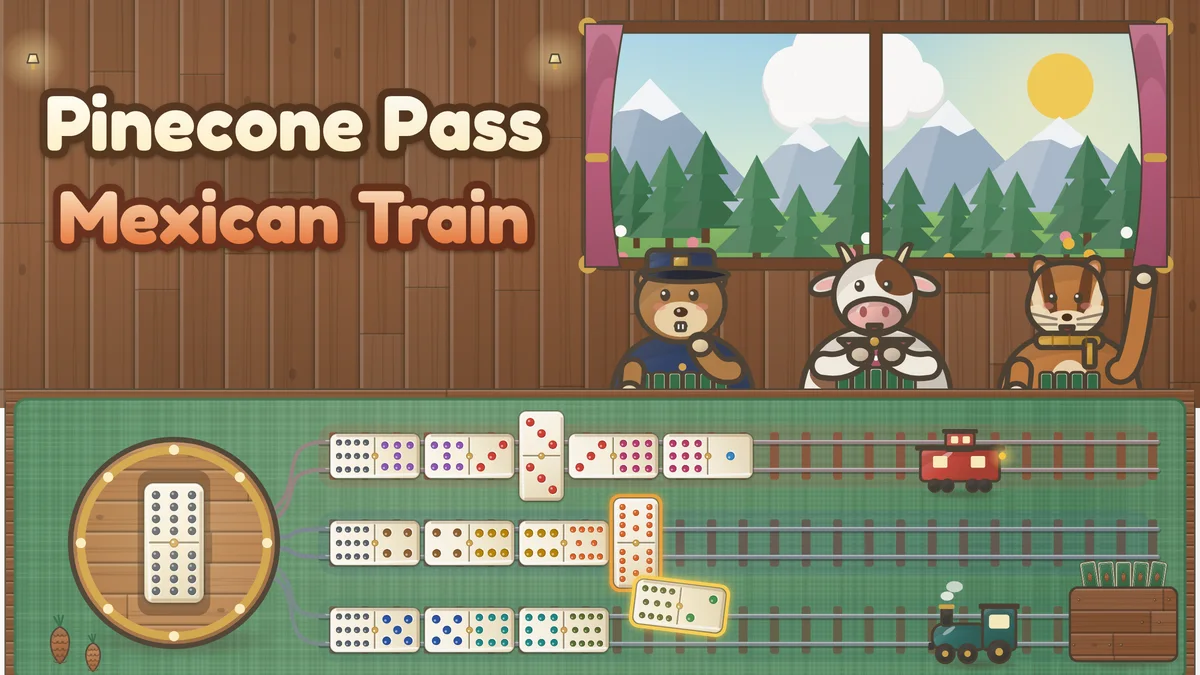
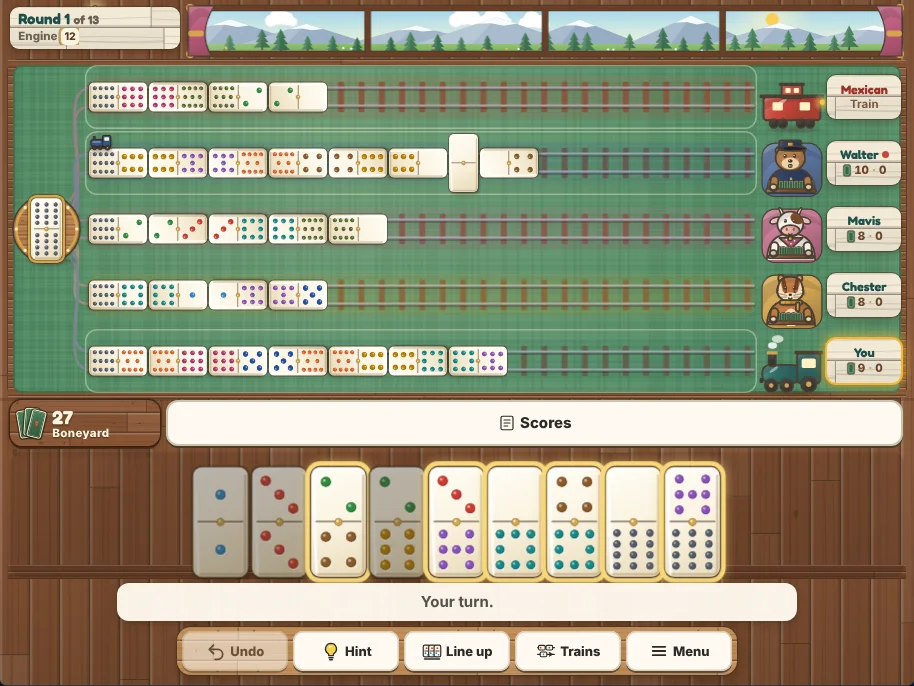
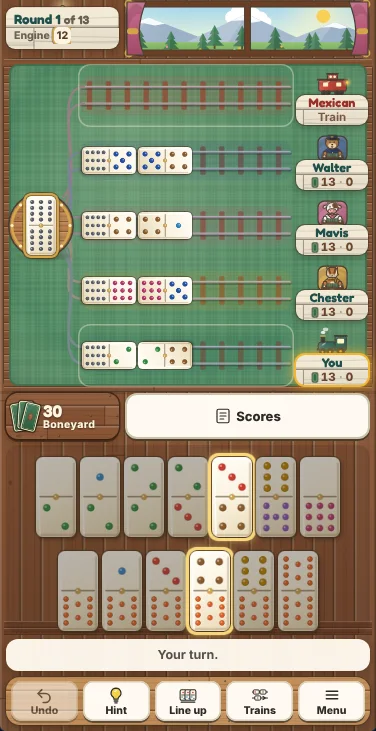
In Pinecone Pass Mexican Train, the engine sits in a wooden station on the left of the table and the trains run to the right, one lane each: the Mexican Train at the top, then each friend, then your own train at the bottom, just above your rack. Settings offers the deal by table size, with 16 tiles each for two or three players.
| Players | Pagat and most rule books | Bauguess rules (2012) |
|---|---|---|
| 2 | 15 | 16 |
| 3 | 15 | 16 |
| 4 | 15 | 15 |
| 5 | 12 | 14 |
| 6 | 12 | 12 |
| 7 | 10 | 10 |
| 8 | 10 | 9 |
Mexican Train rules: your turn
Every player owns one train, a line of tiles that starts at the station and runs toward their seat. There is also the Mexican Train, which belongs to nobody and is open to everyone on every turn. A tile goes on a train when one of its ends matches the open end of the last tile, so a train ending in a 7 needs a tile with a 7 on it, and the tile’s other end becomes the new open end. A train with no tiles yet starts with a tile that matches the engine.
On your turn, play one tile on a train you may use: your own train, the Mexican Train, or any other player’s train that has a marker on it. If you can play, you must; you may not draw or pass to keep a tile back.
If none of your tiles fits, draw one tile from the boneyard. If it fits, play it. If it does not, or the boneyard is empty, your turn is over and you put your marker on your own train. While your marker is there, anyone may play on your train. It comes off as soon as you play a tile on your own train again.
In Pinecone Pass Mexican Train, the tiles you can play glow and the others dim. Tap one and the trains it fits light up, with an outline showing where it will go; tap the train to place it, or tap the tile again when it fits only one train. When nothing fits, the boneyard glows: tap it to draw.
Doubles and how to cover them
A double is placed crosswise on its train, and it has to be covered: the player who placed it must play a second tile on the double at once, in the same turn, drawing a tile if they have nothing that fits. A double and its cover take two tiles from your hand in one turn, which is the only way to play two tiles at once.
If you cannot cover your double, your turn ends and your marker goes on your train. The next player must then cover it, and so on round the table, each player who cannot cover it drawing once and marking their own train. Until the double is covered, nobody may play anywhere else. That is why a double you cannot cover is risky: it stops the whole table, and it costs everyone who cannot answer it a marker.
A double needs no cover once every other tile with its number has been played, because no tile could ever cover it. And if a double is the last tile in your hand, you may play it and go out.
In Pinecone Pass Mexican Train, a double waiting for its cover glows orange, along with its lane, and the message line says which number it needs.
How a round ends and is scored
The round ends the moment someone plays their last tile. It also ends if the boneyard is empty and nobody can play anywhere, a blocked round. Each player then adds up the dots on the tiles left in their hand, and that is their score for the round. A blank counts 0, so the double blank is worth nothing, and the double 12 is worth 24. The player who went out scores 0.
For example, Mavis plays her last tile while you still hold the 12-5, the double 3 and the 1-blank. You score 17 plus 6 plus 1, which is 24. Low is good, so heavy tiles are the ones to get rid of.
In Pinecone Pass Mexican Train, each name plate shows how many tiles that player holds and their total so far, so you can always see when someone is down to one or two. A score card after every round shows the tiles each player was left with.
| What is left in your hand | What you score |
|---|---|
| Nothing: you played your last tile | 0 |
| Some tiles | The dots on every tile, added up |
| The double blank only | 0 |
| The double 12 | 24 for that tile |
How a game of Mexican Train is won
A full game is 13 rounds, one for each double from 12 down to blank. Add up every round’s score, and after the thirteenth round the player with the lowest total wins.
If two players tie for the lowest total, the player with more rounds at 0 wins. If that is still tied, the one whose lowest round score above 0 is smaller wins. Pinecone Pass Mexican Train uses this rule, and the final scores say when it decided the game.
Thirteen rounds take a while, so many families play fewer. Settings offers a half game of 7 rounds (the double 12 down to the double 6) and a short game of 3 rounds (12, 11 and 10).
Common Mexican Train rule variations
Rule books disagree most about the first turn and about doubles. In the rules Pinecone Pass Mexican Train follows by default, every turn is one tile (two with a double) from the very first, as in the Bauguess rules. Pagat’s main rules instead let each player build their own train as long as they like on their first turn, with no other train allowed until everyone has had a first turn and no drawing for a player who cannot start; a double left at the end of a first-turn train is covered in order once everyone has gone. Settings offers that as Build your train first.
Some rule books, Bauguess and Pagat among them, let the tile after a double go on any train, leaving the double for the next player to cover, and allow several doubles in one turn. This game follows the consensus rule summarized on Wikipedia, where the player who places a double covers it on the double. Other house rules include taking a marker off as soon as anyone plays on the train, scoring the double blank as 50, and playing in partnerships.
| Rule | Default | Option |
|---|---|---|
| Tiles each | 15 for two to four players | 16 for two or three players, 15 for four |
| First turn | One tile (two with a double) | Build your own train as long as you like |
| Game length | 13 rounds, 12 down to blank | 7 rounds or 3 rounds |
| Players | Four: you and three friends | Three or two |
Controls in Pinecone Pass Mexican Train
On a phone or tablet, tap a glowing tile to pick it up, then tap a glowing train to place it, or tap the tile again when it fits only one train. Settings can switch to placing a tile on one tap. Tap the boneyard to draw, and Pass when the boneyard is empty. With a mouse, click the same way.
On a keyboard, the arrow keys move along your rack and Enter or Space picks the tile in focus. Enter again places it, or, if it fits more than one train, moves to the trains, where the arrows choose and Enter places. D draws, P passes, N deals the next round, T shows every train, L lines up your rack, U undoes and H shows a hint.
Line up sorts your rack into the longest train your tiles can make from your own train’s open end, then the extras, heaviest first. Trains shows every tile of every train, because a long train on a small screen folds its middle into a short stack. Undo takes back the tile you just placed, as long as nobody has played since; a draw is final. Hints look only at what you can see and say why. Your friends wait while a menu is open, and their speed can be set to Relaxed.
How strong are Walter, Mavis and Chester?
All three friends play at the level you choose. Gentle plays a tile that fits on its own train when it can, any tile at random about four times in ten, and gives no thought to doubles or heavy tiles. Steady sheds its heaviest tile, prefers its own train and lifting its own marker, and avoids a double it cannot cover. Sharp plans the longest train its hand can make and keeps those tiles for itself, plays its extras on the Mexican Train and marked trains, plays its doubles together with their covers, sheds its heaviest tiles once another player is down to two, and leaves open ends that the next player has shown they cannot match.
We measured the levels with our own simulation of 1,000 full games of 13 rounds for each pairing, one player against three of another at a four-player table, with the seats and the first starter moving round the table. The scripted beginner plays its heaviest tile that fits, wherever it fits, with no plan for its own train. In a four-player game an even match wins about one game in four, 250 of 1,000, with an average place of 2.5.
So a newcomer playing simple, sensible tiles wins well over half their games against Gentle. Steady is a real opponent, and Sharp is for practiced players: over 13 rounds its planning adds up, and the same beginner did not win once against it. These are computer players, not people, so treat the numbers as a guide.
| Who played | Games won of 1,000 | Average place |
|---|---|---|
| Gentle against three random players | 207 | 2.57 |
| Steady against three random players | 747 | 1.34 |
| Sharp against three random players | 998 | 1.00 |
| Scripted beginner against three Gentle | 634 | 1.53 |
| Scripted beginner against three Steady | 137 | 2.88 |
| Scripted beginner against three Sharp | 0 | 3.96 |
| Steady against three Gentle | 750 | 1.34 |
| Sharp against three Gentle | 995 | 1.00 |
| Sharp against three Steady | 929 | 1.10 |
| Steady against three Sharp | 0 | 3.94 |
Beginner Mexican Train strategy
Sort your hand into a train before you play. The 1994 Parsons rules suggest it: find the longest string of matching tiles that starts from the engine (or from your train’s open end later in the round) and set it aside as your own train. Every tile that does not fit that string is an extra. Line up in Pinecone Pass Mexican Train does this for you.
Spend your extras first. Play them on the Mexican Train and on marked trains while you can, and keep the tiles of your planned train for your own train, where nobody else can take your place.
Keep your train private. A train with a marker can be played on by anyone, and every tile they add changes its open end, which can leave you unable to continue it. Your own train comes first because it is the one place only you can use.
Play doubles when you hold a tile to cover them. Two tiles leave your hand in one turn, and a double played early in a round costs less than one left in your hand at the end.
Common Mexican Train mistakes
Playing a tile from your own planned train on the Mexican Train just because it fits there. You may have nothing left for your own train later.
Playing a double you cannot cover. It puts a marker on your train and stops everyone else until someone covers it.
Holding heavy tiles too long. A double 12 left in your hand when someone goes out is 24 points. When another player is down to a tile or two, shed your heaviest tiles first.
Forgetting to lift your marker. Once your train has a marker, a tile on your own train takes it off, and the sooner you do it, the fewer tiles other players can add to your train.
Mexican Train tips
Watch who draws. A player who draws or passes has shown they have no tile for the open ends in front of them, so a number they lacked is a good one to leave on a train they can use.
If another player changes the open end of your marked train, look for a tile that brings it back to the number your plan needs.
Count the tiles of a number. There are 13 tiles with each number, so when most of the 9s are already on the table, a train ending in 9 is hard to continue, and a double 9 may not need covering at all.
Use the hint and Line up to learn. In Pinecone Pass Mexican Train the hint names a tile, a train and the reason, using only what you can see at the table.
Keep playing
Mexican Train comes down to a few habits: plan the longest train your tiles can make and save it for yourself, spend your other tiles on the Mexican Train and marked trains, keep a marker off your train, play a double when you can cover it, and shed your heavy tiles when someone is nearly out. Start with Gentle friends, use the hint and Line up while you learn, and move up to Steady when you finish first more often than not. For more classic table games, try Kettle Burrow Hearts, four-player Hearts with Hazel the hedgehog, Bertie the badger and Mabel the mole; Birch Cove Gin Rummy, two-player gin rummy against Murray the moose; or Meadowlark Barn Shut the Box, the dice and tiles game, with Posy the goat.
- Play Pinecone Pass Mexican Train
- Pinecone Pass Mexican Train: features, controls and FAQ
- Kettle Burrow Hearts: the classic four-player card game
- Birch Cove Gin Rummy: gin rummy against the computer
- Meadowlark Barn Shut the Box: the dice and tiles game
- Teahouse Mahjong: match free tiles in a tea room
- How to play Hearts: rules, scoring and strategy
- How to play gin rummy: rules, scoring and strategy
- How to play Shut the Box: rules and strategy
- How to play checkers: rules and strategy
- How to play mancala: rules and strategy
More guides and roundups
Crazy Eights is the classic card game where you race to empty your hand by matching the top card of the pile, and every eight is wild. Here is how to deal, what you may play, how drawing and passing work, how a hand is scored, how a game ends, the house rules families add, how strong each level of our computer players is, and the strategy, common mistakes and tips that help you go out first.
How to Play Farkle: Rules, Scoring and StrategyFarkle is the six-dice game where you set aside dice that score and decide, throw after throw, whether to bank your points or push on. Here are the rules, the full scoring chart, hot dice and the final round, the common house rules, and strategy with the chances worked out exactly.
How to Play Chinese Checkers: Rules and StrategyChinese checkers is the race across a six-pointed star: step or hop your ten marbles into the point opposite before anyone else fills theirs. Here is how to set up for two, three, four or six players, how steps and hop chains work, how a game is won, what to do about marbles left in your home, how strong each level of our computer players is, and the strategy that wins more races.
How to Play Cribbage: Rules, Scoring and StrategyCribbage is the classic two-player card game played with a pegging board. Here is how to deal, what to lay away to the crib, how the play to 31 scores, how to count a hand line by line, how the board and the game to 121 work, how strong each level of our computer opponent is, and the strategy, common mistakes and tips that win more games.