Cozy Classic
Free Mexican Train Dominoes
Pinecone Pass Mexican Train
Classic Mexican Train for two to four players, with the tiles you can play lit up, every train readable on a phone, a score sheet for all 13 rounds, three friendly computer players at three levels, and hints that explain.
What you do
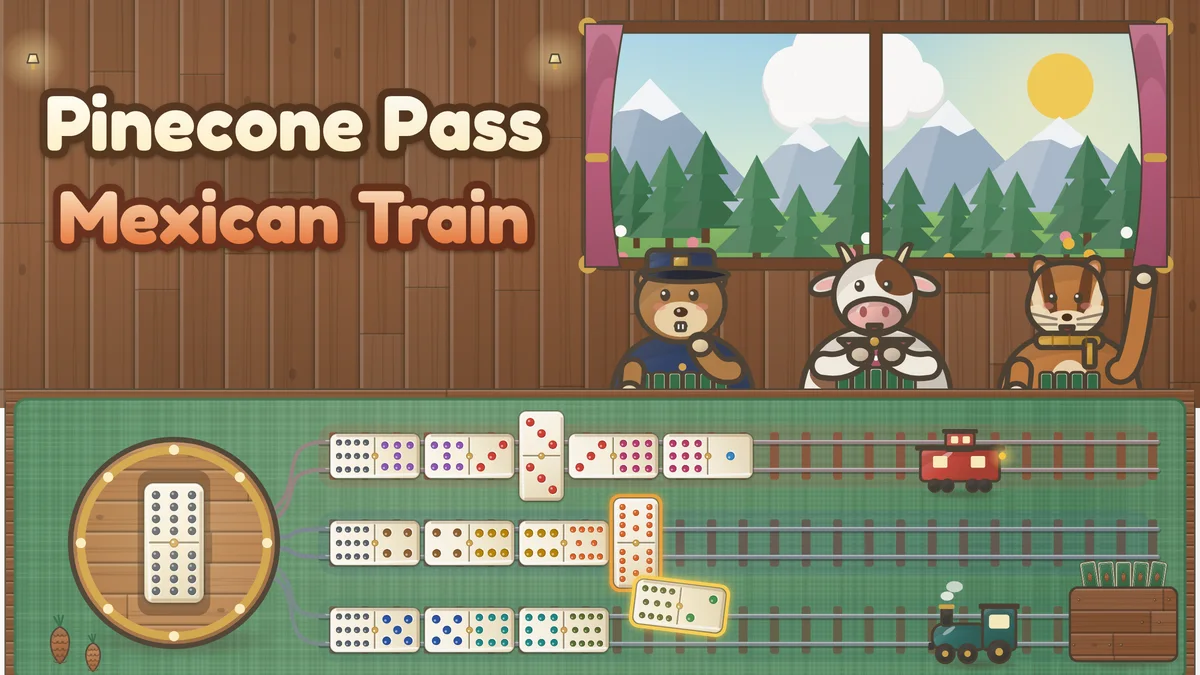
Pinecone Pass Mexican Train is the classic Mexican Train dominoes game for two to four players, played with a double-twelve set of 91 tiles in the dining car of a little train climbing a mountain pass: walnut paneling, brass lamps, a long window onto pines and snowy peaks, and a toy railway on the green felt table. Each round starts from a double in the station, the double 12 in round one and on down to the double blank in round 13. You build your own train from the station toward you, everyone shares the Mexican Train, and a train with a marker on it is open to all until its owner plays on it again. Play a double and it must be covered before anyone plays anywhere else. Play your last tile and you score nothing for the round; everyone else counts the dots left in their hand, and the lowest total after the last round wins. You play with up to three friends: Walter the marmot, a retired conductor in his navy cap; Mavis the cow, warm and unhurried in her rose kerchief; and Chester the chipmunk, quick and cheerful in his mustard scarf.
- Three levels for your friends: Gentle plays any tile that fits, mostly on its own train, with no plan; Steady sheds its heaviest tiles, keeps its own train going and avoids a double it cannot cover; Sharp plans the longest train its hand can make, keeps those tiles for itself, plays its doubles with their covers and sheds its heavy tiles when someone is nearly out.
- On your turn, the tiles you can play glow and the rest dim. Pick one and the trains it fits light up, with an outline where it will go. A tile that fits nowhere says why: a double to cover first, a first-turn train, or the open ends it does not match.
- Every train stays readable on a phone. Each one runs along its own lane from the station, and a long train folds its middle into a short stack with a count, so its open end always shows at full size. Trains shows every tile of every train.
- Line up sorts your rack into the longest train your tiles can make from your train’s open end, followed by the extras, heaviest first.
- Common published options: a deal by table size (16 tiles each for two or three players), building as long a train as you like on your first turn, a half game of 7 rounds or a short game of 3, large numbers instead of dots on the tiles, and three speeds.
- Hints from what you can see at the table, undo for the tile you just placed, a score sheet for every round, and statistics for each level (games, wins, rounds, how often you went out and your best average a round), with your game saved on this device as you play.
How to play
- Press Play. You play with Walter, Mavis and Chester, or with fewer friends if you choose two or three players in Settings. Everyone draws 15 tiles and the rest stay face down in the boneyard. Your tiles stand in your rack below the table.
- Each round starts from a double in the station: the double 12 in round one, then the double 11, and on down to the double blank in round 13. The first turn moves one seat each round.
- On your turn, play one tile with an end that matches the open end of a train you may use: your own train, the Mexican Train, or any train with a marker. An empty train starts with a tile that matches the station’s double. Your train runs along the bottom lane and the Mexican Train along the top.
- If you can play, you must. If nothing fits, draw one tile from the boneyard and play it if it fits. If it does not, or the boneyard is empty, your turn ends and a marker goes on your train: anyone may play there until you play on your own train again, which lifts it.
- Doubles: when you play a double, cover it at once with a second tile of that number on the double, drawing one if you need to. If you cannot, your train gets a marker and the next player must cover it, and so on. Nobody plays anywhere else until the double is covered. A double needs no cover once every other tile with its number has been played.
- The round ends when someone plays their last tile, or when the boneyard is empty and nobody can play. Everyone scores the dots left in their hand. After the last round the lowest total wins; a tie goes to the player with more rounds at 0, then to the lowest round score above 0.
Controls
- Touch or mouse: tap a glowing tile to pick it up, then tap a glowing train to place it, or tap the tile again when it fits only one train. Settings can switch to placing a tile on one tap. Tap the boneyard to draw when nothing fits, and tap Pass when the boneyard is empty. Undo, Hint, Line up, Trains and Menu sit on the shelf below the table, or beside it on a landscape phone.
- Keyboard: the arrow keys move along your rack and Enter or Space picks the tile in focus. Enter again places it, or, when it fits more than one train, moves to the trains, where the arrows choose and Enter places. D draws, P passes (or ends a first-turn train), N deals the next round, T shows every train, L lines up your rack, U undoes, H shows a hint and Escape clears a pick.
- Restart in the toolbar starts a new game. Menu starts a new game, shows the score sheet, every train, your statistics and the rules, and opens Settings: your friends’ level, the number of players, the game length, the deal, the first turn, dots or numbers on the tiles, how you place a tile and your friends’ speed. The toolbar also has pause, help, optional sound and fullscreen.
Tips worth knowing
- Plan your own train first. Find the longest string of tiles that runs on from your train’s open end and save it for yourself; the tiles left over are your extras. Line up shows this for you.
- Play your extras on the Mexican Train and on marked trains while you can, so the tiles your own train needs stay in your hand.
- Keep your train private. A marker lets everyone play on your train and change its open end, and only a tile on your own train lifts it.
- Play a double when you hold a tile to cover it, so two tiles leave your hand in one turn. A double you cannot cover puts a marker on your train.
- Heavy tiles cost the most if the round ends with them in your hand, so shed them first when another player is down to a tile or two.
- Watch who draws. A player who draws or passes has shown they have no tile for the open ends in front of them, so leaving one of those numbers open slows them down.
Accessibility
- Everything can be played with a keyboard: the arrow keys move a visible focus along your rack, Enter or Space picks and places, the arrows choose between trains when a tile fits more than one, and single letter keys draw, pass, deal the next round, show every train, line up, undo and hint.
- Every tile in your rack is labeled for screen readers with its numbers, its dots and where it fits, or why it cannot be played now. The trains, the boneyard and the name plates read out what they hold.
- Each number has its own dot pattern and its own color, and Settings can show the numbers themselves in large print instead. Playable tiles get an outline as well as the others dimming.
- Nothing is timed. Your friends wait while a menu is open, their speed can be set to Relaxed, and every train can be looked at in full at any time.
- Reduced motion places the tiles at once instead of dealing and sliding them, stops the friends’ fidgeting and the glowing pulses, and keeps the sparkles small. Sound is optional and never needed to play.
Questions
How strong is each level?
We measured the levels with our own simulation of 1,000 full games of 13 rounds for each pairing, one player against three of another at a four-player table, with the seats and the first starter moving round the table. An even match wins about one game in four. Against three players that play a legal tile at random, Gentle won 207 of 1,000 games (20.7 percent, close to an even share), Steady 747 and Sharp 998. One Steady player beat three Gentle players in 750 games (75.0 percent) and one Sharp player beat three Gentle in 995 (99.5 percent). One Sharp player beat three Steady in 929 games (92.9 percent), and one Steady player beat three Sharp in none of 1,000. These are computer players, not people, so treat the numbers as a guide.
Can a beginner beat Gentle?
Yes, that is what Gentle is for. In the same simulation, a simple scripted beginner that plays its heaviest tile that fits, wherever it fits, with no plan for its own train, won 634 of 1,000 games against three Gentle players (63.4 percent, well over twice an even share). The same beginner won 137 of 1,000 against three Steady players (13.7 percent) and none of 1,000 against three Sharp players, so Sharp is for practiced players.
Which Mexican Train rules does this use?
The common published rules for a double-twelve set: 15 tiles each for two to four players, the station’s double counting down from 12 to blank over 13 rounds, one tile a turn from the first turn, your own train plus the Mexican Train and any train with a marker, one draw when you cannot play and a marker when you still cannot, doubles covered on the double before anyone plays elsewhere, and the dots left in your hand as your score. Rule books and families differ, so Settings offers 16 tiles each for two or three players, building as long a train as you like on your first turn, and games of 7 or 3 rounds.
What can I undo?
Undo takes back the tile you just placed, as long as nobody has played since. A draw is final, because you have seen the tile, and so is a pass. Undo is there for a slip of the finger, and the final scores show how many you used.
Do Walter, Mavis and Chester look at my tiles?
No. Each friend chooses from what a player at the table could see: their own tiles, every train, the markers, which double needs covering, how many tiles each player holds and how many are left in the boneyard, who has drawn or passed (never which tile they drew), and the scores. The hints follow the same rule. Our regressions check this by shuffling every hidden tile and confirming each choice stays the same.
What does the game save?
It saves after every move: your settings, the game in progress (every tile played and drawn, so you can close the page mid-round and carry on later) and your statistics for Gentle, Steady and Sharp. Everything stays in this browser’s local storage, with no account.