
CozyWorld game guide · By CozyWorld
This guide covers our own game, written from the current game rules and browser checks.
How to Play Crazy Eights: Rules and Strategy
Crazy Eights is the classic card game where you race to empty your hand by matching the top card of the pile, and every eight is wild. Here is how to deal, what you may play, how drawing and passing work, how a hand is scored, how a game ends, the house rules families add, how strong each level of our computer players is, and the strategy, common mistakes and tips that help you go out first.
How do you play Crazy Eights? Everyone gets a few cards, one card is turned up to start a pile, and on your turn you play a card that matches the top of the pile by suit or by rank. Eights are wild: you can play one on anything and choose the suit that comes next. If nothing fits, you draw. The first player to get rid of every card wins the hand. It takes a minute to learn and a few minutes to play, which is why it has been a family favorite for generations.
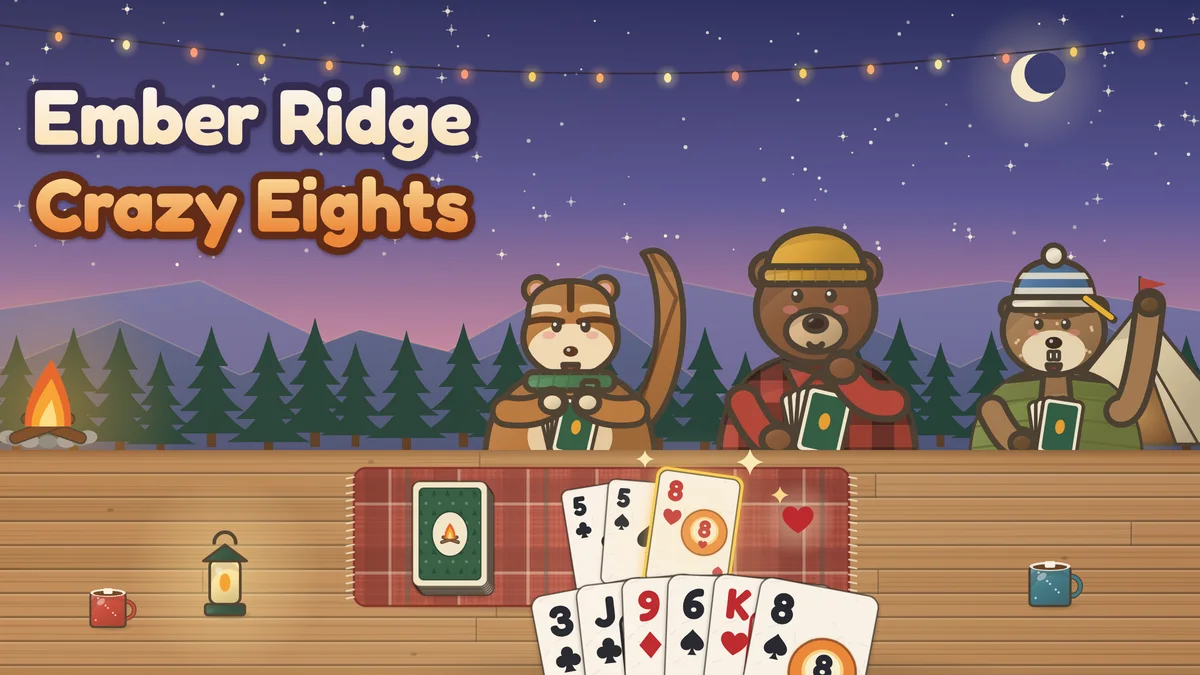
This guide covers the standard rules from published sources: the deal, what you may play, eights and naming a suit, drawing and passing, going out, scoring a hand, how a game ends, and the house rules that families add. Then it shows the controls in Ember Ridge Crazy Eights (CozyWorld’s free Crazy Eights game, played at a camp table with Nutmeg the chipmunk, Hugo the bear and Mortimer the marmot), how strong each level of the computer players is, beginner strategy, the most common mistakes and a few tips. The strength figures and strategy numbers come from our own simulation, which plays the game’s real rules.
What is Crazy Eights?
Crazy Eights is a shedding game: the aim is to be the first to get rid of all your cards. It is played with one ordinary 52-card deck by two to five players, each playing for themselves, and with two decks shuffled together when more join in. Wikipedia counts it as the best known American member of the Eights group, a large family of matching games, and Pagat, the card game rules site, lists other names for it, such as Crates, Switch, Swedish Rummy and Rockaway.
Wikipedia traces the game to the 1930s, when it was simply called Eights, with the name Crazy Eights following in the 1940s. Because the rules are so simple, almost every family plays a slightly different version. The rules below are the common ones found in published rule books, followed by the most popular house rules.
How to deal Crazy Eights
Choose a dealer. The dealer shuffles and deals the cards one at a time, face down, starting with the player on their left. Each player gets five cards, or seven each when only two are playing. The rest of the deck goes face down in the middle as the stock.
The dealer turns up the top card of the stock and puts it beside the stock to start the discard pile. This card is called the starter. If the starter is an eight, the usual published rule is to bury it in the middle of the stock and turn up the next card instead, so nobody begins with a wild card on the pile. Play starts with the player on the dealer’s left and goes clockwise.
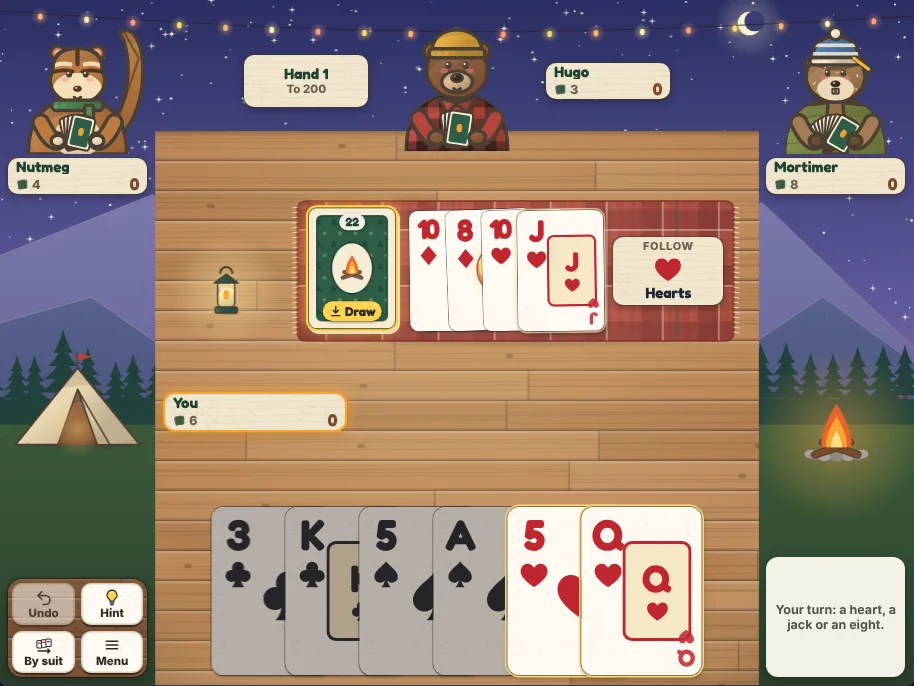
In Ember Ridge Crazy Eights, you sit at the bottom of the table. With three friends, Nutmeg sits on your left, Hugo across from you and Mortimer on your right; with two, Nutmeg and Mortimer; and with one, Hugo sits across. Your cards arrive sorted by suit with the eights at the end, and Sort switches to sorting by rank.
| Players | Cards each | Cards left in the stock |
|---|---|---|
| 2 | 7 | 37, after the starter is turned |
| 3 | 5 | 36, after the starter is turned |
| 4 | 5 | 31, after the starter is turned |
Crazy Eights rules: what you may play
On your turn, play one card face up on the discard pile. It must match the top card by suit or by rank. On the 7 of hearts you may play any heart or any 7: the 2 of hearts, the king of hearts or the 7 of clubs would all do.
Eights are wild. You may play an eight on any card, whatever its suit or rank, and when you do, you name a suit. The next player must then play a card of the suit you named, or another eight. The eight’s own suit and rank no longer matter: after an 8 of clubs naming hearts, a 3 of clubs does not fit, but any heart does.
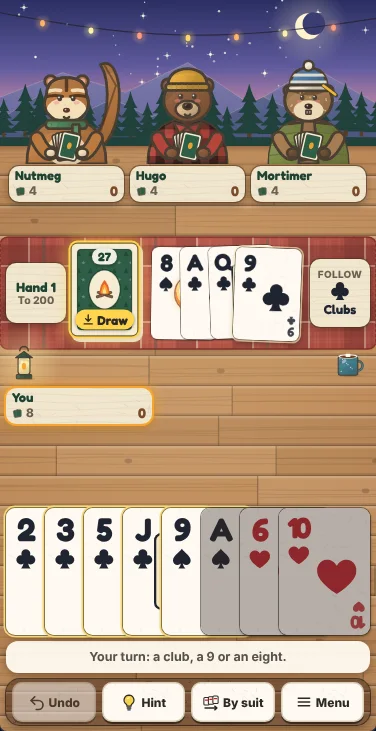
In Ember Ridge Crazy Eights, the cards you may play are outlined and the others dim, and a card you cannot play says why when you tap it. Tap a card to pick it up and tap it again to play it. A badge beside the pile always shows the suit to follow.
Wild eights and naming a suit
An eight is the one card that always fits, which makes it the most valuable card in your hand. Whoever plays it names any of the four suits, including the eight’s own. The player after them must follow that suit or play an eight of their own, which names a new suit.
In Ember Ridge Crazy Eights, playing an eight raises a suit picker over the bottom of the table, in reach of your thumb, with four big buttons. Each shows how many cards of that suit you hold besides the eight, and the keyboard keys C, D, S and H name clubs, diamonds, spades and hearts. Cancel puts the eight back in your hand.
Drawing from the stock and passing
If you cannot play, you draw from the stock. In the most common rules, which Ember Ridge Crazy Eights uses by default, you keep drawing one card at a time until you draw a card you can play, and then play it. You may also draw when you could play, if you would rather keep your cards.
Many families play that you draw just one card instead. If it fits, you may play it at once or keep it; if not, your turn ends. Settings offers this as Draw one card.
When the stock runs out, most published rule books do not shuffle the pile into a new stock. Play goes on without drawing, and a player who has no card that fits passes. If every player passes in turn, the hand is blocked and ends at once. Ember Ridge Crazy Eights plays it that way and spots a blocked hand as soon as nobody holds a card that fits. Pagat notes that many groups shuffle the pile, all but its top card, into a new stock instead.
Going out and scoring a hand
The first player to play their last card goes out and wins the hand. They score the cards left in everyone else’s hands: 50 for each eight, 10 for each king, queen, jack and ten, 1 for each ace, and face value for every other card. Being caught with an eight is expensive, which is one more reason to play your eights before the end.
For example, at a table of four you go out. Nutmeg is left with the 8 of spades and the 3 of clubs, Hugo with the king of hearts and the ace of diamonds, and Mortimer with the 6 of diamonds. Nutmeg’s cards are worth 53, Hugo’s 11 and Mortimer’s 6, so you score 70 for the hand.
In a blocked hand, nobody went out. The player whose cards are worth the least wins the hand and scores the difference between their cards and each other player’s, as Wikipedia describes. If two players tie for the least, each scores that difference.
| Card | Points |
|---|---|
| Each eight | 50 points |
| Each king, queen, jack and ten | 10 points |
| Each ace | 1 point |
| Each 2, 3, 4, 5, 6, 7 and 9 | Its face value |
How a game of Crazy Eights ends
Scores carry over from hand to hand, and the first player to reach a target wins. A common target is 50 points for each player, so 100 for two players, 150 for three and 200 for four. When the target is reached, the highest score wins.
If two players tie for the highest score at or above the target, Ember Ridge Crazy Eights plays another hand, and keeps going until one player alone has the highest score. For a quicker game, Settings offers single hands, where each hand is a game of its own and the first player out wins.
| Players | First to reach |
|---|---|
| 2 | 100 points |
| 3 | 150 points |
| 4 | 200 points |
Common Crazy Eights house rules
Pagat describes Crazy Eights as one of the easiest games to change, and lists the special cards that many groups add. Ember Ridge Crazy Eights offers the three most common as settings, all off by default. When one of these cards is turned up as the starter, it counts as though the dealer had played it, and when a player goes out on one, its effect is ignored.
Other house rules exist, such as saying "last card" when you have one left, playing several cards of the same rank at once, using a jack instead of a queen to skip, or making the queen of spades worth five cards to the next player. Agree on yours before you deal.
| Card | What it does | Default |
|---|---|---|
| Two | The next player draws two cards, unless they play a two, which passes four to the player after them, and so on | Off: a two is an ordinary card |
| Queen | The next player misses a turn (with two players, you play again) | Off: a queen is an ordinary card |
| Ace | Play changes direction (with two players, it does nothing special) | Off: an ace is an ordinary card |
Controls in Ember Ridge Crazy Eights
On a phone or tablet, tap a card to pick it up and tap it again to play it; Settings can switch to playing a card on one tap. Tap the stock to draw. Pass, Keep it, Next hand and Scores appear beside your name plate when they apply. With a mouse, click the same way.
On a keyboard, the arrow keys move along your hand and Enter or Space picks or plays the card in focus. D draws, P passes, N deals the next hand, U undoes, H shows a hint and S sorts your hand.
Undo takes back the card you just played, as long as nobody has played since, so no new card has been seen. A draw is final, because you have seen the card. Hints look only at what you can see (your cards, the pile, and who drew or passed on which suit) and say why. Your friends wait while a menu or the suit picker is open, and their speed can be set to Relaxed.
How strong are Nutmeg, Hugo and Mortimer?
All your friends play at the level you choose. Gentle plays the first card it finds that fits and four times in ten simply plays any legal card at random, eights included. Steady weighs every card: it stays in the suit it holds most of, uses a matching rank to switch to a longer suit, keeps its eights for when it is stuck, and sheds high cards once anyone is down to a card or two. Sharp plays like Steady and also reads the record of the hand: a player who drew on a suit probably has none of it, so when that player is close to going out, Sharp steers play to a suit they seem to lack.
We measured the levels with our own simulation of 1,000 games to 200 for each pairing, one player against three of another at a table of four, with the seats and the first dealer moving round the table. The scripted beginner plays the first card that fits, keeps its eights until nothing else fits, names the suit it holds most of and draws only when it must. In a four-player game an even match wins about one game in four, 250 of 1,000, with an average place of 2.5.
So a newcomer playing simple, sensible cards wins more than an even share against Gentle, and somewhat less against Steady and Sharp. Head to head against one friend, the same beginner won 609 of 1,000 games against Gentle, 379 against Steady and 310 against Sharp. Crazy Eights has a lot of luck in the deal and the draw, so the gaps between the levels are smaller than in games like Hearts or checkers, and anyone can win a game. These are computer players, not people, so treat the numbers as a guide.
| Who played | Games won of 1,000 | Average place |
|---|---|---|
| Gentle against three random players | 320 | 2.26 |
| Steady against three random players | 419 | 2.03 |
| Sharp against three random players | 429 | 2.01 |
| Scripted beginner against three Gentle | 292 | 2.28 |
| Scripted beginner against three Steady | 228 | 2.48 |
| Scripted beginner against three Sharp | 221 | 2.50 |
| Steady against three Gentle | 357 | 2.16 |
| Sharp against three Gentle | 384 | 2.11 |
| Sharp against three Steady | 266 | 2.38 |
Beginner Crazy Eights strategy
Keep your eights until you need them. In our simulation, a player who played an eight whenever it had one, and otherwise played like the scripted beginner, won only 169 of 1,000 games against three beginners, while a beginner who saved its eights won 345 of 1,000 against three of those eager players. An eight is your way out when nothing else fits, and it costs 50 points if someone else goes out while you hold it.
When you do play an eight, name the suit you hold the most of. You are then likely to have a card for that suit on your next turn, and less likely to have to draw.
Use a matching rank to change suit. On the 9 of clubs, a 9 of hearts moves play into hearts, your longer suit, without spending an eight.
Shed high cards when someone is nearly out. Tens and court cards are worth 10 each to whoever goes out first. In our simulation, a player who went out at a table of four scored between 66 and 81 points on average, depending on who was playing, and between 24 and 29 at a table of two.
Common Crazy Eights mistakes
Playing an eight when another card fits. It feels like a clever move, but it leaves you without a way out later.
Naming a suit you hold only one card of, or none. Unless you are blocking a player who is about to go out, name your longest suit.
Ignoring the draws. When a player draws on a suit, they most likely had none of it, and if they are down to one or two cards, keeping play in that suit can stop them going out.
Holding on to high cards to the end. A hand full of court cards and tens is costly when someone else goes out.
Forgetting how many cards the others hold. A player with one card left can win on their next turn, so that is the moment to steer play away from them.
Crazy Eights tips
Count the eights. There are only four, and once you have seen three played, the last one is the only wild card left.
Keep a spread of suits for as long as you can, so a change of suit does not leave you drawing.
In a game to a target, look at the scores. When you are far behind, going out quickly matters more than shedding points.
Use the hint to learn. In Ember Ridge Crazy Eights it names a card and the reason, using only what you can see at the table.
Keep playing
Crazy Eights comes down to a few habits: keep your eights for when you are stuck, name the suit you hold most of, use a matching rank to change suit for free, watch who draws on which suit, and shed your high cards when someone is nearly out. Start with Gentle friends, use the hint when you are unsure, and move up to Steady when you win more than your share. For more classic card games, try Kettle Burrow Hearts, four-player Hearts in a burrow kitchen; Birch Cove Gin Rummy, two-player gin rummy against Murray the moose; or Porch Swing Solitaire, our Klondike game. For dice, try Meadowlark Barn Shut the Box.
- Play Ember Ridge Crazy Eights
- Ember Ridge Crazy Eights: features, controls and FAQ
- Kettle Burrow Hearts: the classic four-player card game
- Birch Cove Gin Rummy: gin rummy against the computer
- Porch Swing Solitaire: Klondike on a porch at dusk
- Meadowlark Barn Shut the Box: the classic dice game
- How to play Hearts: rules, scoring and strategy
- How to play gin rummy: rules, scoring and strategy
- How to play Shut the Box: rules and strategy
- How to play checkers: rules and strategy
- How to play mancala: rules and strategy
- How to play Klondike solitaire: setup and rules
- How to play FreeCell solitaire: setup and rules
- How to play Pyramid solitaire: setup and rules
More guides and roundups
Cribbage is the classic two-player card game played with a pegging board. Here is how to deal, what to lay away to the crib, how the play to 31 scores, how to count a hand line by line, how the board and the game to 121 work, how strong each level of our computer opponent is, and the strategy, common mistakes and tips that win more games.
How to Play Mexican Train Dominoes: Full RulesMexican Train is the domino game where everyone builds a train of matching tiles from one station. Here is how to set up a round, which trains you may play on, how markers and doubles work, how a round ends and is scored, how the full 13-round game is won, the common rule variations, how strong each level of our computer players is, and the strategy, mistakes and tips that keep your score low.
How to Play Euchre: Rules, Bowers and ScoringEuchre is the fast partnership card game played with 24 cards, where the two jacks of the trump color outrank the aces. Here is how to deal, how the right and left bowers work, how trump is made in two rounds of bidding, what going alone means, how a hand is scored, how strong each level of our computer players is, and the strategy, common mistakes and tips that win more hands.
How to Play Farkle: Rules, Scoring and StrategyFarkle is the six-dice game where you set aside dice that score and decide, throw after throw, whether to bank your points or push on. Here are the rules, the full scoring chart, hot dice and the final round, the common house rules, and strategy with the chances worked out exactly.