
CozyWorld game guide · By CozyWorld
This guide covers our own game, written from the current game rules and browser checks.
How to Play Euchre: Rules, Bowers and Scoring
Euchre is the fast partnership card game played with 24 cards, where the two jacks of the trump color outrank the aces. Here is how to deal, how the right and left bowers work, how trump is made in two rounds of bidding, what going alone means, how a hand is scored, how strong each level of our computer players is, and the strategy, common mistakes and tips that win more hands.
Euchre is a trick-taking card game for four players in two partnerships, played with a short deck of 24 cards. One suit becomes trump each hand, and the side that chooses it must take at least three of the five tricks. Its twist is the bowers: the jack of trump and the other jack of the same color become the two highest cards in the deck. Hands are quick, every card counts, and a good partnership feels like a quiet conversation across the table.
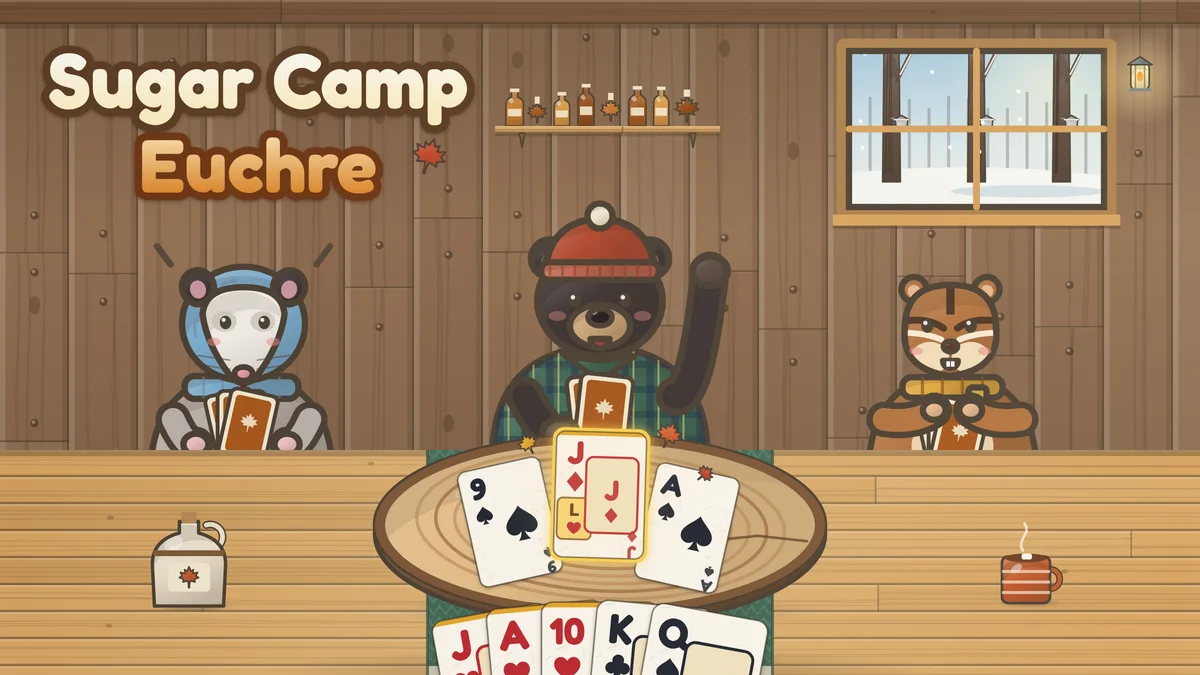
This guide covers the standard four-player rules: the deal, the bowers and the order of the cards, the two rounds of making trump, going alone, playing the tricks, scoring a hand and winning the game, and the common ways families change the rules. Then it shows the controls in Sugar Camp Euchre (CozyWorld’s free euchre game, where you partner Hollis the black bear against Opal the opossum and Chet the chipmunk), how strong each level of the computer players is, beginner strategy, the most common mistakes and a few tips. The strength figures come from our own simulation, which plays the game’s real rules.
The cards and the partners
Euchre uses 24 cards: the 9, 10, jack, queen, king and ace of each of the four suits. Take them from an ordinary deck and set the rest aside. Four players sit around the table, and the two sitting opposite each other are partners for the whole game. Partners score together and help each other, but never show each other their cards.
The game is most likely derived from an old card game from Alsace called Jucker or Juckerspiel, and it became a favorite in North America in the 1800s. It even gave the deck its joker: the joker first appeared in euchre packs in the 1850s, as an extra top trump.
In Sugar Camp Euchre, you sit at the bottom of the table with Hollis, your partner, across from you. Opal sits on your left and Chet on your right, and they play together against you both.
How to deal euchre
The dealer shuffles and deals five cards to each player, clockwise from the player on their left, in two rounds of small packets: three, two, three and two cards in turn on the first round, then two, three, two and three on the second, so everyone ends up with five. The four cards left over make the kitty. The dealer turns the top card of the kitty face up. That card is the up-card, and its suit is the first one offered as trump.
The deal passes one seat to the left after every hand, so everyone deals in turn. In Sugar Camp Euchre, Chet deals the first hand, which makes you the first to speak.
The bowers and the order of the cards
Once a suit is trump, the cards change order. The jack of trump is the right bower, the highest card in the deck. The jack of the other suit of the same color is the left bower, the second-highest card. Then come the ace, king, queen, 10 and 9 of trump. Any trump beats any card of another suit.
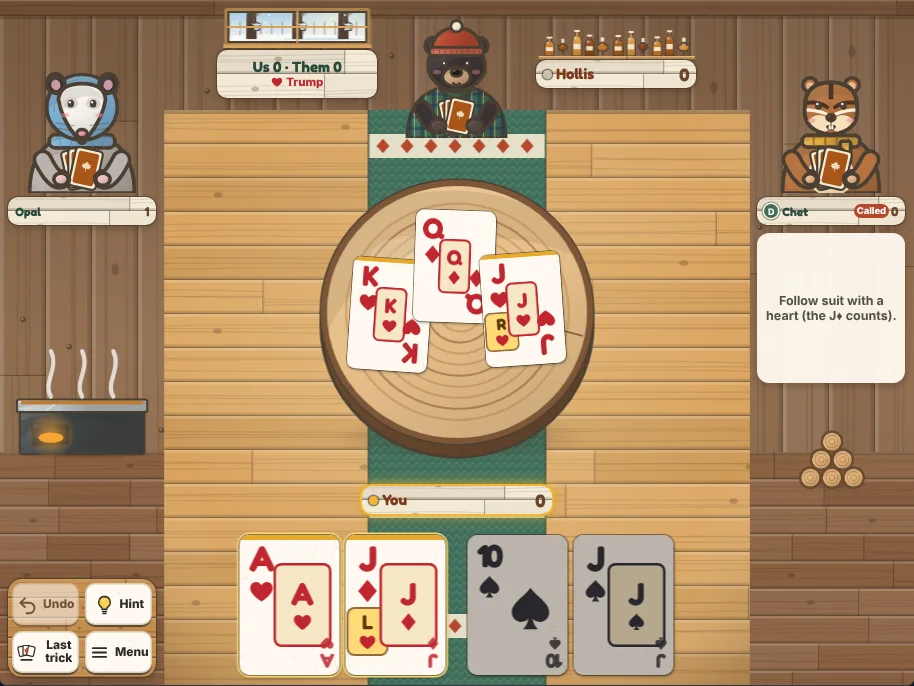
The left bower changes suit for the hand: it counts as a trump and not as a card of its own suit. If hearts are trump, the jack of diamonds is a heart. You must play it when hearts are led and you have no other heart, and you may not play it to follow a diamond lead. That leaves the suit of the same color with only five cards, ace, king, queen, 10 and 9.
In Sugar Camp Euchre, each bower carries a small tag with R or L and the trump suit, the left bower sits among your trumps, and tapping the score sign shows the full order of the cards for the hand.
| Rank | Trump (hearts) | Other suits |
|---|---|---|
| Highest | Jack of hearts (right bower) | Ace |
| 2nd | Jack of diamonds (left bower) | King |
| 3rd | Ace of hearts | Queen |
| 4th | King of hearts | Jack (not in diamonds) |
| 5th | Queen of hearts | 10 |
| 6th | 10 of hearts | 9 |
| Lowest | 9 of hearts |
Making trump: round one
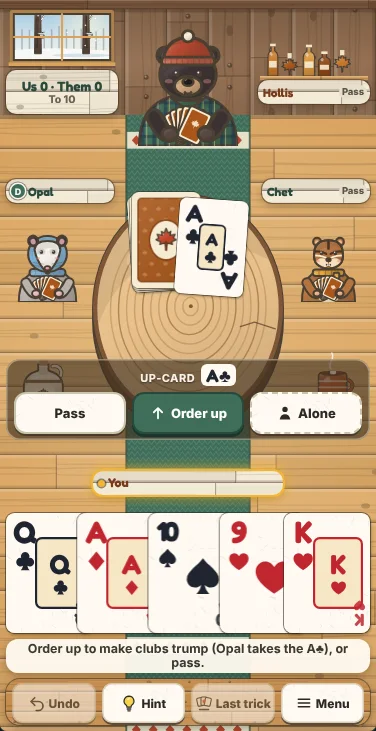
Starting with the player on the dealer’s left and going clockwise, each player may pass or order up the up-card. Ordering up makes the up-card’s suit trump and tells the dealer to pick it up. The dealer speaks last and may pick it up themselves. The player who makes trump is the maker, and their side must take at least three tricks.
Whenever the up-card is taken, the dealer adds it to their hand and discards one card face down, so they still hold five. Ordering up the dealer’s card helps the dealer, which is fine when the dealer is your partner and costly when they are an opponent. In Sugar Camp Euchre the button says Order up, or Pick it up when you are the dealer.
Round two and stick the dealer
If all four players pass, the up-card is turned face down and its suit can no longer be trump for this hand. Starting again on the dealer’s left, each player may name any other suit as trump, or pass. If all four pass a second time, the cards are thrown in and the next player deals.
Many players use a rule called stick the dealer (or screw the dealer): the dealer may not pass the second time and must name a suit if the other three have passed. It keeps every hand in play. Sugar Camp Euchre throws the cards in by default and offers stick the dealer in Settings.
Going alone
The player who makes trump, in either round, may choose to go alone. Their partner lays their cards face down and sits the hand out, and the lone maker plays against both opponents. Taking all five tricks alone scores 4 points instead of 2. Three or four tricks still score 1, and fewer than three is a euchre for the other side.
When a lone maker plays, the player on the maker’s left leads the first trick. If the dealer’s partner orders up the up-card and goes alone, the dealer sits out, and the up-card stays unused.
In Sugar Camp Euchre, turn on Alone before you tap Order up or a suit. When Hollis goes alone, your cards are laid down and you watch him play the hand.
Playing the tricks
The player on the dealer’s left leads the first trick, with any card. Play goes clockwise. Each player must follow suit, playing a card of the suit led, if they can, remembering that the left bower belongs to trump. A player who cannot follow may play any card, including a trump.
The highest trump in the trick wins it. If no trump was played, the highest card of the suit led wins, and a card of another suit can never win. The winner leads the next trick. After five tricks the hand is scored.
In Sugar Camp Euchre, the cards you may play are outlined and the others dim, and a card you cannot play says why when you tap it, including when the left bower must follow trump. Tap a card to pick it up and tap it again to play it. Each finished trick stays on the log slab for a moment, with the winning card glowing.
How to score a hand of euchre
Only one side scores in a hand. If the makers take three or four tricks, they score 1 point. If they take all five, a march, they score 2, or 4 when the maker went alone. If the makers take fewer than three tricks, they are euchred and the defenders score 2.
For example, Opal orders up hearts and she and Chet take three tricks: they score 1. On the next hand you call spades and you and Hollis take only two tricks: Opal and Chet score 2 for the euchre.
In Sugar Camp Euchre, a breakdown after every hand shows who called trump, each side’s tricks and each player’s share, the points for the hand and the running totals.
| What happened | Points |
|---|---|
| Makers take 3 or 4 tricks | 1 to the makers |
| Makers take all 5 tricks (a march) | 2 to the makers |
| A lone maker takes 3 or 4 tricks | 1 to the makers |
| A lone maker takes all 5 tricks | 4 to the makers |
| Makers take fewer than 3 tricks (euchred) | 2 to the defenders |
Winning a game of euchre
The first side to reach 10 points wins the game. Because only one side scores in each hand, there is never a tie. Shorter games to 5 or 7 points are common too, and Sugar Camp Euchre offers both in Settings. In our simulation, a game to 10 between evenly matched sides took about 11 to 13 hands.
Common euchre rule variations
Euchre is played a little differently from town to town, so families often agree a few house rules before the first deal. The table lists the ones Sugar Camp Euchre offers, with its default first. With the farmer’s hand on, a player dealt only 9s and 10s may show the hand and swap three of its cards for the three face-down cards of the kitty before the bidding. With defending alone on, a defender facing a lone maker may play alone too, and a lone defender who euchres the maker scores 4. With no trump on, a player may call no trump in round two: there are no bowers, every suit runs ace high, and the highest card of the suit led wins.
| Rule | Default | Option |
|---|---|---|
| All four pass twice | Throw in and redeal | Stick the dealer: the dealer must name a suit |
| Farmer’s hand (only 9s and 10s) | Played as dealt | Swap three cards for the kitty |
| Defending alone | Defenders always play as a pair | A defender may play alone against a lone maker |
| No trump | Trump is always a suit | No trump may be called in round two |
| Game length | To 10 | To 7 or to 5 |
Controls in Sugar Camp Euchre
On a phone or tablet, the bidding panel sits just above your cards: tap Pass or Order up in round one, or a suit in round two, and turn on Alone first to go alone. As dealer, tap the card to discard, then tap it again. In play, tap a card to pick it up and tap it again to play it; Settings can switch to playing a card on one tap. After a hand, tap Next to deal the next one. With a mouse, click the same way.
On a keyboard, the arrow keys move along your hand and Enter or Space picks or plays the card in focus. P passes, O orders up, A turns going alone on or off, Tab reaches the suit buttons, T shows the order of the cards, N deals the next hand, L shows the last trick, U undoes and H shows a hint.
Undo takes back your last bid, discard or card, as long as nobody has acted since, so nothing new has been seen. Hints look only at what you can see (your cards, the up-card, the bids and the cards played) and say why. The computer players wait while a menu is open, and their speed can be set to Relaxed.
How strong are Opal, Hollis and Chet?
All three computer players play at the level you choose, so Hollis is as strong as your opponents. Gentle makes trump only with three trumps including a bower, or four trumps, never goes alone, leads its highest card, and four times in ten simply plays a legal card at random. Steady weighs each suit before calling (its trumps, off-suit aces and the suits it could trump), leads trump when its side made it, never trumps its partner’s winning card and goes alone only with a hand that should take every trick. Sharp plays like Steady and also weighs the up-card and its seat, counts every trump played, watches who is out of a suit, covers its partner’s card when an opponent could still beat it, and goes alone with a big hand.
We measured the levels with our own simulation of 1,000 games to 10 for each pairing, two partners against two, with the seats and the first dealer moving round the table and each deal played twice with the sides swapped. The scripted beginner makes trump with three trumps or more, never goes alone, leads its highest card outside trump, plays low when its partner is winning and otherwise wins as cheaply as it can. An even match wins about half the games.
So a newcomer playing simple, sensible cards with a Gentle partner wins two games in three against Gentle players. Steady and Sharp are real opponents, and euchre has plenty of luck in the deal: even then the beginner wins about four games in ten with a partner of the same level. In the Sharp against Steady games, the Sharp pair went alone 664 times in 1,000 games and took all five tricks 281 times. These are computer players, not people, so treat the numbers as a guide.
| Who played | Games won of 1,000 | Average final score |
|---|---|---|
| A Gentle pair against a random pair | 993 | 10.4 to 2.3 |
| A Steady pair against a random pair | 997 | 10.4 to 1.6 |
| A Sharp pair against a random pair | 998 | 10.4 to 1.6 |
| Scripted beginner and a Gentle partner against a Gentle pair | 667 | 8.9 to 7.0 |
| Scripted beginner and a Steady partner against a Steady pair | 426 | 7.8 to 8.5 |
| Scripted beginner and a Sharp partner against a Sharp pair | 399 | 7.6 to 8.6 |
| A Steady pair against a Gentle pair | 859 | 9.7 to 5.5 |
| A Sharp pair against a Gentle pair | 894 | 9.9 to 4.9 |
| A Sharp pair against a Steady pair | 589 | 8.5 to 7.7 |
Beginner euchre strategy
Count your trumps for each suit, with the left bower among them. Three trumps including a bower, plus an off-suit ace, is a common reason to order up or name a suit. Two small trumps and no aces usually is not.
Think about the dealer before you order up. The dealer gets the up-card, so ordering up a jack for an opponent hands them the right bower. When your partner deals, a good up-card is worth more to your side.
When your side makes trump, lead trump early to draw the other side’s trumps, so your aces and kings can win later. When you are defending, lead an off-suit ace, or a suit the makers are likely to be short in.
As dealer, discard a lone low card of a suit, so you are out of that suit and can trump it when it is led.
Common euchre mistakes
Forgetting the left bower. It is a trump for the whole hand: count it when you bid, play it when trump is led, and do not try to follow its own suit with it.
Trumping your partner’s winning trick. If your partner is already winning, throw your lowest card and keep your trump for the other side.
Ordering up a strong card for the dealer on the other side with a thin hand. You give them a trump and need three tricks yourselves.
Going alone with a hand that has a loser in it, such as a lone king of another suit. Taking three or four tricks alone scores only 1, the same as with your partner, and one bad trick can turn it into a euchre.
Leading trump when you are defending. It usually helps the makers by drawing out your own side’s trumps.
Euchre tips
Listen to the bidding. A partner who passes in round one but names a suit in round two is telling you about that suit. Many players also call next (the suit of the same color as the up-card turned down) from the dealer’s left, because the dealer turned that color down.
Keep track of the bowers and the aces of trump. Until the right bower has been played, a left bower or an ace of trump can still be beaten.
Watch the score. Near the end of a game, a single point can matter more than the chance of a march, and a euchre against you can end it.
Use the hint to learn. In Sugar Camp Euchre it names a bid or a card and the reason, using only what you can see at the table, and the last trick button lets you check what was just played.
Keep playing
Euchre comes down to a handful of habits: count your trumps with the left bower among them, order up when your side can take three tricks, lead trump when you make it, never trump your partner’s winner, and go alone when your hand can take every trick. Start against Gentle players with Hollis beside you, use the hint when you are unsure, and move up to Steady once you win more often than not. For another trick-taking game, try Kettle Burrow Hearts; for a two-player card game, try Birch Cove Gin Rummy; and for a quiet game on your own, try Porch Swing Solitaire, our Klondike game.
- Play Sugar Camp Euchre
- Sugar Camp Euchre: features, controls and FAQ
- Kettle Burrow Hearts: four-player Hearts against the computer
- Birch Cove Gin Rummy: gin rummy against the computer
- Porch Swing Solitaire: Klondike on a porch at dusk
- How to play Hearts: rules, scoring and strategy
- How to play gin rummy: rules, scoring and strategy
- How to play Klondike solitaire: setup and rules
- How to play checkers: rules and strategy
- How to play Shut the Box: rules and strategy
More guides and roundups
Cribbage is the classic two-player card game played with a pegging board. Here is how to deal, what to lay away to the crib, how the play to 31 scores, how to count a hand line by line, how the board and the game to 121 work, how strong each level of our computer opponent is, and the strategy, common mistakes and tips that win more games.
How to Play Crazy Eights: Rules and StrategyCrazy Eights is the classic card game where you race to empty your hand by matching the top card of the pile, and every eight is wild. Here is how to deal, what you may play, how drawing and passing work, how a hand is scored, how a game ends, the house rules families add, how strong each level of our computer players is, and the strategy, common mistakes and tips that help you go out first.
How to Play Mexican Train Dominoes: Full RulesMexican Train is the domino game where everyone builds a train of matching tiles from one station. Here is how to set up a round, which trains you may play on, how markers and doubles work, how a round ends and is scored, how the full 13-round game is won, the common rule variations, how strong each level of our computer players is, and the strategy, mistakes and tips that keep your score low.
How to Play Chinese Checkers: Rules and StrategyChinese checkers is the race across a six-pointed star: step or hop your ten marbles into the point opposite before anyone else fills theirs. Here is how to set up for two, three, four or six players, how steps and hop chains work, how a game is won, what to do about marbles left in your home, how strong each level of our computer players is, and the strategy that wins more races.