Cozy Classic
Free Euchre
Sugar Camp Euchre
Classic euchre for four, with you and a computer partner against two computer players, the bowers marked on every card, the cards you may play lit up, a breakdown after every hand, three levels and hints that explain.
What you do
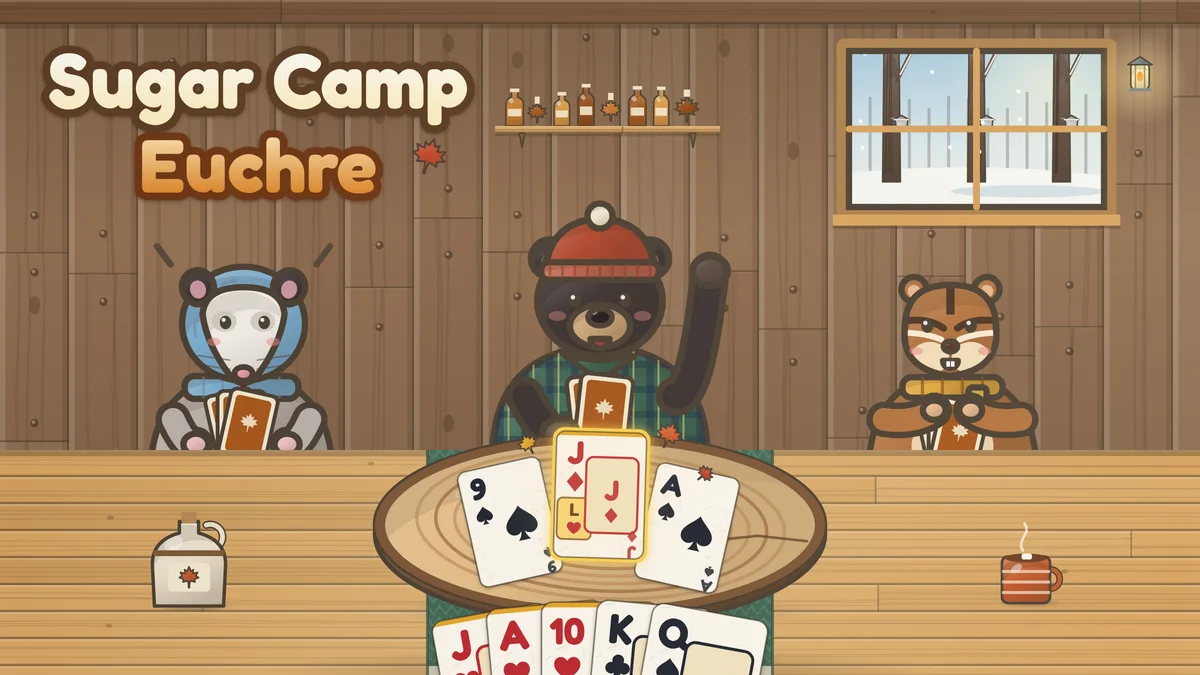
Sugar Camp Euchre is the classic partnership trick-taking card game, played at a pine table inside a maple sugarhouse in early spring, with the evaporator steaming, sap buckets on the maples outside the window and a shelf of syrup jars by the door. You and Hollis the black bear, your partner across the table, play against Opal the opossum on your left and Chet the chipmunk on your right. The deck is 24 cards, the 9 up to the ace of each suit. Everyone gets five cards and one card is turned face up. In the first round of bidding each player may order the dealer to pick up that card, which makes its suit trump; if everyone passes, the second round lets each player name any other suit. Whoever makes trump must take at least three of the five tricks with their partner, or the other side scores instead. The jack of trump, the right bower, is the highest card, and the other jack of the same color, the left bower, becomes the second-highest trump. A player with a strong hand may go alone for 4 points. The first side to 10 wins. Opal is thoughtful and polite, Hollis is calm and steady, and Chet is quick and cheerful, at a Gentle, Steady or Sharp level.
- Three levels for all three computer players: Gentle calls trump only with plenty of trumps and often plays a card at random, Steady weighs each suit before calling and leads trump when it makes it, and Sharp also weighs the up-card and its seat, counts every trump, plays to its partner and goes alone with a big hand.
- The bowers are clear: the right and left bowers carry a small R or L tag with the trump suit, the left bower sorts into your trumps, and the score sign opens the order of the cards for the hand at any time.
- On your turn, the cards you may play stand out and the others dim, and a card you cannot play says why, including when the left bower counts as trump rather than its own suit.
- A breakdown after every hand shows who called trump, each side’s tricks, the points scored and the running totals, and a final card ends the game.
- Standard rules by default (throw in and redeal when all pass twice, a game to 10), with common options: stick the dealer, farmer’s hand, defending alone, no trump, and games to 5 or 7.
- Hints that use only what you can see at the table, for bidding, discarding and play, a look back at the last trick, and an undo that takes back your last bid, discard or card until someone else acts.
How to play
- Press Play. Chet deals five cards to everyone and turns the next card face up on the three-card kitty. Your cards sit along the bottom, trump first once it is made. Opal sits on your left, Hollis, your partner, across the table and Chet on your right.
- Round one: starting on the dealer’s left, each player may order up the face-up card, making its suit trump, or pass. If someone orders it up, the dealer takes the card and discards one face down. When you are the dealer, you may pick it up yourself.
- Round two: if all four pass, the card is turned down, and each player in turn may name any other suit as trump or pass. If all four pass again, the cards are thrown in and the next player deals.
- The bowers: the jack of trump is the right bower, the highest card. The jack of the other suit of the same color is the left bower, the second-highest trump, and it counts as a trump for following suit. Then trump runs ace, king, queen, 10, 9.
- Tricks: the player on the dealer’s left leads. Everyone must follow the suit led if they can; if not, they may play any card, trump included. The highest trump wins the trick, or the highest card of the suit led, and the winner leads next.
- Scoring: the side that made trump scores 1 for three or four tricks and 2 for all five (a march). A player who went alone scores 4 for a march. If the makers take fewer than three tricks, they are euchred and the other side scores 2. The first side to 10 wins.
Controls
- Touch or mouse: during the bidding, tap Pass, Order up or a suit on the panel, and turn on Alone first to go alone. In play, tap a card to pick it up and tap it again to play it, or switch to playing on one tap in Settings. Tap the score sign to see the order of the cards. Undo, Hint, Last trick and Menu sit on the shelf below the table, or beside it on a landscape phone.
- Keyboard: the arrow keys move along your hand and Enter or Space picks or plays the card in focus. P passes, O orders up, A turns going alone on or off, Tab reaches the suit buttons in round two, T shows the order of the cards, N deals the next hand, L shows the last trick, U undoes, H shows a hint and Escape clears a pick.
- Restart in the toolbar starts a new game. Menu starts a new game, changes the computer players’ level, the game length, the rule options, how you play a card and the speed in Settings, and shows your statistics and the rules. The toolbar also has pause, help, optional sound and fullscreen.
Tips worth knowing
- Count your trumps with the up-card’s suit in mind, and remember the left bower is one of them. Three trumps with a bower and an off-suit ace is a common reason to order up.
- When you make trump, lead trump to draw out the other side’s trumps, unless your partner made it and you have a winner to cash first.
- Do not trump your partner’s winning card. Throw your lowest card instead and save your trumps for the other side’s tricks.
- As dealer, discard a lone low card of a suit, so you can trump that suit when it is led.
- Watch for the bowers. Until the right bower has been played, a left bower or an ace of trump can still be beaten.
- Use the hint to learn. It looks only at the cards you can see and says why it picks a bid or a card.
Accessibility
- Everything can be played with a keyboard: the arrow keys move a visible focus along your hand, Enter or Space picks and plays, Tab reaches the bidding buttons, and single letter keys pass, order up, go alone, show the order of the cards, deal the next hand, show the last trick, undo and hint.
- Every card in your hand is labeled for screen readers with its name, whether it is a bower or a trump, and whether it can be played now, and why not when it cannot. The name plates read out who deals, who called trump and each player’s tricks.
- The cards you may play are marked by an outline as well as by dimming the others, the bowers carry a letter as well as a color, and every score is shown as a number.
- Nothing is timed. The computer players wait while a menu is open, their speed can be set to Relaxed, and the last trick can be looked at any time.
- Reduced motion places the cards at once instead of dealing and sliding them, stops the players’ fidgeting and keeps the sparkles small. Sound is optional and never needed to play.
Questions
How strong is each level?
We measured the levels with our own simulation of 1,000 games to 10 for each pairing, two partners against two, with the seats and the first dealer moving round the table and each deal played twice with the sides swapped. An even match wins about half the games, and euchre has plenty of luck in the deal. Against a pair that bids and plays at random, a Gentle pair won 993 of 1,000 games, a Steady pair 997 and a Sharp pair 998. A Steady pair beat a Gentle pair in 859 games (85.9 percent) and a Sharp pair beat a Gentle pair in 894 (89.4 percent). A Sharp pair beat a Steady pair in 589 games (58.9 percent). These are computer players, not people, so treat the numbers as a guide.
Can a beginner beat Gentle?
Yes, that is what Gentle is for. In the same simulation, a simple scripted beginner that makes trump with three trumps or more, never goes alone, leads its highest card outside trump and wins tricks as cheaply as it can, playing with a Gentle partner against two Gentle players, won 667 of 1,000 games (66.7 percent). With a Steady partner against two Steady players it won 426 (42.6 percent), and with a Sharp partner against two Sharp players 399 (39.9 percent).
Which euchre rules does this use?
Standard four-player partnership euchre: a 24-card deck from 9 to ace, five cards each dealt in packets of three and two, one card turned up, two rounds of bidding with the turned suit out in the second, the dealer picking up and discarding, the right and left bowers, going alone, 1 point for three or four tricks, 2 for a march, 4 for a lone march, 2 for a euchre, and a game to 10. If all four pass twice, the hand is thrown in and the deal passes on. Families differ, so Settings offers stick the dealer, the farmer’s hand, defending alone, no trump and shorter games to 5 or 7.
What are the right and left bowers?
The two highest trumps. The right bower is the jack of the trump suit. The left bower is the jack of the other suit of the same color: if hearts are trump, the jack of diamonds. For the hand it is a trump, not a diamond, so you must play it when hearts are led and you have no other heart, and you may not play it to follow diamonds. In the game both bowers carry an R or L tag with the trump suit.
What does going alone mean?
The player who makes trump may choose to play without their partner, who lays their cards down for the hand. A lone player who takes all five tricks scores 4 points instead of 2. Three or four tricks still score 1, and fewer than three is a euchre worth 2 to the other side. Turn on Alone before you order up or name a suit.
What can I undo?
Undo takes back your last bid, discard or card, as long as nobody has acted since, so nothing new has been seen. Once the next player bids or plays, your choice stands. A farmer’s swap is final, because the cards from the kitty are seen at once.
Do Opal, Hollis and Chet look at my cards?
No. Each computer player chooses from what a player at the table could see: their own cards, the face-up card, the bids, the cards played to every trick, who has run out of a suit, the scores and, for the dealer, the card they discarded. The hints follow the same rule. Our regressions check this by shuffling the hidden cards and confirming every choice stays the same.
What does the game save?
It saves after every bid and card: your settings, the game in progress (every bid, discard and card played, so you can close the page mid-hand and carry on later) and your statistics for Gentle, Steady and Sharp. Everything stays in this browser’s local storage, with no account.