
CozyWorld game guide · By CozyWorld
This guide covers our own game, written from the current game rules and browser checks.
How to Play Cribbage: Rules, Scoring and Strategy
Cribbage is the classic two-player card game played with a pegging board. Here is how to deal, what to lay away to the crib, how the play to 31 scores, how to count a hand line by line, how the board and the game to 121 work, how strong each level of our computer opponent is, and the strategy, common mistakes and tips that win more games.
Cribbage is a card game for two players with one ordinary deck and a wooden pegging board. Each hand has three parts: both players lay away two cards to an extra hand called the crib, then take turns laying cards and adding up a running count to 31, then count the cards in their hands for fifteens, pairs, runs and flushes. Every point is pegged on the board, and the first player to 121 wins. A hand takes a few minutes, and the choice of which two cards to give up keeps it interesting for a lifetime.
This guide covers the standard two-player six-card rules: the cut for deal, the crib, the starter and his heels, the play to 31 with the go and last card, the show with its scoring table and worked examples, the board, the game to 121, skunks and the ways rule books differ. Then it shows the controls in Chickadee Hill Cribbage (CozyWorld’s free cribbage game against Quincy the porcupine), how strong each of Quincy’s levels is, beginner strategy, the most common mistakes and a few tips. The strength figures and crib averages come from our own simulation and our own count, which use the game’s real rules and scorer.
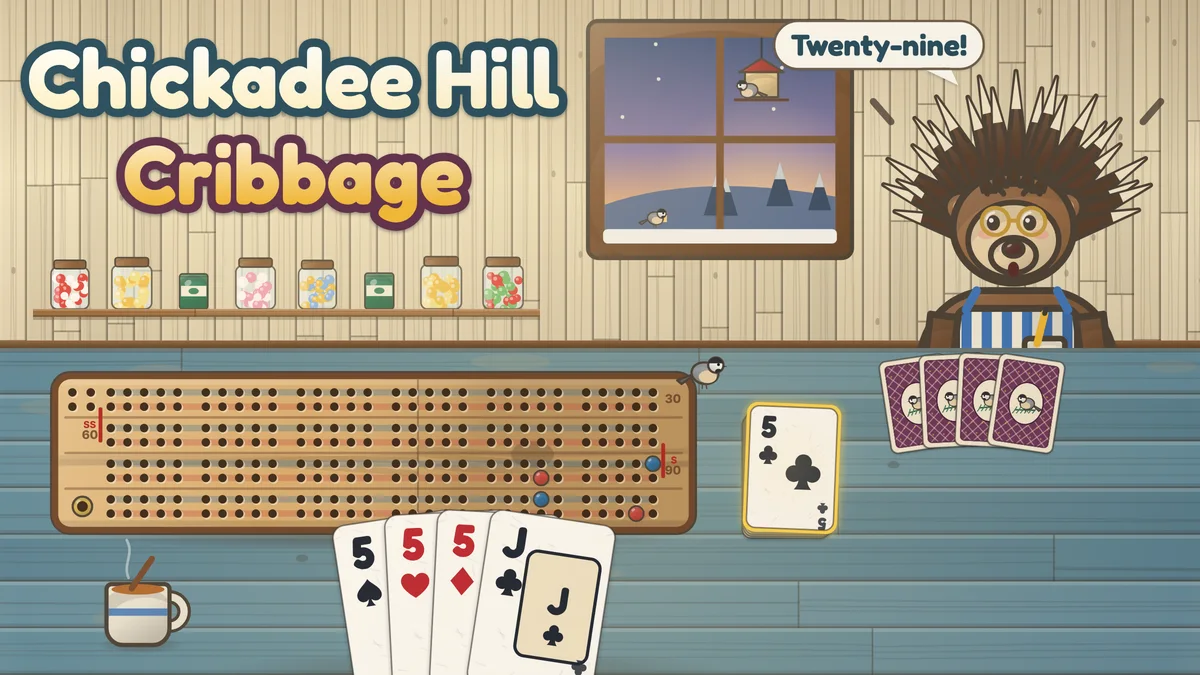
What is cribbage?
Cribbage is a two-player card game in which you score points for combinations of cards, both while the cards are being played and when the hands are counted afterward. It is traditionally credited to the English poet Sir John Suckling in the early 1600s, and it is still widely played today, with clubs and tournaments in North America run under the American Cribbage Congress rule book.
The score is kept by moving pegs along a board full of holes rather than on paper, and scoring a point is called pegging it. The usual game is to 121 points. The rules on this page are the standard two-player six-card game, as written in the American Cribbage Congress rules and on Pagat, the card game rules site, and as summed up on Wikipedia. Three- and four-player games deal five cards each instead of six.
How to deal cribbage
Cribbage uses one standard 52-card deck with the jokers taken out. To decide who deals first, each player cuts the deck and shows a card; the lower card deals, with aces low, and a tie means cutting again. After the first hand, the deal goes back and forth.
The dealer shuffles and deals six cards to each player, one at a time, starting with the other player, who is called the pone. The rest of the deck goes face down to one side. Being the dealer is an advantage, because the crib belongs to the dealer, as the next section explains.
Cards have a rank for pairs and runs and a value for counting. Aces are always low, so A-2-3 is a run but Q-K-A is not.
| Card | Value for the count and for fifteens |
|---|---|
| Ace | 1 |
| 2 to 10 | The number on the card |
| Jack, queen, king | 10 each |
The crib: laying away two cards
Each player looks at their six cards and lays away two of them face down. The four cards laid away form the crib, an extra hand that belongs to the dealer and is counted at the end of the hand. Each player keeps the other four.
This is the most important decision in cribbage. When the crib is yours, lay away cards that score together, such as a pair, a 5 with a ten-card or two cards in a row, because those points come back to you. When the crib belongs to the other player, lay away cards that are far apart and unlikely to help, such as a king and a 9.
In Chickadee Hill Cribbage, tap two cards to pick them and tap Send to crib. A tag on the table says whose crib it is, and Undo takes the two cards back until the starter is cut.
The starter and his heels
Once both players have laid away, the pone cuts the rest of the deck and the dealer turns up the top card of the lower part. This card is the starter, sometimes called the cut card. It is not played, but it counts as a fifth card in both hands and in the crib during the show.
If the starter is a jack, the dealer pegs 2 points at once. This is called two for his heels. In the game, tap the deck or tap Cut the deck when the cut is yours.
The play: pegging to 31
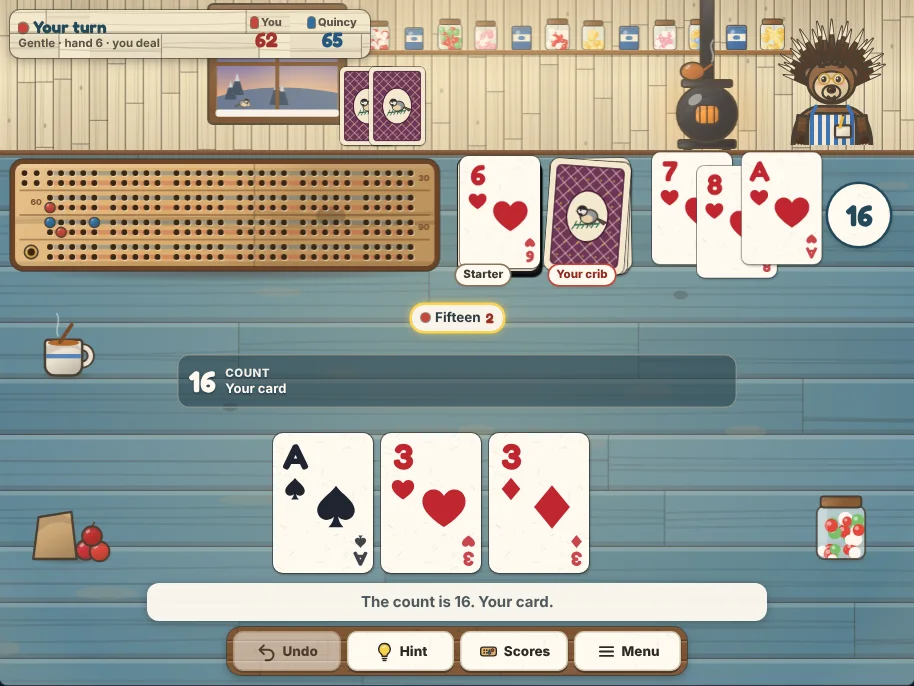
Starting with the pone, the players take turns laying one card face up in front of themselves and saying the running count: the total value of all the cards laid so far. The count may never go past 31.
You peg points during the play for making the count exactly 15 or exactly 31, for pairing the card just played (and for three or four of a kind), and for runs. A run in the play is three or more of the last cards laid, in any order, that form a sequence: if the cards so far are 4, 6 and then 5, the 5 makes a run of three, and with a count of 15 it scores 2 more for the fifteen. Runs and pairs only count among cards laid one after another, in the current count.
When you cannot lay a card without passing 31, you say go. The other player keeps laying cards as long as they can stay at 31 or under, scoring for any combinations along the way. Then the last player to lay a card pegs 1 for the go, or 2 if they reached exactly 31 (never both). The count starts again from zero, and the player who did not lay the last card leads.
The play goes on until both players have laid all four cards. Whoever lays the very last card of the play pegs 1 for last card, or 2 if it makes 31.
| What you do | Points |
|---|---|
| Make the count exactly 15 | 2 |
| Make the count exactly 31 | 2 |
| Pair the card just played | 2 |
| Three of a kind in a row (a pair royal) | 6 |
| Four of a kind in a row (a double pair royal) | 12 |
| A run of three or more among the last cards played, in any order | 1 a card |
| Go: the last card before neither player can play | 1 |
| Last card of the play (if it is not 31) | 1 |
| His heels: the starter is a jack (dealer only) | 2 |
The show: counting your hand
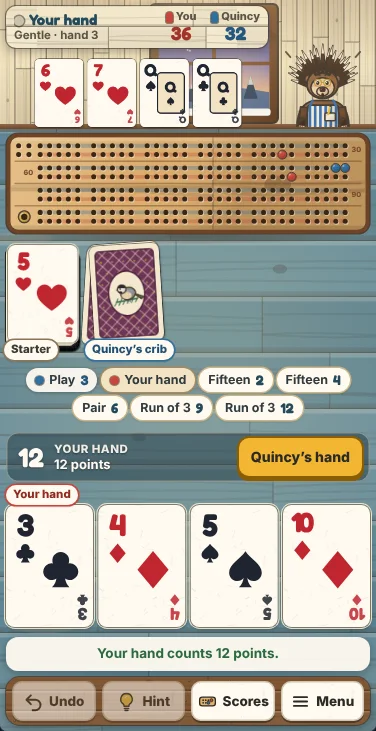
After the play, each player picks up their four cards and counts them together with the starter. The order matters: the pone counts first, then the dealer counts their hand, then the dealer turns over the crib and counts it. The crib is also counted with the starter.
Score 2 for every different combination of cards that adds up to 15, 2 for every pair, and 1 a card for every run of three or more. A card can be part of several combinations, and each one counts. With two 6s and a 4 and 5, for example, there are two different runs of three (one with each 6), so both count.
A flush is all four cards of a hand in one suit, worth 4, or 5 if the starter matches too. The crib is different: it scores a flush only when all four crib cards and the starter are the same suit, for 5. Finally, the jack of the same suit as the starter, held in a hand or the crib, scores 1 for his nobs.
| Combination | Points |
|---|---|
| Each combination of cards that adds up to 15 | 2 |
| Each pair | 2 |
| Three of a kind (three pairs) | 6 |
| Four of a kind (six pairs) | 12 |
| Each run of three or more | 1 a card |
| Flush of four in the hand | 4 |
| Flush of five (the hand or crib and the starter) | 5 |
| His nobs: the jack of the starter’s suit | 1 |
Counting a hand line by line
Players count out loud in a fixed order: fifteens first, then pairs, then runs, then a flush and his nobs, adding as they go. Saying it the same way every time makes it much harder to miss points. The table counts a hand of 4♥ 5♣ 6♦ 6♠ with the jack of clubs as the starter, exactly the way Chickadee Hill Cribbage says it.
The total is 14: fifteen two, fifteen four, fifteen six, a pair is eight, and two runs of three for fourteen. A run with a pair inside it, like this one, is called a double run, and players soon learn its value by heart. The second table lists the common ones, not counting any fifteens.
The best possible hand is 29: three 5s and the jack of the fourth suit, with the fourth 5 turned up as the starter. It has eight fifteens (16), four of a kind (12) and his nobs (1). No hand can score 19, 25, 26 or 27, which is why players jokingly call a hand with no points at all a nineteen. In our own count of every possible four cards and starter, a hand averages about 4.8 points, while hands kept with care average much more: Steady Quincy’s hands averaged 8.3 points in our simulation.
| What is said | Cards | Points |
|---|---|---|
| Fifteen 2 | 5♣ J♣ | 2 |
| Fifteen 4 | 4♥ 5♣ 6♦ | 2 |
| Fifteen 6 | 4♥ 5♣ 6♠ | 2 |
| A pair is 8 | 6♠ 6♦ | 2 |
| A run of three is 11 | 4♥ 5♣ 6♠ | 3 |
| A run of three is 14 | 4♥ 5♣ 6♦ | 3 |
Double runs and other combinations to know
A few patterns turn up so often that experienced players count them as one item. A double run of three such as 3-4-4-5 is two runs of three and a pair, 8 in all. A triple run such as 3-3-3-4-5 is three runs and three of a kind, 15. A double double run such as 3-3-4-4-5 is four runs and two pairs, 16. Add any fifteens on top.
The game’s scorer is tested against every possible hand: for all 12,994,800 ways to hold four cards with a starter, its counts match the published table of how often each total occurs, for hands and for cribs.
| Pattern | Example | Points |
|---|---|---|
| Double run of three | 3-4-4-5 | 8 |
| Double run of four | 3-4-5-5-6 | 10 |
| Triple run | 3-3-3-4-5 | 15 |
| Double double run | 3-3-4-4-5 | 16 |
The cribbage board and the game to 121
The cribbage board is a wooden board with a track of holes for each player, and each player has two pegs. Most boards give each player 120 holes in streets of 30, plus a final game hole for 121. The pegs leapfrog: to score, take your back peg and move it that many holes ahead of your front peg. The gap between your two pegs always shows your last score, which makes mistakes easy to spot.
The game ends the moment a player reaches 121, even in the middle of the play or the show, and that player wins. This is why the order of the count matters: near the end of a close game, the pone counts first and can peg out before the dealer counts at all.
In Chickadee Hill Cribbage the store’s board has four streets of 30 holes with a lane for each player, red pegs for you and blue for Quincy, and the brass game hole at the end. The pegs hop hole by hole as points are scored, and the score sign above the table keeps both totals.
Skunks, muggins and where rule books differ
Many players count a skunk: winning before the other player reaches 91 counts as two games, and winning before they reach 61 (a double skunk) as four. Double skunks are not in the official rules, and tournament scoring uses its own match points, so skunks are an option in Chickadee Hill Cribbage, off unless you turn them on in Settings. With skunks on, the skunk lines are marked on the board.
Muggins is another common but optional rule. When you count your own hand, any points you miss can be claimed by the other player. In the game, you can let the game count every hand for you (the default), or count your own hand and crib: say what you think it is worth, and the game then shows the right count line by line. With muggins on, Quincy takes the points you missed; with it off, you simply get the right total.
Some older rule books describe a five-card game for two, played to 61, and three- and four-player games are played with five cards each. The rules on this page, and in the game, are the common modern standard: six cards each, the crib to the dealer, the crib flush only with five cards, and the game to 121.
Controls in Chickadee Hill Cribbage
Each game starts with a cut for deal: tap Deal and the game deals for whoever cut the lower card. Your six cards run along the bottom of the table. Tap two to pick them and tap Send to crib. When it is your turn to cut, tap the deck or Cut the deck. In the play, tap a card to lay it; cards that would take the count past 31 are dimmed, and a Go button appears when none of your cards fits. Every point is said in a short line on the table and pegged on the board.
In the show, each count is listed line by line, with the cards of each line lifted so you can follow along. The next button moves on to the next hand to be counted, and Show all shows a count at once. Hint suggests which two cards to lay away and what they average, the card to play and why, or where the points are when you count your own hand, using only the cards you can see. Undo takes back your two crib cards until the starter is cut. Scores lists every point of the hand.
On a keyboard, the arrow keys move along your hand and Enter or Space picks and plays. C sends your picks to the crib or cuts the deck, G says go, N moves the show on or deals the next hand, U undoes, H shows a hint, L lists the points of the hand and Escape clears your picks. Menu starts a new game and opens Settings (Quincy’s level, who counts your hand, muggins, skunks and Quincy’s speed), your statistics for each level and the rules. Your game is saved on your device as you play.
How strong is each level?
Quincy has three levels. Gentle half the time lays away and plays a card without thinking, and otherwise keeps the four cards worth the most as they stand and lays whichever card scores the most right now. Steady keeps the four cards that score best on average over every possible starter and plays carefully, avoiding counts that hand you easy points. Sharp also weighs what the two cards it lays away will be worth in the crib, remembers every card played, and thinks through the rest of the play.
To check that each level does what it says, we ran our own simulation of 2,000 games to 121 for each pairing: 1,000 deals, each played twice with the players swapping seats, so both sides get the same cards. A random player lays away and plays cards at random. The scripted beginner keeps the four cards worth the most as they stand, with no thought for the starter or the crib, and lays whichever card scores the most right now, which is roughly how many people play their first games.
All three levels beat the random player easily. Steady beat Gentle in 1,748 games and Sharp beat Gentle in 1,821, while Sharp beat Steady in 1,119 of 2,000, a real but modest edge that comes mostly from the crib: as dealer, Sharp’s cribs averaged 5.1 points to Steady’s 4.1. The beginner beat Gentle in 1,637 of 2,000 games, so Gentle is a fair first opponent, but won only 780 against Steady and 668 against Sharp. Cribbage has plenty of luck in the cards, so even Sharp loses a fair share of games. These are computer players, not people, so treat the numbers as a guide.
| Pairing | Won | Lost |
|---|---|---|
| Gentle against a random player | 1,742 | 258 |
| Steady against a random player | 1,980 | 20 |
| Sharp against a random player | 1,987 | 13 |
| Scripted beginner against Gentle | 1,637 | 363 |
| Scripted beginner against Steady | 780 | 1,220 |
| Scripted beginner against Sharp | 668 | 1,332 |
| Steady against Gentle | 1,748 | 252 |
| Sharp against Gentle | 1,821 | 179 |
| Sharp against Steady | 1,119 | 881 |
Beginner strategy
Keep your fives. Sixteen of the 52 cards are worth ten, so a 5 makes fifteen with a great many cards. Keep 5s in your hand, and lay them in your own crib when you have to give one up, but avoid giving them to the other player’s crib.
Think about the crib every time you lay away. The table shows what some pairs of cards average in a crib once the other player’s two cards and the starter are added, from our own count over every possible combination. A pair of 5s is by far the best gift to your own crib, and cards far apart, such as a 10 and a king, are the safest to give away.
Lead a card lower than 5 when you can. With the count at 4 or less, no single card can bring it to 15, so the other player cannot peg a fifteen with their reply.
Think twice before making the count 21. The other player then needs only a ten-card for 31, and ten-cards are the most common cards in the deck. Making the count 5 is risky in the same way, because any ten-card makes 15.
| Two cards laid away | Average crib |
|---|---|
| 5 and 5 | 9.0 |
| 5 and jack | 7.3 |
| 5 and 6 | 7.1 |
| 5 and 10 | 7.0 |
| 2 and 3 | 6.8 |
| 7 and 8 | 6.8 |
| 9 and king | 3.5 |
| 10 and king | 3.4 |
Common mistakes
Keeping the hand that looks best right now. Four cards that already score 4 points can be worse than four that score 2 but combine with many starters. Count how many of the possible starters would help, not just what you hold.
Pairing a card when the other player can make three of a kind. If you pair a 7 and the other player holds the third 7, they peg 6. Pairing is often worth it, but think about what is left in their hand and how many of that rank you have seen.
Forgetting the order of the count near the end. When both players are close to 121, the pone counts first and may win before the dealer counts at all. Pegging in the play matters most in these last hands.
Missing points in your own count. A pair inside a run doubles the run, a jack of the starter’s suit is worth 1, and every different set of cards that makes 15 counts. Saying the count in the same order every time catches most of these.
Tips for winning more games
Watch the board. When you are well ahead, play safely and avoid giving away points in the play; when you are well behind, keep cards that could make a big hand and take more chances.
Remember what has been played. If two kings are already down, the other player is much less likely to pair your king, and every card laid in the play is one they no longer hold.
Count your own hand once the automatic count feels easy. The game checks every count and shows you the right total line by line, so it is a safe way to get faster at seeing fifteens, double runs and his nobs.
Use the hint to learn. Ask for a hint when you are unsure which two cards to lay away and read what each choice averages. The hint uses only the cards you can see, never Quincy’s hand.
Keep playing
Cribbage rewards the same few habits over and over: keep the cards that score together, lay away cards that help your own crib and hurt the other player’s, lead low, stay away from 21, and count every hand in the same order. Start against Gentle Quincy, let the game count for you while you learn, use the hint when you are unsure, and move up to Steady when you win more games than you lose. When counting comes easily, switch to counting your own hand and see how many points you find. For more classic games, try Birch Cove Gin Rummy, Kettle Burrow Hearts or Porch Swing Solitaire, our Klondike game.
- Play Chickadee Hill Cribbage
- Chickadee Hill Cribbage: features, controls and FAQ
- Birch Cove Gin Rummy: gin rummy against the computer
- Kettle Burrow Hearts: the classic trick-taking game
- Porch Swing Solitaire: Klondike on a porch at dusk
- Kingfisher Canal Checkers: classic checkers on a canal boat
- How to play gin rummy: rules, scoring and strategy
- How to play Hearts: rules, scoring and strategy
- How to play Klondike solitaire: setup and rules
- How to play checkers: rules and strategy
- How to play Shut the Box: rules and strategy
More guides and roundups
Chinese checkers is the race across a six-pointed star: step or hop your ten marbles into the point opposite before anyone else fills theirs. Here is how to set up for two, three, four or six players, how steps and hop chains work, how a game is won, what to do about marbles left in your home, how strong each level of our computer players is, and the strategy that wins more races.
How to Play Crazy Eights: Rules and StrategyCrazy Eights is the classic card game where you race to empty your hand by matching the top card of the pile, and every eight is wild. Here is how to deal, what you may play, how drawing and passing work, how a hand is scored, how a game ends, the house rules families add, how strong each level of our computer players is, and the strategy, common mistakes and tips that help you go out first.
How to Play Euchre: Rules, Bowers and ScoringEuchre is the fast partnership card game played with 24 cards, where the two jacks of the trump color outrank the aces. Here is how to deal, how the right and left bowers work, how trump is made in two rounds of bidding, what going alone means, how a hand is scored, how strong each level of our computer players is, and the strategy, common mistakes and tips that win more hands.
How to Play Farkle: Rules, Scoring and StrategyFarkle is the six-dice game where you set aside dice that score and decide, throw after throw, whether to bank your points or push on. Here are the rules, the full scoring chart, hot dice and the final round, the common house rules, and strategy with the chances worked out exactly.