Cozy Classic
Free Cribbage
Chickadee Hill Cribbage
Classic six-card cribbage with a real pegging board, every hand counted for you line by line, a friendly computer opponent at three levels, and hints that explain.
What you do
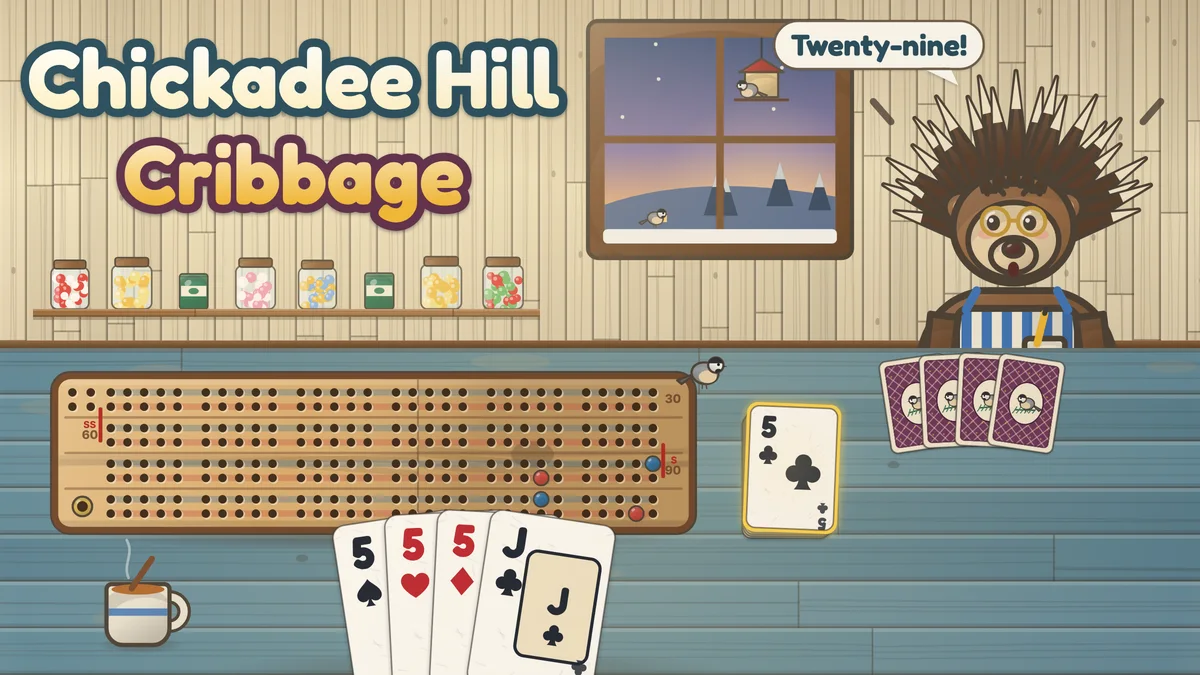
Chickadee Hill Cribbage is the classic two-player card game, played on a table painted in worn milk-paint blue in a country general store at dusk, with a woodstove glowing, jars of candy on the shelves and chickadees at the feeder outside the window. Each player gets six cards and lays two away face down to the crib, an extra hand that scores for the dealer. A starter card is cut, then you take turns laying cards and adding up the count to 31, pegging points for fifteens, pairs, runs and the go. Last, each hand is counted with the starter: fifteens, pairs, runs, flushes and his nobs. Every point is pegged on the store’s old maple cribbage board, and the first to 121 wins. Your opponent is Quincy, a round and gentle porcupine shopkeeper in gold-wire spectacles and a striped apron, who rests a paw on his chin while he thinks, beams when a card goes his way and claps his paws for your good hands.
- Three levels for Quincy: Gentle keeps cards that look good right now and often lays a card without thinking, Steady keeps the four cards that score best on average with the starter and is careful in the play, and Sharp also weighs the crib, remembers every card played and thinks through the rest of the play.
- A wooden cribbage board with two pegs for each player that leapfrog hole by hole as points are scored, with the streets marked and the skunk lines shown when skunks count.
- Every count of the show is said line by line, the way players say it at the table (fifteen two, fifteen four, a pair is six), with the cards of each line lifted so you can follow along.
- Let the game count for you, or count your own hand and crib: say what it is worth, then see the right count line by line. Muggins is an option for players who like it.
- Standard rules from the published rule books: the cut for deal, his heels, the go and last card, the crib flush rule, his nobs and the game to 121, with skunks and double skunks as an option.
- Hints that use only what you can see: which two cards to lay away and what they average, the card to play and why, and where the points are when you count your own hand.
How to play
- Press Play. Each new game begins with a cut for deal: the lower card deals first, with aces low. The dealer owns the crib, an extra hand that scores for them, and the deal goes back and forth after every hand.
- You and Quincy each get six cards. Tap two of yours to lay away to the crib, then tap Send to crib. Quincy lays two away as well. When the crib is yours, lay away cards that score together; when it is his, lay away cards that do not help him.
- The non-dealer cuts the deck and the top card of the lower part is turned up as the starter. If it is a jack, the dealer pegs 2 for his heels.
- The play: starting with the non-dealer, take turns laying one card face up and adding it to the count. Face cards count 10, aces 1 and every other card its number, and the count may not pass 31. Peg 2 for making the count 15, 2 for exactly 31, 2 for a pair with the card just played (6 for three of a kind, 12 for four) and 1 a card for a run of three or more, in any order.
- When none of your cards fits under 31, say go. The other player keeps laying cards while they fit, then pegs 1 for the go (or 2 for 31), and the count starts again from zero. The last card of the play scores 1.
- The show: each hand is counted with the starter, the non-dealer first, then the dealer, then the dealer’s crib. Score 2 for every combination of cards making 15, 2 for every pair, 1 a card for every run of three or more, 4 for a flush in the hand (5 if the starter matches; the crib scores a flush only with all five cards) and 1 for the jack of the starter’s suit, his nobs. The first to 121 wins at once, even in the middle of the play.
Controls
- Touch or mouse: tap two cards to pick them for the crib, then tap Send to crib. When the cut is yours, tap the deck or Cut the deck. In the play, tap a card to lay it; cards that would take the count past 31 are dimmed, and Go appears when none fits. In the show, Next moves on to the next count and Show all shows a count at once. Undo, Hint, Scores and Menu sit on the shelf below the table, or beside it on a landscape phone.
- Keyboard: the arrow keys move along your hand and Enter or Space picks or plays the card in focus. C sends your picks to the crib or cuts the deck, G says go, N moves the show on or deals the next hand, U undoes, H shows a hint, L lists every point of the hand and Escape clears your picks. When you count your own hand, type the number or use the arrow keys, then press Enter.
- Restart in the toolbar starts a new game. Menu starts a new game, changes Quincy’s level, the counting, muggins, skunks and Quincy’s speed in Settings, and shows your statistics and the rules. The toolbar also has pause, help, optional sound and fullscreen.
Tips worth knowing
- Keep your fives. Sixteen of the 52 cards count ten (the tens, jacks, queens and kings), so a 5 makes fifteen with almost anything. In our own count of every possible crib, a pair of fives laid away averages about 9 points, the most of any two cards.
- When the crib is yours, lay away cards that work together, such as a pair, a 5 with a ten-card, or two cards in a row. When it is Quincy’s, lay away cards far apart in rank, such as a king and a 9, which average under 4 points in a crib.
- Lead a card lower than 5 when you can. With the count at 4 or less, no single card can bring it to 15, so Quincy cannot peg a fifteen with his reply.
- Think twice before making the count 21. Quincy then needs only a ten-card for 31, and ten-cards are the most common in the deck.
- Count your hand in the same order every time: fifteens first, then pairs, then runs, then a flush and his nobs. That is how the game says it, and it keeps you from missing points.
- Watch the board near the end of a game. The non-dealer’s hand is counted first, so when both players are close to 121, the points pegged in the play and the order of the count can decide the game.
Accessibility
- Everything can be played with a keyboard: the arrow keys move a visible focus along your hand, Enter or Space picks and plays, and single letter keys send cards to the crib, cut, say go and move the show on.
- Every card in your hand is labeled for screen readers with its name and what tapping it does, the deck says what the starter is, and the score sign and the board read out both scores.
- The count of the play is always shown as a number, and every count of the show is listed line by line, so you never need to add anything up yourself unless you choose to.
- Nothing is timed. Quincy waits while a menu is open, and his speed can be set to Relaxed.
- Reduced motion places the cards at once instead of dealing and sliding them, moves the pegs without their hop, stops Quincy’s fidgeting and keeps the sparkles small. Sound is optional and never needed to play.
Questions
How strong is each level?
We measured Quincy with our own simulation of 2,000 games to 121 for each pairing: 1,000 deals, each played twice with the players swapping seats, so both sides get the same cards. Against a player that lays away and plays cards at random, Gentle won 1,742 games (87.1 percent), Steady 1,980 (99.0 percent) and Sharp 1,987 (99.3 percent). Steady beat Gentle in 1,748 games (87.4 percent) and Sharp beat Gentle in 1,821 (91.0 percent). Sharp beat Steady in 1,119 (56.0 percent), mostly through the crib: as dealer, Sharp’s cribs averaged 5.1 points to Steady’s 4.1. These are computer players, not people, so treat the numbers as a guide.
Can a beginner beat Gentle?
Yes, that is what Gentle is for. In the same simulation, a scripted beginner that keeps the four cards worth the most as they stand (with no thought for the starter or the crib) and lays whichever card scores the most right now beat Gentle in 1,637 of 2,000 games (81.8 percent). The same beginner won 780 of 2,000 against Steady (39.0 percent) and 668 of 2,000 against Sharp (33.4 percent).
Which cribbage rules does this use?
Standard six-card cribbage for two players: the lower card in the cut deals first, six cards each with two laid away to the dealer’s crib, the starter cut by the non-dealer with 2 for his heels to the dealer, the play to 31 with the go and last card, and the show counted non-dealer, dealer, crib, with 1 for his nobs. A flush of four counts in the hand, but the crib scores a flush only when all five cards match. The game is to 121 and ends as soon as either player reaches it. Muggins (taking the points the other player misses when they count their own hand) is a common optional rule, so it is off unless you turn it on. With skunks counting, winning before the other player reaches 91 counts as two games and before 61 as four.
What is the best hand in cribbage?
Twenty-nine: three fives and the jack of the fourth suit in your hand, with the fourth five turned up as the starter. It holds eight fifteens (16 points), six pairs among the four fives (12) and his nobs (1). No hand can score 19, 25, 26 or 27, which is why some players jokingly call a hand with no points at all a nineteen. The game’s own count of every possible hand, used in its tests, finds the same.
Does Quincy look at my cards?
No. Quincy chooses from what a player at the table could see: his own cards, the two he laid away, the starter once it is cut, the cards played so far and when you said go. The hints follow the same rule. Your hand, the crib and the deck are never shown to him, and a face-down card’s face is not even written into the page until it is turned up.
What can I undo?
Undo takes back the two cards you laid away to the crib, until the starter is cut, so you can choose again. Cards laid in the play stay down, because Quincy has seen them.
What does the game save?
The game keeps three things on this device, in the browser’s local storage: your settings, the game in progress card by card, so a reload picks up where you left off, and your statistics for each level. No account is needed.