Cozy Classic
Free Chinese Checkers
Tamarack Lake Chinese Checkers
Chinese checkers for two, three, four or six, with the marbles that can move ringed, every reachable hole lit, hop chains played one hop at a time with a clear end of turn, friendly computer players at three levels, hints with a reason, and unlimited undo.
What you do
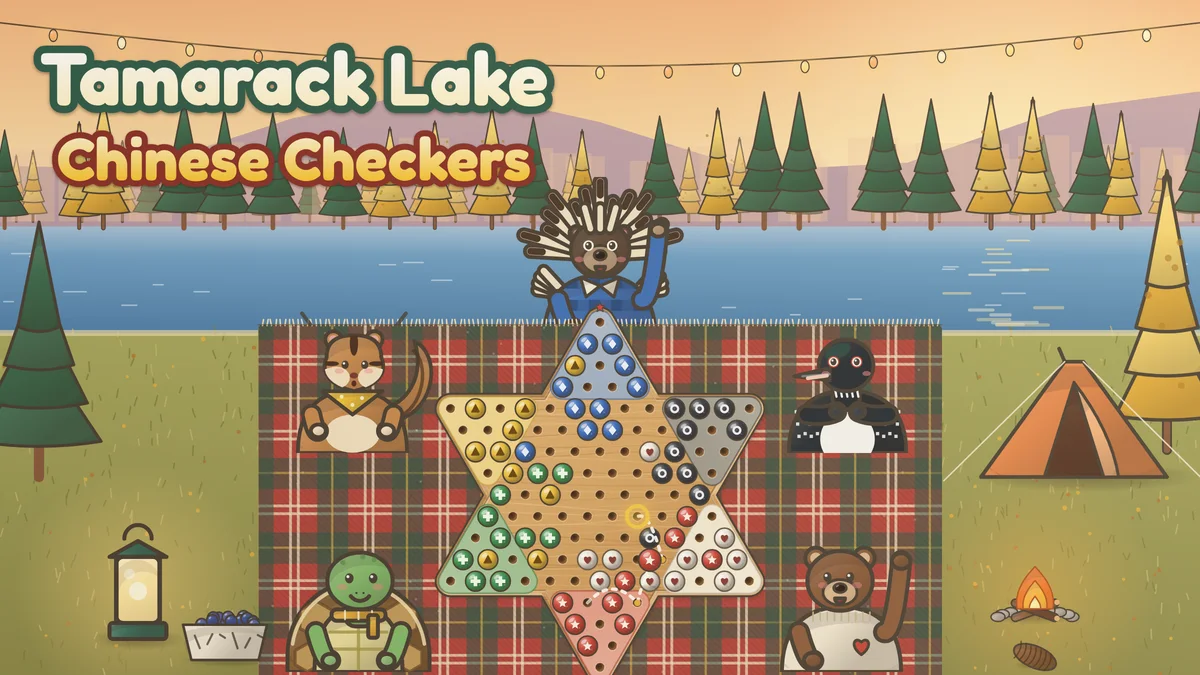
Tamarack Lake Chinese Checkers is the star board game with its standard rules, played on a wooden star board laid on a plaid wool blanket at a lakeside campsite in autumn, with golden tamaracks and dark pines along the far shore, the low sun on the water, string lights, a tent and a campfire. The board has 121 holes: a hexagon in the middle and a point of ten holes on each of its six sides. Each player starts with ten marbles filling one point and races them into the point straight across. On your turn you move one marble, either one step to a hole next door or a chain of hops over single marbles, as far as the chain goes. Nothing is captured, so every marble on the board, yours or anyone’s, is a stepping stone. Your marbles are red with a star; the campers’ marbles each carry their own shape as well as their own color. The campers are Myrtle the turtle in a mustard scarf, Scout the chipmunk in a yellow bandana, Quill the porcupine in a blue flannel shirt, Lumi the loon with her striped white necklace, and Huck the bear cub in a cream sweater. They sit on the blanket beside their points, think with a paw at the chin, cheer their own long hops and clap for yours.
- Two, three, four or six players on the standard points: you against Quill across the board, Scout and Lumi in every other point, Myrtle, Quill and Lumi in two opposite pairs, or all five campers.
- Three levels for the campers: Gentle often moves a marble just because it likes it, Steady makes the move that brings it closest to home right now, and Sharp plans three of its own moves ahead, builds hopping ladders and watches what its moves open for everyone else.
- Hop chains are played one hop at a time: tap a gold ring to hop, and a Hop again or end turn tag sits over your marble until you tap it again or press End turn. Dashed rings mark the far ends of longer chains, so you can also make a whole chain with one tap.
- On your turn the marbles that can move are ringed, and the one you pick shows its steps as dots and its hops as gold rings. The campers’ moves since your last one stay on the board as faint dotted trails.
- Hints from Sharp’s plan, with a short reason: a finish, a long chain of hops, a ladder for next turn, the marble farthest behind, or room made in your home. Unlimited undo takes back your move and the campers’ replies together.
- Every player’s marbles have their own shape (a star, a plus, a triangle, a diamond, a ring or a heart) as well as their own color, so the game never depends on color alone.
How to play
- Press Play and pick how many players. The star board has 121 holes. Your ten red star marbles fill the point at the bottom of the screen, and your home is the point straight across, at the top. Each camper races the same way, from their point to the one opposite.
- On your turn, tap one of your ringed marbles. Its steps show as dots: tap one to move to that empty hole next door, in any of the six directions.
- Or hop. A gold ring marks a hop: over one marble right next to yours (anyone’s, your own too) into the empty hole straight beyond it. After a hop the same marble may hop again, in any direction, as many times as you like. Tap the next gold ring to keep going, or tap your marble or End turn to stop. A step and hops never mix in one move.
- Nothing is captured: marbles that are hopped over stay where they are. Marbles may pass through any point on the board and stop anywhere.
- The first player to fill their home with all ten of their own marbles wins. A player with no legal move passes, and if nobody can move the game is a draw.
Controls
- Touch or mouse: tap one of your ringed marbles, then a lit hole. A dot steps, a gold ring hops, and a dashed ring makes a whole chain of hops at once. In a chain, tap each next gold ring, then tap your marble or End turn to stop. Tap an earlier landing to go back to it. Undo, Hint, End turn and Menu sit on the shelf below the board, or beside it on a wide screen.
- Keyboard: the arrow keys move a visible focus between the holes, and Enter or Space picks up the marble in focus and moves it to the hole in focus. E ends a hop chain, U undoes, H shows a hint, and Escape puts a marble down or takes back an unfinished chain.
- Restart in the toolbar starts a new game. Menu starts a new game, changes the campers’ level, the number of players, who moves first, the home rule, the hops and the move speed in Settings, and shows your statistics and the rules. The toolbar also has pause, help, optional sound and fullscreen.
Tips worth knowing
- Look for hops before steps. A single step moves a marble one hole; a chain of hops can carry it across half the board in one turn.
- Build ladders: leave marbles one hole apart in a line toward your home, so a marble behind them can hop the whole way up. The hint names a move that sets one up.
- Use everyone’s marbles. Nothing is captured, so a camper’s marble in the middle of the board is a stepping stone for you too.
- Do not leave a marble behind. The last marble out of your start point often costs the game, so bring stragglers along with the rest.
- Fill your home from the tip. Marbles at the far corner of your home leave room for the ones still coming in.
- Use the hint and undo to learn. The hint says why a move is good, and undo lets you try another choice and see what the campers do.
Accessibility
- Everything can be played with a keyboard: the arrow keys move a visible focus between the holes, Enter or Space picks up a marble and moves it, E ends a hop chain, U undoes and H shows a hint.
- Every hole is labeled for screen readers with its row (A at the top to Q at the bottom) and place in the row, the point it belongs to, the marble on it, and whether that marble can move or the hole is a step, a hop or the end of a longer chain.
- Each player’s marbles carry their own shape as well as their own color: red stars for you, then green plus signs, yellow triangles, blue diamonds, charcoal rings and pearl hearts. Each kind of highlight has its own shape too.
- Nothing is timed. The campers wait while a menu is open, and undo is unlimited.
- Reduced motion places each marble at once instead of rolling and hopping it, stops the pulsing rings and the campers’ fidgeting, and keeps the sparkles small and still. Sound is optional and never needed to play.
Questions
How strong is each level?
In our own simulation of 1,000 two-player games for each pairing, under the standard rules with the first move changing hands every game, Gentle, Steady and Sharp each won all 1,000 against a player that picks legal moves at random. Against each other, Steady beat Gentle in all 1,000, Sharp beat Gentle in all 1,000, and Sharp beat Steady in all 1,000. A scripted beginner won 163 of 1,000 against Steady and none of 1,000 against Sharp. Gentle moves four times in ten just because it likes the move, Steady makes the move that brings its marbles closest to home right now, and Sharp plans three of its own moves ahead while every other player answers each one.
Can a beginner beat Gentle?
Yes. In our own simulation, a scripted beginner that always moves the marble gaining the most ground toward home, and never looks further ahead, beat Gentle in 921 of 1,000 two-player games (92.1 percent). Bigger tables are harder because you race more players at once: against two Gentle campers it won 165 of 200 games, against three it won 128 of 200, and against five it won 91 of 200, where an even share would be one game in six.
Why is it called Chinese checkers?
It is not Chinese and not a form of checkers. According to Wikipedia, the game was invented in Germany in 1892 under the name Stern-Halma, a star-shaped version of the older American game Halma, and the name Chinese checkers began in the United States as a marketing idea by Bill and Jack Pressman in 1928, whose game was first called Hop Ching checkers.
Why can’t five people play?
Each player races to the point straight across from where they start. With five players, one of them would have nobody across the board to race against while the others pair off, so the standard counts are two, three, four or six. With three, the players use every other point, so each one’s home starts empty.
What is the anti-blocking rule?
Under the standard rules, a player who leaves marbles in their starting point can keep the player opposite from filling it. Published rules from Tactic and GameRules.com fix this two ways: a marble that reaches its home may move only within it, and your home counts as filled once every hole holds a marble, even if some belong to someone else. Taken literally, that second rule could end a game in its first few moves, while a home is still full of the marbles that start there, so here your home counts once every hole is filled, at least one marble in it is yours, and none of your own marbles is left in your starting point. It is off by default and can be turned on in Settings.
What are super hops?
The fast-paced variant, sometimes called Super Chinese Checkers. A hop may jump one marble at a distance, landing as far beyond it as you started before it, with every hole in between empty. It still jumps only one marble per hop. It is off by default.
What does the game save?
Your settings, the game in progress with every move, and your statistics for each level and each number of players (games played, won, lost and drawn, and your quickest win), all in this browser’s local storage. There is no account.