Cozy Classic
Free Backgammon
Lemon Terrace Backgammon
Backgammon with the checkers that can move ringed, the legal landings lit, a tap on a die to move by it, pip counts always showing, undo inside your turn, a doubling cube for matches, and a friendly computer opponent at three levels.
What you do
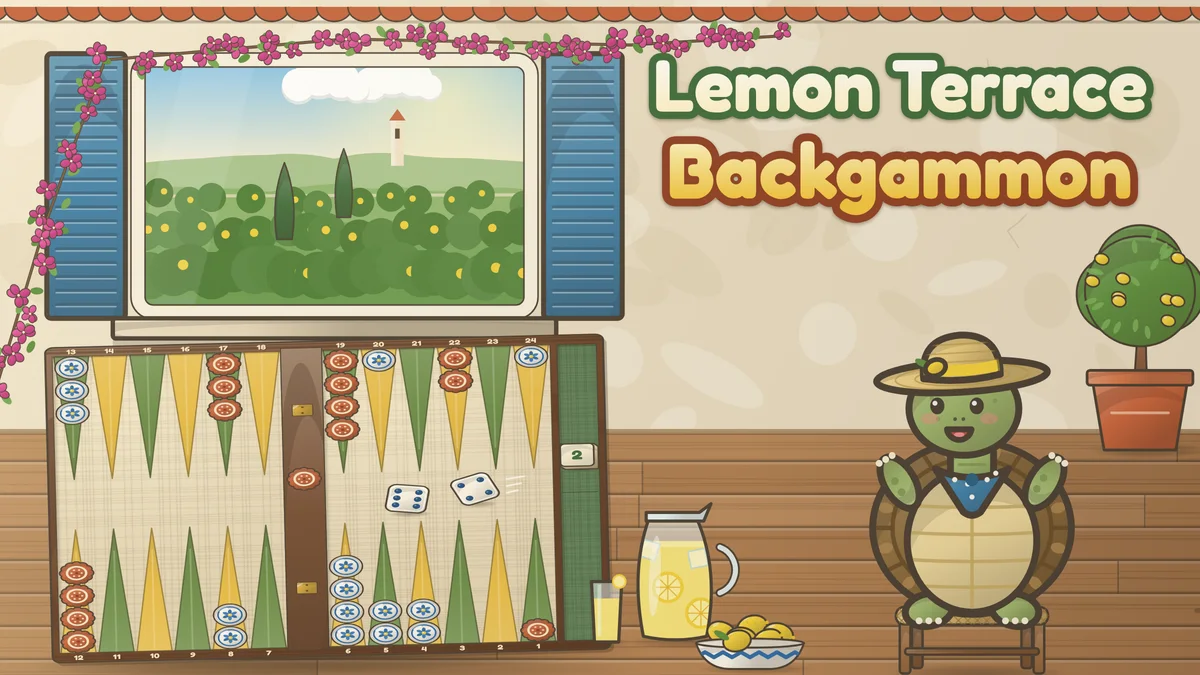
Lemon Terrace Backgammon is backgammon with the standard rules, played on a walnut board on a shady terrace above terraced hills of lemon trees, with blue shutters, a climbing bougainvillea and a jug of lemonade on the table. Each side has 15 checkers that race around the 24 points in opposite directions to their own home board and then bear off. You land on a lone checker to hit it to the bar, build points of two or more that the other side cannot land on, and play both numbers of every roll when you can. Your checkers are white glaze with a blue painted flower and a smooth edge; Remo’s are terracotta with a fluted edge and a cream ring, so the two sides differ in pattern and shape as well as color. Your opponent is Remo, an old garden tortoise in a wide straw hat with a lemon on the band and a blue neckerchief, who sits on a rush stool beside the board, shakes the dice in his hand, rubs his chin while he thinks and claps for your good games.
- Three levels for Remo: Gentle often plays whatever catches his eye, Steady judges every play of the roll by how the position looks right after it, and Sharp looks a roll ahead at all 21 of your possible replies and weighs gammons and the match score.
- On your turn the checkers that can move wear a ring. Tap one and its landings light up, including spots it reaches by using both numbers; a dashed ring marks a checker you would hit. Or tap a die to move by that number.
- Undo takes back your moves inside the turn until you press Done, and the dice never change, because every roll follows from the game’s seed.
- A doubling cube that is on for matches by default, with the Crawford rule, and settings to use it in single games too or to leave it out. Play one game, or a match to 3, 5 or 7 points.
- Pip counts for both sides on the score sign, hints from Sharp’s judgment for your play, your doubles and your answer to Remo’s, and an automatic bear-off assist for the pure race that you can turn off.
- Statistics for each level (games, wins, gammons, points and matches) saved on this device with the match in progress, three move speeds, and full keyboard play.
How to play
- Press Play. Your 15 white checkers start with two on point 24, five on 13, three on 8 and five on 6, and you move them from point 24 down toward point 1. Remo’s terracotta checkers start on the matching points and move the other way. Your home board is points 1 to 6 at the bottom right.
- You and Remo each roll one die to start. The higher number goes first and plays both numbers. After that, press Roll on your turn, then move: each die moves one checker that many points, onto a point that does not hold two or more of Remo’s checkers. Doubles are played four times.
- Use both numbers whenever you can. If only one number can be played, you must play the larger one when it fits. If neither can be played, press OK and the turn passes.
- Land on a single checker of Remo’s to hit it to the bar. A checker on the bar must come back in on Remo’s home board before anything else moves, and the same goes for yours.
- When all 15 of your checkers are in your home board, you can bear them off: a die removes a checker from the point of that number, and a higher number bears off from your highest point. The first to bear off all 15 wins 1 point, 2 for a gammon (the loser bore off none) or 3 for a backgammon (none off and a checker still on the bar or in the winner’s home board).
- In a match, before you roll you may press Double to offer the cube. Remo takes and plays on for double, or passes and gives up the game at its value before the double. He can offer it to you too: press Take or Pass.
Controls
- Touch or mouse: press Roll, then tap a ringed checker and a lit spot, or tap a die to move by that number. Tap the picked checker again to put it down. Press Done to finish the turn. Undo, Hint and Menu sit on the shelf above the big button, or beside the board on a wide screen.
- Keyboard: R rolls, D doubles, T takes and P passes. The arrow keys move a visible focus along the points, the bar and the tray, Enter or Space picks up the checker in focus and moves it to the spot in focus, and Enter finishes the turn once the play is complete. 1 to 6 move by that die, U undoes, H shows a hint and Escape puts a checker down.
- Restart in the toolbar starts a new match. Menu starts a new game or match, changes Remo’s level, the match length, the cube, the bear-off assist and the move speed in Settings, and shows your statistics and the rules. The toolbar also has pause, help, optional sound and fullscreen.
Tips worth knowing
- Make points in front of Remo’s back checkers. Two or more checkers on a point block it, and a row of blocked points in your home board is hard for a checker on the bar to get past.
- Leave as few blots as you can within six points of Remo’s checkers, since that is the reach of a single number. A blot seven or more points away can only be hit by a combination of both dice, which is much less likely.
- Watch the pip counts on the sign. When you are ahead in the race, break contact and run for home. When you are behind, keep checkers back and hope for a shot.
- Hit when it helps. Sending a checker of Remo’s back costs him pips and can stop his plans, but hitting loose in your own home board risks a return shot.
- Double when you have a strong lead that might not last, and take when you still have about a quarter of the chances or more. The hint gives Sharp’s view for any position.
- Use the hint and undo to learn. The hint names the play Sharp prefers, and undo lets you try another way of playing the same roll before you press Done.
Accessibility
- Everything can be played with a keyboard: R rolls, the arrow keys move a visible focus along the points, the bar and the tray, Enter or Space moves the checker in focus, 1 to 6 move by a die, U undoes and H shows a hint.
- Every point, the bar and the tray are labeled for screen readers with the checkers on them and whether a checker there can move or can land there, and the score sign reads out whose turn it is, the pip counts, the match score and who owns the cube.
- The two sides differ in pattern and shape as well as color: white checkers with a blue flower and a smooth edge against terracotta checkers with a fluted edge and a cream ring. Each kind of highlight has its own shape: a ring, a lifted checker, a dot, a hollow dot and a dashed ring.
- Nothing is timed. Remo waits while a menu is open, and the action buttons sit at the bottom of the screen on phones.
- Reduced motion places each checker at once instead of sliding it, stops the dice from tumbling and Remo from fidgeting, and keeps the sparkles small. Sound is optional and never needed to play.
Questions
How strong is each level?
We ran our own simulation of single games with the cube off, the two players swapping seats every game: 1,000 games for each pairing, or 400 for the pairings with Sharp, who thinks longer. Against a player that picks legal plays at random, Gentle won 987 of 1,000 games, Steady 996 of 1,000 and Sharp all 400. Against each other, Steady beat Gentle in 909 of 1,000 games, Sharp beat Gentle in 371 of 400, and Sharp beat Steady in 233 of 400 (58.3 percent), scoring 0.25 points a game more. The dice decide a great deal in any one game, so the gaps show over many games.
Can a beginner beat Gentle?
Yes. In the same simulation, a scripted beginner that hits when it can, makes new points, bears off when it can and avoids leaving blots within reach, but never looks ahead, beat Gentle in 590 of 1,000 games (59.0 percent). The same beginner won 147 of 1,000 games against Steady and 53 of 400 against Sharp, so those levels expect you to plan ahead.
Which backgammon rules does this use?
The standard rules: 15 checkers each on 24 points, an opening roll where the higher die moves first with both numbers, each die a separate move, doubles played four times, both numbers used when possible and the larger one when only one can be, hitting a lone checker to the bar, entering from the bar before any other move, bearing off once all 15 are home, and 1, 2 or 3 points for a single win, a gammon or a backgammon. The doubling cube follows the usual rules, and matches use the Crawford rule. Beavers and the Jacoby rule, which some players add when not playing a match, are not used.
What is the doubling cube for?
It raises what a game is worth. Before rolling, a player who feels ahead may offer to double. The other player either takes, and the game goes on at twice the value with the taker owning the cube (only the owner may double next), or passes and gives up the game at its value before the double. Here the cube only changes the points in a game or match. By default it is used in matches and left out of a single game.
What is the Crawford rule?
In a match, the first time either player gets within one point of winning, the next game is played without the cube. That stops the player who is behind from doubling at once when the leader has nothing to lose by the cube. After that one game, the cube is back in use for the rest of the match.
What does the game save?
Your settings, the match in progress with every roll and play, and your statistics for each level, all in this browser’s local storage. Moves you have made but not confirmed with Done are not saved; after a reload you play that same roll again. There is no account.