
CozyWorld game guide · By CozyWorld
This guide covers our own game, written from the current game rules and browser checks.
How to Play Tic Tac Toe and Ultimate Tic Tac Toe
Tic tac toe is the game of X and O on a 3 by 3 grid, and ultimate tic tac toe is the same game played on nine boards at once. Here are the rules of both, why two careful players always draw, the best opening, how forks win and how to block them, the strategy for ultimate, and how strong each level of our computer opponent is.
How do you play tic tac toe? Two players take turns marking the squares of a 3 by 3 grid, one with X and one with O, and the first to get three of their marks in a row wins. Most people learn it young and stop playing once they notice that every careful game ends in a draw. That is exactly what makes it worth a second look as an adult: knowing why it is a draw, and how to win the games where the other side slips, takes a few ideas that carry over to many other board games. Ultimate tic tac toe, nine small games inside one big one, keeps those ideas and adds a great deal more to think about.
This guide covers the rules of classic tic tac toe, why perfect play always ends in a draw, the best opening (a corner or the center), forks and how to block them, then the rules and strategy of ultimate tic tac toe. It also shows the controls in Cattail Landing Tic Tac Toe (CozyWorld’s free tic tac toe game against Percival the crane, on a lakeside porch at dusk) and how strong each of Percival’s levels is. The rules, the solved-game facts and the history come from Wikipedia’s articles on tic tac toe and ultimate tic tac toe, the classic strategy from Newell and Simon’s list as that article gives it, and the ultimate advice from Ben Orlin’s 2013 post on the game. The game counts and the level strengths come from our own counting and simulation, and each is labeled as such.
What you need and how to set up
Tic tac toe needs a 3 by 3 grid, drawn with two lines across and two lines down, which makes nine squares. One player marks X and the other O. Any pencil and scrap of paper will do, which is why the game turns up on napkins, steamed windows and the margins of meeting notes.
The game has other names, among them noughts and crosses and Xs and Os, and it is very old. Wikipedia’s article on the game notes that grids for three-in-a-row games have been found cut into roofing tiles in ancient Egypt dating from around 1300 BC, and that one of the first computer games, OXO, played it on the EDSAC computer at Cambridge in 1952.
X goes first. That is the usual convention, and the players settle who takes X: the loser of the last game, or taking turns, since going first is an advantage, as the numbers further down show.
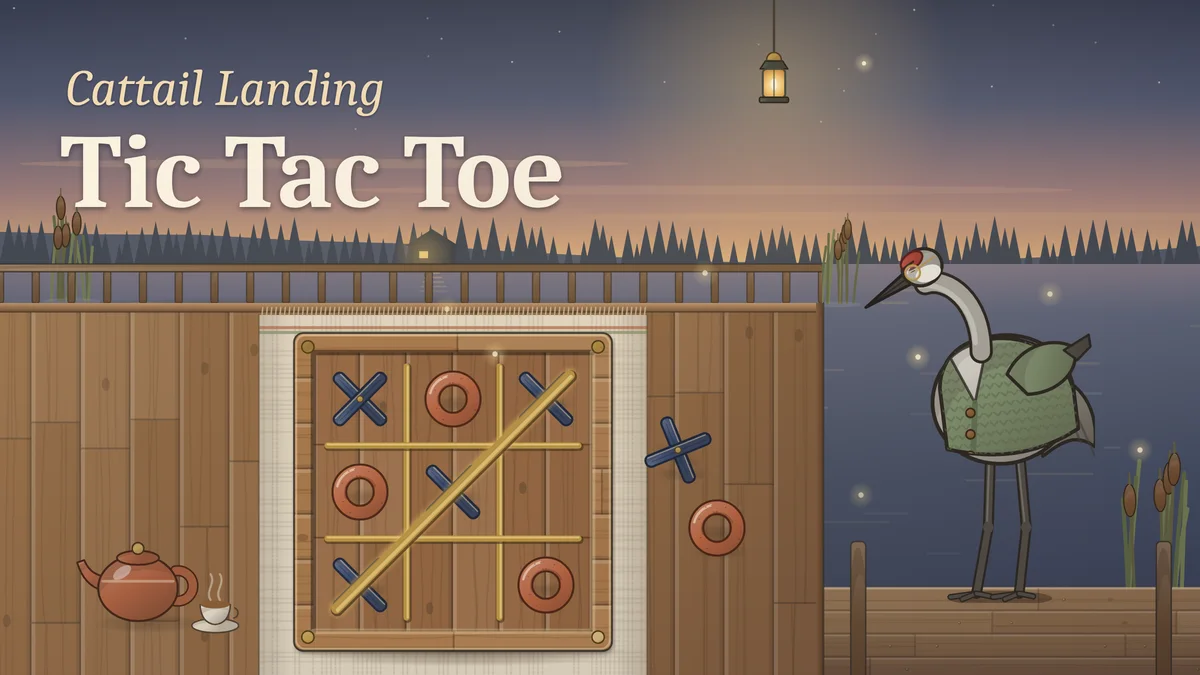
In Cattail Landing Tic Tac Toe the grid is an oak board with brass inlay lines on the table of a lakeside porch. X is a cross of two ink-blue slats held with a brass pin, and O is a ring of terracotta clay. Against Percival you play X and go first unless you choose otherwise in Settings, where Percival can go first or the two of you can take turns every game.
| How many | |
|---|---|
| Squares | 9 |
| Lines of three | 8: 3 across, 3 down and 2 diagonals |
| Lines through the center square | 4 |
| Lines through each corner square | 3 |
| Lines through each edge square | 2 |
| Marks in a full game | X makes 5 and O makes 4 |
Tic tac toe rules
Players take turns, X first. On your turn you mark one empty square with your own mark. You must mark a square on every turn, you may not pass, and a mark stays where it is for the rest of the game.
The first player to get three of their own marks in a row, across, down or on a diagonal, wins at once. There are eight such lines on the grid: the three rows, the three columns and the two diagonals.
If all nine squares fill with no three in a row, the game is a draw. Many players call it early, once neither side can complete a line, but the result is the same.
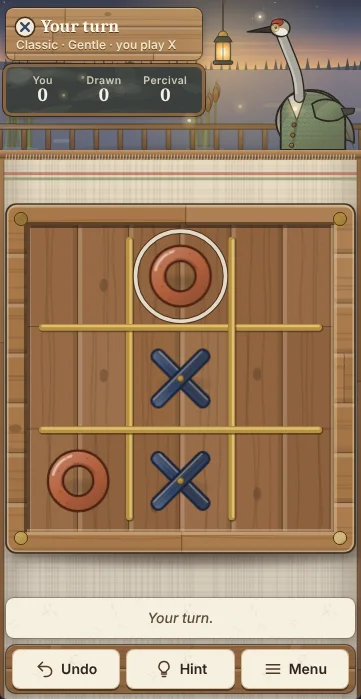
In Cattail Landing Tic Tac Toe you tap a square to place your mark, and it sets down with a quiet wooden tock, or a clink of clay for an O, if you have sound on. Percival answers after a moment, tipping his head while he thinks. When someone makes three in a row, a brass bar is laid across the line and a card shows the result with your tally for the level.
Why perfect play always ends in a draw
Tic tac toe is a solved game: if both players make no mistakes, it always ends in a draw. Neither side can force a win, because every threat can be blocked in time and every fork can be prevented if you see it coming. Wikipedia’s article on the game says so, and the game is small enough to check for yourself, or have a computer check.
We did. Playing out every possible game in the tests for Cattail Landing Tic Tac Toe, counting every order of moves and stopping when someone wins, there are 255,168 different games. X wins 131,184 of them, O wins 77,904, and 46,080 are drawn. So X wins just over half of all the different games, which shows the advantage of going first, and yet with best play from both sides none of those wins can be forced.
The games pass through 5,478 different positions, counting the empty board. If you count a position and its rotations and mirror images as one, there are 765 essentially different positions, and 138 finished ones: 91 won by X, 44 won by O and 3 drawn. Our counts match the figures in Wikipedia’s article.
That is also how Perfect Percival plays. He works out the value of every square from every position to the end of the game and only plays a square that keeps at least a draw, so he never loses. The game’s tests prove it by playing him against every possible sequence of replies, as X and as O.
| How many | |
|---|---|
| Different games (every order of moves) | 255,168 |
| Won by X | 131,184 |
| Won by O | 77,904 |
| Drawn | 46,080 |
| Positions reached in play, empty board included | 5,478 |
| Positions, counting rotations and mirror images as one | 765 |
| Finished positions, the same way: won by X, won by O, drawn | 138: 91, 44 and 3 |
The opening: a corner or the center
Every first move draws with best play, even an edge square, but they are not equally good in practice. The difference is how many replies the other player has that hold the draw. Checking every reply with the game’s own solver, the numbers come out as in the table below.
A corner opening is the hardest to answer: of O’s eight replies, only the center holds the draw, and the other seven lose. This is why Wikipedia’s article says a corner gives the opponent the smallest choice of squares that avoid losing. A center opening leaves O four safe replies, the corners, and the four edges lose. An edge opening is the easiest to answer, with four safe replies of eight.
So as X, open in a corner or the center. The corner sets the most traps for a careful opponent. The center sits on four lines, more than any other square, and it is the easiest opening to play well from, which is why the same article suggests it against a player who is not perfect. Perfect Percival, given the choice, opens in a corner, and the hint suggests a corner on an empty board.
As O, the replies to learn are short: answer a corner with the center, answer the center with a corner, and answer an edge with the center.
| X opens | Replies that hold the draw | Replies that lose |
|---|---|---|
| A corner | The center only | The other 7 squares |
| The center | Any of the 4 corners | Any of the 4 edges |
| An edge | The center, the 2 corners beside it, or the edge opposite | The 2 far corners and the 2 edges beside it |
Forks and blocking
A threat is two of your marks in a line with the third square empty. A block is marking that third square before the other side can. One threat is easy to stop. A fork is a move that makes two threats at once, and since the other side can block only one of them, a fork wins the game.
Here is a fork from the table above. X opens in the top left corner, and O answers on the top edge, one of the losing replies. X takes the center, threatening the diagonal, so O must block in the bottom right. Now X marks the bottom left corner, which makes two threats at once: the left column and the other diagonal. O can block one, and X completes the other.
Wikipedia’s article gives the order of priorities from Newell and Simon’s 1972 tic tac toe program, and a player who follows it never loses: win if you can; otherwise block; otherwise make a fork; otherwise block the other side’s fork, ideally by making a threat of your own that forces them to answer somewhere harmless; otherwise take the center; otherwise take the corner opposite the other side’s corner; otherwise take an empty corner; otherwise take an empty edge.
The fourth step is the one most people skip, and it decides most games between players who never miss a simple block. Steady Percival is built that way: he always takes a win and always blocks, then prefers the center and the corners, but he does not see a fork coming.
That makes Steady a good teacher. As X, open in a corner. He takes the center. Take the corner opposite yours. He takes another corner, which makes a threat you must block, and your block makes a fork, so you win. As O against that same opening, the safe move is an edge, never a corner: an edge makes a threat of your own that X has to answer, and the fork never comes.
Ultimate tic tac toe rules
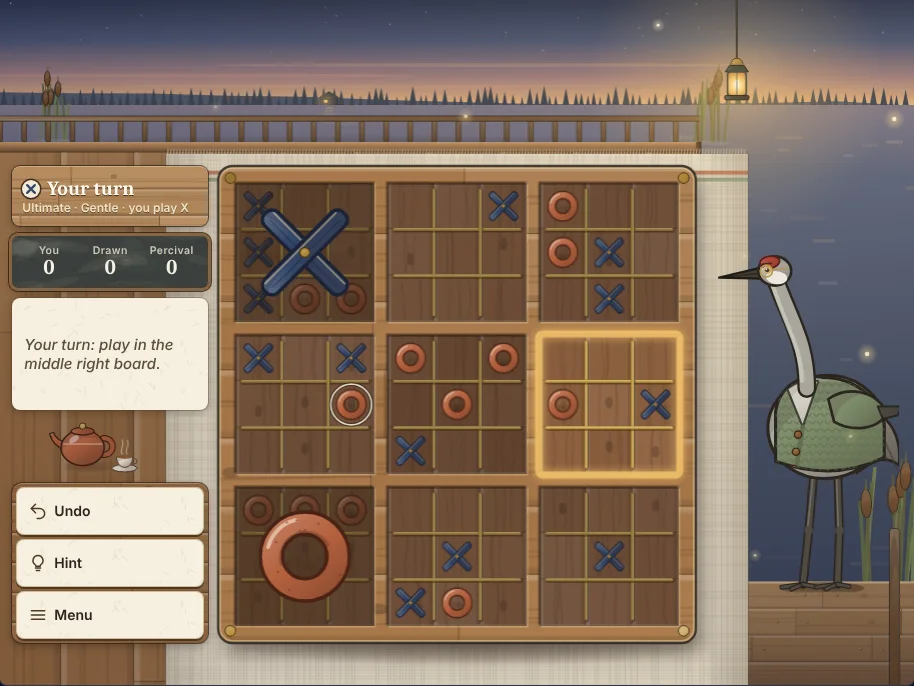
Ultimate tic tac toe is played on a big 3 by 3 grid whose nine squares are each a small tic tac toe board, 81 squares in all. Players take turns, X first, marking one square at a time, and the first move can go in any of the 81 squares.
After that, where you play decides where your opponent plays. The square you mark inside a small board sends your opponent to the small board in the same position on the big board. Mark the top right square of any small board, and the next move must be somewhere in the top right board.
Three in a row on a small board wins that board, and it counts as your mark on the big board. A small board that fills with no three in a row is tied and counts for nobody. If you are sent to a board that is already won or full, you get a free move and may play in any open board. Win three small boards in a row on the big board, across, down or on a diagonal, to win the game. If every board is decided with no such line, the game is a draw.
Ben Orlin’s 2013 post on his blog Math with Bad Drawings sets out the same rules: you must play in the board your opponent sends you to, a won board gives a free move to anyone sent there, and a tied board counts for neither player. Some groups play won and tied boards in other ways, so agree on the rules before you start. Cattail Landing Tic Tac Toe plays the rules above.
On screen, the board or boards you may play in have a lamplight edge and the rest are dimmed. A won board is shaded with a large X or O across it, a tied board is hatched, and a tap outside the boards you are sent to gives a small shake and says where to play.
Ultimate tic tac toe strategy
Look at where your move sends your opponent before you look at the board you are playing in. Ben Orlin puts this at the heart of the game: a square that wins you a small board is no bargain if it sends the other side to a board where they win one straight back, or to a board that is won or full, which gives them a free move anywhere.
Sending your opponent to a board that is nearly full, or one where neither side can make a line, is often the strongest quiet move, because it keeps them out of the boards that matter. Orlin suggests exactly that.
The center board and the center squares matter most. The center board sits on four lines of the big board, and every move in a center square sends the reply to the center board. But do not chase the center board at any cost: a board won in the right place, beside two of yours on the big board, is worth more than an early board that nobody can line up.
Sometimes it pays to give up a small board on purpose. Wikipedia’s article on ultimate tic tac toe notes that letting the other side take one board can buy you a better position elsewhere, and in practice a board you cannot hold is often best left to fill while you send the play somewhere that suits you.
Think about free moves late in the game. Once several boards are decided, a careless square can hand the other side a free move into the one board they need. The hint in Cattail Landing Tic Tac Toe often suggests a square for just that reason, and says so.
Controls in Cattail Landing Tic Tac Toe
Tap a square, or click it, to place your mark. On a keyboard, the arrow keys move a visible focus between the squares, and Enter or Space marks the square in focus. In classic the number keys 1 to 9 mark that square, counting across from the top left. In ultimate they mark that square of the board you are sent to; with a free move, choose the square with the arrow keys and press Enter.
Undo takes back your last move together with Percival’s reply, as often as you like. Hint rings the best square it finds and says why: a win, a block, a fork, blocking his fork, the center, a corner, a square that holds the draw when others would lose, or in ultimate a board win, a block, a move that does not hand him a free move or a square that sends him to a board with no quick win in it. U undoes, H shows a hint and Escape clears it.
Menu starts a new game, opens Settings (classic or ultimate, Percival or two players, his level and who goes first) and shows your statistics and the rules. In two-player mode the players pass the screen after each move, Undo takes back one move, and hints work for whoever is to play. Statistics are kept for each level of each game, with a separate tally for two-player games, and the game in progress is saved on your device as you play.
How strong is each level?
Percival has three levels at each game. At classic, Gentle takes a win he can see seven times in ten and blocks yours half the time; otherwise he marks a square wherever he fancies, leaning toward the center and the corners. Steady always takes a win and always blocks but does not see a fork coming. Perfect has worked out every game to the end and never loses. At ultimate, Gentle takes a board he can win more often than not and otherwise plays loosely, Steady looks two moves ahead (his move and your reply), and Sharp searches as far as a fixed budget allows, usually about nine moves ahead.
To check that each level does what it says, we ran our own simulation of 1,000 games for each pairing (500 for each pairing with Sharp), with the two players swapping who goes first every game. A random player marks any empty square, or any legal square in ultimate. The scripted beginner completes three in a row when it can, otherwise blocks, and otherwise marks a square at random, leaning toward the center and the corners; at ultimate it also takes a board it can win, blocks one, and avoids sending the other side to a board they can win at once. That is roughly how many people play their first games.
The beginner beat classic Gentle more often than it lost, so Gentle really is beatable while you learn. It won 88 of 1,000 games against Steady, every one of them as X, by stumbling into a fork, and none against Perfect. Perfect drew all 1,000 games against himself, as a solved game should, and drew every game against Steady too. At ultimate the gaps are wider: Sharp lost one of his 2,000 games, to the scripted beginner. These are computer players, not people, so treat the numbers as a guide to the gap between the levels.
| Game | Pairing | Games | Won | Lost | Drawn |
|---|---|---|---|---|---|
| Classic | Gentle against a random player | 1,000 | 725 | 158 | 117 |
| Classic | Steady against a random player | 1,000 | 900 | 11 | 89 |
| Classic | Perfect against a random player | 1,000 | 939 | 0 | 61 |
| Classic | Scripted beginner against Gentle | 1,000 | 540 | 136 | 324 |
| Classic | Scripted beginner against Steady | 1,000 | 88 | 177 | 735 |
| Classic | Scripted beginner against Perfect | 1,000 | 0 | 446 | 554 |
| Classic | Perfect against Perfect | 1,000 | 0 | 0 | 1,000 |
| Ultimate | Gentle against a random player | 1,000 | 777 | 136 | 87 |
| Ultimate | Steady against a random player | 1,000 | 974 | 3 | 23 |
| Ultimate | Sharp against a random player | 500 | 500 | 0 | 0 |
| Ultimate | Scripted beginner against Gentle | 1,000 | 752 | 145 | 103 |
| Ultimate | Scripted beginner against Steady | 1,000 | 123 | 697 | 180 |
| Ultimate | Scripted beginner against Sharp | 500 | 1 | 498 | 1 |
| Ultimate | Steady against Gentle | 1,000 | 952 | 14 | 34 |
| Ultimate | Sharp against Gentle | 500 | 500 | 0 | 0 |
| Ultimate | Sharp against Steady | 500 | 497 | 0 | 3 |
Beginner strategy
Make the same three checks before every mark, in this order. Can I make three in a row? Then do it. Can the other side make three in a row next turn? Then block it. Can either of us make a fork? Then make yours, or take the square theirs needs.
Prefer the center and the corners. The center is on four lines and each corner on three, while an edge square is on only two, so center and corner marks do more work, both for your lines and against theirs.
Play classic against Gentle until you win more than you lose, then move to Steady and practice forks, then try to hold Perfect to a draw from both sides of the board. Going second against Perfect is the best defensive practice there is, because he always plays the opening with the most ways to go wrong.
Common mistakes
Missing a diagonal. Rows and columns are easy to see; the diagonals, and above all the corner to corner diagonal that runs the other way, are the threats that get missed.
Answering a corner with anything but the center. Seven of O’s eight replies to a corner opening lose against best play. It is the single most useful fact in the game.
Taking a corner in the opposite corner trap. After X has two opposite corners and O has the center, O’s natural move, another corner, loses to a fork. An edge holds the draw.
Blocking a threat with a square that sets up the other side’s fork. When you must block, check whether the block also leaves them a fork; if it does, block with a move that makes a threat of your own.
In ultimate, winning a small board and forgetting where it sends the reply. The board you just won is rarely the problem; the board your move sends the other side to often is.
Tips for winning more games
As X, open in a corner, and if O does not take the center, look at once for a fork. Against a careful O who does take the center, take the opposite corner and see whether they fall for the trap.
As O, answer a corner with the center, the center with a corner, and an edge with the center. Then follow the order of priorities: win, block, fork, block a fork.
In ultimate, count where each candidate move sends your opponent before you choose, and keep the boards that matter to you out of their reach. A board that is nearly full is often the safest place to send them.
Use undo and the hint to learn. Ask for a hint when you are unsure, read why it likes the square, and use undo to try your own idea and see how Percival answers.
Keep playing
Tic tac toe rewards one habit above all: before every mark, check every row, column and diagonal for two of the other side’s marks with the third square empty, then look for the square that would give either player two threats at once. Learn the safe replies to each opening, try the opposite corner trap on Steady, and see how long you can hold Perfect to a draw. When the small board feels settled, move to ultimate, where the board you send your opponent to matters as much as the square you play. For more classic games against a calm computer opponent, try Peach Lane Four in a Row, where the discs fall and you need four; Larkspur Lookout Dots and Boxes, the pencil-and-paper game of claiming boxes; or Kingfisher Canal Checkers on a canal boat.
- Play Cattail Landing Tic Tac Toe
- Cattail Landing Tic Tac Toe: features, controls and FAQ
- Peach Lane Four in a Row: drop discs and line up four
- Larkspur Lookout Dots and Boxes: join the dots and claim boxes
- Kingfisher Canal Checkers: classic checkers on a canal boat
- Starling Hill Reversi: flip discs on a green board
- How to play Four in a Row: rules and strategy
- How to play dots and boxes: rules and strategy
- How to play checkers: rules, setup and strategy
- How to play Reversi: rules and strategy
- Classic board games to play online
More guides and roundups
Games for two on one screen, a village to share by link, Hearts at a friendly table, sweet baking and cat games, then cozy picks for couples.
How to Play Farkle: Rules, Scoring and StrategyFarkle is the six-dice game where you set aside dice that score and decide, throw after throw, whether to bank your points or push on. Here are the rules, the full scoring chart, hot dice and the final round, the common house rules, and strategy with the chances worked out exactly.
How to Play Chinese Checkers: Rules and StrategyChinese checkers is the race across a six-pointed star: step or hop your ten marbles into the point opposite before anyone else fills theirs. Here is how to set up for two, three, four or six players, how steps and hop chains work, how a game is won, what to do about marbles left in your home, how strong each level of our computer players is, and the strategy that wins more races.
How to Play Backgammon: Rules, Setup and StrategyBackgammon is the two-player race game of checkers, dice and the doubling cube. Here is how to set up the board, how the opening roll and moving work, the rule for using both dice, hitting and entering from the bar, bearing off, gammons and backgammons, the cube and the Crawford rule, how strong each level of our computer opponent is, and the basic strategy, common mistakes and tips that win more games.