Cozy Classic
Free Dots and Boxes
Larkspur Lookout Dots and Boxes
Classic dots and boxes with big, forgiving lines to tap, boxes that fill with a picture of whoever claimed them, the last turn highlighted, a computer opponent at three levels who understands chains, hints with a reason, and unlimited undo.
What you do
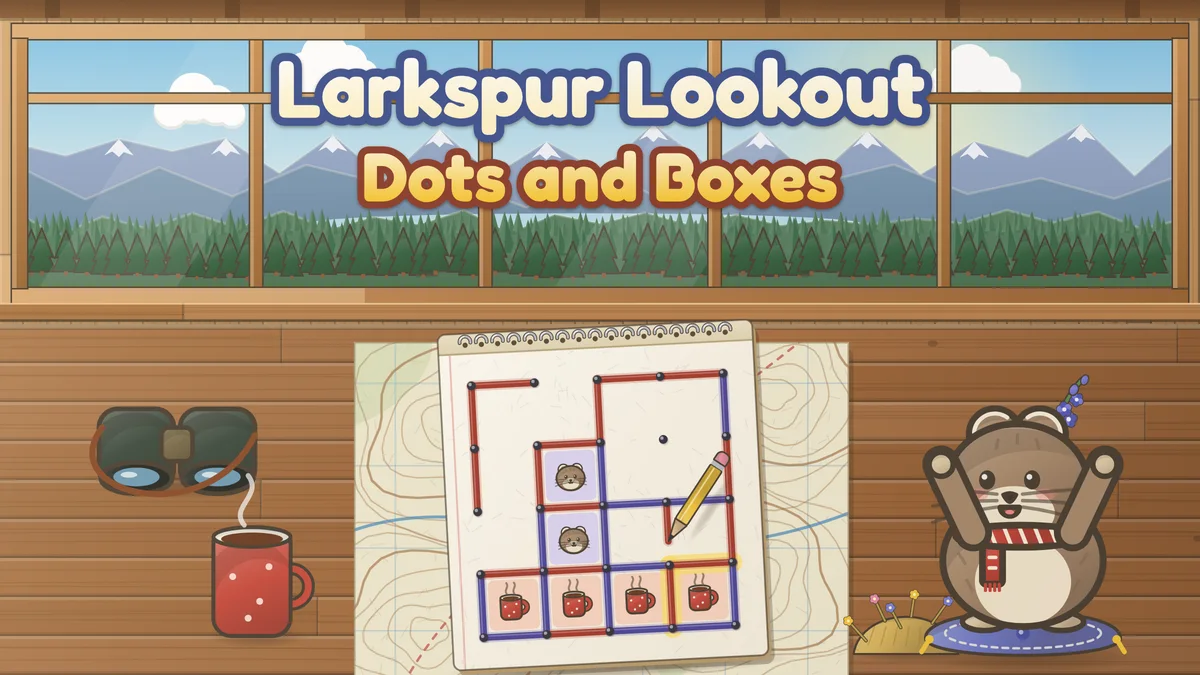
Larkspur Lookout Dots and Boxes is the pencil-and-paper game of dots and boxes with its standard rules, played on a spiral notepad on the map table of a mountain fire lookout, with windows all around onto blue ranges and pine forest, binoculars at one elbow and a mug of cocoa at the other. You and your opponent take turns drawing a line between two dots side by side. Close the fourth side of a box and it is yours, and you draw again. When every line is drawn, the most boxes wins. Your boxes fill with a red enamel camp mug on a coral tint and Pebble’s with her own round face on lavender; with a friend, Player 2’s boxes get a little pine tree on sage, so every box shows its owner by shape as well as color. Your opponent is Pebble, a round little pika in a red striped scarf with a sprig of larkspur behind her ear, who sits on a blue cushion beside her haypile of wildflowers, draws her lines with a pencil you can watch, cheers when she claims a box, looks amazed when you claim one and claps when you win.
- Three levels for Pebble: Gentle always takes a box you leave her, but only half of her other lines are chosen with care, so she often hands you one. Steady never gives a box away while a safe line is left, and when she must, she gives the fewest. Sharp fights for control of the long chains, hands back the last two boxes of a chain when that wins more, and searches the endgame of chains and loops line by line.
- Big, forgiving lines: press anywhere near the line you want to see it previewed in pencil, slide to another if you like, and let go to draw it. A tap between lines picks the nearest one still open, and a mouse previews the line under it.
- Claimed boxes fill with a picture of the claimer: your camp mug, Pebble’s face, or a pine tree for Player 2 in a game with a friend. The lines of the last turn sit under a soft yellow highlighter, so you can always see what just happened.
- Hints from Sharp’s own search with a short reason: take a box, leave the last two boxes of a chain on purpose, split a two-box chain so it cannot be handed back, play a safe line, or give away the fewest boxes. Optional warnings shade any box a line would leave with three sides while you aim.
- Unlimited undo that takes back your last line and Pebble’s lines after it, boards of 3 by 3, 4 by 4, 5 by 5 and 6 by 6 boxes, a choice of who draws first or taking turns, and three speeds for Pebble’s pencil.
- Play a friend on the same device, passing it back and forth, with Pebble cheering you both on. Statistics for each of Pebble’s levels (games, wins, losses, ties and your biggest winning margin) are saved on this device with the game in progress.
How to play
- Press Play. The notepad shows a square grid of dots: 4 by 4 boxes unless you choose another board, which is 25 dots and 40 lines to draw. You draw the first line unless you choose otherwise in Settings.
- On your turn, draw one line, across or down, between two dots side by side that are not yet joined. Tap near the line, or press and slide to aim, then let go.
- If your line completes the fourth side of a box, the box is yours: it fills with your mug, and you must draw another line. One line can close two boxes at once, and it still earns just one more line. Your turn ends when you draw a line that closes no box.
- Pebble does the same on her turn, drawing in indigo pencil while yours is red. Every box she closes fills with her face.
- When every line is drawn, whoever has more boxes wins. On the 4 by 4 and 6 by 6 boards the boxes can split evenly, for a tie.
Controls
- Touch or mouse: tap near the line you want. Press and hold to see it previewed in pencil, slide to another line if you like, and let go to draw it. A tap between lines picks the nearest line still open. Undo, Hint and Menu sit on the shelf below the notepad, or beside it on a wide screen.
- Keyboard: the arrow keys move a visible focus from line to line, and Enter or Space draws the line in focus. U undoes, H shows a hint, and Escape clears the hint.
- Restart in the toolbar starts a new game. Menu starts a new game, opens Settings (your opponent, the board, who draws first, Pebble’s speed and the third-side warnings), and shows your statistics and the rules. The toolbar also has pause, help, optional sound and fullscreen.
Tips worth knowing
- Early on, avoid drawing the third side of a box. A box with three sides is a free box for the other player. A line that hands nothing over is called a safe line, and the safe lines run out sooner than you expect.
- Late in the game every line hands something over, because the open boxes have joined into chains: rows of boxes where one line gives the whole row away. Most players take what they are given and then open the shortest chain they can.
- Learn to leave the last two boxes. When you are handed a chain of three boxes or more, take all but the last two, then draw the line at the far end of those two. Your opponent takes the pair and must open the next chain for you. Julian West writes that this one move is enough to beat most casual players.
- Hand over a two-box chain by its middle line. That splits it into two single boxes, so your opponent cannot take one and leave you the other to make you open the next chain. West calls this a hard-hearted handout.
- Count the long chains. The long chain rule from Elwyn Berlekamp, as Science News reported it, says the player who draws first wants the number of dots plus the number of long chains (three boxes or more) to come out even, and the second player wants it odd. On the 4 by 4 board, with 25 dots, the first player wants an odd number of long chains.
- Use the hint and undo to learn. The hint says why it likes a line, and undo lets you try your own idea and see how Pebble answers.
Accessibility
- Everything can be played with a keyboard: the arrow keys move a visible focus from line to line, Enter or Space draws the line in focus, U undoes and H shows a hint.
- Every line is a button labeled for screen readers with the two dots it joins (for example, Across from a1 to b1), who drew it and whether it was part of the last turn, and on your turn whether it would take a box or, with warnings on, hand one over.
- Claimed boxes show their owner by picture as well as color: a mug with a handle, a round face with ears, or a pointed pine tree. Each player’s lines are drawn in their own pencil color.
- Nothing is timed. Pebble waits while a menu is open, and undo is unlimited.
- Reduced motion draws Pebble’s lines at once instead of sliding her pencil along them, stops the boxes popping and Pebble’s fidgeting, shortens her pauses and keeps the sparkles small and still. Sound is optional and never needed to play.
Questions
How strong is each level?
We measured Pebble with our own simulation of 1,000 games for each pairing on the 4 by 4 board, with the two players taking turns to draw the first line. Against a player that draws lines at random, Gentle, Steady and Sharp each won all 1,000. Against each other, Steady beat Gentle in 883 games with 54 ties, Sharp beat Gentle in 987 with 11 ties and 2 losses, and Sharp beat Steady in 947 with 46 ties and 7 losses. These are computer players, not people, so treat the numbers as a guide.
Can a beginner beat Gentle?
Yes, that is what Gentle is for. In the same simulation, a simple scripted beginner that takes any box it can, otherwise draws a line that leaves no box with three sides, and otherwise draws any line, beat Gentle in 667 of 1,000 games (66.7 percent) and tied 103 more. The same beginner won 129 of 1,000 against Steady and 4 of 1,000 against Sharp, so Sharp expects you to know about chains.
Which dots and boxes rules does this use?
The standard rules as Wikipedia gives them: the game starts with an empty grid of dots, the players take turns drawing a single line across or down between two unjoined dots side by side, a player who completes the fourth side of a box claims it and takes another turn, and when no more lines can be drawn the player with the most boxes wins. Every line starts undrawn, including the outside edge, which Wikipedia calls an American board.
What is a chain, and why leave two boxes?
Late in a game the open boxes join into chains, where drawing any line in a chain lets the other player take the whole chain. A player handed a chain can take every box, but then must draw the next line and open another chain. Wikipedia describes the stronger play, which it calls the double-cross strategy: take all but the last two boxes, and hand those two back with one line. The other player takes them, with a single line that closes both boxes, and then has to open the next chain. Sharp Pebble plays this way, and the hint shows it to you.
Who wins with perfect play?
On the 3 by 3 board of nine boxes, Science News reported in 2003 that an alert player starting second can always win. Our own computation with the game’s exact search agrees: from the empty 3 by 3 board, best play on both sides gives the second player 6 boxes to 3. Bigger boards are far harder to work out, and Wikipedia notes that playing dots and boxes perfectly is PSPACE-complete, a class of very hard problems for computers.
What does the game save?
Your settings, the game in progress with every line, and your statistics for each of Pebble’s levels (games played, won, lost and tied, and your biggest winning margin), plus a count of games finished with a friend, all in this browser’s local storage. There is no account.