
CozyWorld game guide · By CozyWorld
This guide covers our own game, written from the current game rules and browser checks.
How to Play Math Path Puzzles: Rules and Strategy
A math path puzzle gives you a starting number and a map of gates that add, subtract, multiply and divide. Choose one route to the end and bring the biggest number you can. Here are the rules, the remainder rule, the controls and the order-of-operations habits that matter most, with numbers from our own simulation.
How do you play a math path puzzle? You start with a number and a map of routes. Every route passes through a row of gates, and every gate carries a sign such as +5, −3, ×2 or ÷3 that changes your number as you go through. You take one gate in each row, the routes fork and rejoin, and the aim is to arrive at the end with the biggest number possible. The whole map is in view from the start, so it is a puzzle about planning, not speed.
If you have seen math runner games or math gates games, where a crowd runs at a pair of gates and you have a moment to pick a side, the idea is the same with the clock taken away. This guide covers the rules, the four signs and the flip gate, the remainder rule for division, the controls in Hollyhock Math Path, where you can play this math puzzle game free with 124 trails and a new path every day, and the order-of-operations habits that find the best route. Every number about strategy comes from our own simulation over the game’s trails, and is labeled as such.
What is a math path puzzle?
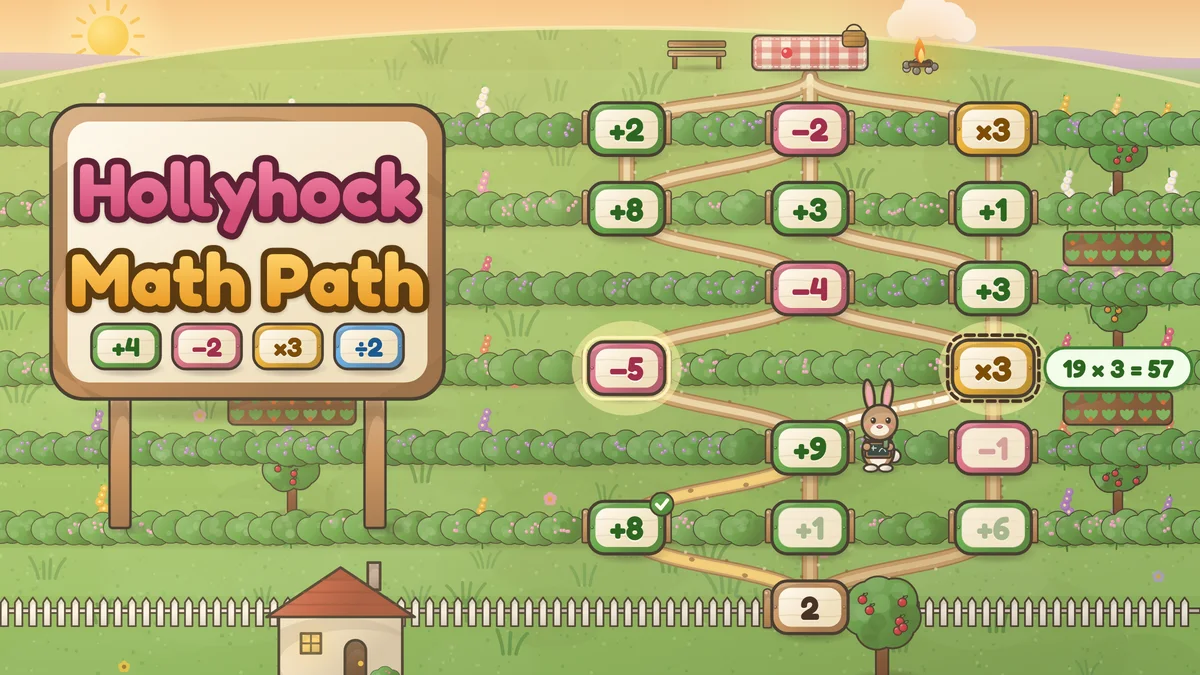
A math path puzzle is a number puzzle laid out as a map. You begin at the bottom with a starting number. Above you are rows of gates, and each gate leads on to one or more gates in the next row, so the routes branch, cross over to the next lane and join up again. Each gate has a sign, and passing through it changes your number: +4 adds four, −3 takes three away, ×2 doubles it and ÷2 halves it.
You pass through exactly one gate in every row, and the last row leads to the finish. Because every route meets the signs in a different order, the same few signs can give very different results, and that is the whole puzzle: (3 + 2) × 2 is 10, but 3 × 2 + 2 is only 8. The goal is the biggest number at the end.
The rules
Start with the number you are given. Choose a gate in the first row; you may take any of them. From then on you may take only a gate that your last gate leads to, which the paths on the map show. Apply each gate’s sign to your number as you pass through it. When you have passed one gate in every row, the number you hold is your result.
Nothing is hidden and nothing is random once the map is drawn. Every route is in view, there is no timer, and the best result is fixed before you take a step, so a math path puzzle can always be worked out with enough care. Many maps have only one route to the best number.
In Hollyhock Math Path the map is a hillside. Tally the rabbit starts at the cottage gate at the foot of the hill with the starting number on her chalk slate, every hedgerow above her has two to four garden gates with painted signs, and the hilltop picnic is the finish.
The four signs and the flip gate
Four of the signs are the everyday operations. The fifth, the flip gate, appears only on the hardest trails: it multiplies by a number below zero, written ×−2 or ×−1. A flip gate turns a number above zero into one below zero, and a number below zero into one above it, because two minuses make a plus.
Each sign in Hollyhock Math Path has its own color as well as its own symbol, so you never have to tell them apart by color alone: plus is leaf green, minus is rose, times is honey gold, divide is sky blue and flip is plum.
| Sign | What it does | Example |
|---|---|---|
| +n | Adds n | 12 + 4 = 16 |
| −n | Takes n away | 12 − 5 = 7 |
| ×n | Multiplies by n | 12 × 3 = 36 |
| ÷n | Divides by n and drops any remainder | 15 ÷ 2 = 7 |
| ×−n (flip) | Multiplies by minus n | −4 × −2 = 8, and 6 × −1 = −6 |
The remainder rule
A math path keeps whole numbers, so a divide gate drops any remainder. 8 ÷ 2 = 4 exactly, but 9 ÷ 2 = 4 as well: the half left over is simply dropped, the way whole-number division works on a calculator with no decimals. 7 ÷ 3 = 2 and 2 ÷ 3 = 0.
Below zero, the remainder is dropped toward zero, never further away from it. So −7 ÷ 2 = −3, not −4, and −2 ÷ 3 = 0. That means a divide gate always pulls a number toward zero, from either side, which matters on the Ridge.
One habit follows from the remainder rule: an odd number loses a little at a divide gate. 7 ÷ 2 × 2 = 6, while 7 × 2 ÷ 2 = 7, so when you can choose, multiply before you divide.
Leaves: how a finish is scored
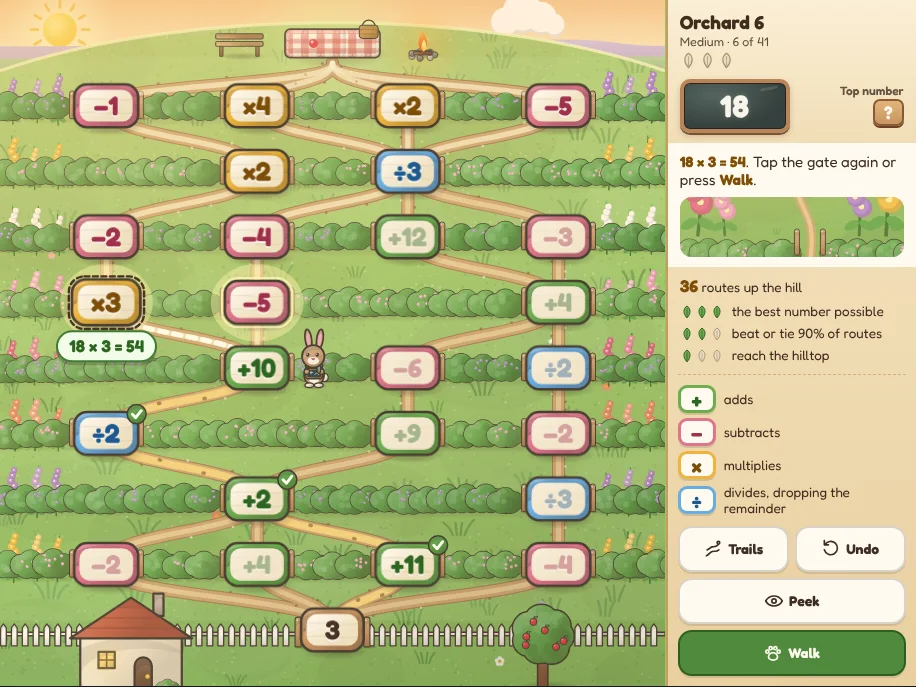
Hollyhock Math Path counts every route from the cottage gate to the hilltop exactly, so it always knows the best number possible and how your number compares with every other route. Bring the best possible number to the top for three leaves. If your number beats or ties at least 90% of all the routes, you earn two leaves. Reaching the top at all earns one.
A finish at the best number with no peeks also earns a no-help mark, gold on today’s path. Your best number and leaves for each trail are kept on your device, and walking a trail again can only raise them.
How to play in Hollyhock Math Path
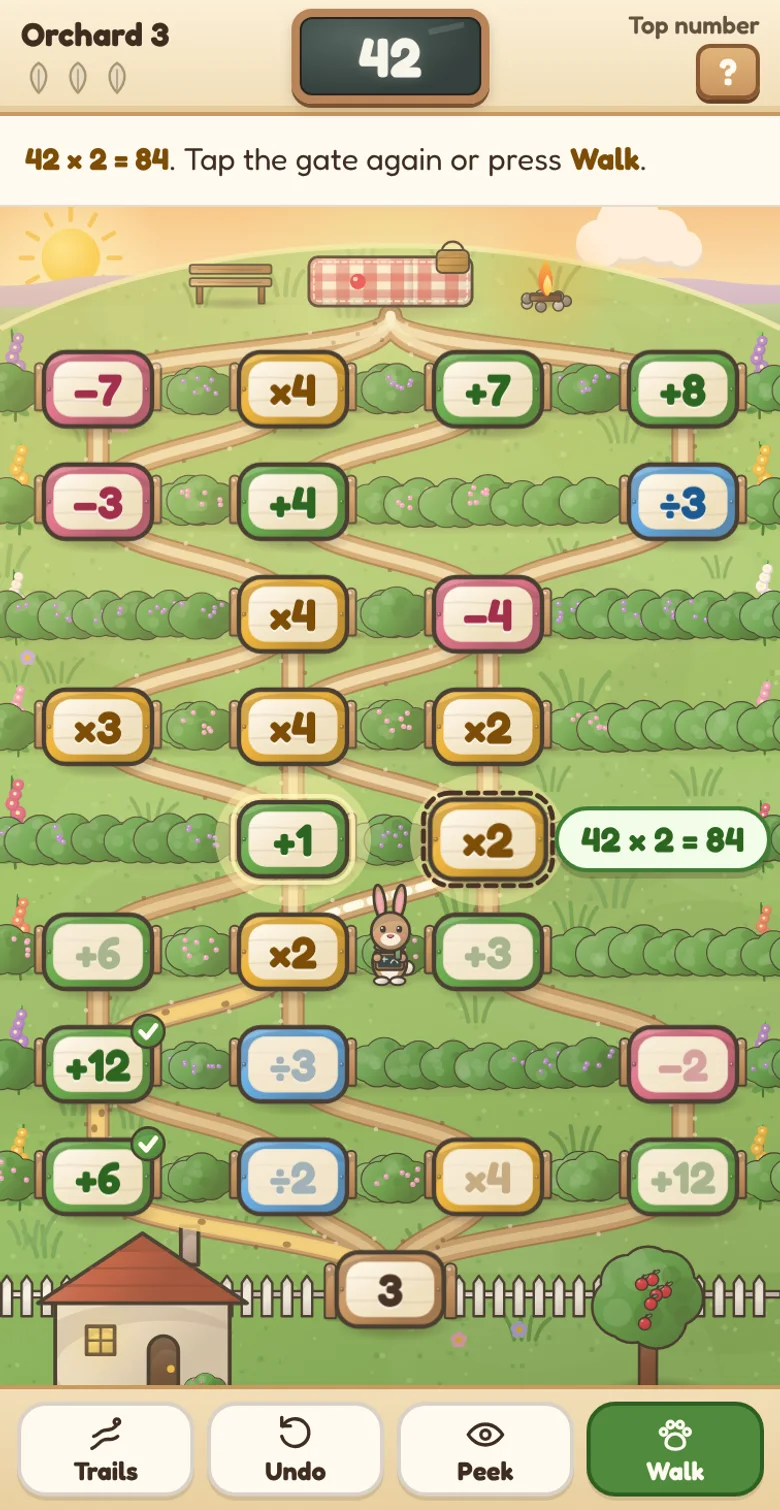
The gates you can reach next glow. Tap or click one to choose it: a bubble shows its sum before you commit, such as 12 × 3 = 36, and Tally looks toward it. Tap the same gate again, or press Walk, and she trots through. The number on her slate turns green when it rises and rose when it falls, and the next hedgerow’s gates light up. If you would rather work the sums out yourself, the Show sums setting turns the bubble off.
Undo steps back one gate at a time, as far as you like, even after you reach the hilltop. Restart takes Tally back to the cottage gate, and Undo can bring the walk back. Peek marks the best next gate from wherever you stand, with your current number; peeks are unlimited, but they are counted. On a trail’s first walk the top number is hidden and shows as a question mark, so you are not simply hunting for a known target; after your first finish it shows, and a setting shows it from the start.
At the hilltop the results show your number, the best possible number, your leaves and the share of routes you beat or tied. From there you can show the best route in gold dashes, walk the trail again or go on to the next one.
On a keyboard, Left and Right (or 1 to 4) choose a gate, Enter or Space walks through it, Z or Backspace undoes, H peeks and Escape closes the cards. Every step is announced for screen readers, for example “Through the times 3 gate: 12 times 3 is 36.”
Strategy: the order of the signs
Add before you multiply. Whatever you add before a times gate gets multiplied too: from 5, +4 then ×3 gives 27, but ×3 then +4 gives only 19. A +4 before a ×3 is worth 12, after it only 4.
Subtract after you multiply. The same rule works the other way for minus gates: from 5, ×3 then −2 gives 13, while −2 then ×3 gives 9. A minus gate taken early has its cost multiplied by every times gate after it.
Divide before you add. A divide gate halves or thirds everything that came before it, including what you just added: from 20, ÷2 then +6 gives 16, but +6 then ÷2 gives 13. Above zero, x ÷ d + c is never smaller than (x + c) ÷ d, so a divide gate early in the walk usually costs less than one late.
A small step back can pay. Sometimes the only path to a ×3 gate starts with a minus gate. From 4, −1 then ×3 then ×2 gives 18, while +2 leads only to +1 and ×2, for 14. Judge a gate by the gates it opens, not by the number it gives you now.
Read the hill from the top down. The last hedgerow decides the most, so find its best gate first, then ask which gate in the row below leads to it, and so on back to the start.
| Start | One order | The other order | Which wins |
|---|---|---|---|
| 5 | +4 then ×3 = 27 | ×3 then +4 = 19 | Add first |
| 5 | ×3 then −2 = 13 | −2 then ×3 = 9 | Subtract last |
| 20 | ÷2 then +6 = 16 | +6 then ÷2 = 13 | Divide first |
| 7 | ×2 then ÷2 = 7 | ÷2 then ×2 = 6 | Multiply before you divide an odd number |
Numbers below zero and flip gates
On the Ridge, numbers can fall below zero, and the usual habits turn around. A times gate makes a number below zero even lower, and a minus gate takes it further down. With no flip gate ahead, keep your number above zero, and if it has already fallen, a divide gate pulls it back toward zero: −30 ÷ 3 = −10.
With a flip gate ahead, a big number below zero is not a disaster but a store of value. From 4, taking −10 gives −6, ×3 gives −18, and a ×−2 flip gate then gives 36. Skip the −10 and the same ×3 gives 12, which the flip gate turns into −24. Before a flip, the lower the better, so minus gates and times gates help and a divide gate costs you: −18 ÷ 2 = −9, which the flip gate turns into only 18.
After the flip, the ordinary habits return. Count how many flip gates a route passes through: an odd number turns the sign over, an even number leaves it as it was.
Common mistakes
Taking the biggest number right now. It is the most natural move and the least reliable one. Every seeded trail in Hollyhock Math Path is checked so that a player who always takes the biggest next number falls short of the best by at least 3 and at least 15% of the best number.
Dividing late. A divide gate near the top halves everything you built on the way up, while one near the bottom halves only the starting number.
Multiplying a number below zero with no flip gate ahead. ×3 on −6 is −18, three times worse.
Forgetting the remainder. 15 ÷ 2 is 7, not 7.5, and an odd number loses a little at every divide gate.
Ignoring where a gate leads. A gate with a great sign can lead only to minus gates, and a modest gate can be the only way to a ×4.
The three trail sets and today’s path
Hollyhock Math Path has 124 trails in three sets, all open from the start. Meadow has six hedgerows of up to three gates with plus, minus and times by 2 or 3, and its numbers never fall below zero. Orchard has eight hedgerows of up to four gates and adds divide gates that drop the remainder; on some trails a route dips below zero. Ridge has ten hedgerows, numbers below zero and flip gates. Each set opens with one or two short teaching trails that coach their idea one line at a time.
Today’s path is a new trail every day, the same for everyone on the same date. Monday and Tuesday bring a Meadow-size path, Wednesday to Friday an Orchard-size one and the weekend a Ridge-size one. It keeps a daily streak, and a best-number finish with no peeks earns a gold mark.
To see how hard each set is, our simulation walked the 40 seeded trails in each set with simple players. One that always takes the biggest number right now never finds the best, by design. One that looks two gates ahead finds it on 67.5% of Meadow trails, 52.5% of Orchard trails and 25% of Ridge trails; one that looks three gates ahead finds it on 80%, 77.5% and 32.5%. A walker that picks every gate at random earns three leaves only 7% of the time on a Meadow trail, 5.9% on Orchard and 2.4% on the Ridge.
| Set | Hedgerows | Routes per trail | Look two gates ahead finds the best | Look three gates ahead finds the best | Random walk earns three leaves |
|---|---|---|---|---|---|
| Meadow | 6 | 10 to 20 | 67.5% | 80% | 7% |
| Orchard | 8 | 12 to 54 | 52.5% | 77.5% | 5.9% |
| Ridge | 10 | 30 to 184 | 25% | 32.5% | 2.4% |
Related games
If you enjoy number puzzles, Sprout Killer Sudoku adds a little arithmetic to sudoku: dotted cages must add up to their sums. Mulberry Lane Bakery is the 2048 sliding puzzle, with a baked good and its number on every tile. Meadowlark Barn Shut the Box is a calm dice game of adding up to the numbers still open, and Starlight Launch is a code-breaking puzzle of three-digit locks.
Keep climbing
Math path puzzles come down to a few habits: add before you multiply, subtract after, divide before you add, and on the hardest paths, let a number fall below zero only when a flip gate is waiting to turn it around. Above all, look a few gates ahead, because the biggest number right now is rarely the road to the biggest number at the end. Start with the first Meadow trail in Hollyhock Math Path, a short lesson that coaches the first idea one line at a time, and work your way up to the Ridge. For more calm number puzzles, try Sprout Killer Sudoku, where cages add up to their sums; Mulberry Lane Bakery, the 2048 puzzle with baked goods on the tiles; or Meadowlark Barn Shut the Box, a dice game of adding up to the numbers still open.
- Play Hollyhock Math Path
- Hollyhock Math Path: features, controls and FAQ
- Sprout Killer Sudoku: cages that add up to their sums
- Mulberry Lane Bakery: the 2048 number puzzle
- Meadowlark Barn Shut the Box: a dice game of sums
- How to play 2048: rules and strategy
- How to play killer sudoku: rules and techniques
- Math games for adults: more free number puzzles
- More cozy puzzle games
More guides and roundups
Match mahjong tiles, solve sudoku and killer sudoku, slide 2048 tiles, make 24 from four number cards, stitch a nonogram, find hidden words, fit a jigsaw, rake leaf piles, sort shells, merge fruit or crack firefly codes. Choose a puzzle by the decisions it asks you to make.
How to Play Make 24: Rules, Hands and TipsMake 24 is the arithmetic puzzle where four numbers, often dealt from a deck of cards, must be combined with adding, subtracting, multiplying and dividing to make exactly 24. Here are the rules, the card table version, how many hands can be done by our own solver’s exact count, the hardest hands with their answers, and the habits that find 24 fastest.
How to Play Farkle: Rules, Scoring and StrategyFarkle is the six-dice game where you set aside dice that score and decide, throw after throw, whether to bank your points or push on. Here are the rules, the full scoring chart, hot dice and the final round, the common house rules, and strategy with the chances worked out exactly.
How to Play Four in a Row: Rules and StrategyFour in a Row is the two-player game of dropping discs into an upright rack and lining up four. Here is how to set up, how a turn works, how a game is won or drawn, what the solved game says about going first, how strong each level of our computer opponent is, and the strategy that wins more games: the middle column, threats and blocks, and odd and even rows.