Cozy Classic
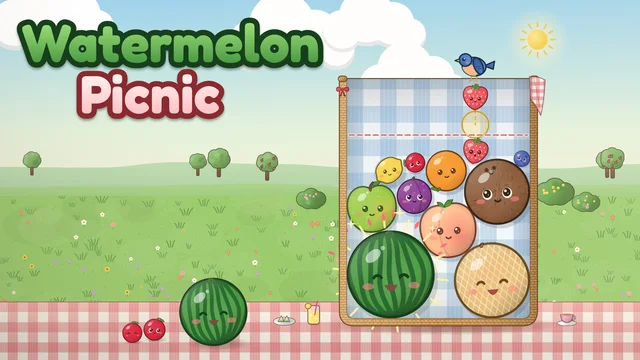
Free 2048 Game
Mulberry Lane Bakery
2048 with every number a baked good you can tell apart at a glance and the number always on the tile, smooth slides that follow a swipe, the arrow keys or the arrow buttons, a one-step undo, hints that look a few moves ahead, a daily board, and boards of 3 by 3 and 5 by 5 as well as the classic 4 by 4.
What you do
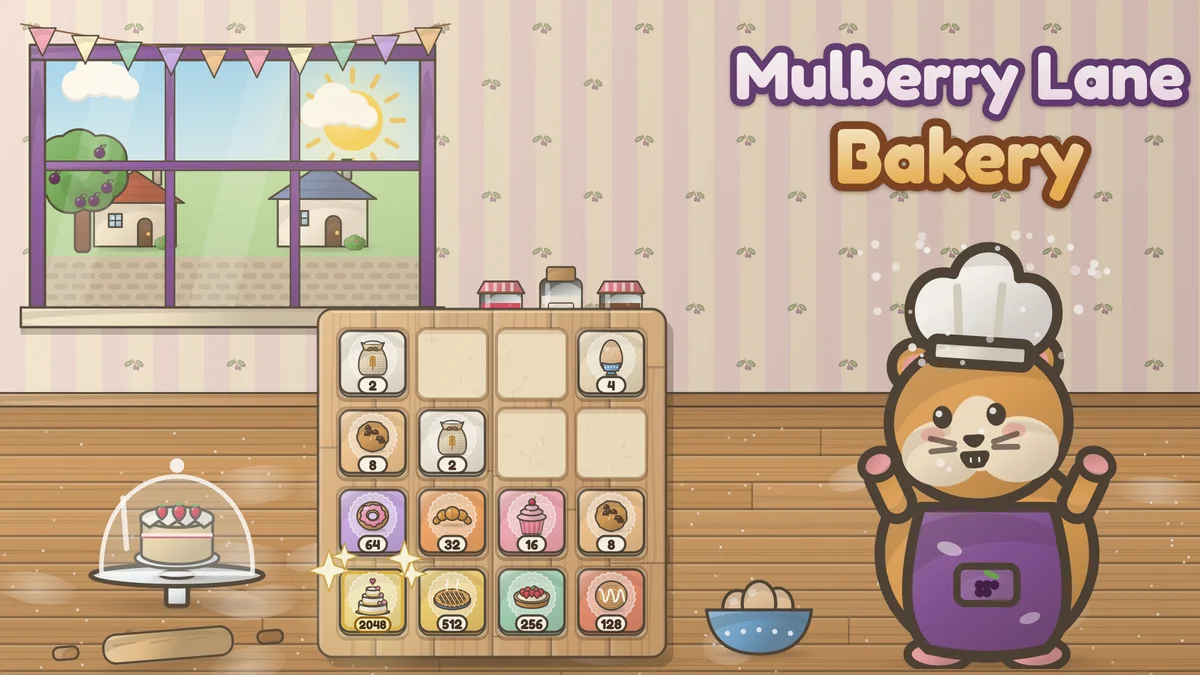
Mulberry Lane Bakery is the classic 2048 number puzzle, set on a wooden pastry board in a small bakery on a cobbled lane. Striped wallpaper and paper bunting hang over a honey-wood counter dusted with flour, and through the shop window you can see the cottages across the way and a mulberry tree. Each move slides every tile on the board one way, and two tiles of the same number that bump together bake into one tile of their total. Every number is a baked good on a ladder: 2 is a sack of flour, 4 an egg, 8 a cookie, 16 a cupcake, 32 a croissant, 64 a donut, 128 a cinnamon roll, 256 a strawberry tart, 512 an apple pie, 1024 a layer cake and 2048 a three-tier wedding cake, with a gingerbread house, a cream puff tower and a golden showpiece beyond. The number stays on every tile, so you never have to learn the ladder to play. Behind the counter stands Dumpling, a round golden hamster in a tall baker’s hat and a mulberry-purple apron, who watches your merges, gasps at a big new bake, frets when the board fills up and throws his paws in the air when you make the cake.
- The classic rules of Gabriele Cirulli’s 2048: tiles slide as far as they go, a matching pair merges once per move, a new 2 or 4 lands after every move, and making 2048 wins, with Keep going for a higher score.
- A ladder of fourteen hand-drawn baked goods, from a sack of flour to a golden showpiece, each on its own colored plate with the number on a cream label, readable on a phone.
- Swipe or drag anywhere in the bakery, use the arrow keys or W, A, S and D, or press the arrow buttons. The page does not scroll while you swipe, and a move that changes nothing just nudges the board.
- A one-step undo (a setting you can turn off), and hints that look a few moves ahead over every tile that could come next, using only what is on the board.
- The classic 4 by 4 board, a tight 3 by 3 whose goal is the 256 strawberry tart and a roomy 5 by 5 whose goal is the 4096 gingerbread house, each with its own best score, plus a daily 4 by 4 board that gives everyone the same start for the date.
- New tiles come from a seed saved with your game, so a reload never changes a tile and undo cannot fish for a better one. A recipe book of every bake you have made, three slide speeds, reduced motion support and a saved game in this browser.
How to play
- Press Play. The 4 by 4 board starts with two tiles, each a 2 or a 4.
- Swipe, drag or press an arrow key. Every tile slides as far as it can that way.
- Two tiles with the same number that bump together become one tile worth both: two 2s make a 4, two 4s make an 8, and so on up the ladder. A tile made by a merge does not merge again in the same move, and your score goes up by each new tile’s number.
- After every move that changes the board, a new tile lands on an empty square: a 2 nine times in ten, and a 4 one time in ten.
- Make a 2048 tile, the wedding cake, to win. You may keep going for a higher score. The game ends when the board is full and no two matching tiles sit side by side.
Controls
- Touch: swipe on the board, or anywhere in the bakery. Undo, Hint and Menu sit on the shelf at the bottom, under your thumb. Arrow buttons can be turned on for tall phones in Settings.
- Mouse: drag the way you want the tiles to go, or click the arrow buttons beside the board on a wide screen.
- Keyboard: the arrow keys or W, A, S and D slide the tiles, U undoes, H shows a hint, and Escape closes a menu or clears the hint.
- Restart in the toolbar starts a new game. Menu starts a new game or the daily board, opens Settings (board size, undo, arrow buttons and slide speed) and shows your statistics, your recipe book and the rules. The toolbar also has pause, help, optional sound and fullscreen.
Tips worth knowing
- Pick a corner and keep your biggest bake in it. Slide mostly toward the two edges that meet there, say down and left, and use the other ways only when you must.
- Keep the edge along your corner full. With the bottom row full and no matching pair in it, a slide to the right cannot pull your big tile out of the corner, and with its column full, neither can a slide up.
- Line your bakes up in order along that edge, biggest in the corner and smaller ones beside it, like a 256, a 128, a 64 and a 32. Then one merge feeds the next, all the way into the corner.
- A habit alone does not get far. In our simulation of 10,000 games for each simple player on the 4 by 4 board, pressing down whenever that moves, otherwise left, then right, and up only when nothing else moves, averaged 2,557 points against 1,083 for random moves, but it made a 512 in only 4.5 percent of games, and no simple habit made a 2048.
- Watch the free squares. With two or fewer left, look for any merge first, and do not let small tiles pile up far from your corner. Dumpling’s worried face is your cue.
- Use undo and the hint to learn. The same move always brings the same new tile, so you can try the hint’s move against your own and compare them fairly.
Accessibility
- Everything can be played with a keyboard: the arrow keys or W, A, S and D slide the tiles, U undoes, H shows a hint and Escape closes menus.
- Every tile shows its number as well as its picture, and the bakes differ in shape and plate color, so color is never the only clue.
- The board is described for screen readers row by row, and each move is announced with the merges it made, the new tile and the score.
- Nothing is timed, and the game waits for you while a menu is open or the game is paused.
- Reduced motion places the tiles at once without sliding or popping, stops the hint’s pulse and Dumpling’s fidgeting, and leaves out the flour and confetti. Sound is optional and never needed to play.
Questions
Is this the original 2048?
It follows the rules of 2048, the sliding tile game Gabriele Cirulli made in 2014 and shared as open source: the 4 by 4 board, new tiles of 2 or 4 (a 2 nine times in ten), each tile merging at most once per move, and 2048 to win, with the option to keep going. The bakery, the baked-good tiles and Dumpling the hamster are our own, and so is the code.
Why are the tiles baked goods?
Because a ladder of treats is a cozy way to see how far you have come: a sack of flour, an egg, a cookie, a cupcake and so on up to the wedding cake. Many people look for a 2048 cupcake game or another food version of 2048, where the numbers become pictures. Here the number stays on every tile as well, so you can play by the numbers alone and still enjoy the bakes.
How hard is it to make 2048?
Hard enough to take practice. We ran our own simulation of simple computer players on the 4 by 4 board, 10,000 games each. Random moves averaged 1,083 points and made a 512 in 1 game. Pressing down whenever that moves, otherwise left, then right, and up only when nothing else moves, averaged 2,557 and made a 512 in 4.5 percent of games, and always taking the move that scores the most right now averaged 3,031 and made a 512 in 12.7 percent. None of them ever made a 2048. The game’s own hint, which looks a few moves ahead, made the 2048 in all 100 games we ran it on. These are computer players, so treat the numbers as a guide.
What are the 3 by 3 and 5 by 5 boards?
Two extra boards with the same rules. The 3 by 3 is tight, so its goal is the 256 strawberry tart: in our simulation of 10,000 games no simple habit made it, while the game’s hint made it in 935 of 1,000 games. The 5 by 5 is roomy, so its goal is the 4096 gingerbread house: simply pressing up, right, down and left in turn made it in 30.8 percent of 10,000 games. Each board keeps its own best score.
What is the daily board?
A 4 by 4 game whose tiles come from the date, so everyone who plays that day gets the same start, and the same moves always bring the same new tiles. Your best score and biggest bake for each day are kept with your statistics.
Can an undo or a reload change the tiles?
No. Every new tile in a game comes from a seed saved with it, along with every move, and the game rebuilds the board from them when you come back. Undo takes back one move; make the same move again and the same new tile appears in the same square.
What does the game save?
Your settings, the game in progress, and your statistics, all in this browser’s local storage: for each board, the games played, the games where you made the goal, your best score and your biggest bake, plus your daily board results and your recipe book. There is no account.