
CozyWorld game guide · By CozyWorld
This guide covers our own game, written from the current game rules and browser checks.
How to Play 2048: Rules and Strategy
2048 is the sliding tile puzzle where two matching numbers merge into their sum. Here is how a move works, exactly which tiles merge, how scoring, winning and the end of a game work, and the corner strategy that gets you to 2048, with numbers from our own simulation of simple strategies.
How do you play 2048? You slide every tile on a 4 by 4 board one way, up, down, left or right, and two tiles with the same number that bump together merge into one tile worth both. After each move a new 2 or 4 appears in an empty square. Keep merging, 2 and 2 into 4, 4 and 4 into 8 and so on, and the moment you make a 2048 tile, you win. The game ends when the board is full and nothing can merge.
This guide covers the full rules: the board, how a move works and exactly which tiles merge, scoring, winning, keeping going and the end of a game. Then it covers the controls in Mulberry Lane Bakery, where you can play 2048 online free with a ladder of baked goods on the tiles, followed by the corner strategy, the most common mistakes and a few tips. Every strategy number here comes from our own simulation of computer players, run with the game’s own rules, and each one is labeled as such.
What is 2048?
2048 is a single-player sliding tile puzzle. Gabriele Cirulli, an Italian web developer, released it on March 9, 2014, as a game you play in a web browser, and published its code on GitHub under the open source MIT License.
Because the code is open, the game is easy to adapt, and you will find versions where pictures stand in for the numbers, such as a 2048 cupcake game where every number is a cake. The rules below are the rules of Cirulli’s original, which most versions follow. There is no timer, and a game lasts as long as you can keep merging.
The board and the tiles
The classic board is a grid of 4 by 4 squares. A game starts with two tiles in random squares, each a 2 or a 4, and the other fourteen squares empty.
Every tile is a power of two: 2, 4, 8, 16, 32 and so on. New tiles only ever arrive as a 2 or a 4. In the original, a new tile is a 2 nine times in ten and a 4 one time in ten, and Mulberry Lane Bakery does the same. Everything bigger has to be built by merging.
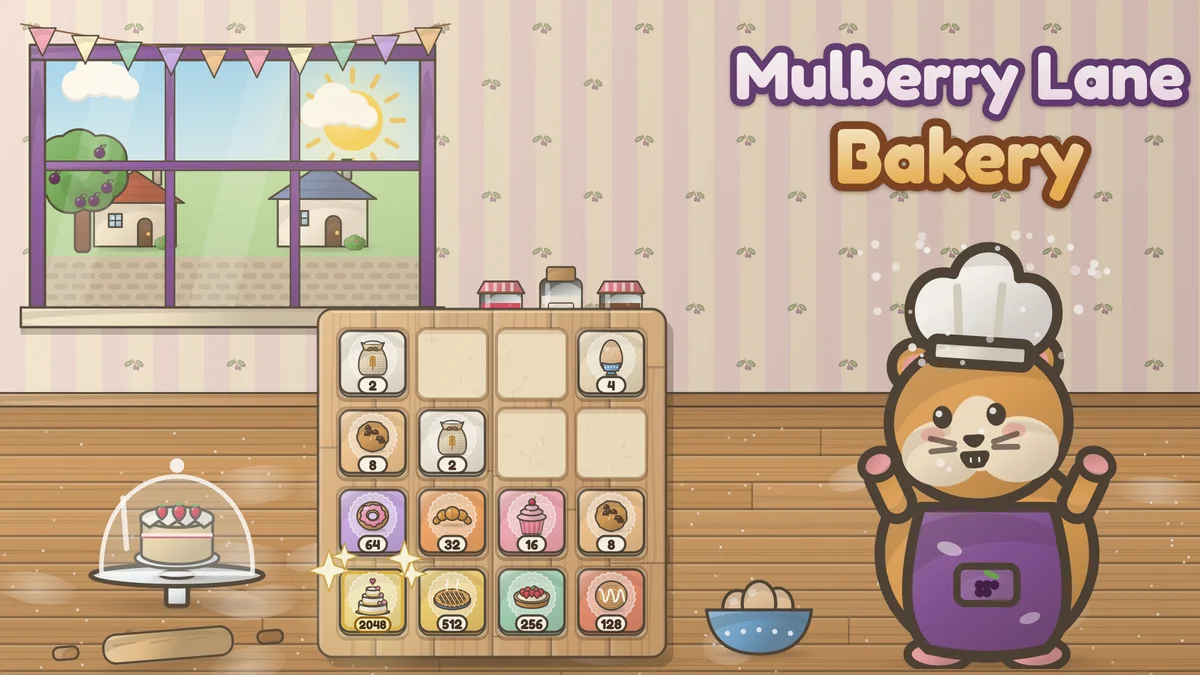
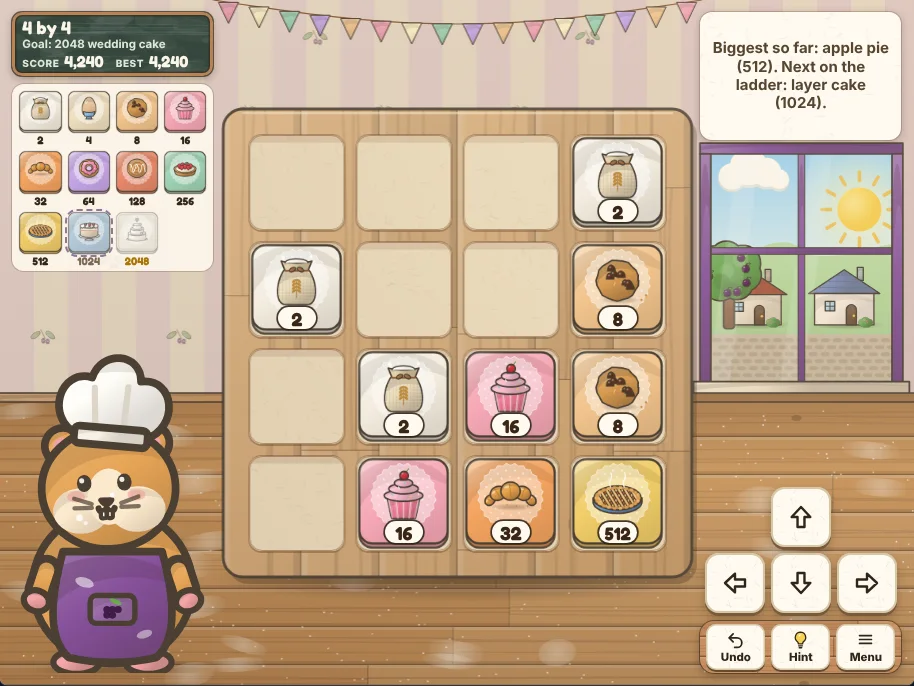
In Mulberry Lane Bakery every number is also a baked good, from a sack of flour up to a three-tier wedding cake, and the number stays on every tile so you never have to learn the pictures to play.
| Tile | Bake |
|---|---|
| 2 | Sack of flour |
| 4 | Egg |
| 8 | Cookie |
| 16 | Cupcake |
| 32 | Croissant |
| 64 | Donut |
| 128 | Cinnamon roll |
| 256 | Strawberry tart |
| 512 | Apple pie |
| 1024 | Layer cake |
| 2048 | Wedding cake (the goal) |
| 4096 | Gingerbread house |
| 8192 | Cream puff tower |
| 16384 and up | Golden showpiece |
How a move works
Choose a direction: up, down, left or right. Every tile on the board slides that way as far as it can, until it reaches the edge or another tile. You cannot move one tile on its own; the whole board moves together.
When two tiles with the same number meet, they merge into one tile worth their sum, in the square nearer the edge you slid toward. Two 2s make a 4, two 4s make an 8, two 1024s make 2048.
Each tile merges at most once per move. A tile made by a merge cannot merge again in the same move, even if a matching tile slides up behind it. When three equal tiles sit in a line, the two nearest the edge you slide toward merge, and the third slides up next to the new tile.
If a direction would not slide or merge anything, it is not a move: nothing happens and no new tile appears. After every move that does change the board, one new tile, a 2 or a 4, appears in a random empty square.
| Row before | Row after | Points | Why |
|---|---|---|---|
| 2, 2, –, – | 4, –, –, – | 4 | The two 2s merge into a 4 |
| 2, –, 2, 4 | 4, 4, –, – | 4 | The 2s meet across the gap, and the new 4 does not merge again this move |
| 2, 2, 2, – | 4, 2, –, – | 4 | Of three in a row, the two nearest the left edge merge |
| 2, 2, 2, 2 | 4, 4, –, – | 8 | Two pairs, two merges |
| 4, 4, 8, – | 8, 8, –, – | 8 | The new 8 cannot join the old 8 until the next move |
| 8, 8, 8, 8 | 16, 16, –, – | 32 | Two merges, worth 16 each |
| 2, 4, 2, 4 | 2, 4, 2, 4 | 0 | Nothing can slide or merge, so this row does not move |
Scoring
Your score starts at 0. Every merge adds the number on the tile it makes: merging two 2s adds 4, merging two 512s adds 1024. Sliding without merging adds nothing, and a move with several merges adds them all.
Big tiles are worth more than their face value along the way, because every smaller tile inside them was a merge too. A 2048 tile built only from 2s has earned 20,480 points by the time it appears: 2,048 for each of the ten steps from 4 to 2048. New tiles that arrive as a 4 skip a step, so the real figure is a little lower.
Mulberry Lane Bakery keeps your best score for each board size, along with your biggest bake, how many games you played and how many reached the goal.
Winning, keeping going and the end of a game
You win when a 2048 tile appears on the board. In the original, a message offers you the choice to keep going, and you can play on for a higher score and bigger tiles: 4096, 8192 and beyond.
The game ends when you have no move left: every square is full and no two tiles with the same number sit side by side, across or up and down. Your score at that moment is your final score. A full board is not over by itself; as long as one pair can merge, you still have a move.
In Mulberry Lane Bakery, making the wedding cake brings up a card with Keep going and New game. When no move is left, the game shows your score and biggest bake, and if undo is on, you can take back the last move and try another way.
Controls in Mulberry Lane Bakery
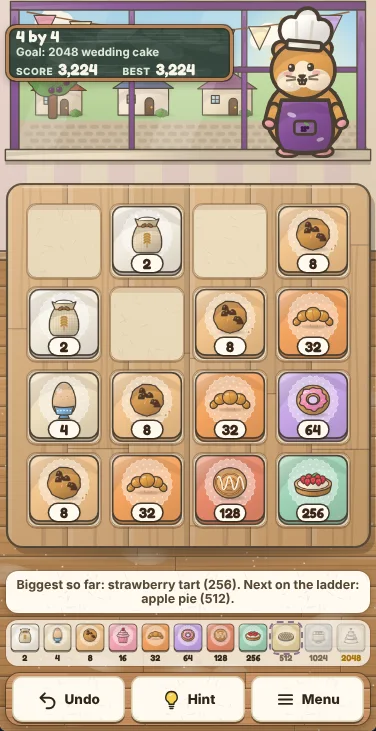
On a phone or tablet, swipe anywhere in the bakery. The page does not scroll while you swipe, and Undo, Hint and Menu sit on a shelf at the bottom of the screen, under your thumb. Arrow buttons can be turned on in Settings, and on a wide screen they sit beside the board.
With a mouse, drag the way you want the tiles to go, or click the arrow buttons. On a keyboard, the arrow keys or W, A, S and D slide the tiles, U undoes, H shows a hint, and Escape closes a menu or clears the hint.
Undo takes back one move, and you can turn it off in Settings for the classic challenge. New tiles never change: every tile comes from a seed saved with your game, so a reload brings back the same board, and making the same move after an undo brings the same new tile in the same square.
The hint uses only what is on the board. It tries each direction and every new tile that could follow, a few moves ahead, and points to the move that keeps the board roomiest and most orderly, in the way the open source 2048 player by Robert Xiao scores a board. Besides the classic board there is a daily 4 by 4 board that gives everyone the same start, a tight 3 by 3 board whose goal is the 256 strawberry tart and a roomy 5 by 5 whose goal is the 4096 gingerbread house.
The corner strategy
The best-known 2048 strategy is to keep your largest tile in one corner, with other large tiles filling the row beside it, and never to let a big tile separate small tiles from each other. Here is how that works in practice.
Pick a corner, say the bottom left. Then slide mostly toward the two edges that meet there, down and left. Each time you press down or left, the big tiles settle toward the corner, and the empty squares, where new tiles appear, gather up and to the right, away from them.
Use right only when down and left do nothing, and up only when nothing else moves. Before you press right, check the bottom row: if it is full and no two tiles in it match, it cannot move, so your corner tile stays put. Before you press up, check the left column the same way. Whenever you can, fill the bottom row before you need to press right.
Keep the bottom row in order, biggest in the corner and smaller ones beside it, like 256, 128, 64 and 32. Then one merge can feed the next all the way into the corner: a new 32 joins the 32, the 64 it makes joins the 64, and so on. When the bottom row is full, build the row above it in the opposite direction, from right to left, so the chain snakes back toward the corner.
How far simple strategies get
To see how much a strategy matters, we ran our own simulation of simple computer players on the 4 by 4 board, with the same rules and new tiles as Mulberry Lane Bakery and the same 10,000 starting seeds for each player. Every player kept going after 2048 until no move was left. Random picks any move that changes the board. Circle presses up, right, down and left in turn. Corner presses down whenever that moves, otherwise left, then right, and up only when nothing else moves. Greedy takes whichever move scores the most points right now, with ties broken in the corner order.
A fixed habit is not enough. The corner habit averaged more than twice the score of random moves, but it made a 512 in only 4.5 percent of games, and no simple habit ever made a 2048. Simply circling the four directions reached 256 a little more often than the corner habit did. Taking the biggest merge every time did better than either. The game’s own hint, which looks a few moves ahead, did far better again: playing the first 100 of the same seeds until it made the 2048 or ran out of moves, it made the 2048 in all 100 of them.
The lesson is that the corner is only the frame. The thinking is in choosing between the safe moves: which one merges, which one keeps squares free, and which one keeps the edge in order. These are computer players, not people, so treat the numbers as a guide to how much each idea helps.
| Player | Average score | Reached 256 | Reached 512 | Reached 1024 | Reached 2048 |
|---|---|---|---|---|---|
| Random | 1,083 | 7.0% | 1 game | Never | Never |
| Circle | 2,298 | 56.6% | 5.8% | Never | Never |
| Corner | 2,557 | 51.8% | 4.5% | 2 games | Never |
| Greedy | 3,031 | 59.1% | 12.7% | 4 games | Never |
The 3 by 3 and 5 by 5 boards
The rules are the same on every board size, but the room you have changes everything. On a 3 by 3 board there are only nine squares, so the board fills almost at once, and Mulberry Lane Bakery sets the goal at the 256 strawberry tart. In our simulation of 10,000 games, no simple habit ever made it: the best got to 128 in fewer than 2 games in 100. The hint, which looks further ahead on the small board, made the 256 in 935 of 1,000 games, so the small board rewards careful thought more than any other.
On a 5 by 5 board there are 25 squares and plenty of room, so the goal is the 4096 gingerbread house. Here even simple habits go far, and the plain circle through up, right, down and left did best of the four simple players, making the 4096 in 30.8 percent of 10,000 games. With so much room, keeping every direction in play seems to matter more than guarding a corner.
| Board and player | Average score | Reached 128 | Reached the goal |
|---|---|---|---|
| 3 by 3, random | 179 | 2 games | Never (goal 256) |
| 3 by 3, circle | 201 | 5 games | Never (goal 256) |
| 3 by 3, corner | 333 | 0.7% | Never (goal 256) |
| 3 by 3, greedy | 342 | 1.8% | Never (goal 256) |
| 3 by 3, hint | 3,564 | 99.9% | 93.5% (goal 256) |
| 5 by 5, random | 7,803 | 99.9% | Never (goal 4096) |
| 5 by 5, circle | 40,125 | 100% | 30.8% (goal 4096) |
| 5 by 5, corner | 13,442 | 100% | 0.1% (goal 4096) |
| 5 by 5, greedy | 24,619 | 100% | 2.6% (goal 4096) |
Common mistakes
Pressing the fourth direction too soon. One press up with a gap in the corner column can lift your biggest tile out of the corner, and a new 2 may drop into the square it left. Press up only when nothing else moves, and check the column first.
Chasing merges all over the board. A merge in the far corner can feel like progress while it pulls tiles away from your edge. Prefer the merge that keeps your big tiles together, even if it scores less right now.
Trapping a small tile. When a 2 or a 4 gets stuck between two big tiles in your bottom row, the chain into the corner breaks until it grows to match its neighbors. Fill gaps in the bottom row before they get a stray tile, and slide toward the corner to close them.
Moving too fast. Nothing in 2048 is timed. Swiping quickly in the same pattern is how a board fills up without your noticing. Slow down whenever only a few squares are free.
Tips for higher scores
Watch the free squares. With two or fewer left, look for any merge first, so the next new tile has somewhere to go.
Remember that a 4 can arrive. One new tile in ten is a 4, and it can land in the one square you were saving for a 2.
Grow the tile next to your corner. To double the tile in the corner you need a match right beside it, so the second square of your edge is the one to build up next.
Use undo and the hint to learn. In Mulberry Lane Bakery the same move always brings the same new tile, so you can try the hint’s move against your own and compare them fairly. Then turn undo off in Settings when you want the classic challenge.
Related games
If you enjoy the steady planning of 2048, try Sprout Sudoku for numbers you work out by logic, or Meadowlark Barn Shut the Box for numbers with a roll of the dice. For merging with real bounce, Watermelon Picnic drops fruit into a picnic basket and Cat Cafe Drop drops cats and treats into a jar. The links below lead to each game and to more of our guides.
Keep baking
2048 comes down to one habit and one skill. The habit: keep your biggest tile in a corner, keep the edge it sits on full and in order, and press the fourth direction only when you must. The skill: among the moves that keep the corner safe, pick the one that leaves the most room and the tidiest edge. Start a game of Mulberry Lane Bakery, try the 3 by 3 board for a quick practice game, and use the hint and undo to compare your moves with one that looks ahead. For more classic games, try Sprout Sudoku, with hints that explain the next step, or Meadowlark Barn Shut the Box, our dice game against Posy the goat. For merging with a bounce, Watermelon Picnic and Cat Cafe Drop drop fruit and cats into a basket and a jar.
- Play Mulberry Lane Bakery, our free 2048 game
- Mulberry Lane Bakery: features, controls and FAQ
- Sprout Sudoku: classic 9x9 puzzles with helpful hints
- Meadowlark Barn Shut the Box: the classic dice game
- Watermelon Picnic: drop and merge fruit up to a watermelon
- Cat Cafe Drop: a cat cafe merge puzzle
- How to play sudoku: rules, techniques and hints
- How to play Shut the Box: rules and strategy
- The best cozy puzzle games
- The best cozy baking games
More guides and roundups
Four in a Row is the two-player game of dropping discs into an upright rack and lining up four. Here is how to set up, how a turn works, how a game is won or drawn, what the solved game says about going first, how strong each level of our computer opponent is, and the strategy that wins more games: the middle column, threats and blocks, and odd and even rows.
How to Play Dots and Boxes: Rules and StrategyDots and boxes is the pencil-and-paper game of joining dots and claiming boxes. Here are the rules, board sizes and extra turns, then the strategy that wins: safe lines, chains, leaving the last two boxes and the long chain rule, with how strong each level of our computer opponent is.
How to Play Farkle: Rules, Scoring and StrategyFarkle is the six-dice game where you set aside dice that score and decide, throw after throw, whether to bank your points or push on. Here are the rules, the full scoring chart, hot dice and the final round, the common house rules, and strategy with the chances worked out exactly.
How to Play Backgammon: Rules, Setup and StrategyBackgammon is the two-player race game of checkers, dice and the doubling cube. Here is how to set up the board, how the opening roll and moving work, the rule for using both dice, hitting and entering from the bar, bearing off, gammons and backgammons, the cube and the Crawford rule, how strong each level of our computer opponent is, and the basic strategy, common mistakes and tips that win more games.