Cozy Puzzle
Hollyhock Math Path
A turn-based number puzzle with every route in view: 124 trails in three sets, from short hand-made lessons to ten-hedge Ridge climbs with flip gates, a new path every day, peeks, unlimited undo and no timer.
What you do
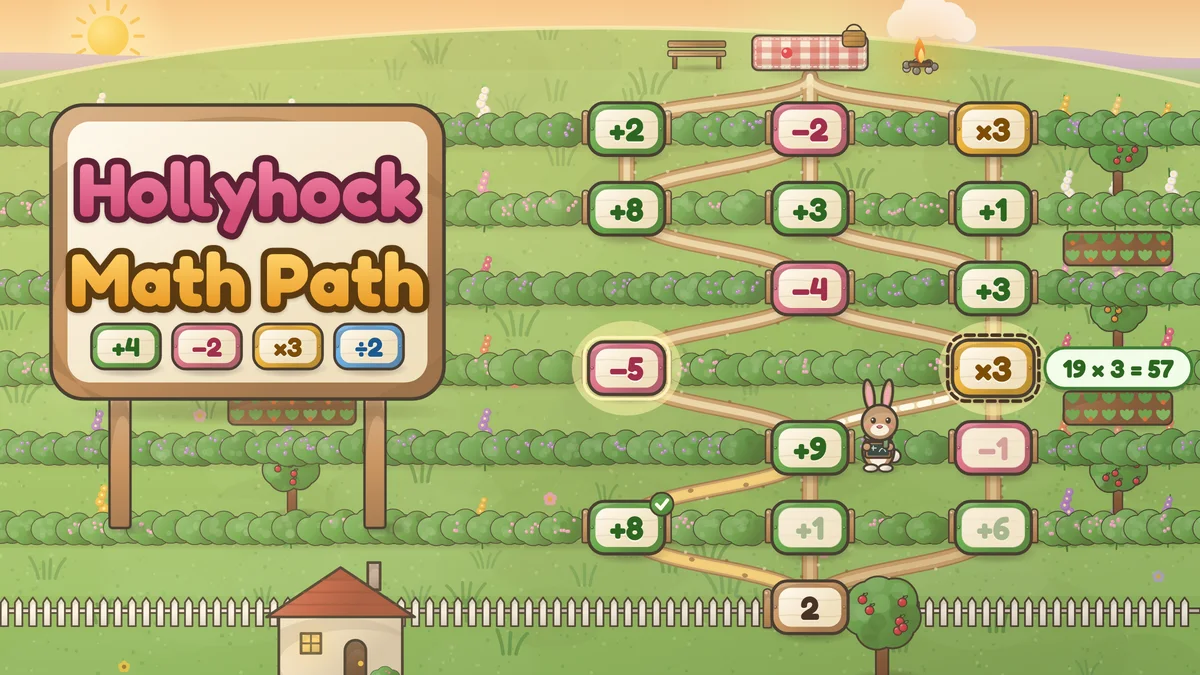
Hollyhock Math Path is a number puzzle you walk. At the foot of Hollyhock Hill a cottage garden gate shows a starting number, and above it rise hedgerow after hedgerow, each with two to four garden gates. Every gate carries a painted sign: +5, −3, ×2, ÷3 and, on the hardest trails, flip gates such as ×−2 that multiply by a number below zero. Tally, a young rabbit in a sage scarf, carries a chalk slate up the hill, and each gate she passes through changes the number on it. The paths between the hedges fork and rejoin, so the order of the signs is yours to choose, and the whole hillside is in view from the first step. The goal is the biggest number at the hilltop picnic: three leaves for the best number possible, two for beating or tying at least 90% of all the routes up the hill, and one for reaching the top. The trick is that the biggest number right now is rarely the road to the biggest number at the top. Adding before a times gate doubles what you added, dividing before you add keeps the addition whole, and on the Ridge a number below zero can turn into a big positive one at a flip gate. Every seeded trail is checked so that grabbing the biggest number at each gate falls short.
- 124 trails in three sets, all open from the start: Meadow (six hedgerows, three lanes, plus, minus and times), Orchard (eight hedgerows, four lanes, and divide gates that drop the remainder) and Ridge (ten hedgerows, numbers below zero and flip gates).
- Four short teaching trails, one idea each, coached one line at a time: add before you double, a small step back, halves drop the remainder, and two minuses make a plus.
- Today's path: a new trail every day, the same for everyone on the same date, Meadow size on Monday and Tuesday, Orchard size Wednesday to Friday and Ridge size on the weekend, with a daily streak and a gold mark for a best-number finish with no help.
- Leaves worked out exactly: the game counts every route up the hill, so it knows the best number possible and how many routes your number beat or tied.
- Sum bubbles that show each gate's sum before you step through (12 × 3 = 36), unlimited undo, a restart that undo can take back, and Peek, which marks the best next gate from wherever you stand.
- Your best number, leaves and no-help mark for every trail save in this browser, along with any walk in progress, and Undo or Restart never touch them.
How to play
- Press Start the first trail on the title card. The first Meadow trail is a short lesson that explains the moves one line at a time above the hill.
- Tally starts at the cottage gate with the number on its sign. Above her, every hedgerow has two to four garden gates, and the paths show which gates lead to which.
- The gates you can reach next glow. Tap one to see its sum in a bubble, then tap it again, or press Walk, to go through. The number on the slate changes, and the next hedgerow's gates light up.
- Signs add (+), subtract (−), multiply (×) or divide (÷). Division drops any remainder toward zero, so 7 ÷ 2 = 3 and −7 ÷ 2 = −3. On the Ridge, flip gates multiply by a number below zero: −4 × −2 = 8.
- Pass through one gate in every hedgerow to reach the hilltop. Three leaves for the best number possible, two for beating or tying at least 90% of all routes, one for reaching the top.
- At the top you can show the best route in gold, walk the trail again or go on to the next one. Undo works there too, so you can step back and try a different last gate.
Controls
- Touch: tap a glowing gate to see its sum, and tap it again (or press Walk) to walk through. The Trails, Undo, Peek and Walk buttons sit in a row under the hill, and every gate you can tap is at least 44 pixels across.
- Mouse: click a glowing gate to choose it and click it again to walk. The buttons under the hill (or beside it on a wide screen) do the rest.
- Keyboard: Left and Right (or 1 to 4) choose a gate, Enter or Space walks through it, Z or Backspace undoes, H peeks, and Escape closes the trails list. Every button is reachable with Tab.
- Toolbar: pause, help, restart (takes Tally back to the cottage gate, and Undo brings the walk back; leaves and best numbers are never touched), optional sound and fullscreen.
Tips worth knowing
- Add before you multiply. A +4 gate followed by ×3 gives you 12 extra, but ×3 followed by +4 gives you only 4 extra.
- Subtract after you multiply, not before: ×3 then −2 costs 2, while −2 then ×3 costs 6.
- Divide before you add. x ÷ 2 + 6 keeps the whole 6, while (x + 6) ÷ 2 halves it, so a divide gate early in the walk usually costs less than one late.
- On the Ridge, a big number below zero is not a disaster if a flip gate lies ahead: −30 at a ×−2 gate becomes 60. A divide gate pulls a number below zero back toward zero, which helps when no flip gate is coming.
- Read the hill from the top down. The last hedgerow's best gate tells you which gate you want in the row before it, and so on back to the cottage.
Accessibility
- Everything can be played with a keyboard: Left and Right or 1 to 4 choose a gate, Enter or Space walks through it, Z or Backspace undoes and H peeks.
- Every step is announced for screen readers, for example "Through the times 3 gate: 12 times 3 is 36", and each gate you can reach next is a button named for its sign and its sum.
- Each sign has its own color and its own symbol (green plus, rose minus, honey gold times, sky blue divide and plum flip), and the numbers on the signs are at least 16 pixels tall on a phone, so nothing depends on color alone.
- Nothing is timed, and nothing is lost to a wrong turn: Undo steps back as far as you like, and your records only ever go up.
- Reduced motion moves Tally straight to each gate and keeps the leaves and sparkles few and nearly still. A speed setting slows or quickens her walk, and sound is optional and never needed to play.
Questions
What is a math path puzzle?
It is a number puzzle laid out as a map of routes. You start with a number, and every gate along the way changes it by adding, subtracting, multiplying or dividing. Because the routes fork and rejoin, you choose the order the signs come in, and the order decides the result: (3 + 2) × 2 is 10, but 3 × 2 + 2 is 8. The aim is the biggest number at the end, and the whole map is in view, so it rewards planning ahead rather than speed.
How is this different from math runner games?
In a math runner game the gates rush toward you and you have a moment to pick a side. Hollyhock Math Path keeps the same idea of number gates but takes the clock away: nothing moves until you choose, every gate on the hill is in view, sums show before you step through, and Undo takes back as many steps as you like. It is a puzzle to think through, not a reflex test.
How are leaves earned?
The game counts every route from the cottage gate to the hilltop, from 10 to 20 on a seeded Meadow trail up to 200 on a Ridge-size path. Bring the best number possible to the top for three leaves. If your number beats or ties at least 90% of all routes, you earn two leaves, and reaching the top at all earns one. Your best number and leaves for each trail are kept, so walking a trail again can only raise them.
How does division work?
Division drops the remainder and rounds toward zero, the way whole-number division works on a calculator that has no decimals. 9 ÷ 2 = 4, 15 ÷ 2 = 7, and on the Ridge −7 ÷ 2 = −3. The first Orchard trail is a short lesson on it.
Can every trail reach the best number, and how hard are they?
Every trail has at least one route to its best number, and the game checks each one exactly. The trails are seeded and then filtered: one is kept only when always taking the biggest number right now falls short of the best by at least 3 and by at least 15% of the best, when no more than two routes reach the best, when the next best number still earns two leaves, and when every number stays between −999 and 9,999. In our simulation of the 40 seeded trails in each set, a player who looks two gates ahead finds the best number on 67.5% of Meadow trails, 52.5% of Orchard trails and 25% of Ridge trails, and one who looks three gates ahead on 80%, 77.5% and 32.5%.
What does the game save?
On this device: any walk in progress on each trail (the gates taken and the peeks used), your best number, leaves and no-help mark for every trail you have finished, today's path and your daily streak, and your settings. It saves after every step, and there is no account.