Cozy Classic
Sprout Killer Sudoku
Killer sudoku with hints that teach: every row, column and box holds 1 to 9, and the digits in each dotted cage add up to its sum.
What you do
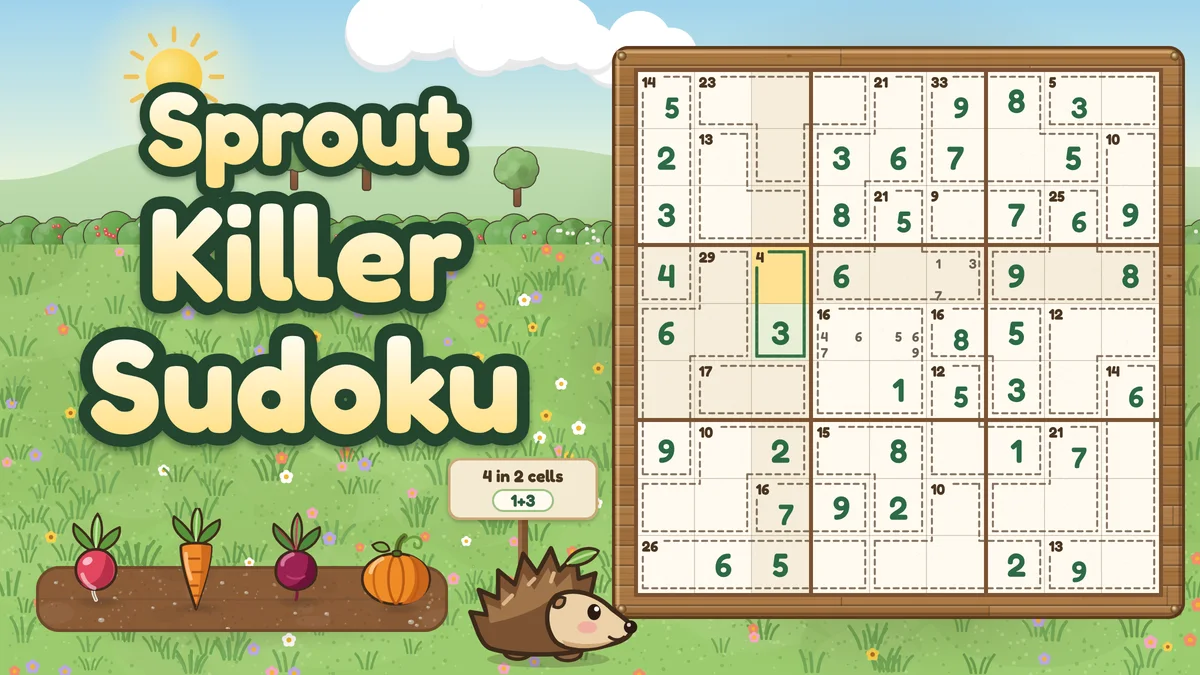
A cozy killer sudoku game with the classic rules. The grid is split into dotted cages, each with a small sum in its corner: the digits in a cage must add up to that sum and may not repeat, and every row, column and 3x3 box still holds 1 to 9 once each. There are 480 puzzles, 120 at each of four levels, and every one has exactly one solution that you can reach by logic alone. The level says which techniques you need: Easy puzzles fall to cage combinations and singles and start with a few digits already in place (2 to 8 of them), Medium adds the 45 rule in one row, column or box and the ways cages and lines narrow each other, Hard needs the 45 rule across two or more rows or columns at once, and Expert needs innie and outie differences, where a cage pokes out of a row, column or box. Medium, Hard and Expert puzzles have no given digits, only cages. Select any cell and the cage sign shows every combination of digits its cage could hold, with the ones the board has ruled out struck through. Stuck? The Hint button finds the easiest next step on your board and explains it in a sentence. Each solved puzzle grows a vegetable in Conker the hedgehog’s patch, a different vegetable for each level, and a new Medium killer sudoku comes up every day. There are no lives, no mistake limits and no streaks. Your puzzles and patch save on this device.
How to play
- Pick a level on the menu and press New puzzle (or Continue), or play today’s puzzle, a Medium killer sudoku that changes every day.
- Fill the grid so every row, every column and every 3x3 box holds the digits 1 to 9 once each.
- The dotted outlines are cages. The digits in a cage add up to the small number in its top-left corner, and a digit never repeats inside a cage.
- Select a cell, then press a digit on the number pad. The sign above the grid lists every combination of digits the selected cell’s cage can be; combinations the board has ruled out are struck through.
- Turn on Notes to pencil in small candidates instead. Auto fills every empty cell with the digits its row, column, box and cage sum still allow.
- A digit that repeats in a row, column, box or cage is always marked, and so is a cage whose digits do not add up. Turn on Check against the solution in the menu to also mark digits that do not match the solution.
- Hint explains the next logical step and highlights the cells involved; press it again to do that step. Each solved puzzle grows a vegetable in the patch.
Controls
- Keyboard: arrow keys move, 1 to 9 place a digit (Shift with a digit writes a note), Backspace, Delete or 0 erase, N switches notes, Z undoes, Y redoes, H gives a hint and C reads out the selected cage’s combinations. Escape closes a hint or the patch.
- Touch or mouse: tap a cell, then a digit key. Erase is on the number pad, and Undo, Redo, Notes, Auto notes and Hint are in the row of tools.
- Toolbar: pause, help, restart (starts the puzzle on the board over; your patch and records stay), optional sound and fullscreen.
Tips worth knowing
- Start with cages that have only one combination, such as 3 in two cells (1+2) or 24 in three cells (7+8+9). Their digits are fixed even if their order is not.
- Use the 45 rule: every row, column and box adds up to 45. Subtract the cages that sit wholly inside one, and what is left over tells you the sum of the cells that stick out or poke in.
- Look for a cage that sits wholly inside a row, column or box. The digits it must hold cannot appear anywhere else in that line or box.
- Pencil in notes once the easy cages are done. Auto notes counts the cage sums, so it shows more than a plain sudoku would.
- Solve one puzzle at each level to grow every kind of vegetable: Easy grows radishes, Medium carrots, Hard beets and Expert pumpkins.
Accessibility
- Everything can be played with a keyboard: arrow keys move around the grid, 1 to 9 place digits, C reads the selected cage’s combinations aloud, and every button is reachable with Tab.
- There is no time pressure. The timer only records how long a puzzle took, and it stops whenever the game is paused or hidden.
- Digits are large on a high-contrast grid with thick box lines. Every cell has a spoken label with its cage’s sum and size. Conflicts and checked mistakes are shown with color and an underline or dot, not color alone.
- Hints are written in plain words and announced to screen readers along with each placement.
- Reduced motion skips the harvest animation, Conker’s hops and the card transitions. Sound is optional and never needed to play.
Questions
What is killer sudoku?
Sudoku with sums instead of given digits. The grid is divided into cages, each with a total; the digits in a cage add up to its total and do not repeat, and the usual sudoku rules still apply to every row, column and box.
How do hints work?
The first press names the easiest next step on your board, such as Cage combinations or The 45 rule, works through the sums in a sentence, rings the cells involved and shades the cage, row, column or box it is about. Press Hint again and the game takes that step: it places the digit, or updates the notes when the step rules digits out. A digit that repeats, breaks a cage or does not match the solution is pointed out first. Each new hint counts toward the puzzle’s record.
What does Sprout Killer Sudoku save?
On this device: the puzzle in progress at each level and today’s puzzle (every digit and note, time and hints), your vegetable patch, how many puzzles you have solved, best times and settings. Undo history lasts until you leave the page. Restart in the toolbar starts the current puzzle over and never touches your patch.