
CozyWorld game guide · By CozyWorld
This guide covers our own game, written from the current game rules and browser checks.
How to Play Killer Sudoku: Rules, Cages and Tips
How to play killer sudoku, from the rules and your first cages to the 45 rule, tables of cage combinations, what Easy to Expert mean and the mistakes that trip people up, with Sprout Killer Sudoku’s cage sign and hints.
To play killer sudoku, fill a 9x9 grid so that every row, every column and every 3x3 box holds the digits 1 to 9 once each, and so that the digits in each dotted cage add up to the small number in its corner, with no digit repeated inside a cage. Most killer sudoku puzzles start with no digits at all: the cages and their sums are the only clues. Sprout Killer Sudoku is our cozy killer sudoku game, set in Conker the hedgehog’s vegetable garden. It has 480 puzzles, 120 at each of four levels from Easy to Expert, and every one has exactly one solution that you can reach by logic alone. This guide covers the rules, the cage combinations worth knowing (with tables), how to start a puzzle, the 45 rule with a worked example from one of our puzzles, what the levels mean and the mistakes that most often go wrong.
The rules
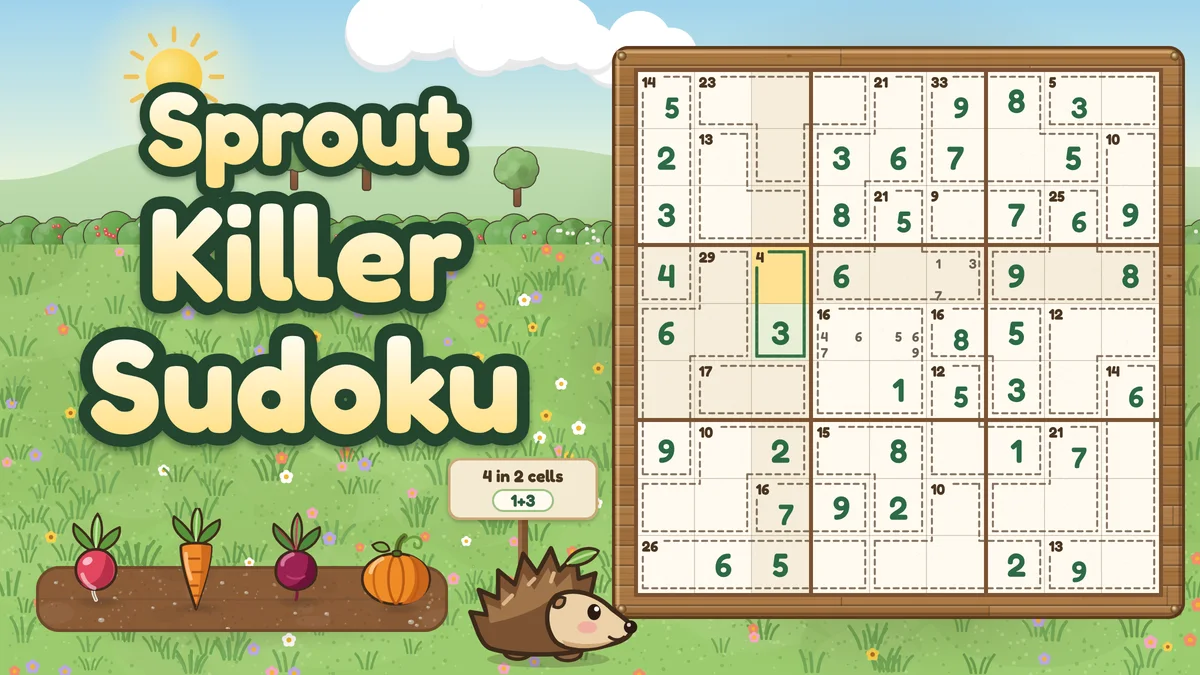
Killer sudoku keeps every rule of sudoku: each row, each column and each 3x3 box holds the digits 1 to 9 once. On top of that, the grid is split into cages, groups of cells drawn with a dotted outline. The small number in a cage’s first cell is its sum. The digits in the cage must add up to that sum, and a digit may not repeat inside a cage, even when the cage crosses from one box into the next. Every cell belongs to exactly one cage, so the sums of all the cages always add up to 405, nine times 45.
Killer sudoku is also called sum sudoku or sumdoku, and it is often described as sudoku crossed with kakuro, the sum-based crossword puzzle. Classic killer sudoku has no given digits. In Sprout Killer Sudoku, Medium, Hard and Expert puzzles follow that rule, while Easy puzzles start with a few digits already placed (2 to 8 of them) so a first puzzle has somewhere to begin.
The game always marks a digit that repeats in its row, column, box or cage, and a full cage whose digits do not add up to its sum, because those break the rules whatever the solution is. It does not tell you when a digit is merely wrong unless you ask: turn on Check against the solution in the menu and any digit that does not match the solution turns red. The check is off by default.
Cage combinations: the sums worth knowing
Most of killer sudoku is knowing which digits can make a sum. Two different digits can make any sum from 3 (1+2) to 17 (8+9), and a sum at either end has only one way to be made. A two-cell cage of 3 must be 1 and 2, and one of 17 must be 8 and 9, so those digits are fixed even before you know their order. The middle sums are looser: a two-cell 10 can be 1+9, 2+8, 3+7 or 4+6, but never 5+5, because a digit cannot repeat in a cage. Here is every two-cell cage.
| Sum | Combinations |
|---|---|
| 3 | 1+2 |
| 4 | 1+3 |
| 5 | 1+4, 2+3 |
| 6 | 1+5, 2+4 |
| 7 | 1+6, 2+5, 3+4 |
| 8 | 1+7, 2+6, 3+5 |
| 9 | 1+8, 2+7, 3+6, 4+5 |
| 10 | 1+9, 2+8, 3+7, 4+6 |
| 11 | 2+9, 3+8, 4+7, 5+6 |
| 12 | 3+9, 4+8, 5+7 |
| 13 | 4+9, 5+8, 6+7 |
| 14 | 5+9, 6+8 |
| 15 | 6+9, 7+8 |
| 16 | 7+9 |
| 17 | 8+9 |
Three-cell cages
Three cells can make any sum from 6 (1+2+3) to 24 (7+8+9). Again the ends are fixed and the middle is wide open: a three-cell 15 has eight combinations. Even a loose cage helps, though. A three-cell 8 has to hold a 1 (it can only be 1+2+5 or 1+3+4), and a three-cell 22 has to hold a 9, so those digits are pinned to the cage even while the other two are not.
| Sum | Combinations |
|---|---|
| 6 | 1+2+3 |
| 7 | 1+2+4 |
| 8 | 1+2+5, 1+3+4 |
| 9 | 1+2+6, 1+3+5, 2+3+4 |
| 10 | 1+2+7, 1+3+6, 1+4+5, 2+3+5 |
| 11 | 1+2+8, 1+3+7, 1+4+6, 2+3+6, 2+4+5 |
| 12 | 1+2+9, 1+3+8, 1+4+7, 1+5+6, 2+3+7, 2+4+6, 3+4+5 |
| 13 | 1+3+9, 1+4+8, 1+5+7, 2+3+8, 2+4+7, 2+5+6, 3+4+6 |
| 14 | 1+4+9, 1+5+8, 1+6+7, 2+3+9, 2+4+8, 2+5+7, 3+4+7, 3+5+6 |
| 15 | 1+5+9, 1+6+8, 2+4+9, 2+5+8, 2+6+7, 3+4+8, 3+5+7, 4+5+6 |
| 16 | 1+6+9, 1+7+8, 2+5+9, 2+6+8, 3+4+9, 3+5+8, 3+6+7, 4+5+7 |
| 17 | 1+7+9, 2+6+9, 2+7+8, 3+5+9, 3+6+8, 4+5+8, 4+6+7 |
| 18 | 1+8+9, 2+7+9, 3+6+9, 3+7+8, 4+5+9, 4+6+8, 5+6+7 |
| 19 | 2+8+9, 3+7+9, 4+6+9, 4+7+8, 5+6+8 |
| 20 | 3+8+9, 4+7+9, 5+6+9, 5+7+8 |
| 21 | 4+8+9, 5+7+9, 6+7+8 |
| 22 | 5+8+9, 6+7+9 |
| 23 | 6+8+9 |
| 24 | 7+8+9 |
Cages with only one combination
For every cage size, the two smallest and the two largest sums can each be made only one way. These are the cages to look for first. Bigger cages work the same way from the other end: a cage of eight cells holds every digit except 45 minus its sum, and a cage of all nine cells always adds up to 45. In Sprout Killer Sudoku cages have two to five cells (Easy cages have at most four).
You do not have to learn any of this by heart to play. Select a cell and the cage sign next to the grid lists every combination its cage can hold, and strikes through the ones the digits already on the board rule out.
| Cage size | Small sums | Large sums |
|---|---|---|
| 2 cells | 3 = 1+2; 4 = 1+3 | 16 = 7+9; 17 = 8+9 |
| 3 cells | 6 = 1+2+3; 7 = 1+2+4 | 23 = 6+8+9; 24 = 7+8+9 |
| 4 cells | 10 = 1+2+3+4; 11 = 1+2+3+5 | 29 = 5+7+8+9; 30 = 6+7+8+9 |
| 5 cells | 15 = 1+2+3+4+5; 16 = 1+2+3+4+6 | 34 = 4+6+7+8+9; 35 = 5+6+7+8+9 |
Your first killer sudoku: where to start
A well-made killer sudoku has exactly one solution, as every Sprout Killer Sudoku puzzle does, so there is always a next step that logic can prove and you never need to guess. If killer sudoku is new to you, choose Easy on the menu and work through these steps.
First, find the cages with only one combination: two-cell cages of 3, 4, 16 or 17, and three-cell cages of 6, 7, 23 or 24. On Easy puzzles, start with one that touches a given digit, because that digit often settles which cell gets which.
Second, look for a cage that sits wholly inside one row, column or box. The digits it has to hold cannot appear anywhere else in that row, column or box. A two-cell 3 inside the top-left box puts the 1 and the 2 of that box in those two cells, so no other cell in the box can be a 1 or a 2.
Third, use the 45 rule, explained in the next section, on any row, column or box where the cages fit almost exactly.
Fourth, fill in notes. Press Auto and every empty cell gets the digits its row, column, box and cage sum still allow, which shows more than a plain sudoku would. Then look for a cell with one note left, or a digit that fits in only one cell of a row, column, box or cage. If you are still stuck, press Hint once: it names the technique and explains the step without doing it.
The 45 rule, with a worked example
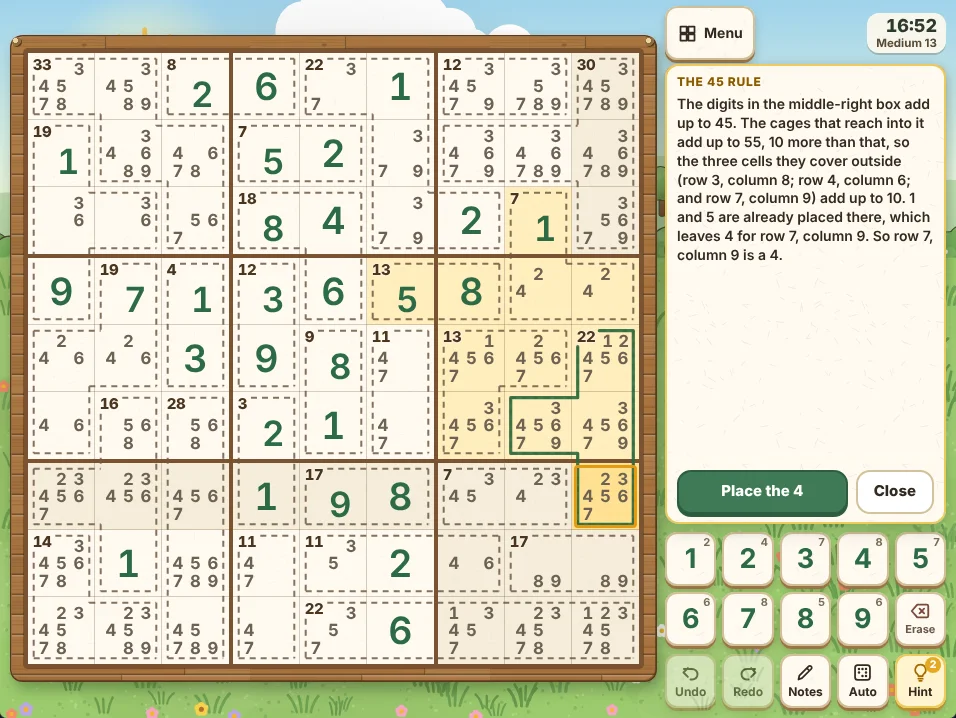
Every row, column and box holds 1 to 9 once, so its digits add up to 45. That simple fact is the strongest tool in killer sudoku. When the cages that sit wholly inside a box add up to less than 45 and only one cell of the box is left over, that cell is the difference. It works the other way too: when a set of cages covers a whole box and one cell outside it, that outside cell is the cages’ total minus 45. Players call the cells left over inside innies and the cells that stick out outies.
Here is a real one: the center box of Medium puzzle 27 in Sprout Killer Sudoku, before a single digit is placed. Three cages sit wholly inside the box: a 19 in three cells, a 15 in two cells and a 10 in three cells. Together they cover eight of the box’s nine cells and add up to 19 + 15 + 10 = 44. The one cell they leave out, row 4, column 6, has to make up the rest of the 45, so it is 45 minus 44, which is 1. That cell is the lower half of a two-cell cage of 9 that reaches up out of the box, so the cell above it, row 3, column 6, is 9 minus 1, which is 8. Two digits are in, from nothing but the sums.
The same idea works on a row or a column, and on two or three neighboring rows or columns at once, which add up to 90 or 135. In Sprout Killer Sudoku the 45 rule on a single row, column or box is a Medium technique, and the Hint button says when it applies: it names the area, adds up the cages inside it for you and says what is left over.
Easy, Medium, Hard and Expert: what the levels mean
Killer sudoku difficulty names are not standardized, and one book’s hard can be another site’s medium, so the name on a puzzle tells you less than the techniques it needs. Every Sprout Killer Sudoku puzzle was graded by solving it with logic alone, always taking the easiest step available, and its level is the hardest technique that solver needed.
Easy puzzles need only cage combinations, naked singles and hidden singles. They start with 2 to 8 digits already placed (5 in a typical puzzle) and have 26 to 34 cages of two to four cells, so there are plenty of small cages with few combinations.
Medium puzzles have no given digits, and every one of the 120 needs the 45 rule on a single row, column or box at least once. Most also use a cage and line step, where a digit a cage must hold is pinned to one row, column or box (the grading solver used one in 87 of the 120), and some use pointing (21).
Hard puzzles need the 45 rule across two or more neighboring rows or columns at once, all 120 of them, as explained below. Pointing and box-line steps turn up along the way, triples are rare (the grading solver used one in 4 of the 120) and none uses an X-wing.
Expert puzzles need innie and outie differences, again all 120 of them. They are not built from exotic patterns: the solver behind the hints knows the X-wing, the XY-wing and the swordfish from classic sudoku, but it used an X-wing in 1 Expert puzzle, an XY-wing in 1 and a swordfish in none. What makes Expert hard is the sums. Harder levels also have fewer, bigger cages: a typical Medium puzzle has 28 cages and a typical Expert puzzle 26.
Today’s puzzle is always a Medium one, which is where most people who already play sudoku will feel at home. You will also see killer sudoku labeled extreme or evil elsewhere. Those names are each publisher’s own; Sprout Killer Sudoku’s hardest level stops at the techniques above, and none of its puzzles needs a guess.
Innies, outies and longer chains
Hard puzzles use the 45 rule on several neighboring rows or columns at once. Two rows add up to 90, so if the cages wholly inside rows 1 and 2 add up to 84, the cells of those rows they leave over add up to 6. When those are two cells in the same row, they can only be 1+5 or 2+4, which already rules out 3, 6, 7, 8 and 9 in both.
Expert puzzles add innie and outie differences. When the cages inside a box, plus one cage that sticks out of it, cover all of the box except one cell, the cell left over inside and the cell sticking out differ by a fixed amount: their difference is the total of those cages minus 45. If that total is exactly 45, the two cells hold the same digit. The Hint button explains each innie and outie step when it is the next one.
Common killer sudoku mistakes
Repeating a digit inside a cage that crosses a box line. The box rule and the cage rule are separate: a cage that spans two boxes still cannot hold the same digit twice. The game marks a repeat in a cage the moment it happens.
Treating a loose cage as fixed. A two-cell 10 is 1+9, 2+8, 3+7 or 4+6, and it is easy to settle on the first pair that comes to mind. Check every combination against the digits already in the cage’s rows, columns and boxes; the cage sign strikes through the ones that no longer fit.
Counting a cage in the 45 rule that is only partly inside the area. Only cages wholly inside a row, column or box can be subtracted from 45. A cage that pokes out has to be handled as an outie, or left out.
Simple arithmetic slips. A 45 rule step adds four or five cage sums, and one wrong total sends you down the wrong path. Add them twice. If a digit you placed from the 45 rule turns out to repeat or breaks a cage, the sum is the first place to look.
How the cage sign and hints work
Conker’s sign next to the grid shows the selected cell’s cage: its sum, how many cells it has and every combination of digits it can hold. Combinations that the digits already on the board rule out are struck through, so as you fill the grid the sign narrows down with you. Press C on a keyboard to have a screen reader read the cage aloud.
Press Hint (or H) and the game looks at your board and finds the easiest next step, trying the techniques from cage combinations and singles upward. The first press names the technique, explains the step in a sentence, rings the cells that make the pattern and shades the rows, columns, boxes or cages it is about. Try it yourself, or press Hint again and the game does it: it places the digit, or for a step that rules candidates out it updates the notes of those cells and says what changed.
If one of your digits does not match the solution, the hint deals with that first, naming the digit and offering to erase it, because logic built on a wrong digit leads nowhere. Each new hint counts toward the puzzle’s record, and the solve card shows your time and how many hints you used. In our automated checks, pressing Hint again and again solved every one of the 480 puzzles from the start without ever having to reveal a digit.
Conker’s patch and today’s puzzle
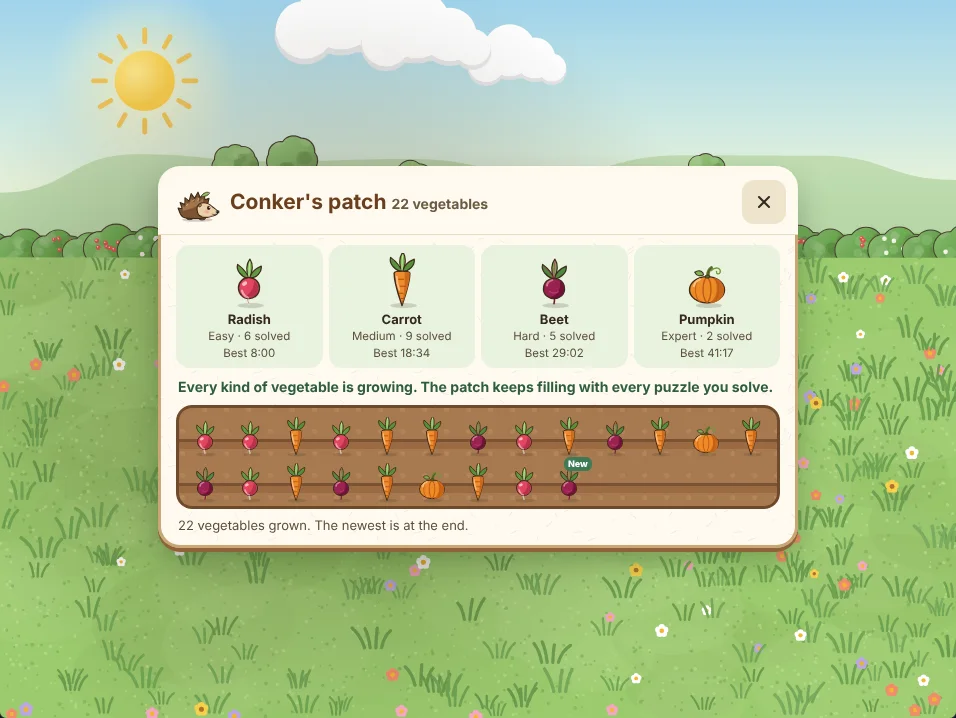
Every puzzle you solve grows a vegetable in Conker the hedgehog’s patch, a different vegetable for each level: a radish for Easy, a carrot for Medium, a beet for Hard and a pumpkin for Expert. The patch shows how many puzzles of each level you have solved and your best times, and draws your newest 60 vegetables in rows of soil, oldest first. Grow one vegetable of every kind and a card celebrates the full patch; after that it simply keeps growing.
Today’s puzzle is one Medium killer sudoku picked by your local date, the same for everyone on that day. It keeps its own record (your first solve of the day) and grows a carrot, but there is no streak to keep. New puzzle on the menu picks the next puzzle of that level you have not solved yet.
Timer, saving and accessibility
The timer is there for your records only. It stops while the game is paused, while the tab is hidden and while a card is open, and there are no lives, no mistake limit and no streaks. Restart in the toolbar starts the puzzle on the board over, clearing its digits, notes, hints and time, and never touches your patch.
Your puzzles save on this device: the one in progress at each level and today’s puzzle, with every digit and note, the time and the hints, plus your patch, best times and settings. Undo history lasts until you leave the page. Everything can be played with a keyboard, every cell has a spoken label with its cage’s sum and size, and reduced motion skips the harvest animation. We checked the game with automated desktop, phone and keyboard browser runs; these are not tests on physical devices or with real players.
Keep growing
Once you have grown one vegetable of each kind, the patch keeps growing with every puzzle you solve, and today’s puzzle brings a new Medium killer sudoku each day. If you would like sudoku without the arithmetic, Sprout Sudoku is the sibling game, with its own guide to every technique from naked singles to the swordfish.
More guides and roundups
Match mahjong tiles, solve sudoku and killer sudoku, stitch a nonogram, find hidden words, fit a jigsaw, rake leaf piles, sort shells, merge fruit or crack firefly codes. Choose a puzzle by the decisions it asks you to make.
Free Online Games for Seniors and Older AdultsFree online games for seniors and older adults: solitaire, mahjong, word search, sudoku, jigsaw and nonograms that open in a browser, with no countdown, no accounts and no purchases. Here is how the seven compare on round length, timers and help.
Word Search for Adults: Cottage Word Search TipsCottage Word Search is a free word search for adults with a saying hidden in every grid. Here is how selection works, what makes a word search easy or hard, how to scan in every direction, where the fall puzzles are and how the four seasonal books grow.
Leaf Pile Nap Guide: Rules, Shapes and HintsThe rules of Leaf Pile Nap, how the animal shapes and the no-touch rule let you solve every garden without guessing, and how blankets, acorns, stars, hints and the daily garden work.