
CozyWorld game guide · By CozyWorld
This guide covers our own game, written from the current game rules and browser checks.
How to Play Make 24: Rules, Hands and Tips
Make 24 is the arithmetic puzzle where four numbers, often dealt from a deck of cards, must be combined with adding, subtracting, multiplying and dividing to make exactly 24. Here are the rules, the card table version, how many hands can be done by our own solver’s exact count, the hardest hands with their answers, and the habits that find 24 fastest.
How do you play Make 24? Four numbers are dealt, often as four playing cards, and you combine them with adding, subtracting, multiplying and dividing to make exactly 24, using every number exactly once. With 1, 2, 3 and 4 you might say 1 × 2 × 3 × 4; with 4, 7, 8 and 8 it takes a little more thought: 8 ÷ 8 is 1, 7 − 1 is 6, and 6 × 4 is 24. Some hands have many answers, some have only one, and some cannot be done at all.
This guide covers the rules, the traditional card table version and its variants from cited sources, and the controls in Bergamot Parlor 24, where you can play Make 24 online free with every hand that can make 24, four new hands a day, a mode for deciding whether a hand can be done, and a solver for any four numbers. Every count of hands and answers here comes from the game’s own solver, which checks every possible way exactly, and is labeled as such.
What is Make 24?
Make 24 is a traditional arithmetic puzzle, also called the 24 puzzle or, as a card game, Twenty-Four. Wikipedia’s article “24 (puzzle)” gives its objective as finding a way to manipulate four integers so that the end result is 24, with all four numbers used exactly once. Its own example is the hand 4, 7, 8 and 8, which makes 24 as (7 − 8 ÷ 8) × 4.
The puzzle is often played with a deck of cards. pagat.com, the card game rules site maintained by John McLeod, lists Twenty-Four as a Chinese game that calls for mental arithmetic. It says the game has been played in Shanghai since at least the 1960s and may have started there, that it is also known in Qingdao and Guangzhou, and that since the end of the 20th century it has spread to some places in North America. Wikipedia likewise says it has been played as a card game in Shanghai since the 1960s.
The rules
The rules fit in one sentence: use all four numbers, each exactly once, with +, −, × and ÷, to make exactly 24. In practice that comes to four points.
Use every number once. A 24 made from three of the four numbers does not count, and no number may be used twice. Combine them with the four operations and as many brackets as you need; (8 − 4) × 6 and 6 × (8 − 4) are the same answer. Fractions and negative numbers along the way are allowed, as long as the end result is exactly 24: 3, 3, 8 and 8 can only make 24 as 8 ÷ (3 − 8 ÷ 3), where 8 ÷ 3 is 8/3, 3 − 8/3 is 1/3, and 8 ÷ 1/3 is 24. Nothing may be divided by 0.
The numbers stay as they are. You cannot put a 1 and a 2 side by side to make 12, and in the basic game there are no powers, roots or factorials. pagat.com notes that some players allow powers, roots or logarithms, but that factorials and approximations are never allowed, and Wikipedia points out that 1, 1, 1 and 1 cannot be done with the basic operations at all.
Some hands have no answer. When a hand cannot make 24, the honest answer is to say so, and many card table versions reward saying so before anyone else does.
Playing with a deck of cards
The traditional version, as pagat.com describes it, uses a standard pack with the picture cards and jokers taken out, leaving 40 cards from ace to 10 in each suit, with the ace counting as 1. Wikipedia describes the same 40-card deck.
In pagat.com’s basic game for two players, each player is dealt 20 cards face down and does not look at them. Both turn up their top two cards at the same time, giving four numbers. The first player to find a way to 24 slaps the table and calls it out; if it is right, the four cards go to the bottom of the other player’s stack, and a wrong answer, or a slap with no answer, means the slapper takes the four cards as a penalty. If neither player can find a way, they may agree that there is none, and each puts one card back under their stack and turns up a new one. The game ends when one player runs out of cards, and that player wins.
pagat.com also gives a four-player version, in which each player turns up one card and anyone with an answer slaps the table silently, and several variants. Some players count the jack, queen and king as 11, 12 and 13, or as 10 each, and some add jokers worth 14 and 15. In one scoring variant for more players, the first to solve a hand scores a point, and if someone calls “no solution” and another player then finds one, the caller scores nothing and the finder scores 2 points. The site also notes that 24 is often reached by pairing numbers, such as 4 × 6, 3 × 8 or 12 × 2, and that 3, 3, 8 and 8 is surprisingly hard.
How to play in Bergamot Parlor 24
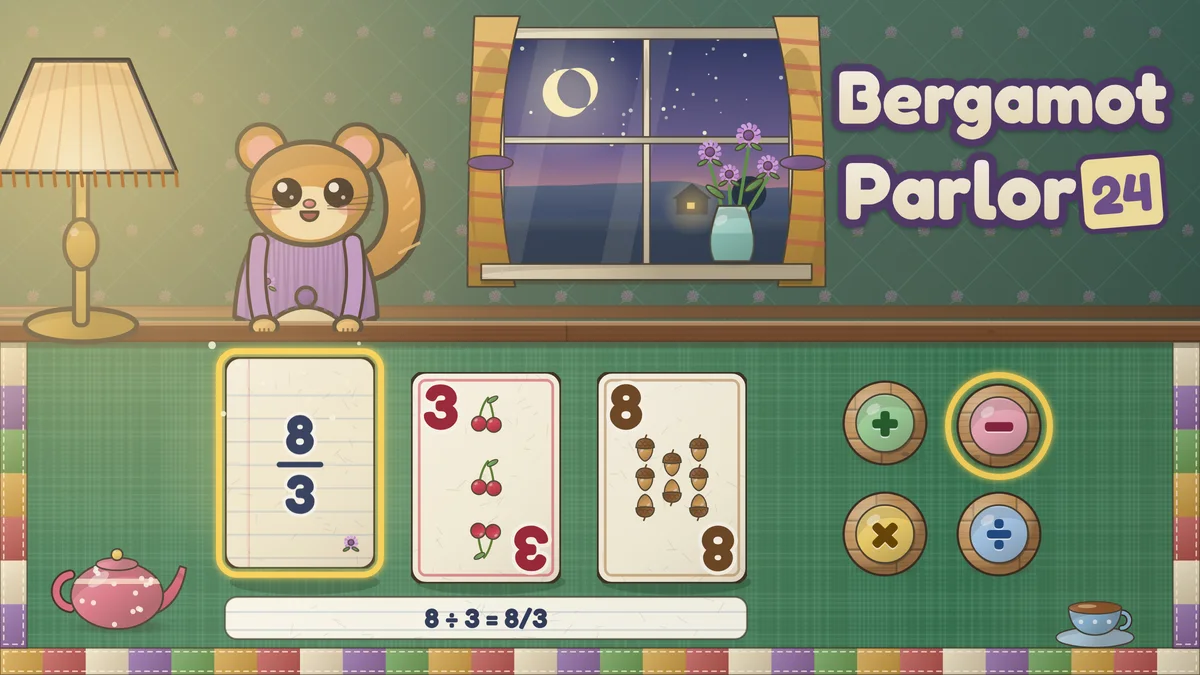
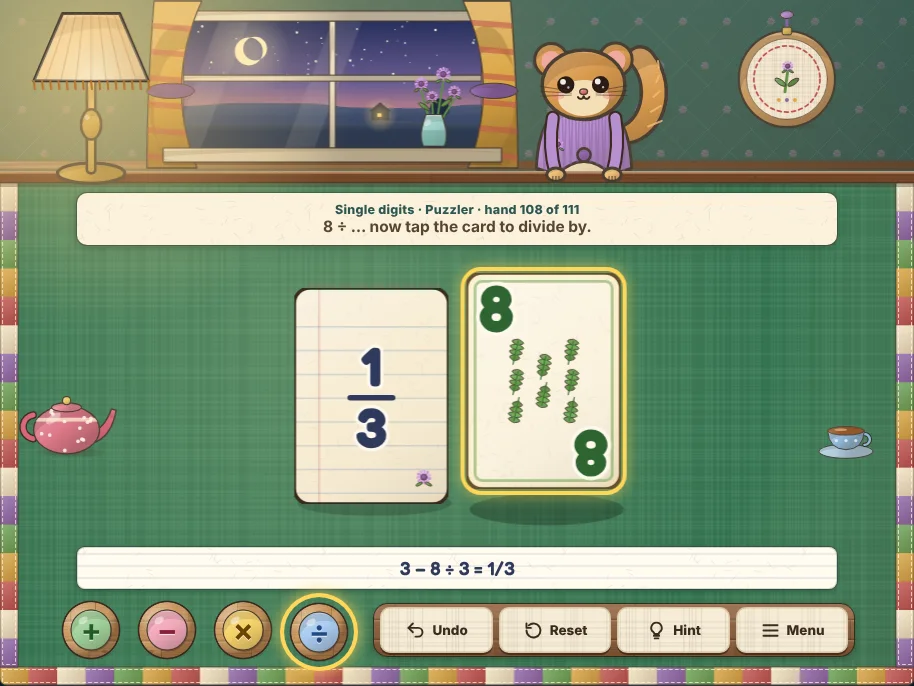
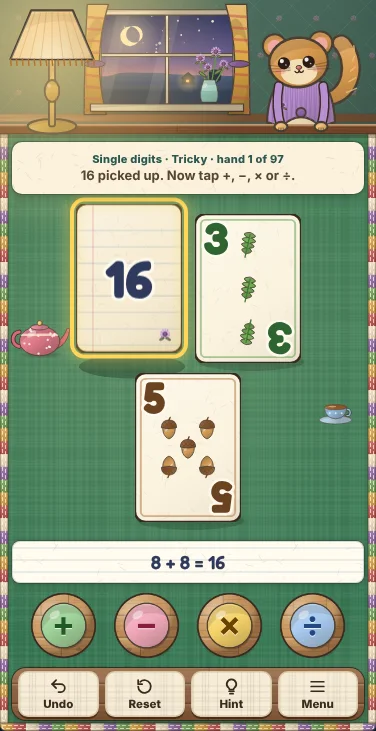
The four cards are dealt onto the green felt of a parlor card table by Ada the dormouse, and you merge them two at a time instead of writing out a sum. Tap a card to pick it up, tap an operation token, +, −, × or ÷, then tap a second card. The two cards become one card with the answer, the first card’s number on the left, so 8, ÷, 3 makes a card showing 8/3. Fractions show as fractions, stacked over a bar.
The new card stays picked up, ready for its next operation, or you can tap any other card instead. Three merges leave one card; if it is 24, the hand is made. A strip of scorepad under the cards writes your merges out in full, such as 8 ÷ (3 − 8 ÷ 3) = 24, so you can see the sum you built.
Undo takes back one merge at a time, as often as you like, and Reset deals the four cards back; Undo brings your merges back again after a Reset. The first hint shows a first merge, keeping your own merges whenever 24 can still be made from them, and the second shows a whole way. If your cards can no longer make 24, the hint says so and lights Reset. There is no clock in any mode, and the game saves as you go.
On a keyboard, 1 to 4 pick a card by its place, + − * (or X) and / choose the operation, U undoes, R resets, H shows a hint, N calls No answer, Enter goes on to the next hand and Escape puts a card down.
How many hands can make 24?
A hand here is four numbers in any order, so 1 2 3 4 and 4 3 2 1 are the same hand. With cards from 1 to 9 there are 495 different hands, and by our solver’s exact count 404 of them can make 24. With the traditional 40-card deck of ace to 10 it is 566 of 715, and with a full deck of ace to king, counting the jack, queen and king as 11, 12 and 13, it is 1,362 of 1,820. Wikipedia gives the same 1,820 four-card combinations for a 52-card deck.
Counted as deals rather than hands, the share changes, because a pair or three of a kind comes up less often than four different cards. By our exact count, 52,908 of the 270,725 possible four-card deals from a 52-card deck cannot make 24, about 19.5 percent or one deal in five.
Our solver counts two answers as one when they differ only in the order of adding or multiplying, in how sums and products are grouped, in signs flipped by subtracting the other way round, or in where a 1 multiplies or divides. By that measure, answers that use a different idea count separately, and the friendliest hand of cards 1 to 9, 2 4 4 8, has 10 answers, while 110 hands have exactly one.
| Cards | Different hands | Can make 24 | Need a fraction | Most answers for one hand |
|---|---|---|---|---|
| 1 to 9 | 495 | 404 (82%) | 7 | 10 |
| Ace to 10, the traditional 40-card deck | 715 | 566 (79%) | 10 | 11 |
| Ace to king, 1 to 13 | 1,820 | 1,362 (75%) | 16 | 11 |
The packs, today’s four and “Can it be done?”
Every hand that can make 24 is in the game, all open from the start: the 404 hands of cards 1 to 9 in one set of packs, and the 958 hands with a 10, jack, queen or king in another. Each set has four packs, Gentle, Steady, Tricky and Puzzler. Puzzler holds the hands with exactly one answer and the hands that need a fraction; the rest are sorted by a score from the solver, where fewer answers make a hand harder, and so does a hand where most first merges lead nowhere, where every answer needs a division, or where every answer goes over 24 on the way. The table shows how the packs differ, by our solver’s count.
Today’s four gives four hands a day, the same for everyone on the same date: one each from the Gentle, Steady and Tricky packs of cards 1 to 9, and one from the Tricky pack of the full deck. Make all four, with hints or without, to add a day to your streak, and copy a result line that shows how many you made and how many hints you used, but never the cards or the answers.
“Can it be done?” deals four cards from a shuffled 52-card deck, ace to king, so hands that cannot make 24 come up about one deal in five. Make 24, or call No answer. A right call scores a point, like a made hand; a wrong call shows a way to 24 and ends your run, and the game keeps your best run. There are no hints in this mode.
| Pack | Hands | Answers per hand | First merges that lead nowhere, on average |
|---|---|---|---|
| Gentle | 98 and 194 | 2 to 10, and 2 to 11 | 48% and 50% |
| Steady | 98 and 193 | 2 to 5 | 70% and 75% |
| Tricky | 97 and 193 | 2 to 3, and 2 to 4 | 82% and 86% |
| Puzzler | 111 and 378 | 1 (one fraction hand has 2) | 86% and 87% |
How to find 24
Look for the pairs first. Most hands finish with one multiplication of two whole numbers: by our solver’s count, 309 of the 404 hands of cards 1 to 9 that can make 24 have an answer whose last step is 4 × 6, 3 × 8 or 2 × 12. So look at your four cards two by two. With 1, 3, 5 and 7, the 1 and the 5 make 6 and the 7 and the 3 make 4, so (1 + 5) × (7 − 3) is 24. With 2, 4, 5 and 7, 5 + 7 is 12 and 4 − 2 is 2, so (4 − 2) × (5 + 7) is 24. If one split into pairs does not work, try the others: four cards can be split into two pairs in only three ways.
Use division to make the number you are missing. With 6, 7, 8 and 9 there is no 3 × 8 or 4 × 6 to be had from two pairs, but 9 − 7 is 2, and 6 × 8 is 48, and 48 ÷ 2 is 24. By our count, 36 hands of cards 1 to 9 need a division in every answer, among them 1 1 6 8, which is 6 × 8 ÷ (1 + 1), and 1 3 7 9, which is (1 + 7) × 9 ÷ 3.
Let big numbers come back down. Going over 24 and taking a little back is often the only way: 3, 3, 3 and 3 make 24 only as 3 × 3 × 3 − 3, and 1, 2, 5 and 5 only as 1 + 5 × 5 − 2. By our count, 25 hands of cards 1 to 9 go over 24 in every answer. Negative numbers, on the other hand, are never needed: every hand of ace to king that can make 24 has an answer with no negative number on the way.
When nothing works with whole numbers, look for a fraction. Only seven hands of cards 1 to 9 need one, but they are the famous hard ones. The trick is nearly always the same: make a fraction from three of the cards that turns the fourth into 24, such as 1/3 for an 8 (8 ÷ 1/3 is 24) or 24/5 for a 5 (5 × 24/5 is 24).
The hardest hands
These are the seven hands of cards 1 to 9 that can only make 24 with a fraction along the way, each with its answer from our solver. Six of them have exactly one answer; 1 4 5 6 has two, the second being 6 ÷ (5 ÷ 4 − 1). Try each one before reading its answer.
With a full deck there are nine more, all with exactly one answer: 1 8 12 12 is 12 ÷ (12 ÷ 8 − 1), 2 2 11 11 is 11 × (2 + 2 ÷ 11), 2 2 13 13 is 13 × (2 − 2 ÷ 13), 2 3 5 12 is 12 ÷ (3 − 5 ÷ 2), 2 4 10 10 is 10 × (2 + 4 ÷ 10), 2 5 5 10 is 5 × (5 − 2 ÷ 10), 2 7 7 10 is 7 × (2 + 10 ÷ 7), 5 5 7 11 is 5 × (7 − 11 ÷ 5) and 5 7 7 11 is 7 × (5 − 11 ÷ 7).
| Hand | Answer | The fraction on the way |
|---|---|---|
| 1 3 4 6 | 6 ÷ (1 − 3 ÷ 4) = 24 | 1/4 |
| 1 4 5 6 | 4 ÷ (1 − 5 ÷ 6) = 24 | 1/6 |
| 1 5 5 5 | 5 × (5 − 1 ÷ 5) = 24 | 24/5 |
| 1 6 6 8 | 6 ÷ (1 − 6 ÷ 8) = 24 | 1/4 |
| 3 3 7 7 | 7 × (3 + 3 ÷ 7) = 24 | 24/7 |
| 3 3 8 8 | 8 ÷ (3 − 8 ÷ 3) = 24 | 1/3 |
| 4 4 7 7 | 7 × (4 − 4 ÷ 7) = 24 | 24/7 |
Hands that cannot make 24
By our solver’s count, 91 of the 495 hands of cards 1 to 9 cannot make 24. Many are full of 1s, which add little, such as 1 1 1 1, 1 1 2 2 and 1 1 2 5, but plenty are not: 2 2 2 2, 7 7 7 7, 8 8 8 8 and 9 9 9 9 all fail, and so do 1 6 7 8 and 4 4 6 6. Spotting these quickly is a skill of its own, and it is the heart of “Can it be done?”, where a wrong No answer call costs you your run.
A good habit before calling No answer is to try each of the three ways to split the four cards into two pairs, and then each card against the other three. If none of those comes near 24, and no fraction turns one card into 24, the hand is very likely one of the hands that cannot be done.
Related games
If you enjoy working with numbers at a calm pace, Meadowlark Barn Shut the Box is our version of the classic dice game, where each roll’s total decides which numbered tiles you flip down. Sprout Killer Sudoku adds cages with sums to the classic 9x9 grid. Puffin Bluff Solitaire is pyramid solitaire, where you clear the cards in pairs that add up to 13, and Mulberry Lane Bakery is our free 2048 game, where matching numbers merge into their sum.
Keep counting
Make 24 comes down to a few habits: look for a pair that makes 24, such as 4 × 6, 3 × 8 or 2 × 12, and try to build its two halves; use division to make the small number you are missing; let a big product come back down; and when nothing works with whole numbers, look for a fraction. Start with the Gentle pack, where about half of all first moves still lead to 24, and work toward the Puzzler hands, where most have exactly one answer. For more calm classics with numbers in them, try Meadowlark Barn Shut the Box, where dice totals decide which tiles you flip; Sprout Killer Sudoku, where every cage has a sum; or Puffin Bluff Solitaire, where pairs of cards add up to 13.
- Play Bergamot Parlor 24, our free Make 24 puzzle
- Bergamot Parlor 24: features, controls and FAQ
- Meadowlark Barn Shut the Box: the classic dice game
- Sprout Killer Sudoku: cages of sums on a 9x9 grid
- Puffin Bluff Solitaire: pyramid solitaire, pairs that make 13
- Mulberry Lane Bakery: our free 2048 game
- How to play Shut the Box: rules and strategy
- How to play killer sudoku: rules and techniques
- How to play pyramid solitaire
- More cozy classic games
More guides and roundups
Match mahjong tiles, solve sudoku and killer sudoku, slide 2048 tiles, make 24 from four number cards, stitch a nonogram, find hidden words, fit a jigsaw, rake leaf piles, sort shells, merge fruit or crack firefly codes. Choose a puzzle by the decisions it asks you to make.
Math Games for Adults: Free Number PuzzlesFree math games for adults in your browser: a hillside of +, −, × and ÷ gates, the Make 24 card puzzle, cage sums, dice totals, cribbage counts, 2048 merges and Farkle odds. No countdown, no account, and hints when you are stuck. Here is what math each one asks for and how they compare.
How to Play Math Path Puzzles: Rules and StrategyA math path puzzle gives you a starting number and a map of gates that add, subtract, multiply and divide. Choose one route to the end and bring the biggest number you can. Here are the rules, the remainder rule, the controls and the order-of-operations habits that matter most, with numbers from our own simulation.
How to Play 2048: Rules and Strategy2048 is the sliding tile puzzle where two matching numbers merge into their sum. Here is how a move works, exactly which tiles merge, how scoring, winning and the end of a game work, and the corner strategy that gets you to 2048, with numbers from our own simulation of simple strategies.