Cozy Classic
Free Make 24 Math Puzzle
Bergamot Parlor 24
Make 24 with no typing and no brackets: tap a card, an operation and a second card, and the two become one card with the answer, fractions shown as fractions. Every hand that can make 24 is here in packs from Gentle to Puzzler, plus four hands a day, a “Can it be done?” mode with hands that cannot, and a solver for any four numbers.
What you do
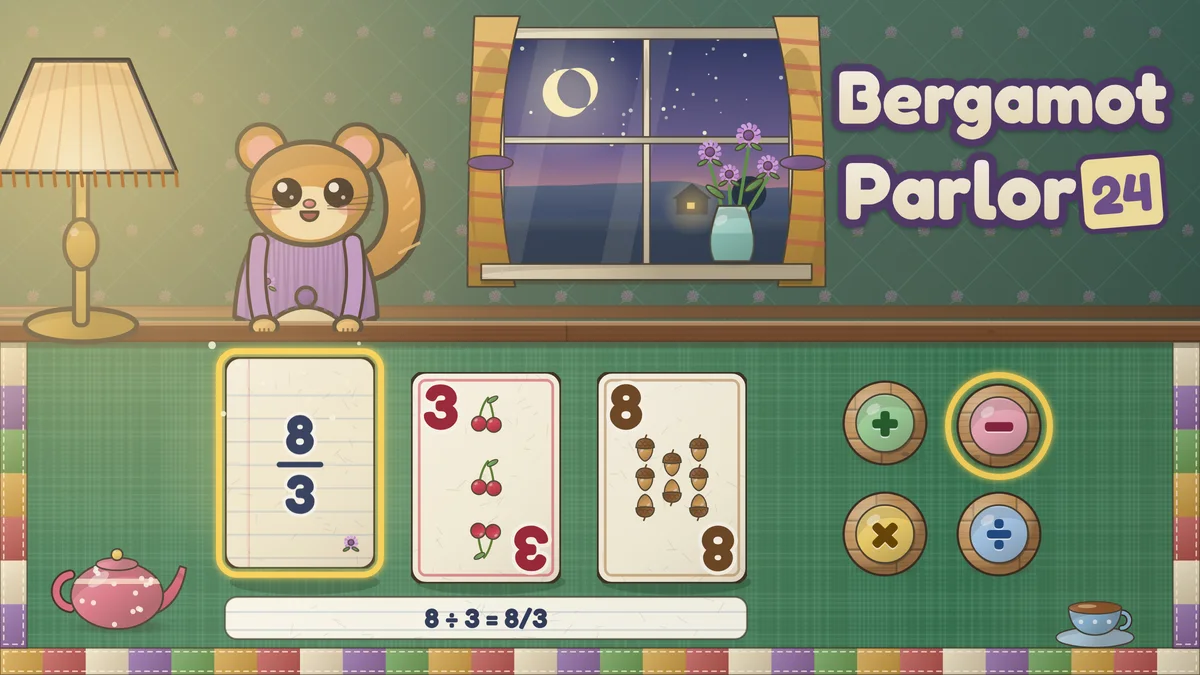
Bergamot Parlor 24 is the traditional arithmetic puzzle often played with a deck of cards: four numbers are dealt, and you combine them with adding, subtracting, multiplying and dividing to make exactly 24, using every card once. It is played at a card table in a small parlor on an autumn evening. Teal wallpaper with gold sprigs of bergamot, a window onto a dusk sky with a crescent moon and the light of a far cottage, a vase of lilac bergamot flowers on the sill, a fringed brass lamp, and a table with a walnut rim and a green felt cloth edged in patchwork, where a teapot and a cup of tea wait beside the cards. The cards are hand-painted number cards with acorns, oak leaves, cherries and daisies for pips and the number large in the corner. When two cards merge they slide together with a puff, and the new card turns over on a page of scorepad paper showing the result, with a fraction stacked over its bar. A line of scorepad under the cards writes your moves out in full, such as 8 ÷ (3 − 8 ÷ 3) = 24. Across the table sits Ada, a golden dormouse in a lilac knitted shawl, who deals each hand from her paw, thinks with you when you ask for a hint and claps when you make 24.
- Merge two cards at a time: tap a card, then +, −, × or ÷, then a second card. Three merges leave one card, and the hand is made when it is 24. Fractions and negative numbers are allowed on the way, as in the traditional rules, and nothing can be divided by 0.
- Every hand of four cards that can make 24, all open: the 404 hands of cards 1 to 9 (of 495) and 958 more with a 10, jack, queen or king (ace to king, 1,362 of 1,820 in all), sorted into Gentle, Steady, Tricky and Puzzler packs by how many answers a hand has and how many first moves still lead to 24.
- Today’s four: four hands a day, the same for everyone on the same date, gentle to tricky with one from the full deck, with a streak and a result line you can copy that shows no cards or answers.
- “Can it be done?”: hands from a shuffled 52-card deck, ace to king, including the ones that cannot make 24 (about one deal in five). Make 24 or call No answer, and keep your best run of points.
- Solve any four numbers: pick four numbers from 1 to 13 in the menu to see whether they can make 24, with every distinct answer, then play them on the table if you like.
- Unlimited undo, a Reset back to the four dealt cards, and two-step hints: the first shows a first merge, keeping your own merges when 24 can still be made from them, and the second shows a whole way. No clock in any mode, three card speeds, reduced motion support and a saved game in this browser.
How to play
- Press Play. Ada deals four number cards onto the felt. Your first hand is 1, 2, 3 and 4.
- Tap a card to pick it up, tap an operation (+, −, × or ÷), then tap a second card. The two merge into one card showing the result, with the first card’s number on the left: 8, ÷, 3 makes 8/3.
- The new card stays picked up, ready for its next operation, or tap any other card to pick that one instead. The scorepad strip under the cards writes your merges out in full.
- Keep merging until one card is left. If it is exactly 24, the hand is made. If not, Undo takes back a step and Reset deals the four cards back.
- Every card must be used exactly once. Fractions and negative numbers on the way are fine, and nothing can be divided by 0.
Controls
- Touch or mouse: tap the cards and the four wooden operation tokens. Undo, Reset, Hint and Menu sit on the tray at the bottom, under your thumb. When a hand is made, the tokens make way for a results ribbon with a big Next hand button, and the 24 card sits large in the middle of the felt with the four cards you were dealt fanned out beside it. If your last card is not 24, the ribbon says so and its button is Undo. In “Can it be done?”, Hint is replaced by No answer.
- Keyboard: 1 to 4 pick a card by its place, + − * (or X) and / choose the operation, U undoes, R resets, H shows a hint, N calls No answer, Enter goes to the next hand when one is made, and Escape puts a card down or closes a menu.
- Restart in the toolbar deals the four cards back, like Reset, and Undo brings your merges back. Menu opens the hand packs, today’s four, “Can it be done?”, the solver, Settings (card speed), your statistics and the rules. The toolbar also has pause, help, optional sound and fullscreen.
Tips worth knowing
- Look for the pairs that make 24 first: 4 × 6, 3 × 8 and 2 × 12, then 48 ÷ 2 and 72 ÷ 3. If two of your cards can make a 6 and the other two a 4, you are done.
- Use division to get the number you are missing. With 6, 7, 8 and 9 there is no 3 × 8 or 4 × 6 to be had, but 9 − 7 is 2, and 6 × 8 ÷ 2 is 24. Every answer for that hand needs a division.
- Big numbers can come back down. With 1, 2, 2 and 13, one answer goes over 24 and takes a little back, 1 × (2 × 13 − 2), and the other stays under it, 2 × (1 + 13 − 2).
- When nothing works with whole numbers, look for a fraction. 3, 3, 8 and 8 can only make 24 as 8 ÷ (3 − 8 ÷ 3): 8 ÷ 3 is 8/3, 3 − 8/3 is 1/3, and 8 ÷ 1/3 is 24. Of the 404 hands of cards 1 to 9 that can make 24, only 7 need a fraction like this.
- Gentle hands have several answers, and about half the first merges still lead to 24. In the Tricky and Puzzler packs a hand has only a few answers or just one, and more than four first merges in five lead nowhere, so it pays to think two steps ahead before you tap.
- A hint keeps your merges when it can. If your cards can still make 24, the first hint shows the next merge from where you are; if they cannot, it says so and lights Reset.
Accessibility
- Everything can be played with a keyboard: 1 to 4 pick a card, + − * and / choose the operation, U undoes, R resets, H shows a hint, N calls No answer, Enter deals the next hand and Escape closes menus.
- Every card is a button labeled for screen readers with its number (a fraction is read as 8 over 3) and, for a merged card, the sum that made it, and every merge is announced with its result and the cards left.
- Color is never the only clue. Each operation token shows its symbol as well as its color (+ green, − rose, × gold, ÷ blue), a picked card lifts with a thick glowing ring, and the cards of a hint wear a dashed ring with a 1 and a 2 for their order.
- Nothing is timed in any mode, and a wrong tap, such as dividing by 0, only brings a gentle explanation.
- Reduced motion places the cards at once without sliding, dealing or flipping, stops the hint’s pulse and Ada’s fidgeting, and leaves out the puffs and petals. Sound is optional and never needed to play.
Questions
How many hands can make 24?
By our solver’s own exact count, 404 of the 495 different hands of cards 1 to 9 can make 24, and 1,362 of the 1,820 hands of ace to king (1 to 13). With the traditional 40-card deck of ace to 10 it is 566 of 715. A hand here is four numbers in any order, so 1 2 3 4 and 4 3 2 1 are the same hand. Every hand that can make 24 is in the game’s packs.
What counts as a different answer?
Two answers count as one when they differ only in the order of adding or multiplying, in how the sums and products are grouped, in signs flipped by subtracting the other way round, or in where a 1, dealt or made from cards such as 2 − 1, multiplies or divides. So (8 − 4) × 6 and 6 × (8 − 4) are one answer. Answers that use a different idea, such as 4 × 6 against 3 × 8, count separately. By that measure the friendliest hand of cards 1 to 9 has 10 answers, and 110 have exactly one.
How are the packs sorted?
The Puzzler pack holds the hands with exactly one answer and the hands that need a fraction on the way. The rest are sorted by a score from the solver: fewer answers make a hand harder, and so does a hand where most first merges leave no way to 24, a hand where every answer needs a division, and one where every answer goes over 24 on the way. Then they are split into three packs of the same size, give or take a hand: Gentle, Steady and Tricky. Single digits and the full deck each have their own four packs.
How often can a hand not be done?
In “Can it be done?” the cards come from a shuffled 52-card deck, ace to king, so pairs and threes come up as often as they would at a real table. By our exact count, 52,908 of the 270,725 possible four-card deals cannot make 24, about 19.5 percent or one deal in five. Counted as different hands instead, 458 of 1,820 cannot, about one in four.
How does today’s four work?
Every date has its own four hands, the same for everyone who plays on that date: one each from the Gentle, Steady and Tricky packs of cards 1 to 9, and one from the Tricky pack of the full deck. Make all four, with hints or without, to add a day to your streak. The result line shows how many you made and how many hints you used, never the cards or the answers.
What does the game save?
Your card speed, the hand in progress in each mode (with every merge, so a reload shows the same table), every pack hand you have made and whether you made it with no hints, your results for today’s four and your “Can it be done?” runs, all in this browser’s local storage. There is no account.