
CozyWorld game guide · By CozyWorld
This guide covers our own game, written from the current game rules and browser checks.
How to Play Hangman: Rules, Letters and Strategy
Hangman is the classic word game of guessing a word one letter at a time before a picture is finished. Here are the rules, how six and eight misses differ, the best first letters by our own count of our word list, how to read the pattern, how phrases change the game, and the common mistakes and tips that solve more words.
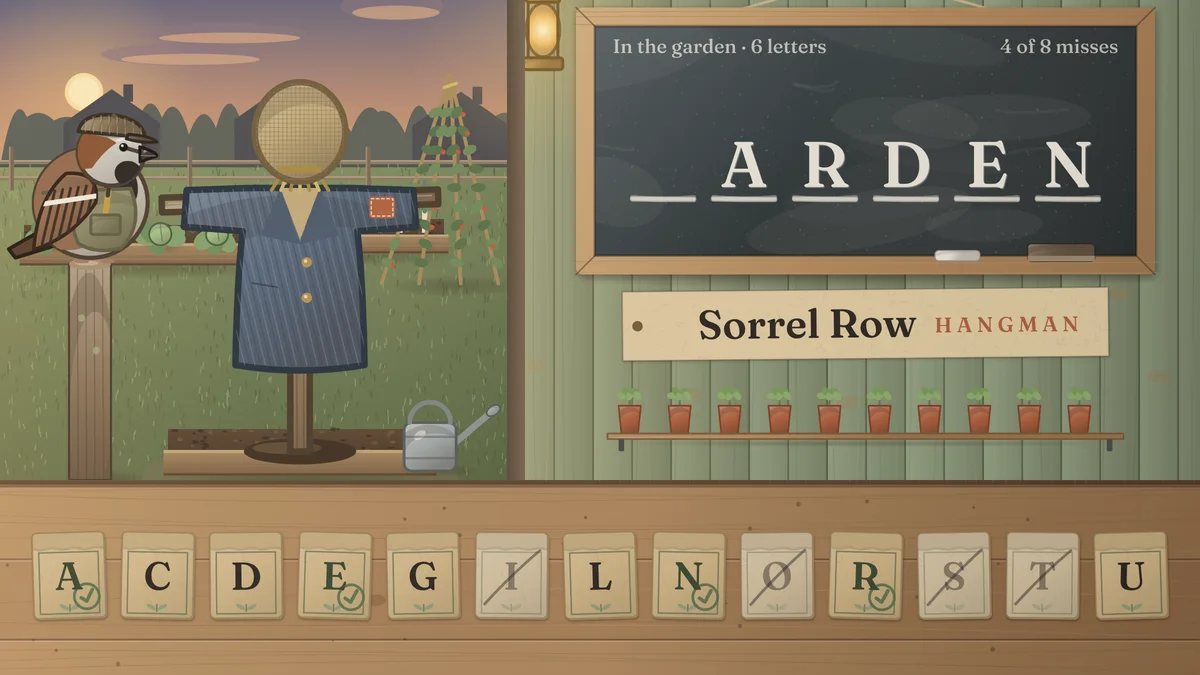
Hangman is a word game for two or more players, played with nothing more than a pencil and paper. One player thinks of a word and writes a blank for each letter. The others guess letters one at a time. A right letter is written into every blank where it belongs, and a wrong one adds a line to a drawing. Find the whole word before the drawing is finished and you win; if the drawing is finished first, the player who chose the word wins.
This guide covers the rules, how many misses to allow, the best letters to start with, how to read the pattern of blanks, what changes when the answer is a phrase, and the most common mistakes, with the controls of Sorrel Row Hangman (CozyWorld’s free hangman game, at a potting bench in a community garden at dusk) along the way. The letter counts and the strategy results come from our own count of the game’s own word lists and our own simulation, which plays the game’s real rules.
Hangman rules and the goal
One player, the setter, chooses a secret word and writes one blank for each of its letters. The other player, the guesser, names one letter at a time. If the letter is in the word, the setter writes it into every blank where it appears, so a word with three Es shows all three at once. If it is not, the setter adds one piece to a drawing and writes the letter to one side, so nobody guesses it twice.
The guesser wins by filling in every blank before the drawing is complete, and the setter wins if the drawing is finished first. On paper, the guesser may also try the whole word at any time: a right answer wins at once, and the setter may count a wrong one as a miss. Sorrel Row Hangman is played letter by letter.
The traditional drawing is a gallows and a hanged stick figure, a head, a body, two arms and two legs, which is where the game gets its name. Sorrel Row Hangman keeps the classic rules and puts up a scarecrow in a garden bed instead: the post, the crossbar, the head, a coat, two straw hands, a hat and, last, the face. People who would rather not draw a hanging use other pictures, such as apples crossed off a tree or slices taken from a pie, and the game works the same way with any of them.
| Part of the game | What happens |
|---|---|
| The start | One blank for each letter; spaces and punctuation in a phrase are shown |
| A letter in the answer | Written into every blank where it appears |
| A letter not in the answer | One more piece of the drawing, and the letter is crossed off |
| A letter guessed before | Not counted again |
| Every blank filled | The guesser wins |
| The drawing finished | The setter wins, and the word is shown |
How many misses: six or eight
There is no single official number of misses. On paper, six is common: a head, a body, two arms and two legs. Many players draw the gallows a piece at a time first, or add a face or shoes to the figure, for more. More misses make an easier game, so agree on the count before you start.
Sorrel Row Hangman offers eight misses by default and six in Settings. With eight, the scarecrow goes up one piece for each miss. With six, it is the same scarecrow, with some pieces going up two at a time. The slate always shows how many misses you have used, and a change in Settings applies from the next word.
The difference is bigger than two letters suggests. In our simulation, a player that guesses letters from English words that fit the blanks solved 594 of our 735 single words with eight misses and 530 with six.
| Miss | With eight misses | With six misses |
|---|---|---|
| 1 | The post | The post and the crossbar |
| 2 | The crossbar | The head |
| 3 | The head | The coat |
| 4 | The coat | Both straw hands |
| 5 | A straw hand | The hat |
| 6 | The other straw hand | The face: the scarecrow is finished |
| 7 | The hat | Not reached |
| 8 | The face: the scarecrow is finished | Not reached |
Controls in Sorrel Row Hangman
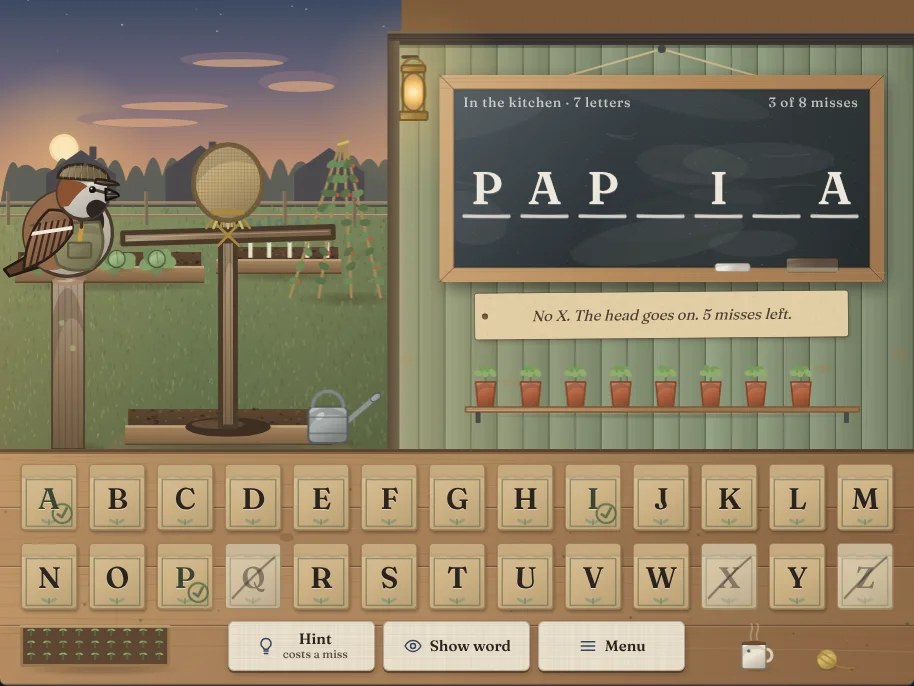
Press Play and Godfrey, a house sparrow in a flat cap, chalks the answer on the slate as one blank per letter, with its category and its length above it. To guess a letter, tap its seed packet on the bench or type it on your keyboard. A packet whose letter is in the answer gets a check mark, and one whose letter is not is struck through, so you can see at a glance what you have tried.
Hint chalks in the first letter still hidden, reading the answer from the start, wherever it appears, and counts as one miss. It is there while you have two misses or more in hand and two letters or more still to find, so it can never finish the scarecrow for you. Show word asks once, then gives you the answer as a loss. On a keyboard, ? gives a hint, Enter goes on to the next word once this one is done, Escape closes a sheet and Tab moves between the buttons.
Menu opens the categories (In the kitchen, In the garden, Travel, Nature, Jobs, Geography, and Idioms and phrases, or any of them), single words or phrases, today’s word, Settings, your statistics and the rules. Today’s word is one single word a day, the same for everyone on the same date, played once, with a streak and a result line you can copy that gives no letters away. Your game is saved in your browser as you play.
The best first letters
Your first guesses cannot use the pattern, because there is none yet, so the best opening letters are the ones found in the most answers. We counted how many of the game’s 735 single words and 377 phrases hold each letter at least once. On a single word, A, E and R lead, each in more than half of the words, then O, I and N. On a phrase, E is in 310 of the 377, and A, R, O and T follow.
You may know the order ETAOIN SHRDLU, the twelve most common letters in English text. It is a fine start, but it counts every letter in running prose, where words like the, that and this repeat endlessly and lift T and H. A hangman answer counts each letter once, however often it repeats, and our list has no the or that among its single words. That is why R ranks third for us and H only 14th.
Vowels are a good opening but not a guaranteed one. Every word in our list has at least one of A, E, I, O and U, yet 309 of the 735 single words have no E, and 102 use only one vowel letter, such as the A in salsa or the U in hummus. U is in just 170 of the 735 single words, fewer than R, N, L, T or S, so guess it later unless the pattern calls for it.
| Rank | Single words (of 735) | Phrases (of 377) |
|---|---|---|
| 1 | A: 427 | E: 310 |
| 2 | E: 426 | A: 281 |
| 3 | R: 375 | R: 252 |
| 4 | O: 319 | O: 244 |
| 5 | I: 310 | T: 241 |
| 6 | N: 286 | N: 229 |
| 7 | L: 266 | I: 216 |
| 8 | T: 266 | S: 214 |
| 9 | S: 255 | L: 173 |
| 10 | C: 201 | H: 147 |
Beginner strategy
Start with two or three of the most common letters: A, E and R on a single word, E, A and R on a phrase. Then look at what the slate shows before you guess again. A first letter, a last letter, or a pair of matching letters already narrows the word down more than another letter from a list would.
Use the category and the length. The category line tells you the kind of word, and the length rules out most of the words of that kind. A seven-letter word In the kitchen with A in the second and fourth places is a short list to think through: in our list it is lasagna or caramel.
Look for common endings and double letters. By our count, 93 of the 735 single words end in ER, far more than any other ending, and 157 have a double letter, such as the TT in kettle. If a word ends in E and a blank, try R: it is R in 93 of the 154 single words that end that way.
Keep the rare letters for last. Z, J, X and Q are each in fewer than 20 of our 735 single words. Guess one only when a word you can picture needs it.
Strategy: read the pattern, not the alphabet
To see how much reading the pattern matters, we ran our own simulation. Four players each played every one of the game’s 735 single words and 377 phrases once, with six and with eight misses, never taking a hint, through the game’s own rules. Nothing was sampled, so the counts are exact for our list.
Three of the players guess in a fixed order whatever the slate shows: the textbook order ETAOIN SHRDLU and then the rest; our list’s own order, most common first; and the five vowels first, then our list’s order. The fourth reads the slate. For each word with blanks it keeps every word from a public-domain list of 172,336 English words (the ENABLE list, with offensive words taken out) that fits what is chalked in and crossed off, and guesses the letter most likely to be in the answer. It knows nothing of our list or the category, much like a player who knows plenty of words but not the one on the slate.
The fixed orders solved fewer than one single word in four even with eight misses, because after the first few letters every fixed order wastes guesses on letters the pattern has already ruled out. The pattern reader solved 594 of the 735 single words with eight misses. These are computer players, not people, so treat the numbers as a guide to how much each habit is worth, not as your own odds.
| Player | Words, 6 misses | Words, 8 misses | Phrases, 6 misses | Phrases, 8 misses |
|---|---|---|---|---|
| Textbook order, ETAOIN SHRDLU | 58 | 142 | 34 | 77 |
| Our list’s order | 75 | 166 | 53 | 126 |
| Vowels first, then our list’s order | 73 | 165 | 42 | 120 |
| Reads the pattern | 530 | 594 | 269 | 338 |
Why short words are the hard ones
A long word looks frightening, but it is usually the easier one. Each letter you find in a long word fills several blanks and narrows the possibilities fast, and there are few long words that fit any one pattern. A short word gives you little to go on, and many short words share a pattern: a four-letter word ending in AKE could be bake, cake, lake, make, rake, take or wake.
In our simulation the pattern reader solved 73 of the 126 words of three to five letters with six misses, and 64 of the 76 words of ten letters or more. If a short word goes badly, it is not you.
| Length | Words | Solved, 6 misses | Solved, 8 misses |
|---|---|---|---|
| 3 to 5 letters | 126 | 73 | 98 |
| 6 or 7 letters | 304 | 219 | 247 |
| 8 or 9 letters | 229 | 174 | 184 |
| 10 letters or more | 76 | 64 | 65 |
Hangman with phrases
In phrase mode the answer is two words or more, from an everyday thing such as a slow cooker to a famous place or an old saying, and the slate shows the spaces, apostrophes and hyphens from the start. That gives you the shape of every word before you guess a letter, and the short words are the way in.
By our count, 161 of the 377 phrases have a word of three letters or fewer, and THE alone is in 45 of them. A, OF and IN are the next most common. Only 14 different words of two letters appear in our phrases, OF, IN, IS, TO, IT and ON most often, and a word of three blanks is THE in 45 phrases and AND in 7. The letters they give you land all through the phrase.
Open a phrase with E, which is in 310 of the 377. In our simulation the pattern reader solved 338 of the 377 phrases with eight misses, a larger share than of the single words: a phrase has more letters to find, but every word in it is a clue to the others.
Place names and Geography
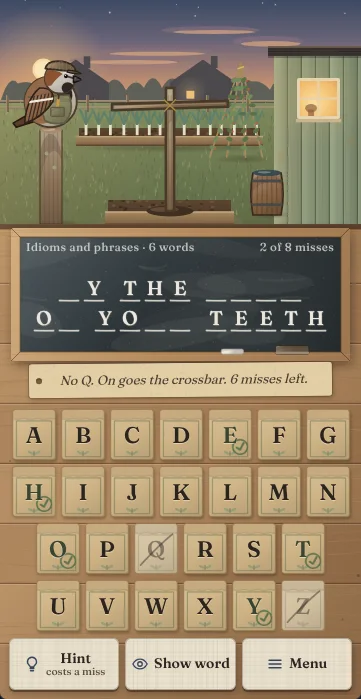
Geography is the hardest category in Sorrel Row Hangman, because its answers are places: countries, cities, rivers, mountains and islands. A word list built for word games leaves place names out, so a player who only thinks of ordinary words has nothing to match.
Our pattern reader shows it plainly. With eight misses it solved 87 of the 205 Geography words and 507 of the 530 words in the other categories. When you play Geography, think of places that fit the blanks. By our count, A is in 149 of the 205 Geography words, N in 112 and I in 102, and 30 of them end in IA.
When to take a hint
A hint in Sorrel Row Hangman is a sure letter that costs exactly what a wrong guess would. It chalks in the first letter still hidden, wherever it appears in the answer.
In our simulation, taking a hint when two misses were left changed the pattern reader’s wins from 594 to 597 of 735 words with eight misses, and from 338 to 332 of 377 phrases. A player guessing in our list’s order went from 166 to 180 words. So a hint helps most when you have run out of ideas, and it rarely saves a word you were already reading well. Use it to get unstuck, not as a safety net.
Common mistakes
Running through the alphabet. Every fixed order of letters in our simulation solved fewer than one single word in four with eight misses, against four in five for the player that read the pattern. After the first few letters, every guess should come from a word you can picture.
Guessing all five vowels. Vowels are common, but U is in fewer than one word in four in our list, and once a word shows A and E in place, the blanks between them are usually consonants. Try R, N, L, T and S before U.
Ignoring the category and the length. They are free clues, shown before your first guess.
Guessing a rare letter on a hunch. A Z or Q that misses costs as much as an R that misses, and R is in far more words. Keep the rare letters for when a word you can picture needs them.
Taking the hint first. It costs a miss and gives you a letter you would very likely have found with A, E or R. It is worth most late in a word, when you are stuck.
Tips for solving more words
Say the pattern aloud. Reading the blanks as sounds, “blank A blank blank E R”, often brings the word to mind faster than staring at it.
Count the blanks between letters you know. A word with an E at both ends, or a double letter in the middle, rules out most candidates at a glance.
Play phrases when you want more to work with. The short words make a phrase easier to open than a single word of the same length.
Play today’s word every day. It is the same word for everyone on the same date, so you can compare result lines with a friend, and the line you copy never gives a letter away.
Move to six misses when eight feels easy. It is the classic count, and it rewards reading the pattern even more.
A short history of hangman
Nobody knows where hangman began. A version appears in Alice Gomme’s 1894 collection of traditional games under the name Birds, Beasts, and Fishes, with no drawing at all: players simply counted how many tries each needed to fill in the blanks. The hanging picture had joined the game by 1902, when a newspaper article described it.
Since then the rules have stayed simple and flexible. Players change the number of misses, swap in a different picture, or play with phrases. One computer study, by Jon McLoone at Wolfram Research in 2010, found that short words with rare and repeated letters, such as jazz, buzz, fizz and fuzz, are among the hardest of all to guess, which matches what our own simulation found about short words.
Keep playing
Hangman rewards one habit above all: after the first two or three letters, stop thinking about the alphabet and start thinking about words that fit the blanks. Open with A, E or R on a single word and E on a phrase, use the category and the short words, keep the hint for when you are truly stuck, and move down to six misses when eight starts to feel easy. For more calm puzzles, try Cottage Word Search, with a hidden saying in every puzzle; Little Stitches, our cross-stitch nonogram; Starlight Launch, a number code to crack from color clues; or Sprout Sudoku, with hints that explain the next step.
- Play Sorrel Row Hangman: rules, controls and FAQ
- Cottage Word Search: themed word searches with a hidden saying
- Little Stitches: nonograms in a cross-stitch hoop
- Starlight Launch: crack a number code from color clues
- Sprout Sudoku: classic 9x9 puzzles with helpful hints
- Word search for adults: Cottage Word Search tips
- How to play nonograms: the Little Stitches guide
- Starlight Launch: read the clues and beat the fox
- Daily word puzzles and other word games to try
- How to play Make 24: rules, hands and tips
- How to play 2048: rules and strategy
More guides and roundups
Match mahjong tiles, solve sudoku and killer sudoku, slide 2048 tiles, make 24 from four number cards, sweep a minesweeper board, stitch a nonogram, find hidden words, unscramble a word, fit a jigsaw, rake leaf piles, sort shells, merge fruit or crack firefly codes. Choose a puzzle by the decisions it asks you to make.
Best Logic Games for Adults: 17 Puzzles to SolveLogic games where every answer can be reasoned out: nine free browser puzzles from CozyWorld, from nonograms to Minesweeper with no-guess boards, then eight more logic puzzle games from daily web puzzles to The Witness.
How to Unscramble Words: Patterns and TipsUnscrambling a word is easier from the ends than from the front. Here are the rules of a word scramble, a beginner’s method, the endings, letter pairs and vowel patterns that turn up most, how to use an unscrambler without spoiling the fun, and the mistakes that cost the most time, with every count taken from our own puzzles and word list.
Free Online Games for Seniors and Older AdultsFree online games for seniors and older adults: solitaire, mahjong, word search, sudoku, jigsaw and nonograms that open in a browser, with no countdown, no accounts and no purchases. Here is how the eight compare on round length, timers and help.