
CozyWorld game guide · By CozyWorld
This guide covers our own game, written from the current game rules and browser checks.
How to Unscramble Words: Patterns and Tips
Unscrambling a word is easier from the ends than from the front. Here are the rules of a word scramble, a beginner’s method, the endings, letter pairs and vowel patterns that turn up most, how to use an unscrambler without spoiling the fun, and the mistakes that cost the most time, with every count taken from our own puzzles and word list.
How do you unscramble a word? Work from the ends rather than the front. Look for a likely ending such as ER, Y or ING, put letters that belong together side by side, such as CH, ST or NG, and spread the vowels out between the consonants. If nothing comes, shuffle the letters into a new order and look again. Most words give way to those four habits, and an unscrambler can finish off the rest.
This guide covers the rules of a word scramble, the controls in Teasel Lane Word Scramble, our free word scramble with an unscrambler on the same page, a method for beginners, prefixes and suffixes, letter pairs, vowel and consonant patterns, using the unscrambler, common mistakes, quick tips and related games. Every count of words here comes from a script we ran over the game’s own 1,020 puzzle words and the 172,336-word list its unscrambler searches. They are counts of those lists, not of English as a whole.
What is a word scramble?
A word scramble is an anagram puzzle. Wikipedia’s article “Anagram” defines an anagram as a word or phrase formed by rearranging the letters of a different word or phrase, using all the original letters exactly once, and its own example is the word anagram, which rearranges into “nag a ram”. In a word scramble you are given the rearranged letters and asked for the word they came from.
The idea is old. The same article says anagrams can be traced back to the time of the ancient Greeks, are said to date back at least to the Greek poet Lycophron in the third century BCE, and were popular throughout Europe during the Middle Ages. It also notes that cryptic crossword puzzles frequently use anagram clues, so a habit of unscrambling pays off well beyond scramble puzzles.
Rules and objective
The objective is to put the letters back in order to spell a real word, using every letter exactly once. A letter that appears twice in the scramble appears twice in the word, and no letter may be added or left out. In Teasel Lane Word Scramble there is no clock and no limit on tries: when every well is full the word is checked, and a row that is not the word simply stays where it is so you can fix it.
Many scrambles allow more than one answer, which is fair in a game against other people but annoying alone. In the word list the game uses, 3,800 of the 8,574 five-letter words share their letters with at least one other word, by our count. So every Teasel Lane puzzle word was chosen to be the only word in the list that uses exactly its letters: if the row you spelled is a real word, it is the answer.
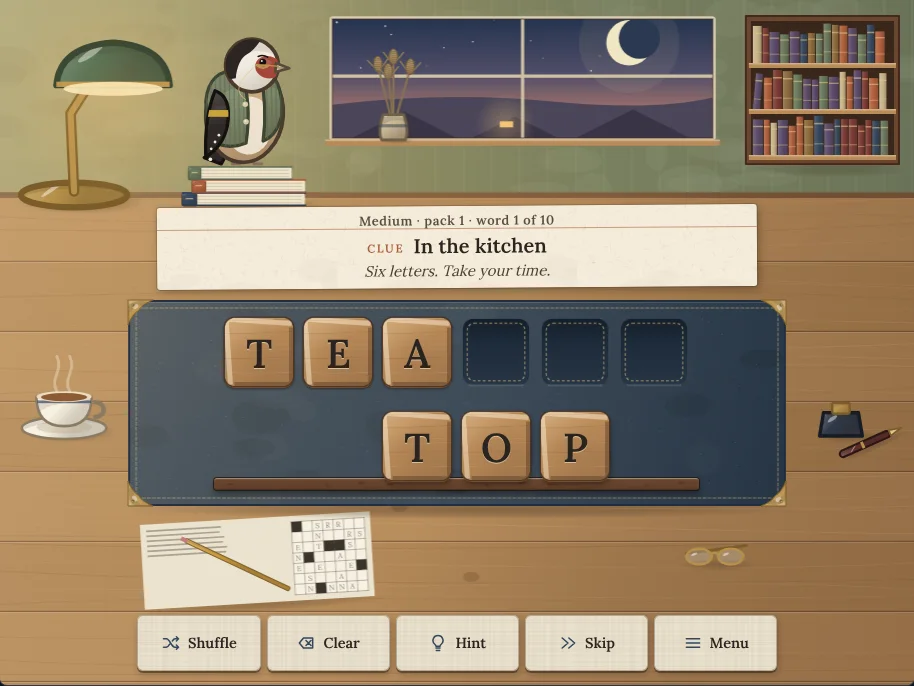
Each word also comes with a category on its clue card, such as In the kitchen, Birds or Books and writing, from 19 categories. The 1,020 puzzles come in three levels, Easy, Medium and Hard, in packs of ten that are all open from the start, and today’s ten gives three Easy, four Medium and three Hard words a day, the same for everyone on the same date.
| Level | Letters | Puzzles | Orders the letters allow, typical word | Words the unscrambler finds in the letters, median |
|---|---|---|---|---|
| Easy | 5 | 250 | 120 | 16 |
| Medium | 6 or 7 | 410 | 720 | 40 |
| Hard | 8 to 11 | 360 | 45,360 | 154 |
Controls in Teasel Lane Word Scramble
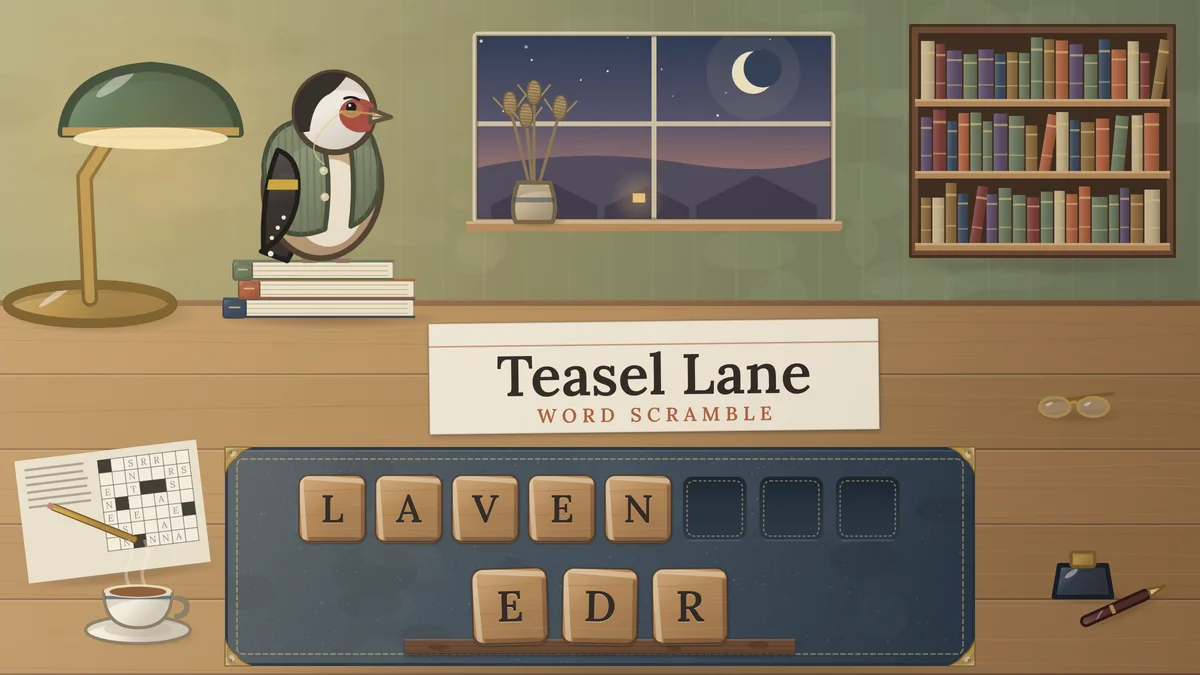
The letters are oak tiles on a walnut rack, and the word goes into wells pressed into an ink-blue leather blotter. Tap a tile to send it to the first empty well, and tap a placed tile to send it back to the rack. Under the desk sit Shuffle, which deals the rack into a new order, Clear, which sends your placed tiles back, Hint, which sets the next letter of the word in place from the left, and Skip, which asks once before it shows the word.
On a keyboard, type a letter to place a tile with that letter. Backspace sends the last tile back, Escape clears the wells, Space shuffles, ? asks for a hint and Enter goes on to the next word once one is done. Menu opens the packs, today’s ten, the unscrambler, Settings, your statistics by level and the rules, and Settings can turn the clue cards face down if you would rather lift each one yourself.
Beginner strategy: work from the ends
Start with the clue. Knowing the word is a bird or something from the tea table rules out more than any single letter does. Then look for the ending, because English words end in a handful of ways far more often than they begin in one. Of the 1,020 puzzle words, 157 end in E, 105 end in Y, 99 end in ER and 30 end in ING. If the rack holds an I, an N and a G, set them at the end and work on what is left; if it holds an E and an R, try ER at the end before anything else.
Next, join the letters that like each other, such as CH, SH, ST or CK, and treat each pair as one tile in your head. A seven-letter word with two pairs is really a five-piece puzzle. Then place the vowels so that each one sits between consonants, and say the result aloud. A row you can pronounce is usually close, even when it is wrong.
If the row still looks like nonsense, press Shuffle. The dealt order is chosen to be unhelpful: by our count, no scramble in the game starts with its word’s first letter, and in 1,015 of the 1,020 puzzles no letter sits in its own place. A fresh order often shows a pair or an ending you could not see before.
Prefixes and suffixes
Wikipedia’s article “Affix” describes an affix as a morpheme attached to a word stem to form a new word or word form. A prefix comes before the stem, as un- does in undo, and a suffix comes after it, as -ing does in looking. The same article gives -ing and -ed as suffixes that mark tense and -(e)s as the suffix that makes nouns plural.
How much they help depends on the words. Across the whole list the unscrambler searches, they are everywhere: of its 167,413 words of five letters or more, 64,395 end in S, 13,235 end in ED and 12,526 end in ING, and 6,625 begin with RE and 3,844 with UN. In the game’s puzzles, which are mostly everyday nouns picked by category, the picture is different. Of the 1,020 puzzle words, 105 end in Y, 99 end in ER, 44 end in S and 30 end in ING, and only 5 begin with RE.
So in a scramble, endings earn their keep and prefixes rarely do. An S in the rack is no promise of a plural, but ER, Y and ING are worth trying at the end first. These counts are of letters, not grammar: a word like rest begins with RE without being re- plus anything, and that is fine for unscrambling, where only the letters matter.
| Letters | Puzzle words | Where |
|---|---|---|
| E | 157 | Last letter |
| Y | 105 | Ending |
| ER | 99 | Ending |
| S | 44 | Ending |
| ING | 30 | Ending |
| RE | 5 | Beginning |
Letter pairs that belong together
Some letters travel in pairs. Wikipedia’s article “Digraph (orthography)” defines a digraph as a pair of characters used to write a single sound, or a sequence of sounds, that does not match the normal values of the two characters combined. Its English examples include ch as in church, sh as in sheep, th as in thin, ng as in thing and ck as in check.
In the puzzles, the pair found in the most words is not a digraph at all: ER turns up in 166 of the 1,020 puzzle words, IN in 116 and AR in 107. Among the consonant pairs, CH is in 76, ST in 59, NG in 50, CK in 44, SH in 37 and TH in 31, and 337 of the 1,020 words hold at least one of the ten pairs we counted. When you see a C and an H, or a C and a K, in the same rack, put them together and see what forms around them.
Two more pairs are worth knowing. A Q nearly always wants a U: in the word list, 2,492 of the 2,521 words with a Q have a U straight after every Q. And doubled letters are common: 285 of the 1,020 words have a double letter, as in HOBBY or ESPRESSO, so two of the same letter in the rack are often meant to sit side by side.
| Pair | Puzzle words |
|---|---|
| ER | 166 |
| IN | 116 |
| AR | 107 |
| CH | 76 |
| ST | 59 |
| NG | 50 |
| CK | 44 |
| SH | 37 |
| TH | 31 |
Vowels and consonants
Counting A, E, I, O and U as vowels and Y as a consonant, about 36 letters in every 100 in the puzzle words are vowels, an average of 2.53 vowels a word. Most words alternate in short runs: 759 of the 1,020 never set more than two consonants side by side, and nearly all of them never set more than two vowels together. By level, 82 percent of the Easy words and 83 percent of the Medium words keep their consonant runs to two or fewer, against 59 percent of the Hard ones, which is part of why long words feel harder.
That makes a useful test for any row you try. If it has three consonants in a row, it can still be right, since clusters such as STR, NCH and GHT are common, but look at it again. If it has three vowels in a row, it is almost certainly wrong. And if a vowel is left over at the end, try it between the two consonants that look least comfortable together.
Using the unscrambler
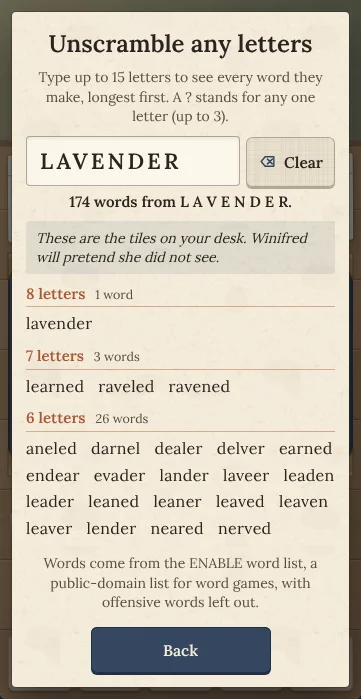
Teasel Lane Word Scramble has an unscrambler on the same page, opened from the title or the Menu. Type up to 15 letters, with ? for up to three blanks that can stand for any letter, and it lists every word those letters make, grouped by length, longest first. It runs on your device, and the list updates as you type. In the results, a letter that a blank stands for is shown in italics and underlined.
It searches ENABLE, the Enhanced North American Benchmark Lexicon. The list’s own README, which Debian publishes with its scowl package at sources.debian.org, says it was formally released into the public domain and calls it eminently suitable for most word games and for crossword puzzle solving. It has 172,823 words; we took out 487 offensive words, leaving 172,336, and the puzzles use the same list. It is a word game list, so expect plenty of words you may never have met.
The letters of TEAPOT make 44 words of two letters or more, including PETTO, the only five-letter word among them. The letters of LAVENDER make 174 words, among them LEARNED, RAVELED and RAVENED, three seven-letter words that leave out one letter. Blanks open things up fast: the seven letters TEALSEN with one blank make 2,030 words. Across the game’s puzzles, each word’s letters make a median of 16 words for Easy, 40 for Medium and 154 for Hard.
The unscrambler is at its best with letters from elsewhere, such as a crossword answer you half know or a rack of tiles in a board game. For a Teasel Lane puzzle it gives the game away at once, since the longest group holds the answer alone, so a hint, which sets one letter, keeps more of the fun. Type the letters on your desk anyway and the unscrambler notes that Winifred will pretend she did not see.
Common mistakes
Staring at the dealt order. The scramble you are dealt is chosen so that no letter starts where it belongs and almost none sits in its own place, so it will not hint at the word. Shuffle, or rearrange the tiles yourself, instead of waiting for the first order to make sense.
Forgetting a repeated letter. A word with two of the same letter has fewer orders, not more: LAVENDER’s eight letters, with two Es, can go in 20,160 orders rather than 40,320, but a doubled letter is easy to overlook when you are building pairs. Count the tiles before you decide a word cannot fit.
Reaching for S at the end. Plurals are common in the word list but rare in the puzzles: only 44 of the 1,020 puzzle words end in S. An S is more often inside the word, in pairs such as ST and SH.
Ignoring the clue, and saving the hint too long. The category narrows things a great deal, and on a long word one hint gives you its first letter, which is worth more than five minutes of shuffling.
Tips for faster solving
Say the letters aloud in a few different orders; your ear catches words your eye misses. Build from a pair you are sure of, such as CK or NG, and add one letter at a time on either side. Put the remaining vowels last. When two letters keep fighting for the same place, leave both out and solve the rest first.
Practice with the Easy packs, where five letters can go in 120 orders at most, before moving to Hard. Today’s ten mixes all three levels and keeps a streak for days with every word solved, with hints allowed, which is a good daily habit. If you want more challenge, turn the clue cards face down in Settings and lift them only when you need to.
Related games
If you like word puzzles, Cottage Word Search has 48 themed puzzles in four seasonal books, where the letters left over spell a hidden saying. Starlight Launch is a code-breaking puzzle: crack 3-digit locks from green and amber clues, a good fit if you enjoy working out an answer from what you have ruled out. Bergamot Parlor 24 is the Make 24 card puzzle, combining four numbers to make exactly 24, and Sprout Sudoku is classic 9x9 sudoku with hints that explain the next step in plain words.
Back to the desk
Unscrambling comes down to a few habits: read the clue, build the ending first, put letters that belong together side by side, keep the vowels spread out, and shuffle when the order in front of you has gone stale. Start with the Easy packs of five-letter words, where the letters can go in 120 orders at most, and work up to Hard, where a typical word allows 45,360. When a word will not come, a hint or the unscrambler is there, and Winifred will not say a word about it.
- Play Teasel Lane Word Scramble, our free word scramble and unscrambler
- Teasel Lane Word Scramble: features, controls and FAQ
- Cottage Word Search: 48 themed word search puzzles
- How to play Cottage Word Search
- Starlight Launch: crack 3-digit locks from color clues
- Bergamot Parlor 24: the Make 24 card puzzle
- How to play Make 24: rules, hands and tips
- Sprout Sudoku: classic 9x9 sudoku
- The best cozy puzzle games
- More cozy classic games
More guides and roundups
Finished today's Wordle in three and want more? Here are the best Wordle alternatives, from the New York Times' own daily games to Quordle, Waffle, Absurdle and Nerdle, plus seven free browser puzzles from CozyWorld.
How to Play Hangman: Rules, Letters and StrategyHangman is the classic word game of guessing a word one letter at a time before a picture is finished. Here are the rules, how six and eight misses differ, the best first letters by our own count of our word list, how to read the pattern, how phrases change the game, and the common mistakes and tips that solve more words.
Fun Trivia Questions and AnswersA hundred general knowledge trivia questions with their answers, in eight topics from food and cooking to the arts, each with a one-line reason the answer is right. They come from the bank of our free daily trivia quiz, along with how the quiz works and how to do better at questions you are not sure of.
Best Logic Games for Adults: 17 Puzzles to SolveLogic games where every answer can be reasoned out: nine free browser puzzles from CozyWorld, from nonograms to Minesweeper with no-guess boards, then eight more logic puzzle games from daily web puzzles to The Witness.