
CozyWorld game guide · By CozyWorld
This guide covers our own game, written from the current game rules and browser checks.
Fun Trivia Questions and Answers
A hundred general knowledge trivia questions with their answers, in eight topics from food and cooking to the arts, each with a one-line reason the answer is right. They come from the bank of our free daily trivia quiz, along with how the quiz works and how to do better at questions you are not sure of.
Good trivia questions have answers you can almost reach: something you half remember from a book, a trip or a dinner table argument, and a reason that makes you nod once you hear it. Here are a hundred of them, in eight topics: food and cooking, nature and animals, geography, history, science, words and language, sports and games, and the arts. Every one has four possible answers in the game, the right one here, and one line on why it is right.
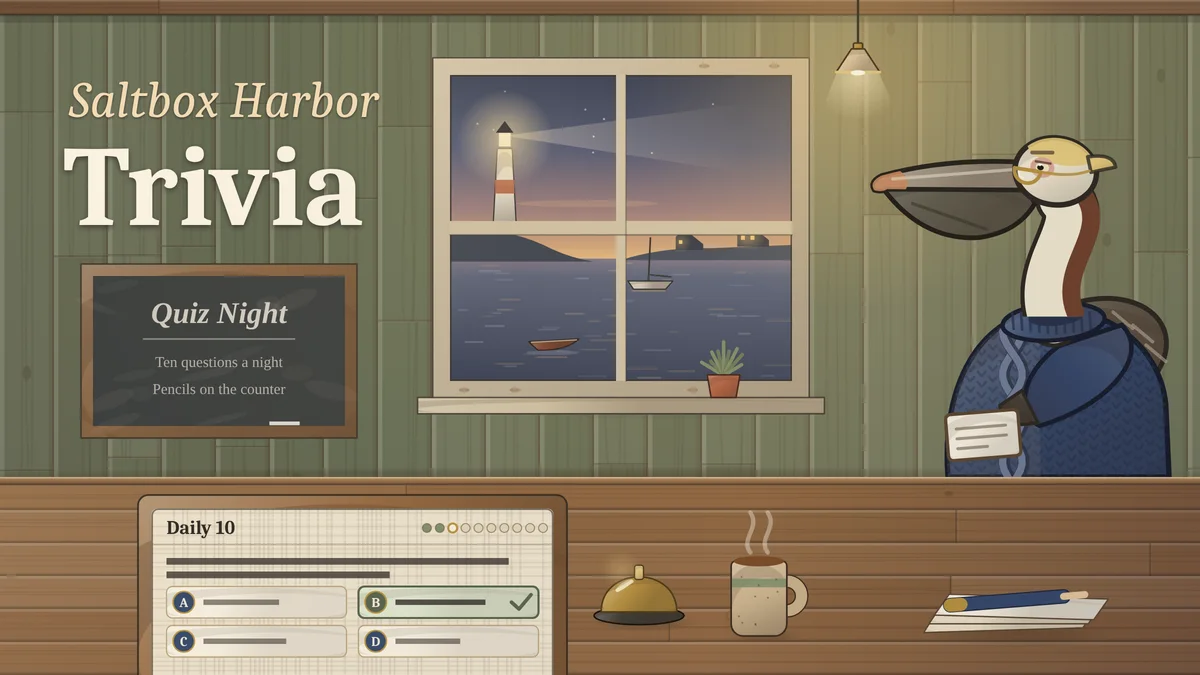
They come from the question bank of Saltbox Harbor Trivia, CozyWorld’s free daily trivia quiz, where Thaddeus, a brown pelican in a fisherman’s sweater, reads the questions in the back room of a harbor pub. Each question in the bank was checked against the Wikipedia article it names, and the answer and the line on why both come from a passage of that article. Cover the Answer and Why columns and test yourself, or read them aloud at the table. The guide starts with how the quiz works and a few habits that help with questions you are unsure of; the questions follow, topic by topic.
How the quiz works
Saltbox Harbor Trivia is a multiple-choice quiz. Each quiz is ten questions, each question has four answers, and exactly one is right. The object is simply to get as many of the ten right as you can. There is no clock, no penalty for a wrong answer beyond the point you did not score, and no way to lose a quiz partway through.
Every day brings the Daily 10: ten questions with at least one from each of the eight topics, the same ten for everyone on that date, with the answers in the same order. It counts once a day. Finish it on days in a row and your streak grows; miss a day and it starts again. Your best streak and your best daily score are kept on your device.
Any time, you can also play a topic quiz: ten questions from one of the eight topics, or ten from the whole bank. Each topic deals from its own shuffled deck, so you see the rest of a topic before a question comes round again. In our own simulation of the game’s decks, a question was never asked again within 42 questions of the same topic, and in our simulation of two years of Daily 10s, the shortest gap before a daily question came back was 66 days.
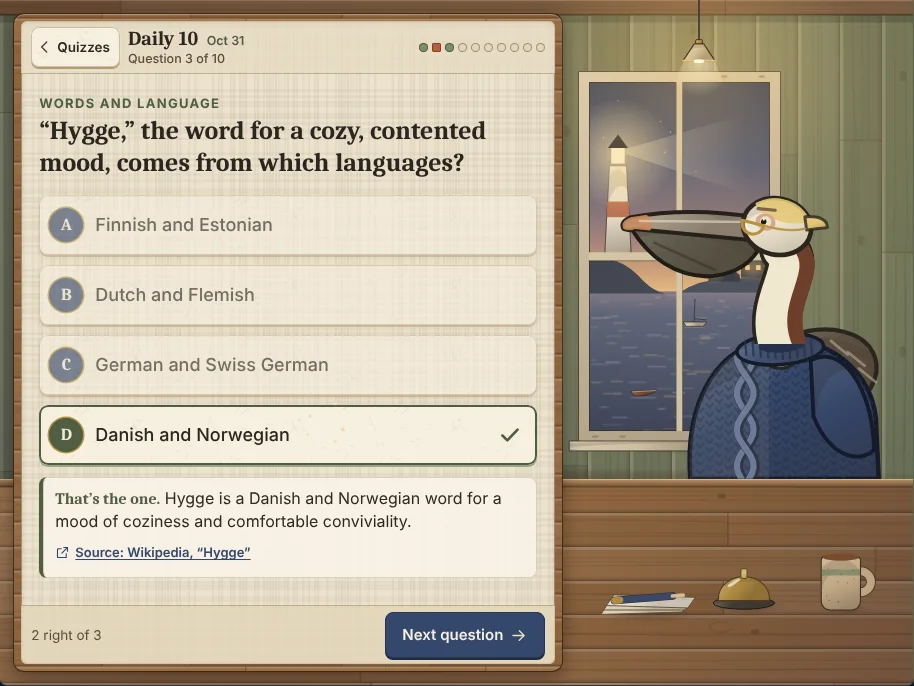
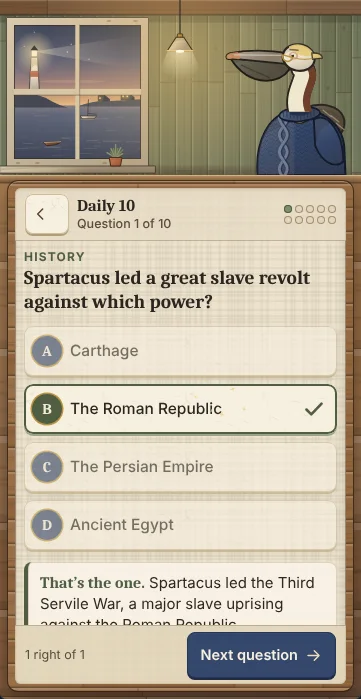
After every answer the right one is marked with a tick and the one you picked, if it was wrong, with a cross, and a line underneath says why, with a link to the article the question was checked against. At the end of a quiz you get your score, a dry word from Thaddeus and a review of all ten.
| Daily 10 | Topic quiz | |
|---|---|---|
| Questions | 10 | 10 |
| Answers per question | 4, one right | 4, one right |
| Topics | All eight, at least one each | One topic, or the whole bank |
| Same for everyone | Yes, by date | No, your own shuffled deck |
| How often | Once a day, with a streak | As often as you like |
| What is kept | Score by date, streak, best score | Quizzes played, best score, share right |
Controls
On a phone or tablet, tap an answer to pick it, then tap Next question. With a mouse, click. The Quizzes button at the top of the board goes back to the list of quizzes, and a quiz you leave there is kept exactly where you left it, even if you close the page.
With a keyboard, press 1 to 4 or A to D to pick an answer, or move between the answers with the arrow keys and press Enter. After answering, Enter or N goes to the next question, and Escape goes back to the list of quizzes. Restart in the toolbar deals ten new questions in a topic quiz.
Beginner strategy: answering the questions you are not sure of
Most trivia questions are not won by knowing the answer outright. They are won by knowing enough to throw out the wrong ones. With four answers, ruling out one takes a blind guess from one chance in four to one in three, and ruling out two makes it one in two. In our own simulation of 100,000 Daily 10 quizzes answered completely at random, the average score was 2.5 out of 10, so every answer you can eliminate is worth having.
Start with the answers that are in the wrong category altogether: a city offered for a river, a country on the wrong continent, a painter from the wrong century. Then use what the question gives you. A question that names a region, a language or a date usually contains a clue to the answer, and the names of things often carry their meaning, especially in science and in the history of words.
For questions with a number or a year, anchor on something you are sure of and reason from it. You may not know the year of the Boston Tea Party, but you know it came before the Declaration of Independence in 1776, and in the game’s version of that question that rules out two of the four years.
Common mistakes
Answering a slightly different question. Words like largest, first, only, longest and not change everything, and they are easy to skim past. A country’s capital and its largest city are different questions, and in Australia they are different cities.
Picking the famous answer because it is famous. Quiz writers know which wrong answer most people reach for. If a question seems too easy, read it again: the familiar name is sometimes right, but it is also the most common trap.
Changing a sound first instinct for no reason. If you knew the answer before you started second-guessing, it is usually still right. Change it only when you can say why the new answer is better.
Skipping the why. A bare fact fades by the next morning, but a fact with a reason attached tends to stay, and the same facts turn up again in other questions.
Tips for better scores
Play the Daily 10 first. It counts once a day and it carries your streak, and because it draws from all eight topics it shows you where you are strong and where you are not.
Practice your weakest topic. The Scores card shows the share of answers you get right in each topic quiz; a run of ten from the one with the lowest share is the quickest way to raise your daily score.
Follow the source when a question surprises you. The link under each answer goes to the Wikipedia article the question was checked against, and reading a paragraph around the fact makes it stick.
Read questions aloud if you are playing with someone. Trivia is a social game at heart, and a second person often remembers the half of the answer you forgot.
Food and cooking trivia questions
Where dishes come from, what is really in them and the kitchen words behind them. Questions on spices and sauces tend to turn on one detail, such as a part of a plant or a place, so read the question twice.
| # | Question | Answer | Why |
|---|---|---|---|
| 1 | Botanically, what is a peanut? | A legume | The peanut is a legume grown mainly for its edible seeds, which ripen underground. |
| 2 | Hollandaise sauce is an emulsion of egg yolk, lemon juice and what? | Butter | Hollandaise is an emulsion of egg yolk, melted butter and lemon juice. |
| 3 | What makes sourdough bread rise? | Wild yeast and bacteria | Sourdough is leavened by a starter of naturally occurring yeast and lactobacillus bacteria. |
| 4 | Mole poblano, a dark sauce of chili peppers and chocolate, is native to which Mexican state? | Puebla | Mole poblano is an old dish native to the state of Puebla, and has been called Mexico’s national dish. |
| 5 | The croissant was inspired by the shape of which Austrian pastry? | The kipferl | The croissant takes its crescent shape from the Austrian kipferl but uses a laminated yeast dough. |
| 6 | The heat of chili peppers is measured on which scale? | The Scoville scale | The Scoville scale measures the spiciness of chili peppers in Scoville heat units. |
| 7 | Clotted cream is most associated with which two English counties? | Devon and Cornwall | Clotted cream is associated with the dairy farms of Devon and Cornwall in south west England. |
| 8 | German pumpernickel bread is made from which grain? | Rye | Pumpernickel is a heavy, dark bread made from coarsely ground rye. |
| 9 | To julienne a carrot is to cut it into what? | Long thin strips | Julienne is a knife cut into long thin strips, like matchsticks. |
| 10 | Turmeric belongs to which plant family? | The ginger family | Turmeric is Curcuma longa, a flowering plant in the ginger family, Zingiberaceae. |
| 11 | Pizza Margherita is traditionally said to be named after whom? | A queen of Italy | A popular legend says a Naples pizzaiolo created it in 1889 in honor of the visiting Queen Margherita. |
| 12 | Tequila is distilled from which plant? | Blue agave | Tequila is distilled from the blue agave plant, mainly around the city of Tequila in Jalisco. |
| 13 | Cloves are the dried what of a tropical tree? | Flower buds | Cloves are the aromatic flower buds of Syzygium aromaticum, a tree in the myrtle family. |
Nature and animal trivia questions
Animals, trees and the odd habits of both. A good share of these reward knowing a family resemblance: which animals are related, and what a plant or animal actually is underneath its common name.
| # | Question | Answer | Why |
|---|---|---|---|
| 14 | Where were cats first domesticated? | The Near East | The cat was first domesticated in the Near East around 7500 BC. |
| 15 | Which oily compound in poison ivy causes an allergic skin rash on contact? | Urushiol | In most people, urushiol causes an allergic skin rash on contact. |
| 16 | Methuselah, one of the oldest known living trees, is what kind of tree? | A bristlecone pine | Methuselah is a Great Basin bristlecone pine in California’s White Mountains, more than 4,800 years old. |
| 17 | A lichen is a partnership between fungi and what? | Algae or cyanobacteria | A lichen is a colony of algae or cyanobacteria living symbiotically among the filaments of fungi. |
| 18 | The axolotl, a salamander that keeps its gills as an adult, is native to lakes in which country? | Mexico | The axolotl is native to Lake Xochimilco and Lake Chalco in the Valley of Mexico. |
| 19 | Hyperion, the world’s tallest known living tree, is what species? | A coast redwood | Hyperion is a coast redwood in Northern California, measured at about 116 m tall. |
| 20 | What is the largest toothed predator on Earth? | The sperm whale | The sperm whale is the largest of the toothed whales and the largest toothed predator. |
| 21 | What often grows on the fur of sloths, tinting it green? | Algae | Sloths move so little that algae grow on their fur, helping camouflage them. |
| 22 | The Australian lyrebird is famous for what? | Mimicking almost any sound | Lyrebirds can mimic natural and artificial sounds from their surroundings. |
| 23 | Besides the platypus, which animals are the only other living egg-laying mammals? | Echidnas | The five living monotreme species, the egg-laying mammals, are the platypus and four species of echidnas. |
| 24 | Which is the tallest and heaviest of all living penguins? | The emperor penguin | The emperor penguin is the tallest and heaviest of all living penguin species. |
| 25 | Where does a flamingo’s pink color come from? | Pigments in its food | Flamingos get their pink and red colors from carotenoid pigments in their diet. |
| 26 | Ants are most closely related to which insects? | Wasps and bees | Ants evolved from wasp-like ancestors and belong to the same order as wasps and bees. |
Geography trivia questions
Rivers, mountains, capitals and the borders between them. When you are unsure, think about which answers are in the right part of the world at all; that usually rules out two of the four.
| # | Question | Answer | Why |
|---|---|---|---|
| 27 | Lesotho is completely surrounded by which country? | South Africa | Surrounded by South Africa, Lesotho is the largest of the world’s three sovereign enclaves. |
| 28 | The Gobi Desert lies in China and which other country? | Mongolia | The Gobi is a large, cold desert and grassland region in southern Mongolia and North China. |
| 29 | Which strait divides the city of Istanbul between Europe and Asia? | The Bosporus | The Bosporus runs through Istanbul and forms part of the boundary between Europe and Asia. |
| 30 | Victoria Falls is on which river? | The Zambezi | Victoria Falls is on the Zambezi River, on the border of Zambia and Zimbabwe. |
| 31 | What is the longest river in the United States? | The Missouri | By the commonly cited length of 2,341 miles, the Missouri is the nation’s longest river, slightly longer than the Mississippi it flows into. |
| 32 | What is the longest river in Europe? | The Volga | The Volga is the longest river in Europe. |
| 33 | Aconcagua, the highest mountain outside Asia, is in which country? | Argentina | Aconcagua, in the Andes of Mendoza Province, Argentina, is the highest mountain outside Asia. |
| 34 | Tokyo was originally known by which name? | Edo | Tokyo, originally Edo, rose to prominence in 1603 as the seat of the Tokugawa shogunate. |
| 35 | Angel Falls, the world’s tallest uninterrupted waterfall, is in which country? | Venezuela | Angel Falls in Venezuela is 979 m high, with an uninterrupted plunge of 807 m. |
| 36 | What is the capital of Australia? | Canberra | Canberra, a planned city, is the capital of Australia. |
| 37 | Thailand was formerly known by which name? | Siam | Thailand was historically known as Siam. |
| 38 | Which continent has the highest average elevation? | Antarctica | Antarctica is the coldest, driest and windiest continent and has the highest average elevation. |
| 39 | Iceland sits on which geological feature, between Europe and North America? | The Mid-Atlantic Ridge | Iceland lies on the Mid-Atlantic Ridge between Europe and North America. |
History trivia questions
Dates, voyages, empires and firsts. For a year question, anchor on something you do know (a war, a reign, a century) and count from there.
| # | Question | Answer | Why |
|---|---|---|---|
| 40 | After the Battle of Waterloo, Napoleon was exiled to which island, where he died? | Saint Helena | After Waterloo he was sent to Saint Helena in the South Atlantic, where he died in 1821. |
| 41 | In which year did the Boston Tea Party take place? | 1773 | The Boston Tea Party was a protest that took place on December 16, 1773, during the American Revolution. |
| 42 | Who was the first human to travel into outer space? | Yuri Gagarin | Yuri Gagarin, flying under the call sign Kedr, was the first human to travel into space. |
| 43 | Hannibal, who led war elephants over the Alps into Italy, was a general of which city? | Carthage | Hannibal was a Carthaginian general who commanded the forces of Carthage against the Roman Republic. |
| 44 | The Silk Road network began with the expansion of which Chinese dynasty into Central Asia? | The Han dynasty | The network began when the Han dynasty expanded into Central Asia around 114 BCE. |
| 45 | The Code of Hammurabi is a law code from which ancient civilization? | Babylon | It is a Babylonian legal text composed around 1753 BC under Hammurabi, king of Babylon. |
| 46 | The Statue of Liberty was a gift to the United States from the people of which country? | France | The statue was a gift from the people of France, dedicated in 1886. |
| 47 | Which German craftsman invented the movable-type printing press? | Johannes Gutenberg | Johannes Gutenberg was a German inventor and craftsman who invented the movable-type printing press. |
| 48 | The D-Day landings of June 6, 1944, took place on the coast of which French region? | Normandy | The Normandy landings on June 6, 1944, began the Allied invasion of Normandy in Operation Overlord. |
| 49 | What was the capital of the Inca Empire? | Cusco | Cusco was founded in the 12th century as the capital of the Kingdom of Cusco and later of the Inca Empire. |
| 50 | Who led the first expedition to reach the South Pole, in 1911? | Roald Amundsen | Amundsen’s Norwegian team reached the South Pole on December 14, 1911. |
| 51 | In which year did the California Gold Rush begin? | 1848 | It began on January 24, 1848, when gold was found at Sutter’s Mill in Coloma. |
| 52 | The Berlin Wall stood from 1961 until which year? | 1989 | The wall encircled West Berlin from 1961 to 1989, separating it from East Berlin and East Germany. |
Science trivia questions
The planets, the elements and the body, with a few of the people who worked them out. Many science answers can be reasoned out from the name: words often carry their Greek or Latin meaning.
| # | Question | Answer | Why |
|---|---|---|---|
| 53 | Diamond is a solid form of which element? | Carbon | Diamond is a solid form of the element carbon, with its atoms in a crystal structure. |
| 54 | Pi is the ratio of a circle’s circumference to its what? | Diameter | Pi is a circle’s circumference divided by its diameter, about 3.14159. |
| 55 | Olympus Mons, one of the largest volcanoes in the Solar System, is on which planet? | Mars | Olympus Mons is a huge shield volcano on Mars. |
| 56 | Edward Jenner pioneered the first vaccine, against which disease? | Smallpox | Jenner pioneered the smallpox vaccine, the world’s first vaccine. |
| 57 | Marie and Pierre Curie named the element polonium after which country? | Poland | Polonium was named after Poland, Marie Curie’s homeland. |
| 58 | Dry ice is the solid form of which substance? | Carbon dioxide | Dry ice is solid carbon dioxide, which turns straight to gas at −78.5 °C. |
| 59 | Which acid gives vinegar its sour taste? | Acetic acid | Vinegar is mainly water and acetic acid. |
| 60 | Halley’s Comet returns to the inner Solar System about every how many years? | 74 to 79 years | It is the only known short-period comet regularly visible to the naked eye, appearing roughly every 74 to 79 years. |
| 61 | What is the nearest star to the Sun? | Proxima Centauri | Proxima Centauri, a small red dwarf about 4.25 light-years away, is the Sun’s nearest star. |
| 62 | Which mineral was historically called “black lead” or plumbago? | Graphite | Graphite was historically called black lead or plumbago, from confusion with similar-looking lead ores. |
| 63 | Which organ produces the hormone insulin? | The pancreas | Insulin is made by the beta cells of the pancreatic islets. |
| 64 | Polaris, the North Star, is in which constellation? | Ursa Minor | Polaris is a yellow supergiant in the northern constellation of Ursa Minor. |
Word and language trivia questions
Figures of speech, word origins and the languages of the world. The surprising histories of everyday words make some of the best quiz questions there are.
| # | Question | Answer | Why |
|---|---|---|---|
| 65 | A word formed by rearranging the letters of another word is called what? | An anagram | An anagram rearranges the letters of a word or phrase to make a new one. |
| 66 | Which official language of South Africa makes especially heavy use of click consonants? | Xhosa | In one count, about 10 percent of basic Xhosa words contained a click. |
| 67 | Which American lexicographer published An American Dictionary of the English Language in 1828? | Noah Webster | Noah Webster’s American Dictionary of the English Language appeared in 1828. |
| 68 | The leotard was made famous by Jules Léotard, who was what kind of 19th-century performer? | An acrobat | The garment was made famous by the French acrobatic performer Jules Léotard (1838–1870). |
| 69 | The word “quarantine” comes from the Italian for a period of how many days? | Forty | It comes from quarantena, meaning “forty days,” used in Venetian in the 14th and 15th centuries. |
| 70 | The word “boycott” comes from Captain Charles Boycott, a land agent shunned by locals in which country? | Ireland | Boycott was an English land agent whose shunning by his community in Ireland gave English the word. |
| 71 | A language used to communicate between people who do not share a native language is called what? | A lingua franca | A lingua franca is a language systematically used between speakers whose native languages differ. |
| 72 | In the acronym “radar,” what does the first R stand for? | Radio | Radar is short for radio detection and ranging. |
| 73 | Saying “not bad” to mean “good” is an example of which figure of speech? | Litotes | Litotes emphasizes a point by stating a negative to affirm a positive, as in “not bad.” |
| 74 | The word “shampoo” came into English from which language? | Hindi | Shampoo dates to 1762 and comes from the Hindi cā̃pō, from a Sanskrit root meaning “to press, knead, or soothe.” |
| 75 | What is a misheard phrase, often a song lyric, called? | A mondegreen | A mondegreen is a mishearing of a phrase that gives it a new meaning. |
| 76 | What is the ¶ symbol, used to mark a new paragraph, called? | A pilcrow | The pilcrow, ¶, is a typographical character marking a new paragraph. |
Sports and games trivia questions
Rules, numbers and origins, from the board games of ancient Egypt to the snooker table. Counting questions are easier if you picture the field, the board or the deck.
| # | Question | Answer | Why |
|---|---|---|---|
| 77 | Senet, one of the oldest known board games, comes from which ancient civilization? | Ancient Egypt | Senet is a board game from ancient Egypt, played with pawns on a 30-square board. |
| 78 | A regulation professional baseball game lasts how many innings? | Nine | A standard professional baseball game has nine innings. |
| 79 | The racket sport squash was invented at which English school? | Harrow School | Squash was invented at Harrow School around 1830. |
| 80 | The marathon commemorates a legendary messenger who ran from the Battle of Marathon to which city? | Athens | Legend says the messenger Pheidippides ran the whole way to Athens to announce the Greek victory. |
| 81 | Which chess move lets a player move the king and a rook in the same turn? | Castling | Castling moves the king two squares toward a rook, and the rook to the square the king crossed. |
| 82 | How many red balls are on a snooker table at the start of a frame? | 15 | A frame of snooker starts with 15 reds and six colored balls. |
| 83 | A standard Go board has a grid of how many lines by how many? | 19 by 19 | The standard Go board is a 19 by 19 grid of lines. |
| 84 | The first commercial jigsaw puzzles, from around 1760, were cut from what? | Maps | John Spilsbury, a London cartographer, cut up world maps as a geography teaching aid. |
| 85 | Polo players drive the ball with a wooden mallet while doing what? | Riding horses | Players hit the ball between the goal posts with a wooden mallet while riding at up to 35 miles per hour. |
| 86 | In chess, what is it called when the player to move has no legal move but is not in check? | Stalemate | Stalemate results in a draw, which can save a player who would otherwise lose. |
| 87 | The boules game pétanque comes from which country? | France | Pétanque is a form of boules that originated in France. |
| 88 | The first basketball games used what for hoops? | Peach baskets | Naismith nailed up peach baskets as the first goals. |
Arts trivia questions
Painting, music, books and the stage. Picture the work if you can; a famous image or a first line often brings the name back with it.
| # | Question | Answer | Why |
|---|---|---|---|
| 89 | Who wrote Robinson Crusoe? | Daniel Defoe | Robinson Crusoe is a novel by Daniel Defoe, first published in 1719. |
| 90 | In sheet music, what does the marking “forte” tell a player to do? | Play loudly | Forte, marked f, means loud; piano, marked p, means soft. |
| 91 | Flamenco, an art form of song, dance, and guitar, comes from which region of Spain? | Andalusia | Flamenco developed in Andalusia in southern Spain. |
| 92 | Mozart was born in which city? | Salzburg | Mozart was born on January 27, 1756, at Getreidegasse 9 in Salzburg. |
| 93 | At which London address does Sherlock Holmes live? | 221B Baker Street | Dr. Watson often shares quarters with Holmes at 221B Baker Street, London, where many of the stories begin. |
| 94 | In Gulliver’s Travels, what is the land of tiny people called? | Lilliput | Shipwrecked on his first voyage, Gulliver is captured by people less than 6 inches tall on the island of Lilliput. |
| 95 | The Venus de Milo was found on which Greek island? | Milos | The statue was discovered in 1820 on the island of Milos. |
| 96 | A line of iambic pentameter has how many iambs, or feet? | Five | Each line has five metrical feet, and an iamb is an unstressed syllable followed by a stressed one, as in “a-BOVE.” |
| 97 | Ikebana is the Japanese art of what? | Flower arrangement | Ikebana is the Japanese art of flower arrangement. |
| 98 | Which Brontë sister wrote Wuthering Heights? | Emily | Wuthering Heights is the only novel by Emily Brontë, first published under the pen name Ellis Bell. |
| 99 | Which artist painted The Persistence of Memory, with its soft, melting pocket watches? | Salvador Dalí | The Persistence of Memory is a 1931 painting by Salvador Dalí. |
| 100 | Who painted American Gothic, the portrait of a farmer holding a pitchfork beside a woman? | Grant Wood | American Gothic is a 1930 painting by Grant Wood. |
Related games
If you like the Daily 10, a daily puzzle may suit you too. Sprout Sudoku and Sprout Killer Sudoku have the classic number puzzles with hints that explain the next step, and Cottage Word Search has 48 themed word searches whose leftover letters spell a saying. For numbers, Bergamot Parlor 24 asks you to make exactly 24 from four cards, and Hollyhock Math Path asks for a route through a garden that adds up.
All of them are free on CozyWorld, run in the browser on a phone, tablet or computer, and save your progress on your device.
Keep playing
The best way to get better at trivia is to keep meeting the facts, a few at a time, with a reason attached. Play the Daily 10 each morning or over lunch, read the why after every answer, and use a topic quiz on the subject you get wrong most often. For more calm classics that reward a good memory, try Cottage Word Search, with 48 themed puzzles through four seasons; Sprout Sudoku, the classic number puzzle with hints that explain the next step; or Hollyhock Math Path, where a route through a number garden has to add up.
- Play Saltbox Harbor Trivia: the free daily trivia quiz
- Saltbox Harbor Trivia: features, controls and FAQ
- Cottage Word Search: 48 themed word search puzzles
- Sprout Sudoku: classic 9x9 sudoku with hints
- Hollyhock Math Path: find the path that adds up
- Bergamot Parlor 24: make 24 from four cards
- Games like Wordle: daily word and logic puzzles
- Free online games for adults
More guides and roundups
Match mahjong tiles, solve sudoku and killer sudoku, slide 2048 tiles, make 24 from four number cards, sweep a minesweeper board, stitch a nonogram, find hidden words, unscramble a word, fit a jigsaw, rake leaf piles, sort shells, merge fruit or crack firefly codes. Choose a puzzle by the decisions it asks you to make.
How to Unscramble Words: Patterns and TipsUnscrambling a word is easier from the ends than from the front. Here are the rules of a word scramble, a beginner’s method, the endings, letter pairs and vowel patterns that turn up most, how to use an unscrambler without spoiling the fun, and the mistakes that cost the most time, with every count taken from our own puzzles and word list.
How to Play Hangman: Rules, Letters and StrategyHangman is the classic word game of guessing a word one letter at a time before a picture is finished. Here are the rules, how six and eight misses differ, the best first letters by our own count of our word list, how to read the pattern, how phrases change the game, and the common mistakes and tips that solve more words.
Best Logic Games for Adults: 17 Puzzles to SolveLogic games where every answer can be reasoned out: nine free browser puzzles from CozyWorld, from nonograms to Minesweeper with no-guess boards, then eight more logic puzzle games from daily web puzzles to The Witness.