
CozyWorld game guide · By CozyWorld
This guide covers our own game, written from the current game rules and browser checks.
How to Play Nonograms: Little Stitches Guide
How nonograms work and how to solve them, from reading clues to exact fits, overlap, edges and joining runs, with the hints and quilts of Little Stitches.
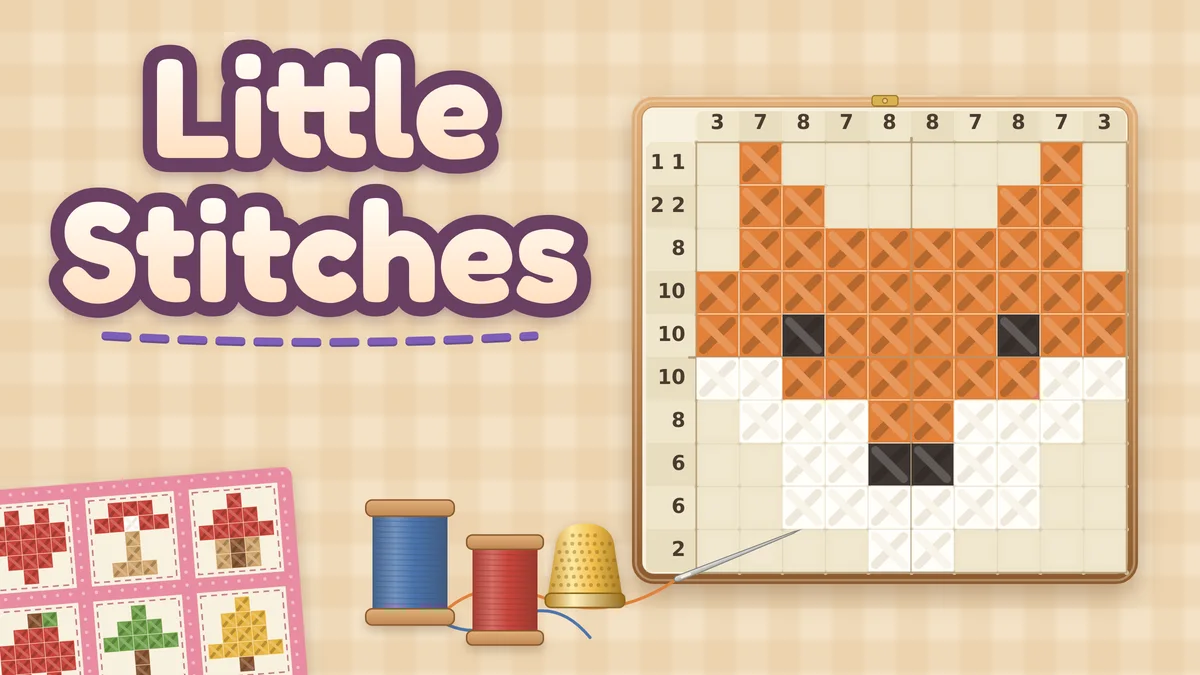
A nonogram is a picture logic puzzle: numbers beside every row and above every column tell you which squares to fill, and when every number is satisfied a hidden picture appears. It is also called griddlers, hanjie or paint by numbers. Little Stitches is our cozy nonogram, set in a cross-stitch hoop: you stitch the squares, and the finished pattern fills in with thread colors and joins a quilt. It has 72 hand-drawn patterns, a new quilt block every day and a Hint button that explains the next step in a sentence.
This guide teaches how nonograms work and how to solve them, one technique at a time, using the rules of the game. Every pattern in Little Stitches has exactly one solution that you can reach one row or column at a time, so none of it needs a guess. After the techniques it covers how hints work, the patterns and quilts, the controls and how the game saves.
How to play nonograms: the rules
A nonogram is a grid with numbers along the top and down the left side. Every square is either stitched or left empty, and the numbers tell you how the stitched squares are grouped. Each number is a run: that many stitched squares in a row, with no empty square inside it. Three rules are all there is to it. The numbers beside a row give its runs from left to right, and the numbers above a column give its runs from top to bottom, in that order. Between two runs there is at least one empty square, so two runs never touch. And a 0 means the line has no stitches at all. Every square that is not part of a run stays empty.
The puzzle is finished when every row and every column matches its numbers, and the stitched squares then make a picture. The numbers tell you how long each run is, never where it starts, and finding where is the whole puzzle. In Little Stitches you only decide between stitched and empty; the thread colors appear when the pattern is finished.
How to read a row or column clue
Read a row’s numbers from left to right and a column’s from top to bottom. A clue of 1 6 1 means three separate runs, in this order: one stitch, then six in a row, then one more stitch. A clue of 10 in a row that is 10 squares wide means the whole row is stitched, and a clue of 0 means none of it is. Little Stitches draws a heavier line every five squares, which makes it easier to count where you are in a 10 square line.
Before you place anything, work out how tight a line is. Add up its runs, add one empty square for each gap between runs, and subtract the total from the length of the line. What is left is the slack: how many squares the whole set of runs can slide. The clue 1 6 1 needs 1 + 6 + 1 plus two gaps, which is 10 squares, so in a row 10 squares wide it has a slack of 0 and can sit in only one way. The clue 6 1 needs 8 squares, so it has a slack of 2. Slack is the number to watch in every technique below: the smaller it is, the more the line tells you.
Your first solve: the Crown pattern
The first pattern in Little Stitches is a 5x5 Crown, and it can be solved from the row numbers alone. Its rows read 1 1 1, then 5, 5, 5, then 0. Each 5 is as wide as the row, so those three rows are stitched from edge to edge. The 1 1 1 needs 1 + 1 + 1 plus two gaps, which is exactly 5 squares: stitch, empty, stitch, empty, stitch. The 0 leaves the last row empty. The column numbers, 4 3 4 3 and 4, then confirm the picture: the first column is a run of four from the top, and the second is a run of three that starts one square down.
On this first pattern a short line above the hoop walks you through these same rows, one at a time, ringing the row it is talking about. The rest of First Stitches gives you eight more small 5x5 patterns to practice on before the larger ones begin.
Step 1: empty lines, full lines and exact fits
Start by scanning every row and column for lines that need no thinking. A 0 is an empty line. A number as big as the line is a full line. And a clue whose runs and gaps add up to the exact length of the line has no slack at all, so there is only one way to place it. In the Teapot pattern in the Tea Time quilt, row 4 reads 1 6 1 and row 5 reads 8 1. The first needs 1 + 6 + 1 plus two gaps and the second needs 8 + 1 plus one gap, and both come to 10, the width of the row, so both rows can be completed on the first pass.
These are the first steps on almost every nonogram, and they are among the first things the Hint button looks for. The hint for an exact fit like row 4 reads: Row 4’s runs 1 6 1 with one gap between each fill all 10 squares exactly.
Step 2: overlap, or simple boxes
Most lines have some slack, but a long run still has less room than it seems. Picture the run pushed as far left as it will go, then as far right. Any square that is stitched in both pictures is stitched wherever the run really sits, so you can stitch it right away. A run of 7 in a row of 10 covers squares 1 to 7 at the far left and 4 to 10 at the far right, so squares 4, 5, 6 and 7 are stitched either way. Nonogram solvers call this overlap, or simple boxes.
With more than one run, use the slack. Each run can slide by the slack and no more, so a run that is longer than the slack always has its length minus the slack in stitched squares, in the middle of its range. The clue 6 1 in a row of 10 has a slack of 2, so the 6 always covers squares 3 to 6, which are 4 squares, while the single stitch is not longer than the slack and gives you nothing yet. That is why the biggest numbers are the best place to begin on a large pattern: they are the runs most likely to be longer than the slack. A typical hint for this step reads: Slide row 6’s run of 7 all the way left or right: it covers the highlighted squares either way.
Step 3: edges
Squares at the ends of a line are easy to reason about, because only one run can claim them. If the first square of a row is stitched, the first run starts right there. Stitch the run’s full length and mark the square after it empty: with the clue 3 2 and square 1 stitched, squares 1 to 3 are stitched and square 4 is empty. The same works from the last square with the last run, counting back toward the start.
A stitch near an edge can pin a run too, even without touching the edge. Take the clue 4 2 with a stitch in square 3. The 2 cannot be the run that covers square 3, because the 4 would then have no room before it, so the stitch belongs to the 4. That run must start in square 1, 2 or 3, which means squares 3 and 4 are stitched whatever happens.
Step 4: marking the empty squares
Marking the squares that stay empty is as important as stitching. Switch to Cross and mark a square the moment you know it stays empty. A cross is a wall that no run can pass, and it often settles the squares beside it: a stretch of squares between two walls that is shorter than the smallest run still to place can be crossed out whole, and a cross at the end of a line shortens that line by one, which shrinks its slack and makes the overlap bigger.
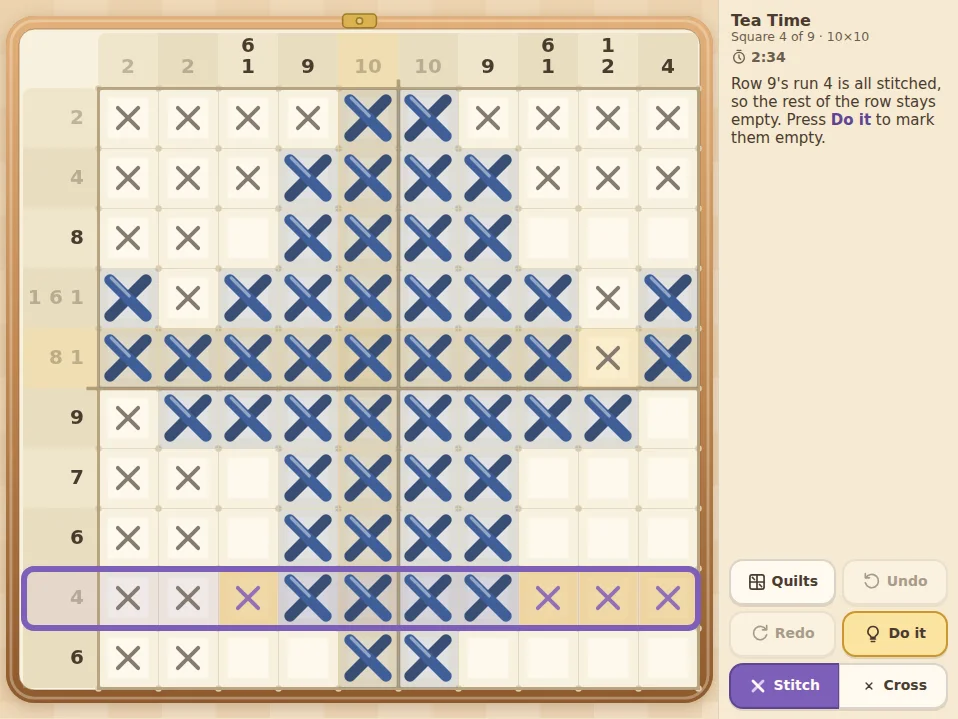
Two kinds of crosses come up all the time. When a run is complete, the squares at both ends of it are empty. And once every run in a clue has its stitches, the rest of the line is empty: in Little Stitches the numbers of a line fade when its stitches match, and that is the moment to cross out whatever is left. A typical hint for this reads: Row 9’s run 4 is all stitched, so the rest of the row stays empty. Crosses are only notes for you. A pattern is finished as soon as every row and column has the stitches its numbers ask for, with or without any crosses.
Step 5: joining and splitting runs
Joining: when two stitches must belong to the same run, stitch every square between them. That is certain when the line has only one run. Take the clue 5 in a row of 10 with stitches in squares 3 and 5. Square 4 has to be stitched, and because the run is 5 squares long and has to cover squares 3 to 5, it can start only in square 1, 2 or 3. That means squares 8, 9 and 10 can never be reached and stay empty.
Splitting: crosses cut a line into stretches, and every run has to fit entirely inside one stretch, in order. Take the clue 4 2 in a row of 10 with a cross in square 5. If the 4 sat to the right of the cross, the 2 would have to come after it, and squares 6 to 10 are only 5 squares long when the 4, a gap and the 2 need 7. So the 4 sits in squares 1 to 4, which is exactly its length, and the 2 is somewhere in squares 6 to 10.
Step 6: let rows and columns help each other
Every square belongs to one row and one column, so every stitch and cross you place is news for the other direction. Solve what you can in the rows, then read the columns again: a column that told you nothing at the start may now have a stitch near its edge, crosses at both ends or a finished run. Then go back to the rows. Sweeping across all the rows and then all the columns, over and over, is how most nonograms are solved. In Little Stitches the row and column under your finger, mouse or keyboard cursor are lightly highlighted, so you can see both lines of a square together, and a line whose numbers have faded needs no more attention.
When you seem to be stuck, go back to the lines with the least slack, and to the lines with a stitch or a cross near an edge. Some nonograms can only be finished with advanced patterns or a guess, but Little Stitches never asks for either: every pattern and every daily block has exactly one solution that can be reached one row or column at a time. If you are stuck, a line somewhere on the board still gives you something. Look for it, or ask for a hint.
How hints work in Little Stitches
Press Hint (or H) and the game looks at your board and finds the simplest next step, trying the same ideas as above in this order: a row or column that is 0, a line whose runs are all stitched so the rest stays empty, runs that fill a line exactly, the squares a long run covers wherever it slides, and finally what the stitches and crosses already in a line force. The first press explains the step in a sentence, rings the row or column and highlights the squares. The sentence shows in a panel beside the hoop on a wide screen and in a line above it on a phone. Try the step yourself, or press Hint again (the button now reads Do it) and the game does it, as one step that Undo can take back. In the screenshot, row 9 says 4 and its four stitches are down, so the hint says the rest of the row stays empty and shows the squares it would cross.
If any of your marks do not match the pattern, the hint deals with that first. It rings the row and says what is wrong, for example that a stitch in row 5 does not belong in this pattern, and Do it unpicks the wrong marks in that row. This is the only way the game checks your work, because it never marks a square wrong by itself. Hints are free and unlimited. Asking for one, even without pressing Do it, counts: a pattern finished without any earns a gold thimble, and a thimble you have earned stays on your record. In our automated checks, hints alone carried every pattern from a blank hoop to the finished picture without a guess.
Patterns, quilts and today’s block
Little Stitches has 72 hand-drawn patterns in eight quilts of nine. First Stitches teaches the rules on 5x5 patterns. Five quilts of 10x10 patterns follow: Tea Time, Sewing Basket, Kitchen Garden, Woodland and Seaside. The last two quilts, Pets and Pals and Starry Night, are tall 10x15 patterns. No pattern is wider than 10 squares, so the squares stay big enough to tap on a phone. Every quilt is open from the start, and inside each quilt the nine patterns run from the easiest to the hardest, so you can begin at a quilt’s first square and work forward or jump to any square you like.
When every row and column matches its numbers, the picture fills in with its thread colors and the game keeps your best time for that pattern. Finish all nine squares of a quilt and it is sewn together. The Quilts button shows every quilt, with your finished squares in color and a gold thimble on the ones you finished without a hint. You can reopen a finished pattern to look at it, or stitch it again from a blank hoop.
Today’s block is a new 10x10 quilt block every day, picked by your local date from a set of 365. Every block is symmetric, in two or three thread colors, and has one solution that you can reach one row or column at a time, like the patterns. It keeps its own record, separate from the patterns. An unfinished block is dropped when the date changes, and there is no streak to keep.
Controls: stitching, crossing and dragging
Tap or click a square to stitch it, and tap a stitched square to unpick it. The Stitch and Cross switch under the hoop chooses what a tap does: switch to Cross to mark squares that stay empty. On a computer, left click stitches and right click crosses, and when the switch is on Cross the two buttons swap.
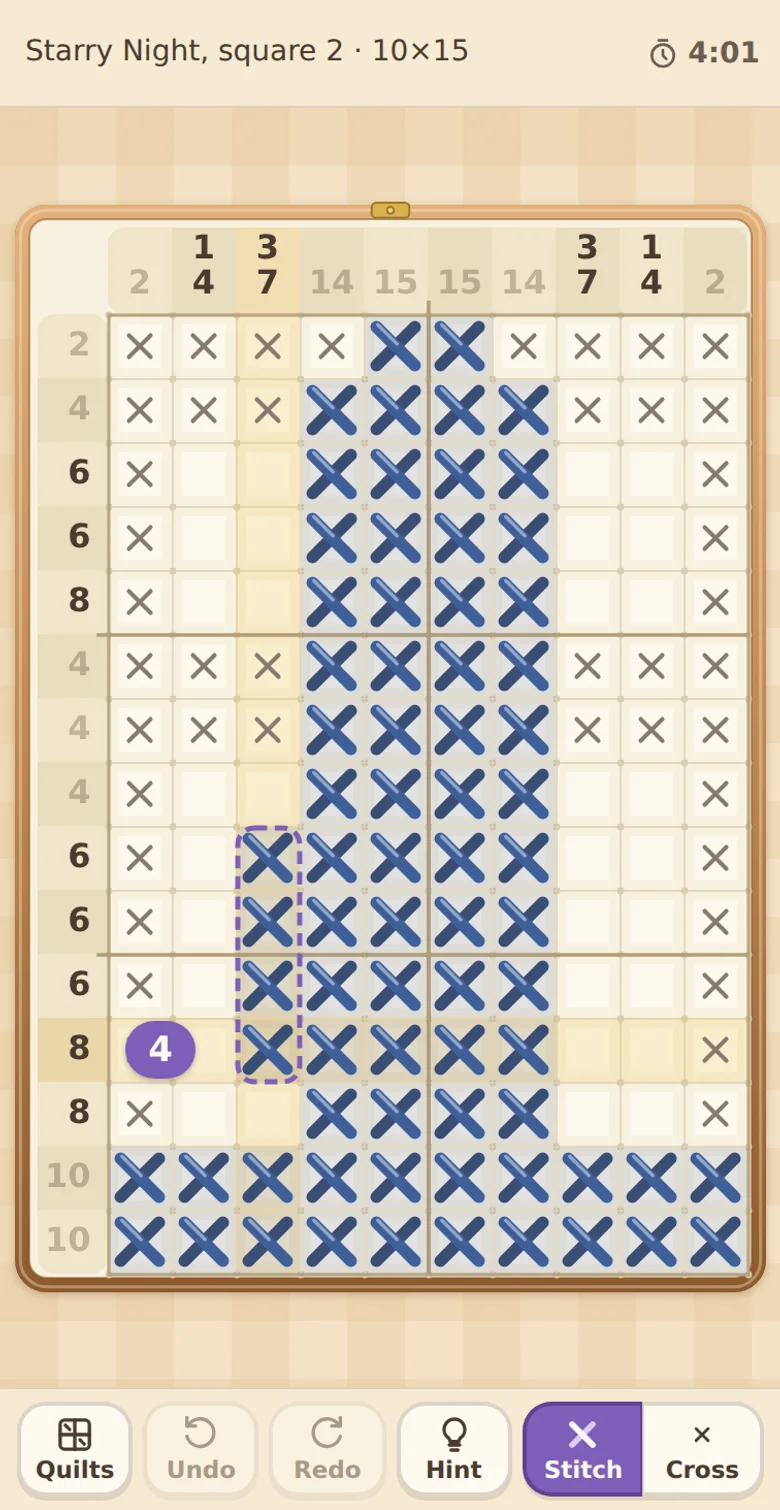
To fill a whole run in one go, press and drag along a row or column. The stroke locks to the row or column you start moving along, a small bubble shows how many squares it covers, and dragging back shortens it. The first square decides what the stroke does: start on a blank square and it stitches (or crosses) the blank squares it passes, and start on a square that already has the mark and it clears that mark along the stroke.
On a keyboard, the arrow keys move a highlighted square, Space or Enter stitches, X crosses, Backspace clears, Z undoes, Y redoes and H asks for a hint. Every button can be reached with Tab, and Escape closes the quilts. Undo and redo are free and step through your strokes one at a time. Restart in the toolbar clears the pattern on screen and its clock, Undo brings it back until your next stroke, and your records and quilts are never touched.
Timer, saving and accessibility
The clock only keeps your own best times. It counts while you are playing and stops while the game is paused, while the title card or the quilts are open and while the tab is hidden, and there are no lives and no mistake limit. Your progress saves on this device: every pattern you have started, with its stitches, crosses, clock and whether you asked for a hint, every finished pattern’s best time and gold thimble, today’s block in progress, the last pattern on screen and your Stitch or Cross choice. It saves after every stroke, undo, hint and finish, and when you pause or switch tabs. If the browser blocks saving, you can still play, and the game says your progress lasts only until you leave the page.
Everything can be played with a keyboard. A stitch is a bold X in thread on a tinted square and a cross is a thin pencil x, so the two differ in shape and weight as well as color. Strokes, rows and columns that match their counts, hints and the finish are announced to screen readers, and the hoop has a spoken summary of the pattern, the marks so far and the square under the keyboard cursor with its counts. Reduced motion shows the finished picture at once instead of filling it in, and sound is optional. We checked the game with automated desktop, phone-size and keyboard browser runs; these are not tests on physical devices or with real players.
Keep stitching
Once you can spot an exact fit, an overlap and an edge at a glance, a 10x10 pattern turns into a string of small, certain steps, and the tall 10x15 quilts are the same steps on a longer line. Start with the Crown, work through First Stitches, and keep Hint for the moment a line stops giving you anything. If you like this kind of careful deduction, Haunted Lanterns is a cozy Light Up puzzle with 36 rooms, where hints also explain each step in a sentence and no room ever needs a guess.
- Play Little Stitches
- More cozy classic games
- Haunted Lanterns: a Light Up logic puzzle with hints that explain
More guides and roundups
Match mahjong tiles, solve sudoku, stitch a nonogram, find hidden words, fit a jigsaw, rake leaf piles, sort shells or crack firefly codes. Choose a puzzle by the decisions it asks you to make.
Free Online Games for Seniors and Older AdultsFree online games for seniors and older adults: solitaire, mahjong, word search, sudoku, jigsaw and nonograms that open in a browser, with no countdown, no accounts and no purchases. Here is how the six compare on round length, timers and help.
Leaf Pile Nap Guide: Rules, Shapes and HintsThe rules of Leaf Pile Nap, how the animal shapes and the no-touch rule let you solve every garden without guessing, and how blankets, acorns, stars, hints and the daily garden work.
Best Cozy Halloween Games to Play in 2026Friendly ghosts, glowing lanterns and a pumpkin patch that keeps growing. Start with three free CozyWorld games in your browser, then pick a longer cozy Halloween game.