
CozyWorld game guide · By CozyWorld
This guide covers our own game, written from the current game rules and browser checks.
Mahjong Tiles: Names and Meanings of Every Tile
A mahjong set looks like 144 different pictures, and it is really 34 tiles repeated four times plus a handful of extras. This guide names every tile and explains what is drawn on it: the dots, bamboo and character suits, the four winds, the three dragons, the flowers and seasons, and the jokers of an American set, with the counts for each style and a few tricks for reading tiles quickly.
The tiles are the first hurdle in mahjong, and the lowest one. A standard Chinese set has 144 tiles, but only 34 different faces make up 136 of them, each appearing four times. Three suits run from one to nine, like the suits in a deck of cards. Seven more faces are the winds and dragons. The last eight tiles, the flowers and seasons, are bonus tiles that appear once each.
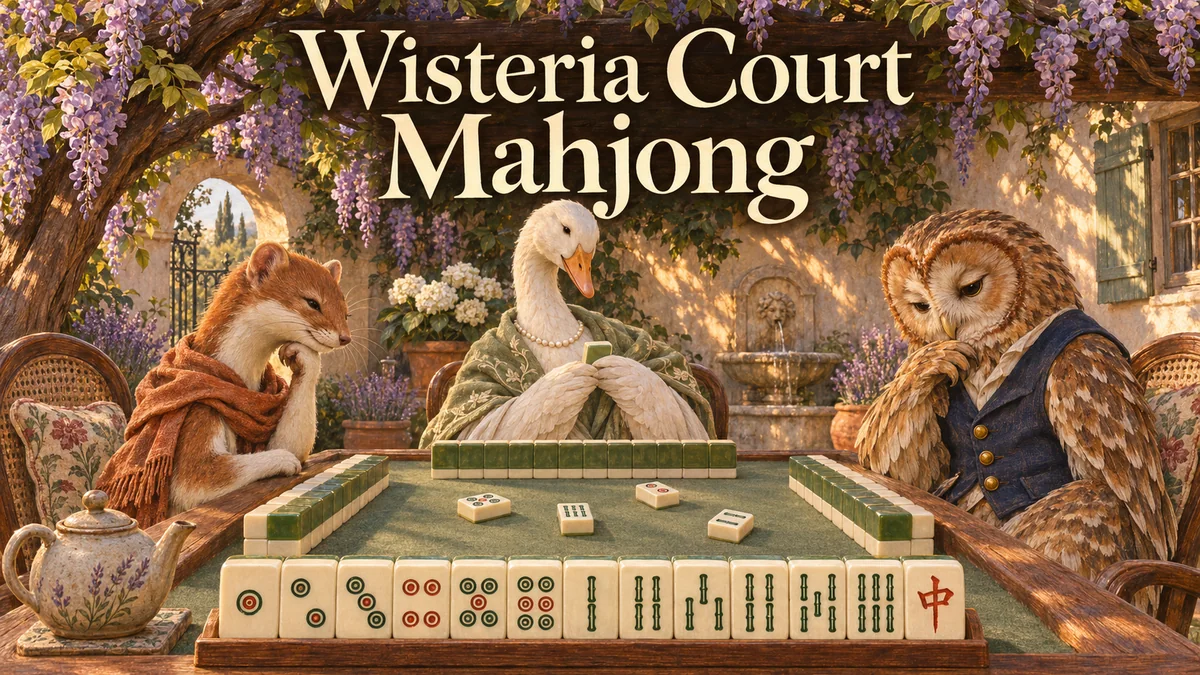
This guide goes through every group: what is on the tile, what it is called, how many there are and what it does in the game. The same tiles are used in the four-player game and in mahjong solitaire, so it serves for both. To see them in play, Wisteria Court Mahjong is CozyWorld’s free four-player table; its character tiles carry a small numeral in the corner and its winds a letter, so you can play before you have learned to read them.
The set at a glance
Every style of mahjong starts from the same 136 tiles: 108 suit tiles and 28 honor tiles. Styles differ in what they add. Most Chinese styles add eight bonus tiles for 144. American mahjong adds eight jokers as well, for 152. Riichi, the Japanese game, adds nothing and plays with 136.
| Group | Different tiles | Copies of each | Total |
|---|---|---|---|
| Dots | 9 (one to nine) | 4 | 36 |
| Bamboo | 9 (one to nine) | 4 | 36 |
| Characters | 9 (one to nine) | 4 | 36 |
| Winds | 4 (East, South, West, North) | 4 | 16 |
| Dragons | 3 (red, green, white) | 4 | 12 |
| Flowers | 4 | 1 | 4 |
| Seasons | 4 | 1 | 4 |
| Jokers (American sets only) | 1 | 8 | 8 |
Dots
The dots suit, also called circles or coins, is the easiest to read: count the circles. The one of dots is a single large circle, often an ornate one, and the nine is three rows of three.
American players call this suit Dots as well.
Bamboo
The bamboo suit shows sticks of bamboo, and again you count them: two sticks, three sticks and so on up to nine. American players call them Bams.
The one of bamboo is the exception. Instead of a single stick, most sets draw a bird, usually a sparrow or a peacock. New players often mistake it for a flower tile. It is an ordinary suit tile and can start the chow one, two, three.
The eight of bamboo is often drawn as two slanted groups of four that look like an M above a W. It still has eight sticks.
Characters
Each tile in the character suit has two Chinese characters. The lower one is the same on all nine tiles: 萬, pronounced wan, which means ten thousand. The upper one is the Chinese numeral from one to nine: 一, 二, 三, 四, 五, 六, 七, 八, 九. American players call this suit Craks, short for characters.
The first three numerals are simply one, two and three strokes. The rest have to be learned, which takes a few games. Many modern sets print a small Western numeral in the corner, and online tables usually do the same.
Winds
There are four wind tiles, each with one black character: 東 East, 南 South, 西 West and 北 North, four copies of each. Sets made for Western players add the letters E, S, W and N in a corner.
Winds have no numbers, so they cannot form a chow. They are collected as pungs, kongs or the pair. Each player also has a seat wind, starting with East for the dealer, and in most scoring a pung of your own seat wind or of the round’s wind is worth extra.
Dragons
The three dragons are the red dragon, a red 中 (zhong, the character for center); the green dragon, a green 發 (fa, from the phrase for prospering); and the white dragon, which is usually a blank tile or an empty frame. No dragon is pictured on any of them. Dragon is the name English-speaking players gave these tiles.
Like winds, dragons only form pungs, kongs and pairs. A pung of any dragon scores in most styles.
In American mahjong the white dragon is called Soap, and each dragon is matched with a suit: green with Bams, red with Craks and white with Dots.
Flowers and seasons
The eight bonus tiles are the most decorative in the set and vary the most between makers. Four are flowers: plum, orchid, chrysanthemum and bamboo. Four are seasons: spring, summer, autumn and winter. Each is numbered one to four.
The numbers match the seats. East is 1, South is 2, West is 3 and North is 4. In Hong Kong scoring, a flower or season with your own seat number is worth one faan, and so is holding no bonus tiles at all.
In Chinese styles these tiles are never part of your hand. When you draw one you place it face up beside your tiles and draw a replacement.
American mahjong treats them differently. All eight are simply Flowers, they are interchangeable, and they are used inside hands on the card as pairs, pungs or kongs.
Jokers
Jokers belong to American mahjong. A set has eight, and they are usually labeled with the word Joker. A joker can stand in for any tile in a group of three or more identical tiles, and never in a pair or as a single tile.
Hong Kong style and riichi do not use jokers.
How to read tiles quickly
Sort by suit first. Dots are round, bamboo is made of sticks and characters always have the red 萬 at the bottom. Anything else is an honor or a bonus tile.
Learn the honors by color and shape: the red 中, the green 發 and the blank white tile; then the four winds, of which 北, North, looks like two people back to back and 西, West, like a box with legs.
For characters, learn 一, 二 and 三 as one, two and three strokes, then 四 as the box and 八 as the two strokes leaning apart. The corner numerals carry you through the rest until they stick.
A bird is the one of bamboo. If a tile has a picture and a small number from one to four, it is a flower or a season.
The tiles at Wisteria Court
Wisteria Court Mahjong draws a traditional set: counted dots, bamboo sticks with a bird for the one, characters with the red 萬, black winds, and red, green and framed white dragons. Character tiles carry a numeral in the corner and winds a letter. With Larger text on, the dots and bamboo tiles show their number in the corner too, here and on Teahouse Mahjong’s Classic tiles. Flowers and seasons have a colored frame and their seat number.
In American style the same tiles are named Dots, Bams and Craks, the white dragon is Soap, and the eight jokers have a violet frame with a sprig of wisteria. Every tile is also named for screen readers.
Sources
PlayFaceToFace, “Mahjong Tiles”, https://www.playfacetoface.com/mahjong-tiles, read on November 9, 2026: the count of each group, the 136 core tiles and 144 with bonus tiles, the bird on the one of bamboo, the character 萬 and its meaning, the wind characters, the dragon characters and the blank white dragon, the flower and season names with their seat numbers, and bonus tiles being set aside and replaced.
I Love Mahj, “Beginner’s Guide to American Mah Jongg”, https://ilovemahj.com/american-mahjong-getting-started, read on November 9, 2026: the American set of 152 tiles with eight Jokers and eight Flowers, and jokers only in groups of three or more.
Tom Sloper, Sloperama, “Which mah-jongg do you play?” (FAQ 2b), https://www.sloperama.com/mjfaq/mjfaq02b.html, read on November 9, 2026: 144 tiles for the Chinese styles, 136 for Japanese riichi, 152 for American with flowers used in the hand.
Hong Kong Mahjong, “Hong Kong Mahjong Scoring Chart”, https://www.mahjonggame.hk/learn/hk-mahjong/scoring, read on November 9, 2026: one faan for a seat flower and for no flowers, and for pungs of dragons and of the seat and round winds.
Wisteria Court Mahjong: the description of our own tiles comes from the game’s art and tile modules.
Keep playing
Once the tiles are familiar, the rest of mahjong is a short step: three suits you can count, seven honor tiles you can recognize, and a few bonus tiles. The first lesson in Wisteria Court Mahjong, Meet the tiles, shows them in a couple of minutes with questions to check yourself, and the game labels the tiles you are least likely to know.
- Play Wisteria Court Mahjong: features, controls and FAQ
- How to play mahjong: rules for beginners
- Mahjong hands and scoring: the Hong Kong faan chart
- American mahjong rules: the Charleston, jokers and the card
- Hong Kong, American and riichi mahjong compared
- Teahouse Mahjong: match the same tiles in a solitaire puzzle
- How to play mahjong solitaire
More guides and roundups
Tile matching games come in four kinds, and they play very differently: triple tile match, mahjong solitaire, match 3 and memory pairs. CozyWorld has a free browser game for each, plus two domino and mahjong games for people who searched for tile games more widely.
Free Online Games for Adults: No DownloadGrown-up games that open in a browser tab: classic cards and board games, sudoku, a village whodunit and a village to share, plus the best free game sites run by newspapers and nonprofits.
How to Play Reversi: Rules, Setup and StrategyReversi is the two-player board game of trapping and turning over discs. Here is how to set up the board, what makes a move legal, how discs flip in all eight directions, when you pass, how the game ends, how strong each level of our computer opponent is, and the strategy, common mistakes and tips that win more games.
Free Online Games for Seniors and Older AdultsFor a free online jigsaw, start with Rainy Day Jigsaw and work at your own pace. If you prefer familiar card or word games, Porch Swing Solitaire uses Klondike rules and Cottage Word Search lets you look for themed words. All three open in a browser without an account or a countdown.